
ACCC association of cancer care centers
Join/Renew
Login
Join/Renew
Login
Education & Resources
ACCC eXchange LogInCorporate Member Sponsored ResourcesACCC eLearning LogInPresentations & Abstracts
Publications
Oncology IssuesPatient Assistance & Reimbursement GuideTrending Now in Cancer CareBusiness Case Studies for Hiring New Staff
Events
2026 ACCC Leadership SummitAnnual Meeting & Cancer Center Business SummitCapitol Hill DayNational Oncology ConferenceOncology Reimbursement MeetingsOncology State Society Meetings
Policy & Advocacy
ACCC 2026 Policy PrioritiesLetters & StatementsAccess, Payment & Reimbursement ReformWhite Bagging & Brown BaggingAdvocacy ResourcesCancer Moonshot
Membership
Join | RenewWho We AreMembership Types & BenefitsCorporate MembersACCC Member Portal FAQMember Directory
Partners
Oncology State SocietiesPartner OrganizationsCME
News
News ReleasesAdvocacy News ReleasesOncology News
About ACCC
Timeline / 50th Anniversary2025 Impact ReportPresident's ThemeACCC Innovator AwardsACCC FellowsBoard of TrusteesACCC Senior Staff
Breast CancerMetastatic Breast Cancer
Gastrointestinal CancerBiliary Tract CancerColorectal CancerGastric CancerLiver Cancer
Genitourinary CancerBladder CancerProstate CancerRenal Cell Carcinoma
Gynecologic CancerOvarian Cancer
Head & Neck Cancer
Hematologic MalignanciesAcute Lymphocytic Leukemia (ALL)Acute Myeloid Leukemia (AML)Chronic Lymphocytic Leukemia (CLL)Mantle Cell Lymphoma (MCL)Multiple Myeloma (MM)Myelodysplastic Syndromes (MDS)
Lung CancerNon-Small Cell Lung Cancer (NSCLC)Small Cell Lung Cancer (SCLC)
Sarcoma
Skin CancerMelanomaNon-Melanoma Skin Cancers (NMSC)
Clinical Practice & TreatmentCancer DiagnosticsCare CoordinationEHR Integration for Biomarker TestingQuality Improvement Collaboration: Integration of Precision Medicine in Community OncologyTreatment
Financial NavigationFAN Boot CampFinancial Advocacy Network (FAN) Resource LibraryPatient Assistance & Reimbursement GuidePrior Authorization
Health Equity & Access3, 2, 1, Go! Practical Solutions for Addressing Cancer Care DisparitiesAppalachian Community Cancer AllianceOncology Advanced PractitionersPersonalizing Care for Patients of All BackgroundsSocial Drivers of Health
Patient-Centered CareAddressing Care Disparities for VeteransAdolescent and Young Adult (AYA)Care Action Plans for People with CancerDermatologic ToxicitiesEmpowering CaregiversGeriatric OncologyHealth LiteracyNutritionOncology PharmacyPatient NavigationPsychosocial Care in OncologyShared Decision-MakingSupportive CareSurvivorship Care
Practice Management & OperationsCancer Program FundamentalsLeadership Sustainment and Engagement VideosOncology Practice Transformation and Integration CenterOncology Team Resiliency
ResearchACCC Community Oncology Research Institute (ACORI)
Technology & InnovationTelehealth & Digital Medicine
ACCCBuzz Blog
CANCER BUZZ Podcast
Oncology Issues
Join/Renew
Login
Breast CancerMetastatic Breast Cancer
Gastrointestinal CancerBiliary Tract CancerColorectal CancerGastric CancerLiver Cancer
Genitourinary CancerBladder CancerProstate CancerRenal Cell Carcinoma
Gynecologic CancerOvarian Cancer
Head & Neck Cancer
Hematologic MalignanciesAcute Lymphocytic Leukemia (ALL)Acute Myeloid Leukemia (AML)Chronic Lymphocytic Leukemia (CLL)Mantle Cell Lymphoma (MCL)Multiple Myeloma (MM)Myelodysplastic Syndromes (MDS)
Lung CancerNon-Small Cell Lung Cancer (NSCLC)Small Cell Lung Cancer (SCLC)
Sarcoma
Skin CancerMelanomaNon-Melanoma Skin Cancers (NMSC)
Clinical Practice & TreatmentCancer DiagnosticsCare CoordinationEHR Integration for Biomarker TestingQuality Improvement Collaboration: Integration of Precision Medicine in Community OncologyTreatment
Financial NavigationFAN Boot CampFinancial Advocacy Network (FAN) Resource LibraryPatient Assistance & Reimbursement GuidePrior Authorization
Health Equity & Access3, 2, 1, Go! Practical Solutions for Addressing Cancer Care DisparitiesAppalachian Community Cancer AllianceOncology Advanced PractitionersPersonalizing Care for Patients of All BackgroundsSocial Drivers of Health
Patient-Centered CareAddressing Care Disparities for VeteransAdolescent and Young Adult (AYA)Care Action Plans for People with CancerDermatologic ToxicitiesEmpowering CaregiversGeriatric OncologyHealth LiteracyNutritionOncology PharmacyPatient NavigationPsychosocial Care in OncologyShared Decision-MakingSupportive CareSurvivorship Care
Practice Management & OperationsCancer Program FundamentalsLeadership Sustainment and Engagement VideosOncology Practice Transformation and Integration CenterOncology Team Resiliency
ResearchACCC Community Oncology Research Institute (ACORI)
Technology & InnovationTelehealth & Digital Medicine
ACCCBuzz Blog
CANCER BUZZ Podcast
Oncology Issues
    • Education & Resources
    • Publications
    • Events
    • Policy & Advocacy
    • Membership
    • Partners
    • News
    • About ACCC
ACCC association of cancer care centers
5425 Wisconsin Ave #600, Chevy Chase, MD 20815
Tel: 301.984.9496 Email Us
Contact UsVolunteers
Advertise
Career Center
Terms and Conditions
Privacy Policy
ACCC Rebranding
Copyright © 2026 Association of Cancer Care Centers. All Rights Reserved.
Home / Publications / Trending Now In Cancer Care / 2018

2018 TRENDING NOW IN CANCER CARE SURVEY

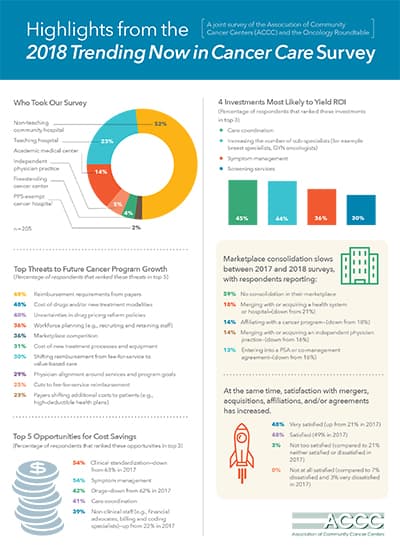
The 2018 Trending Now in Cancer Care Survey marks the ninth year of an annual ACCC survey designed to identify current and emerging trends across U.S. cancer programs. The comprehensive survey was conducted in partnership with Advisory Board's Oncology Roundtable. More than 200 respondents from 161 organizations participated in the 2018 survey, which provides insights into nationwide developments in the business aspects of cancer care.
View Highlights
2018 Trends in Cancer Care Survey

2018 Top Challenges and Concerns

Payer reimbursement requirements and healthcare reform policy bubble to the surface as top threats. Nearly half (48 percent) name reimbursement requirements from payers, 48 percent cite cost of drugs and/or new treatment modalities, and 40 percent find uncertainties in drug pricing reform policies a top threat to future program growth.

Care coordination and symptom management identified as top opportunities for return on investment and cost savings. Proactive symptom management and improved communication between care settings can help keep patients out of the ER and reduce unnecessary hospitalizations—cutting costs and improving the patient experience.

The promise of EHRs to streamline communication and increase efficiency remains unrealized. While 69 percent of respondents report their EHRs either "significantly improved" or "somewhat improved" care coordination, nearly 70 percent say EHRs have made physician and staff workdays longer. Almost half (49 percent) feel that EHRs have had a negative impact on provider-patient interactions.

Patients are refusing treatment due to high costs. Nearly half (49 percent) have had a cancer patient refuse treatment because of financial worries in the past year; 79 percent report being “very concerned” or “somewhat concerned” about this trend.

Precision medicine and immunotherapy challenges. Insurance coverage (68 percent) and payer reimbursement requirements (63 percent) hinder survey respondents' ability to conduct biomarker testing. Nearly three-fourths (72 percent) report that cost and reimbursement are the greatest challenges to offering immunotherapy treatments.

The full 2018 Trending Now in Cancer Care Survey is available to ACCC members only.

Log In to Read Full Report

If you have any questions about the survey, please contact Provider Resources.

PODCASTS

[MINI-PODCAST] Ep 64: A Summer of Disconnect for Cancer Professionals

Jul 20, 2021

In this episode, we focus on the mental and emotional toll that COVID-19 continues to have on cancer care professionals—while much of the public experiences a 'summer of joy' due to rising vaccinations.

[PODCAST] Ep 61: CLL Patient Education in Transitional Times

Jun 29, 2021

As the COVID-19 pandemic recedes and restrictions loosen for most of the U.S., we'll discuss how patient education has become even more critical during this transition.

[MINI-PODCAST] Ep 59: Collaboration and Innovation in the Time of COVID-19

May 25, 2021

We’ll delve into the dramatic changes in care delivery that Montefiore Health System underwent during the pandemic, lessons learned along the way that can help pave the way forward, and how the spirit of collaboration and innovation that emerged in 2020 will remain long after the pandemic.

[MINI-PODCAST] Ep 58: Impact of COVID-19 on Revenue Optimization

May 18, 2021

Explores the impact of the COVID-19 pandemic on the financial health of cancer programs and practices across the country, from lower patient volume and screening interventions and decreased revenue streams.

[PODCAST] Ep 03: Why Comprehensive Cancer Care Services Matter

Aug 28, 2019

On this episode of CANCER BUZZ, learn how cancer programs are finding ways to justify and implement services that are vital to truly “whole-person” cancer care.

[PODCAST] Ep 02: Fostering Cancer Care Team Resiliency & Well-Being

Jul 31, 2019

Learn how organizations like Vidant Health and The Outer Banks Hospital are creating a healthier, more rewarding workplace by making employee wellness a strategic priority.

[PODCAST] Ep 01: Zeroing In On Symptom Management

Jun 26, 2019

In this episode, Tina Curtis and Elizabeth Malosh of the Froedtert & the Medical College of Wisconsin Clinical Cancer Center at Froedtert Hospital Campus talk about why and how their program decided to launch its 24-Hour Cancer Clinic in 2016.

OUR SUPPORTER

Pfizer Oncology Logo