
ACCC association of cancer care centers
Join/Renew
Login
Join/Renew
Login
Education & Resources
ACCC eXchange LogInCorporate Member Sponsored ResourcesPresentations & AbstractsPresident's ThemeACCC Connect eLearning LogIn
Publications
Oncology IssuesPatient Assistance & Reimbursement GuideTrending Now in Cancer Care
Events
2026 ACCC Leadership SummitAnnual Meeting & Cancer Center Business SummitCapitol Hill DayNational Oncology ConferenceOncology Reimbursement MeetingsOncology State Society Meetings
Policy & Advocacy
2024 Policy Wrap-Up and ACCC 2025 Policy PrioritiesLetters & StatementsAccess, Payment & Reimbursement ReformWhite Bagging & Brown BaggingAdvocacy ResourcesCancer Moonshot
Membership
Join | RenewWho We AreMembership Types & BenefitsCorporate MembersACCC Member Portal FAQMember Directory
Partners
Oncology State SocietiesPartner OrganizationsCME
News
News ReleasesAdvocacy News ReleasesOncology News
About ACCC
Timeline / 50th Anniversary2025 Impact ReportACCC Innovator AwardsACCC FellowsACCC Senior Staff
Breast CancerMetastatic Breast Cancer
Gastrointestinal CancerBiliary Tract CancerColorectal CancerGastric CancerLiver Cancer
Genitourinary CancerBladder CancerProstate CancerRenal Cell Carcinoma
Gynecologic CancerOvarian Cancer
Head & Neck Cancer
Hematologic MalignanciesAcute Lymphocytic Leukemia (ALL)Acute Myeloid Leukemia (AML)Chronic Lymphocytic Leukemia (CLL)Mantle Cell Lymphoma (MCL)Multiple Myeloma (MM)Myelodysplastic Syndromes (MDS)
Lung CancerNon-Small Cell Lung Cancer (NSCLC)Small Cell Lung Cancer (SCLC)
Sarcoma
Skin CancerMelanomaNon-Melanoma Skin Cancers (NMSC)
Clinical Practice & TreatmentCancer DiagnosticsCare CoordinationEHR Integration for Biomarker TestingQuality Improvement Collaboration: Integration of Precision Medicine in Community OncologyTreatment
Financial NavigationFAN Boot CampFinancial Advocacy Network (FAN) Resource LibraryPatient Assistance & Reimbursement GuidePrior Authorization
Health Equity & Access3, 2, 1, Go! Practical Solutions for Addressing Cancer Care DisparitiesAppalachian Community Cancer AllianceOncology Advanced PractitionersPersonalizing Care for Patients of All BackgroundsSocial Drivers of Health
Patient-Centered CareAddressing Care Disparities for VeteransAdolescent and Young Adult (AYA)Care Action Plans for People with CancerDermatologic ToxicitiesEmpowering CaregiversGeriatric OncologyHealth LiteracyNutritionOncology PharmacyPatient NavigationPsychosocial Care in OncologyShared Decision-MakingSupportive CareSurvivorship Care
Practice Management & OperationsCancer Program FundamentalsLeadership Sustainment and Engagement VideosOncology Practice Transformation and Integration CenterOncology Team Resiliency
ResearchACCC Community Oncology Research Institute (ACORI)
Technology & InnovationTelehealth & Digital Medicine
ACCCBuzz Blog
CANCER BUZZ Podcast
Oncology Issues
Join/Renew
Login
Breast CancerMetastatic Breast Cancer
Gastrointestinal CancerBiliary Tract CancerColorectal CancerGastric CancerLiver Cancer
Genitourinary CancerBladder CancerProstate CancerRenal Cell Carcinoma
Gynecologic CancerOvarian Cancer
Head & Neck Cancer
Hematologic MalignanciesAcute Lymphocytic Leukemia (ALL)Acute Myeloid Leukemia (AML)Chronic Lymphocytic Leukemia (CLL)Mantle Cell Lymphoma (MCL)Multiple Myeloma (MM)Myelodysplastic Syndromes (MDS)
Lung CancerNon-Small Cell Lung Cancer (NSCLC)Small Cell Lung Cancer (SCLC)
Sarcoma
Skin CancerMelanomaNon-Melanoma Skin Cancers (NMSC)
Clinical Practice & TreatmentCancer DiagnosticsCare CoordinationEHR Integration for Biomarker TestingQuality Improvement Collaboration: Integration of Precision Medicine in Community OncologyTreatment
Financial NavigationFAN Boot CampFinancial Advocacy Network (FAN) Resource LibraryPatient Assistance & Reimbursement GuidePrior Authorization
Health Equity & Access3, 2, 1, Go! Practical Solutions for Addressing Cancer Care DisparitiesAppalachian Community Cancer AllianceOncology Advanced PractitionersPersonalizing Care for Patients of All BackgroundsSocial Drivers of Health
Patient-Centered CareAddressing Care Disparities for VeteransAdolescent and Young Adult (AYA)Care Action Plans for People with CancerDermatologic ToxicitiesEmpowering CaregiversGeriatric OncologyHealth LiteracyNutritionOncology PharmacyPatient NavigationPsychosocial Care in OncologyShared Decision-MakingSupportive CareSurvivorship Care
Practice Management & OperationsCancer Program FundamentalsLeadership Sustainment and Engagement VideosOncology Practice Transformation and Integration CenterOncology Team Resiliency
ResearchACCC Community Oncology Research Institute (ACORI)
Technology & InnovationTelehealth & Digital Medicine
ACCCBuzz Blog
CANCER BUZZ Podcast
Oncology Issues
    • Education & Resources
    • Publications
    • Events
    • Policy & Advocacy
    • Membership
    • Partners
    • News
    • About ACCC
ACCC association of cancer care centers
1801 Research Boulevard, Suite 400, Rockville, MD 20850
Tel: 301.984.9496 Fax: 301.770.1949 Email Us
Contact UsVolunteers
Advertise
Career Center
Terms and Conditions
Privacy Policy
ACCC Rebranding
Copyright © 2026 Association of Cancer Care Centers. All Rights Reserved.
Advertisement
Home / Education And Resources / Patient Centered Care / Geriatric / Age Friendly Health Systems Oncology Action Community

AGE-FRIENDLY HEALTH SYSTEMS: ONCOLOGY ACTION COMMUNITY

Three factors that impact caring for older adults in the United States today are occurring simultaneously. Together the factors make a compelling case for cancer providers to better support the needs of older adults and caregivers:

  • Demography: The number of adults over the age of 65 is projected to double over the next 25 years.
  • Complexity: Approximately 80 percent of older adults have at least one chronic disease, and 77 percent have at least two. Many of our health systems are ill-equipped to deal with the social complexity many older adults face.
  • Disproportionate Harm: Older adults have higher rates of health care utilization as compared to other age groups and experience higher rates of health care-related harm, delay, and discoordination. One consequence of this is a rate of ED utilization that is four times that of younger populations.

Becoming an Age-Friendly Health System entails reliably providing a set of specific, evidence-based geriatric best practice interventions to all older adults in your health system. This is achieved primarily through redeploying existing health system resources to achieve:

  • Better health outcomes for this population;
  • Reduced waste associated with low-quality services;
  • Increased utilization of cost-effective services for older adults; and
  • Improved reputation and market share with a rapidly growing population of older adults.

The 4Ms Framework of Age-Friendly Care

The 4Ms — What Matters, Medication, Mentation, and Mobility — make care of older adults that can be complex, more manageable. The 4Ms identify the core issues that should drive all care and decision making with the care of older adults. They organize care and focus on the older adult’s wellness and strengths rather than solely on disease. The 4Ms are relevant regardless of an older adult’s individual disease(s). They apply regardless of the number of functional problems an older adult may have, or that person’s cultural, ethnic, or religious background.

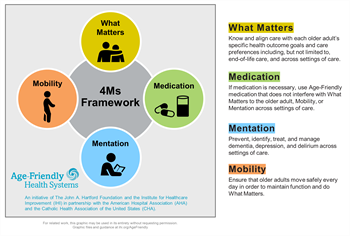
The 4Ms are a framework, not a program, to guide all care of older adults wherever and whenever they touch your cancer program’s care and services. The intention is to incorporate the 4Ms into existing care, rather than layering them on top, to organize the efficient delivery of effective care.

In 2020, the COVID-19 pandemic has put an increased burden on older adults, families, and staff in health systems. Perhaps especially during this challenging time, we have found that the 4Ms can reduce burden on care teams by providing an organizing framework to focus on the most critical care for older adults.

Age-Friendly Health Systems practice the 4Ms in every interaction with older adults. IHI recognizes care locations, such as hospitals, practices, retail-clinics, and nursing homes as Age-Friendly when they share a description of how they assess, document, and act on each of the 4Ms.

Download this one-pager to learn more and share with your colleagues.
Related Resources

  • Guide to Using the 4Ms (IHI)
  • Geriatric Oncology Gap Assessment Tool (ACCC)
  • Practical Application of Geriatric Assessment: A How-To Guide for the Multidisciplinary Team (ACCC)
  • Multidisciplinary Approaches to Caring for Older Adults with Cancer (ACCC)

From the ACCCBuzz Blog

Age-Friendly Health Systems_ACCCBuzz_Square

First Oncology-Focused, Age-Friendly Health Systems Action Community

Mar 28th 2023

The U.S. population is aging. So ACCC—in partnership with the Institute for Healthcare Improvement (IHI)—developed the Oncology Action Community to help participating cancer programs and practices become age-friendly health systems.

Finger Stacking Healthcare Blocks

Converging Goals: Public Health & the Cancer Moonshot Initiative

Sep 22nd 2022

On September 16, the National Comprehensive Cancer Network convened experts and stakeholders in D.C. for a policy summit spotlighting today’s cancer screening and prevention landscape. Learn what speakers discussed, including what changes need to happen to create an equitable future for all people at risk—or not—for cancer.
Ovarian Cancer Awareness_ACCCBuzz

Enhancing Advanced Ovarian Cancer Care Delivery

Aug 30th 2022

September is Ovarian Cancer and Gynecologic Cancer Awareness Month. In recognition, ACCC shares how its Barriers to Quality Care in Ovarian Cancer Phase II will test the model developed in the previous phase to optimize care for patients with advanced epithelial ovarian cancer.