Emotional distress and mental health for patients and caregivers can greatly impact quality of life, treatment outcomes, and even the cost of care. While progress has been made with distress screening, finding effective and efficient practice solutions to address these needs can tax the care delivery system and contribute to staff stress and burnout.
To help its membership address access and delivery of psychosocial services, on March 8, 2023 ACCC hosted a multistakeholder summit in partnership with The American Psychosocial Oncology Society (APOS) and The Association of Oncology Social Work (AOSW) focused on psychosocial care delivery in oncology to:

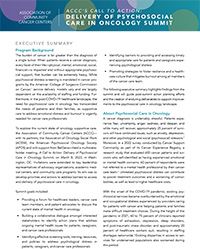
Invitees included individuals from across the multidisciplinary psychosocial cancer care team, including key leadership representatives of advocacy organizations, licensed clinical social workers (LCSWs), licensed independent clinical social workers (LICSWs), clinical psychologists, board of oncology certified social workers (OSW-Cs), nurses, advanced practice providers (APPs), and one physician. After a day rich in discussion and interaction, the group came together to identify a series of action items that, if enacted, could create impactful change in the delivery of psychosocial care in oncology.
ACCC is proud to showcase this collaborative art project on mental health awareness and psychosocial care in oncology, sponsored by BeiGene, which debuted early this month at the 40th National Oncology Conference in Austin, Texas. Attendees had great fun coloring the mural and interacting with each other on such an important topic.

This installment of Oncology Issues emphasizes collaboration, whether between oncology and other medical specialties, between surgeons, or between the cancer care community and policy makers.

ACCC is excited to share its new provider resources for TIL cell therapy, including a referral readiness checklist, patient pathway guide, and white paper with tangible steps for improving access.

In recognition of the importance of mental well-being and mental health services, ACCC highlights 3 thought leadership pieces featured in recent volumes of Oncology Issues that tackle mental health–forward interventions for both patients and providers.

Supporting AYAs with cancer truly takes a village. Multidisciplinary collaboration, community partnerships, survivorship champions, and patient voices are all essential to building programs that meet the needs of this diverse population.
ACCC recognizes August 1st as World Lung Cancer Day through its past Innovator Award winners.

Discover recommendations for cancer care providers to improve care quality and outcomes for patients with acute myeloid leukemia who do not receive a transplant.
Lipson Cancer Institute adapted the University of Washington’s Collaborative Care model to embed counseling services into oncology and palliative care across 6 clinic locations.
Caregivers experience higher levels of financial, emotional, and physical health difficulties than non-caregivers and are more likely to suffer from depressive symptoms and mental health problems. The Caregivers Clinic at Memorial Sloan Kettering Cancer Center is the first of its kind and provides comprehensive psychosocial care to family members and friends of patients who experience significant distress and burden because of their caregiving role.

The Ohio State University's Cancer and Aging Resilience (CARE) Clinic goes beyond reviewing cancer-specific treatment. This new care model pairs patients with a multidisciplinary team to assess patients for balance, cognition, nutrition, symptom management, and many more—all in one visit.

We proposed creating an online video support group to enable patients with cancer who would otherwise have difficulty attending such groups to participate virtually.

In partnership with American Psychosocial Oncology Society and Association of Oncology Social Work.


Breaking down the social stigma that is often still associated with seeking mental health services is key to making cancer care clinicians and staff feel a "sense of safety" and that they will not be penalized for accessing mental health services.
The Collaborative Care Model uses the stepped care approach, enabling a flexible and personalized treatment approach that aligns with each patient’s specific needs.

Virginia Cancer Research Institute successfully implemented a cutting-edge clinical trials navigation program that improved the patient and provider experience and demonstrated a significant return on investment.

Training in community-based psychological first aid is a promising intervention that promotes adaptive functioning by instilling individuals with the knowledge and skills necessary to support oneself and others when stressful events occur.
This project was made possible with support from BeiGene, USA.