
ACCC association of cancer care centers
Join/Renew
Login
Join/Renew
Login
Education & Resources
ACCC eXchange LogInCorporate Member Sponsored ResourcesPresentations & AbstractsPresident's ThemeACCC Connect eLearning LogIn
Publications
Oncology IssuesPatient Assistance & Reimbursement GuideTrending Now in Cancer Care
Events
2026 ACCC Leadership SummitAnnual Meeting & Cancer Center Business SummitCapitol Hill DayNational Oncology ConferenceOncology Reimbursement MeetingsOncology State Society Meetings
Policy & Advocacy
2024 Policy Wrap-Up and ACCC 2025 Policy PrioritiesLetters & StatementsAccess, Payment & Reimbursement ReformWhite Bagging & Brown BaggingAdvocacy ResourcesCancer Moonshot
Membership
Join | RenewWho We AreMembership Types & BenefitsCorporate MembersACCC Member Portal FAQMember Directory
Partners
Oncology State SocietiesPartner OrganizationsCME
News
News ReleasesAdvocacy News ReleasesOncology News
About ACCC
Timeline / 50th Anniversary2025 Impact ReportACCC Innovator AwardsACCC FellowsACCC Senior Staff
Breast CancerMetastatic Breast Cancer
Gastrointestinal CancerBiliary Tract CancerColorectal CancerGastric CancerLiver Cancer
Genitourinary CancerBladder CancerProstate CancerRenal Cell Carcinoma
Gynecologic CancerOvarian Cancer
Head & Neck Cancer
Hematologic MalignanciesAcute Lymphocytic Leukemia (ALL)Acute Myeloid Leukemia (AML)Chronic Lymphocytic Leukemia (CLL)Mantle Cell Lymphoma (MCL)Multiple Myeloma (MM)Myelodysplastic Syndromes (MDS)
Lung CancerNon-Small Cell Lung Cancer (NSCLC)Small Cell Lung Cancer (SCLC)
Sarcoma
Skin CancerMelanomaNon-Melanoma Skin Cancers (NMSC)
Clinical Practice & TreatmentCancer DiagnosticsCare CoordinationEHR Integration for Biomarker TestingQuality Improvement Collaboration: Integration of Precision Medicine in Community OncologyTreatment
Financial NavigationFAN Boot CampFinancial Advocacy Network (FAN) Resource LibraryPatient Assistance & Reimbursement GuidePrior Authorization
Health Equity & Access3, 2, 1, Go! Practical Solutions for Addressing Cancer Care DisparitiesAppalachian Community Cancer AllianceOncology Advanced PractitionersPersonalizing Care for Patients of All BackgroundsSocial Drivers of Health
Patient-Centered CareAddressing Care Disparities for VeteransAdolescent and Young Adult (AYA)Care Action Plans for People with CancerDermatologic ToxicitiesEmpowering CaregiversGeriatric OncologyHealth LiteracyNutritionOncology PharmacyPatient NavigationPsychosocial Care in OncologyShared Decision-MakingSupportive CareSurvivorship Care
Practice Management & OperationsCancer Program FundamentalsLeadership Sustainment and Engagement VideosOncology Practice Transformation and Integration CenterOncology Team Resiliency
ResearchACCC Community Oncology Research Institute (ACORI)
Technology & InnovationTelehealth & Digital Medicine
ACCCBuzz Blog
CANCER BUZZ Podcast
Oncology Issues
Join/Renew
Login
Breast CancerMetastatic Breast Cancer
Gastrointestinal CancerBiliary Tract CancerColorectal CancerGastric CancerLiver Cancer
Genitourinary CancerBladder CancerProstate CancerRenal Cell Carcinoma
Gynecologic CancerOvarian Cancer
Head & Neck Cancer
Hematologic MalignanciesAcute Lymphocytic Leukemia (ALL)Acute Myeloid Leukemia (AML)Chronic Lymphocytic Leukemia (CLL)Mantle Cell Lymphoma (MCL)Multiple Myeloma (MM)Myelodysplastic Syndromes (MDS)
Lung CancerNon-Small Cell Lung Cancer (NSCLC)Small Cell Lung Cancer (SCLC)
Sarcoma
Skin CancerMelanomaNon-Melanoma Skin Cancers (NMSC)
Clinical Practice & TreatmentCancer DiagnosticsCare CoordinationEHR Integration for Biomarker TestingQuality Improvement Collaboration: Integration of Precision Medicine in Community OncologyTreatment
Financial NavigationFAN Boot CampFinancial Advocacy Network (FAN) Resource LibraryPatient Assistance & Reimbursement GuidePrior Authorization
Health Equity & Access3, 2, 1, Go! Practical Solutions for Addressing Cancer Care DisparitiesAppalachian Community Cancer AllianceOncology Advanced PractitionersPersonalizing Care for Patients of All BackgroundsSocial Drivers of Health
Patient-Centered CareAddressing Care Disparities for VeteransAdolescent and Young Adult (AYA)Care Action Plans for People with CancerDermatologic ToxicitiesEmpowering CaregiversGeriatric OncologyHealth LiteracyNutritionOncology PharmacyPatient NavigationPsychosocial Care in OncologyShared Decision-MakingSupportive CareSurvivorship Care
Practice Management & OperationsCancer Program FundamentalsLeadership Sustainment and Engagement VideosOncology Practice Transformation and Integration CenterOncology Team Resiliency
ResearchACCC Community Oncology Research Institute (ACORI)
Technology & InnovationTelehealth & Digital Medicine
ACCCBuzz Blog
CANCER BUZZ Podcast
Oncology Issues
    • Education & Resources
    • Publications
    • Events
    • Policy & Advocacy
    • Membership
    • Partners
    • News
    • About ACCC
ACCC association of cancer care centers
1801 Research Boulevard, Suite 400, Rockville, MD 20850
Tel: 301.984.9496 Fax: 301.770.1949 Email Us
Contact UsVolunteers
Advertise
Career Center
Terms and Conditions
Privacy Policy
ACCC Rebranding
Copyright © 2026 Association of Cancer Care Centers. All Rights Reserved.
Advertisement
Home / Education And Resources / Clinical Practice Treatment / Care Coordination / Eliminating Precision Medicine Disparities

ELIMINATING PRECISION MEDICINE DISPARITIES

Identification of actionable biomarkers continues to drive application of precision medicine in oncology. For patients with lung cancer, molecularly targeted therapies based on expression of specific biomarkers may be potential treatment options. Only through biomarker testing can clinicians discover whether lung cancers have targetable biomarkers.

Despite increasing evidence supporting the role of biomarkers in treatment decision-making for patients with lung cancer, recent studies1-3 report that more than 70 percent of patients treated in the community do not receive biomarker testing as recommended by National Comprehensive Cancer Network (NCCN) clinical practice guidelines, and more than 50 percent of patients do not receive appropriate precision medicine therapies based on the test results.2 Among underserved patient populations, the gap is even wider.4,5 Analysis of CMS claims data has revealed that Medicaid patients are 40 percent less likely to get tested than patients with private health insurance and Medicaid patients are 30 percent less likely to receive targeted therapies after testing, compared to patients with private health insurance.4

The ACCC Eliminating Precision Medicine Disparities project is focused on understanding specific barriers and challenges to equal access to precision medicine among underserved patient communities. Through this project, ACCC seeks to:

  • Evaluate patient and provider perceptions of equity in access to biomarker testing and gaps in access to appropriate precision medicine therapies based on identification of actionable biomarkers.
  • Gather feedback from patients and healthcare providers regarding specific barriers and challenges in obtaining biomarker testing and access to precision therapies.
  • Develop interventions for both patients and providers to promote biomarkers testing for patients with lung cancer in underserved communities.

The project is guided by an expert multidisciplinary Advisory Committee. ACCC is pleased to partner with LUNGevity for the patient-facing components of this education intervention.

For more information on this project, please contact the ACCC Provider Education department.

Video Podcasts

Jun 28, 2024
In this episode, CANCER BUZZ TV speaks with Tom Lycan, DO, MHS, assistant professor of Hematology & Oncology at the Wake Forest School of Medicine, about a practical tool that can provide a care plan roadmap for providers and patients to mitigate precision medicine disparities.

Nov 11, 2021
Hear from two authors of an ACCC/LUNGevity Foundation study that identified key areas of clinician need related to biomarker testing in NSCLC.

Featured Resources

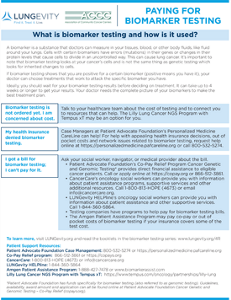
Paying for Biomarker Testing

A biomarker is a substance that doctors can measure in your tissues, blood, or other body fluids, like fluid around your lungs. Cells with certain biomarkers have errors (mutations) in their genes or changes in their protein levels that cause cells to divide in an uncontrolled way. This can cause lung cancer. It’s important to note that biomarker testing looks at your cancer’s cells and is not the same thing as genetic testing which looks for inherited changes to cells.

If biomarker testing shows that you are positive for a certain biomarker (positive means you have it), your doctor can choose treatments that work to attack the specific biomarker you have.
Download
Paying for Biomarker Testing

News & Media

Poor Oncologist-Patient Communication Adding to NSCLC Biomarker Testing Disparities, Survey Finds

Precision Oncology News
Feb 28th 2022

Leigh M. Boehmer, PharmD, on Real-World Inequities in NSCLC Biomarker Testing

MedPage Today
Feb 4th 2022

Overcoming Barriers to Genomic Testing in Community Care Settings

Contemporary OB/GYN
Nov 3rd 2021

Overcoming Barriers to Genomic Testing in Community Care Settings

Targeted Oncology
Nov 2nd 2021

Survey Examines Oncology Clinician Perceptions of Biomarker Testing for Underserved Patients With Lung Cancer

The ASCO Post
Sep 15th 2021

Lung Cancer Biomarker Testing Survey Reveals Access Gaps, Attitudes in Community, Academic Practices

Precision Oncology News
Sep 15th 2021

Minority of Clinicians Understand, Use Biomarker Guidelines in NSCLC Treatment or Patient Discussions

WCLC Meeting News
Sep 14th 2021

Association of Community Cancer Centers Releases Report at IASLC 2021

ACCC
Sep 13th 2021

Biomarker testing decisions for lung cancer vary between academic, community oncologists

Healio
Sep 11th 2021

From Oncology Issues

Biomarker Testing in Patients With Non-Small Cell Lung Cancer

Biomarker Testing in Patients With Non-Small Cell Lung Cancer

Leigh M. Boehmer, PHARMD, BCOP; Upal Basu Roy, PHD, MPH; Janelle Schrag, MPH; Nikki Martin, MA; Alexandra Howson, PHD; Latha Shivakumar, PHD, CHCP; Brad Coleman, PMP; and Greg Salinas, PHD

While recent advances in precision medicine have substantially changed the management of lung cancer, care must be taken to ensure that these advances do not worsen health disparities. This study included a case component that divided overall respondents into two cohorts to observe how patient characteristics, such as age, socio-economic status, race/ethnicity, and health literacy, affected the likelihood of ordering biomarker testing.

Patient Perceptions of Biomarker Testing

Patient Perceptions of Biomarker Testing

Nikki Martin, MA; Lisa Dropkin; Lydia Redway; Mariel Molina; Janelle Schrag, MPH; Latha Shivakumar, PhD, CHCP; Leigh M. Boehmer, PharmD, BCOP; and Upal Basu Roy, PhD, MPH

As precision medicine becomes more common in the management of lung cancer, little is understood about the patient experience with biomarker testing, particularly of underserved patients. This study used survey and focus group methodology to determine patient perspectives on the educational needs within this community.

Appendix A: Patient Survey

Appendix B: Focus Group Guide

Abstracts and Presentations

[Abstract 123] Identifying barriers to equitable biomarker testing in underserved patients with NSCLC: A mixed-methods study to inform quality improvement opportunities

[Abstract 123] Identifying barriers to equitable biomarker testing in underserved patients with NSCLC: A mixed-methods study to inform quality improvement opportunities

Sep 24th 2021

Presented at the 2021 ASCO Quality Care Symposium, September 24 - 25, 2021.

[Abstract] A United States study focused on patients' understanding of, attitudes towards, and barriers to the use of biomarker testing for NSCLC

[Abstract] A United States study focused on patients' understanding of, attitudes towards, and barriers to the use of biomarker testing for NSCLC

Sep 10th 2021

Presented at the IASLC 2021 World Conference on Lung Cancer, September 8-14, 2021

Interactive eCourse

Health Literacy Best Practices for Lung Cancer Biomarkers

Now available is a 30-minute eCourse for members of the multidisciplinary cancer care team on how to use consistent, evidence-based health literacy best practices as it relates to lung cancer biomarker testing. Complete “Health Literacy Best Practices for Lung Cancer Biomarkers” to gain a lexicon of health terminology that resonates with patients and their caregivers and access downloadable resources about health literacy and biomarkers.

Register Now

References

  1. Gutierrez ME, Choi K, Lanman RB, et al. Genomic profiling of advanced non-small cell lung cancer in community settings: gaps and opportunities. Clin Lung Cancer. 2017;18(6):651-659.
  2. Mason C, Ellis PG, Lokay K, et al. Patterns of biomarker testing rates and appropriate use of targeted therapy in the first-line, metastatic non-small cell lung cancer treatment Setting. J Clin Pathw. 2018;(1):49–54.
  3. Audibert CM, Shea MB, Glass DJ, et al. Trends in the molecular diagnosis of lung cancer: results from an online market research survey. Washington, DC: Friends of Cancer Research; 2018.
  4. Palazzo LL, Sheehan DF, Tramontano AC, et al. Disparities and trends in genetic testing and erlotinib treatment among metastatic non-small cell lung cancer patients. Cancer Epidemiol Biomark Prev. 2019;28(5):926-934.
  5. Wong W, Wu N, et al. ALK testing trends and patterns among community practices in the United States. JCO Precis Oncol. 2018;2:1-11.