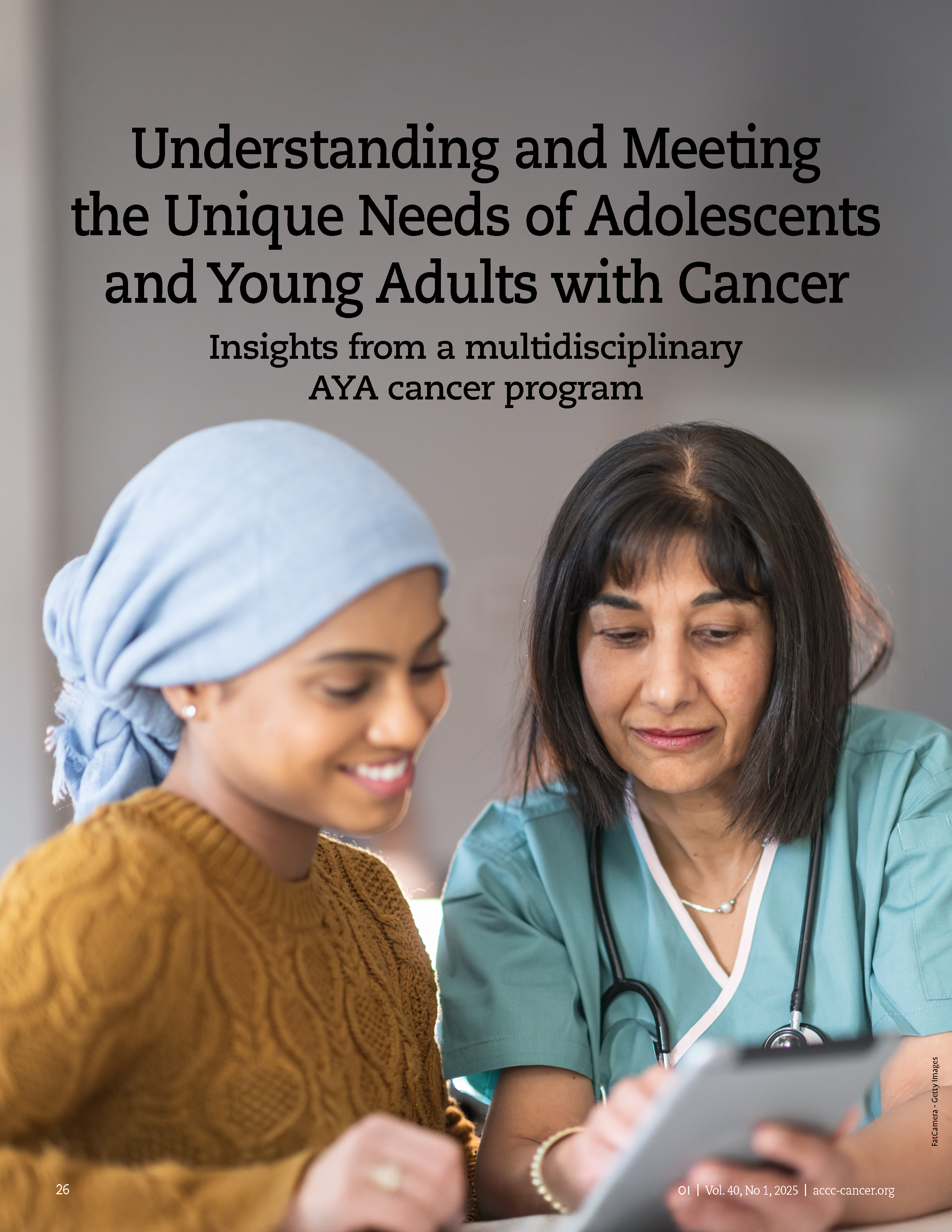
National Comprehensive Cancer Network (NCCN) Guidelines define an adolescent and young adult (AYA) oncology patient as an individual between 15 and 39 years of age at the time of initial diagnosis. These guidelines state that AYAs develop different cancers than other age groups; this patient population also has unique needs around treatment and survivorship.
According to NCCN more than 700,000 AYAs are diagnosed with cancer annually in the U.S., accounting for 5 out of 100 new cancer diagnoses and 2 out of 100 cancer deaths.
The American Cancer Society calls attention to issues that can uniquely affect young adults with cancer including:
Several recent studies report a continued increase in diagnosis of colorectal cancer in individuals younger than age 50 in the U.S., and that younger adults are being diagnosed with more advanced disease.1-3
A recent observational study by Sung and colleagues found increased risk of obesity-linked cancer in the younger adult population. Researchers found that individuals born around 1985 had a 2 to 5 times increased risk for kidney, gallbladder, pancreatic, and endometrial cancers—almost double the risk for colorectal cancer and about 1.5 times the risk for multiple myeloma--compared to those born around 1950.4
Explore resources from ACCC to help cancer care providers better serve the unique needs of AYA patients with cancer:
From mental health concerns to fertility preservation, adolescents and young adults with cancer require a specialized approach to treatment and survivorship care. In honor of Childhood Cancer Awareness Month, ACCC highlights a pivotal program from the University of North Carolina Lineberger Comprehensive Cancer Center and resources that meet the critical needs of these patients.

Childhood cancer, although rare, remains the leading cause of death by disease in children under the age of 15 years. Despite its rarity, the impact of the disease in young people is long-lasting, with challenges extending well beyond the completion of treatment.

ACCC recognizes July as Sarcoma and Bone Cancer Awareness Month.

The rising costs of anti-cancer treatment in the United States have placed adolescents and young adults with cancer at an increased risk for financial toxicity.

ACCC convened its members, sponsors, and industry partners in person (for the first time since the dawn of the COVID-19 pandemic) and online for the 48th Annual Meeting and Cancer Center Business Summit in Washington, D.C., enabling more people to participate in ways in which they were most comfortable.

Poor access to care among AYA patients is not only evident in low clinical trial enrollment. The struggle to access much-needed care continues when treatment concludes. Most AYA cancer survivors must learn to navigate follow-up medical care on their own.
Adolescents and young adults (AYAs) face poorer cancer outcomes and experiences compared with younger and older patients, and they historically have been lost between pediatric and adult models of oncology care. The Association of Cancer Care Centers (ACCC) is committed to providing up-to-date guidance on treating AYA patients with cancer to improve their outcomes. In this episode of CANCER BUZZ, a team from the University of North Carolina (UNC) AYA Oncology Program shares how it’s meeting the unique needs of this patient population by providing developmentally appropriate cancer care through a multidisciplinary approach, including clinical trial access and interactive infusion space; sharing resources where AYAs need additional support; and developing education about fertility and the short- and long-term impacts of cancer.
Laura Holmes Haddad shares how her battle with breast cancer changed her perception of the resources available to younger adults with cancer, and what cancer programs can do to meet their needs.
1. Virostko J, Capasso A, Jankeelov TE, Goodgame B. Recent trends in the age at diagnosis of colorectal cancer in the US National Cancer Data Base, 2004-2015. Cancer. 2019;125(21):3828-3835.
2. Siegel RL, Miller KD, Fedewa SA, et al. Colorectal cancer statistics, 2017. CA Cancer J Clin. 2017;67:177-193.
3. American Cancer Society: Key statistics for colorectal cancer. Available at cancer.org/colon-rectal-cancer/about/key-statistics.html.
4. Sung H, Siegel RL, Rosenberg PS, Ahmedin J. Emerging cancer trends among young adults in the USA: analysis of a population-based cancer registry. Lancet Pub Health. 2019;4(3):PE137-E147.