Approximately 85% of all patients with cancer are diagnosed and treated in community settings. Despite this, only 3% of those patients are enrolled in clinical trials. Inadequate time, infrastructure, resources, incentives, and reimbursement all contribute to this sparse participation rate.
To address this disparity, the ACCC Community Oncology Research Institute (ACORI) was launched in 2021. ACORI’s mission is to establish clinical trials as a standard of care for all patients, regardless of where they are treated, by helping community oncology programs access the tools, knowledge sharing, effective practices, and peer mentorships that can increase their ability to offer clinical trials.
We advocate for equal representation within clinical trials to trial sponsors and regulatory agencies. ACORI will develop education and resources that promote strategies and solutions to facilitate clinical trial accessibility, as we investigate persistent areas of disparities in cancer clinical trial participation.
ACORI utilizes ACCC know-how to build capacity and competency among community research programs to make them research-ready by democratizing knowledge, skills, and infrastructure for clinical research. We will also facilitate mentorship opportunities between established and developing research programs and convene community oncology stakeholders for peer-to-peer learning and networking.
ACORI is a primary resource for academic and industry sponsors that fosters relationships with trial sponsors and other research groups. The Institute vets research and trial opportunities and disseminates pertinent opportunities to interested community oncology research programs.
Explore practical approaches to expanding access to cancer clinical trials and strengthening research programs. Articles in this issue of the ACORI Research Review Newsletter highlight strategies to improve patient engagement through trial matching platforms, community partnerships, decentralized research models, culturally responsive educational resources, and site self-assessment tools. Also featured are emerging FDA policy considerations, innovations that support more efficient trial activation and enrollment, and a featured phase 3 study evaluating a new adjuvant treatment approach for early-stage triple-negative breast cancer.
A forum dedicated to making oncology clinical trials a standard of care. ACCC members can join the ACORI Research Community to:
ACORI hosts live summits that convene key stakeholders to discuss challenges in ensuring equitable access to clinical trials and addressing issues that impact community cancer centers' ability to conduct effective clinical research.
Held in October 2024, the Community Oncology Inclusive Clinical Trial Design Summit outlined a comprehensive strategy to improve inclusion in oncology trials. Key stakeholders in cancer care generated ideas for action items to make cancer care research more inclusive, efficient, and patient-centered. These discussions included aligning eligibility criteria with real-world populations, integrating AI into clinical trial design and operations, utilizing advanced practice providers (APPs) in clinical research, and innovative/decentralized trial designs to improve access and participation.
Held September 13-14, 2021, in collaboration with Stand Up to Cancer, the ACORI Call to Action Summit: Activating Equity in Community Oncology Research identified concrete strategies for engaging patients, caregivers, and their communities to strengthen oncology research. More than 120 people from 60 organizations generated 200+ ideas for action items to make cancer care research more diverse, equitable, and accessible.
To help standardize understanding of baseline knowledge across cancer care teams, we’ve created this digital glossary of clinical research terms. We hope it will serve as a tool to improve patient education and encourage shared decision-making conversations.
In 2022, adapted from a Duke University program pioneered by ACCC President Nadine Barrett, PhD, a course was developed for all members of the cancer care team to better understand the universal nature of implicit and conscious bias in cancer research and clinical trials. This online implicit bias training program that presents the broader context of structural and systemic racism, the role of implicit bias in clinical trial selection, vignettes with real-world examples of implicit bias, and guidance for mitigating disparities in cancer research settings.
The Just ASK™ Training Program and Training Facilitation Guide are available free-of-charge and provide a comprehensive, complementary set of tools to help research sites overcome barriers that have historically limited participation in cancer clinical trials among underrepresented racial and ethnic groups.
These resources build on the ASCO-ACCC Research Statement "Increasing Racial and Ethnic Diversity in Cancer Clinical Trials," published in May 2022, which outlines actionable steps for individual stakeholders in the cancer clinical trial ecosystem to increase diversity in research participation.

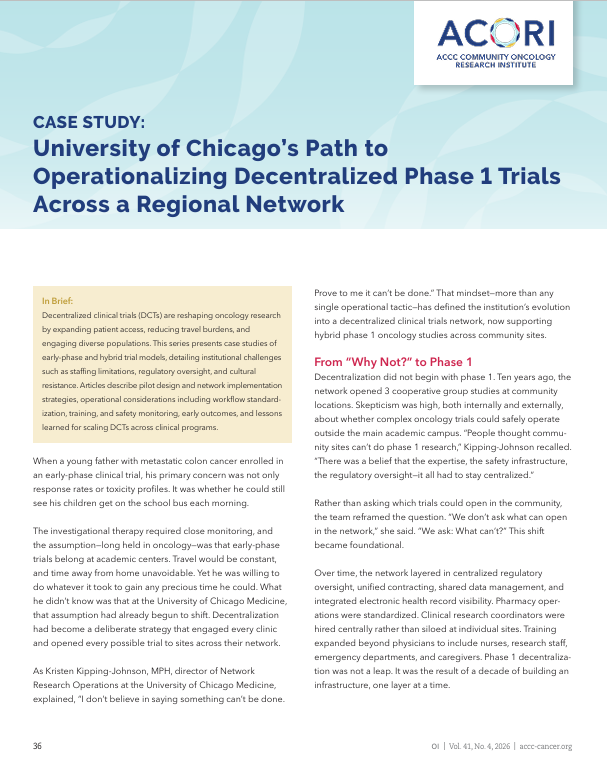
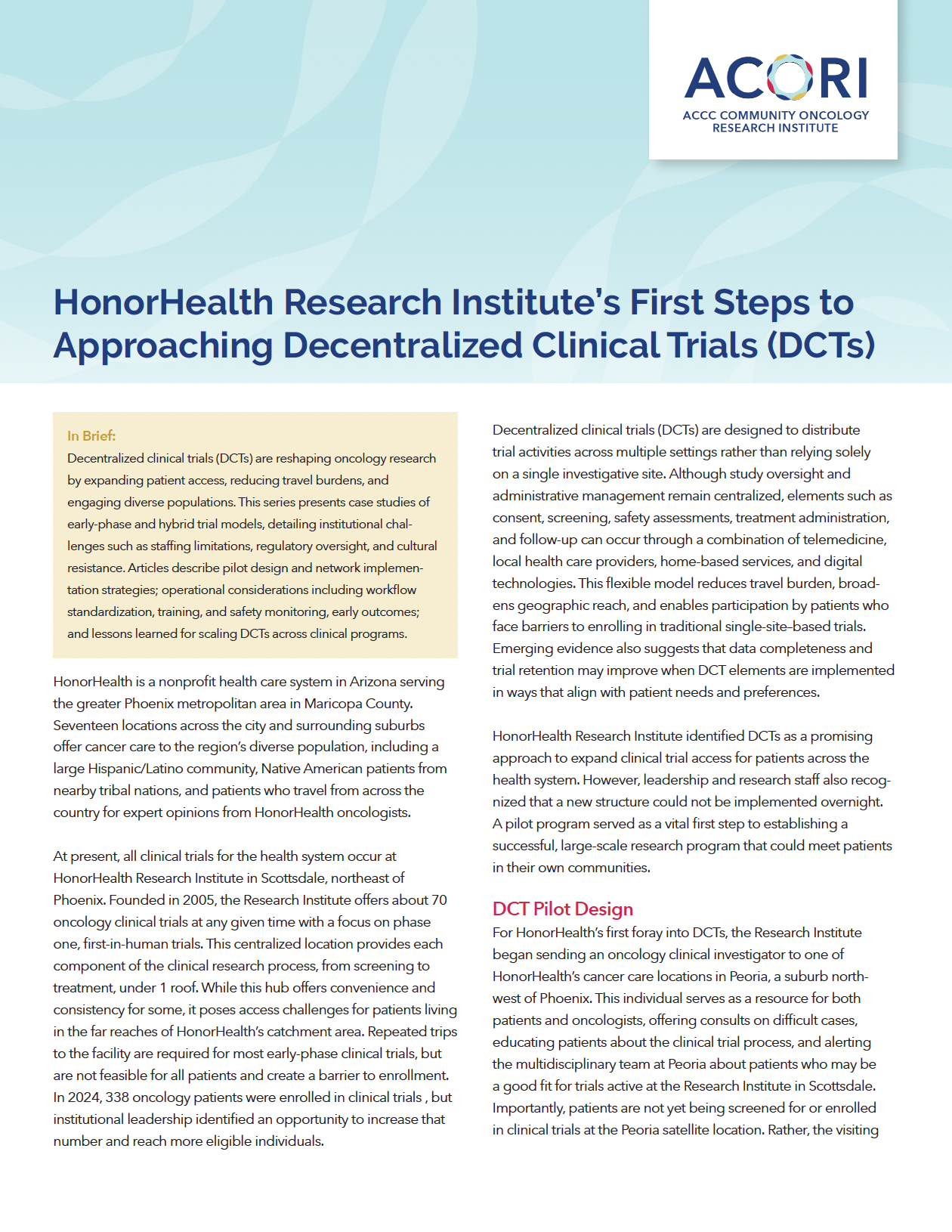
Decentralized clinical trial approaches, including remote consent, telehealth, local laboratory and imaging services, and more, can help reduce some of the many barriers that prevent eligible patients from participating in trials. But as the participants in ACCC’s Advancing Decentralized Clinical Trials in the Community Setting Roundtable Series emphasized, implementing DCT elements is not simply a matter of adopting new technology. Doing so successfully requires thoughtful workflows and oversight structures that consider equity, scalability, and sustainability.

Leaders at Mary Bird Perkins Cancer Center have rebuilt their now nationally recognized clinical trials program from the ground up, with diverse enrollment a cornerstone of their philosophy.

Recognizing the weight of the barriers to trial participation, Susan G. Komen partnered with breastcancertrials.org to develop a free clinical trials navigation e-course designed to help patient navigators better support individuals in accessing trials.

Fueled by advances in digital health technology and the growing need to address operational constraints in nonacademic settings, decentralized clinical trial designs are poised to redefine how (and where) clinical evidence is generated.
Instead of viewing clinical trials as a last resort, patients with pancreatic cancer and their oncologists are encouraged to investigate clinical trials from the start of treatment.

ACCC recognizes National Cancer Research Month.
Clinical trials are vital to offering and developing the most effective treatment options. However, there are large disparities in enrollment across race, ethnicity, geography, and type of cancer care center. Mary Bird Perkins Cancer Center in Baton Rouge, LA uses local partnerships, culturally tailored outreach, and workforce innovation to drive sustainable and equitable participation in clinical trials. Minorities now make up 21% of their clinical trial participation, surpassing the national average. Following these meaningful gains in attracting local minority populations and underserved communities to take part in clinical trials, the Mary Bird Perkins research team received a grant to further support this work. In this episode of CANCER BUZZ, Victor Lin, MD, PhD, research medical director at Mary Bird Perkins Cancer Center, shares strategies for success in their community, including awareness campaigns and partnerships. CANCER BUZZ also speaks with TaeJeanne “TJ” Taylor-Lawrence, RN, registered nurse and patient navigator, about building relationships and supporting patients in clinical trials.
On October 29-30, 2024, the ACCC Community Oncology Research Institute (ACORI) hosted the Community Oncology Inclusive Clinical Trial Design Summit in Arlington, VA. The event brought together stakeholders including academic and community cancer center practitioners and researchers, advocacy organizations, government agencies, and industry partners to discuss strategies to increase patient access to clinical trials in the community setting. Five priority areas were identified that characterize actionable strategies to promote fair and accessible clinical trial design that is representative of all patients with cancer: strengthening the clinical trial workforce, optimizing trial design, engaging communities outside of clinical trial interactions, decentralizing clinical trials, and leveraging artificial intelligence/digital health tools for increased access and efficiency.
The imPROVE study aims to bridge the gap in patient-reported outcomes (PRO) data for Black women with breast cancer by enhancing engagement with tailored electronic PROs (ePROs) and partnering with community leaders to address barriers and ensure accessibility and relevance in community cancer care settings. In this episode, CANCER BUZZ speaks with Manraj Kaur, PhD, investigator and lead faculty for research and innovation at Patient-Reported Outcomes, Value, and Experience (PROVE) center at Mass General Brigham and Andrea Pusic, MD, chief of division of plastic and reconstructive surgery, director of PROVE center at Mass General Brigham, and professor of surgery at Harvard Medical School about the imPROVE study’s efforts to enhance Black women’s engagement in ePROs in breast cancer treatment. Dr. Kaur sheds light on strategies to improve technology accessibility for Black women in their cancer care center by providing iPads and refined usability features on the imPROVE app. Dr. Pusic highlights imPROVE implementation results at five community cancer centers, including utilizing local champions and equitable access to resources.
Immunotherapy and targeted therapies have transformed the way patients are treated and allow more patients than ever before to survive stage IV diagnoses. Other key advancements in oncology being prioritized in Puerto Rico today include early detection and prevention efforts. However, a lack of education, access, and health insurance coverage often prevents community members from timely cancer screenings. The same factors contribute to a lack of diversity in clinical trials, as noted by Dr. Marcia Cruz-Correa. Both these important issues require a community-based approach, through building advisory groups, working with local oncologists, and reaching community members where they are in a way they understand.
Expanding access to clinical trials in community oncology settings is essential to improving diversity, equity, and inclusion in cancer research. In this episode, CANCER BUZZ speaks with clinical research coordinator, Oluwakemi “Kemi” Oladipupo, MSHS, MPH, BSN, RN, CCRP, whose cancer center recently participated in a foundational oncology clinical trials course, developed by ACCC and the Association of Clinical Research Professionals (ACRP) to help cancer programs expand availability of trials to traditionally underserved communities. Oladipupo shares how this training prepared their center for the challenges of a growing research program, the progress they’ve made, and the pivotal role of clinical research coordinators in expanding research programs and improving patient access to clinical trials.

ACCC and the Association of Clinical Research Professionals launched a pilot program aimed at expanding clinical trial access and capacity in community oncology settings.
In an effort to collaboratively and strategically reduce barriers to clinical trial participation, ACCC Community Oncology Research Institute hosted the Community Inclusive Clinical Trial Design Summit in the fall of 2024.
ACORI recently hosted the Community Oncology Inclusive Clinical Trial Design Summit to address issues limiting equitable and diverse enrollment in clinical trials.

Learn how one health care system is operationalizing the Just Ask™ implicit bias program to ensure equitable access to clinical trials.
The characteristics of 1,310 clinical trials conducted across 64 community oncology practices were reviewed to discern what factors may contribute to a trial being well-suited for the community setting. Additionally, the characteristics of trials run at community cancer centers were compared to factors that may favor an academic setting.
Oncology programs encounter many challenges when engaging in clinical trials. The Association of Cancer Care Centers’ (ACCC) Community Oncology Research Institute (ACORI) conducted a survey to gather insights about barriers to clinical trial implementation, patient recruitment, and identifying resources to support community cancer programs.
Oncology programs encounter many challenges when engaging in clinical trials. The Association of Cancer Care Centers’ (ACCC) Community Oncology Research Institute (ACORI) conducted a survey to gather insights about barriers to clinical trial implementation, patient recruitment, and identifying resources to support community cancer programs.
On October 29-30, 2024, 70+ industry leaders reviewed the landscape of clinical trial diversity and developed actionable strategies based on several key themes.
A 2022–2023 ACCC survey and 2024 interviews assessed research capacity at member sites. Selected programs received training, tools, and mentorship to strengthen clinical trial readiness and expand research activity.
This project is supported by AstraZeneca, Genentech, Gilead, Lilly, Merck, Regeneron, and Sanofi.