
Hematologic malignancies (blood cancers), which impact the normal production and function of blood cells, often begin in bone marrow where stem cells develop into white blood cells, red blood cells, or platelets. These types of cancers occur when an uncontrolled growth of abnormal cells overtakes the development of normal blood cells, interfering with the regular functions of those cells. Hematologic cancers can be classified into three categories: leukemia, lymphoma, and multiple myeloma.
Developing quality improvement programs aimed at reducing health care disparities and improving the standard of care received by patients with hematologic cancers are key priorities in ACCC's educational programming. Leverage our recent research and explore practical, actionable resources that you can implement in your cancer program today.
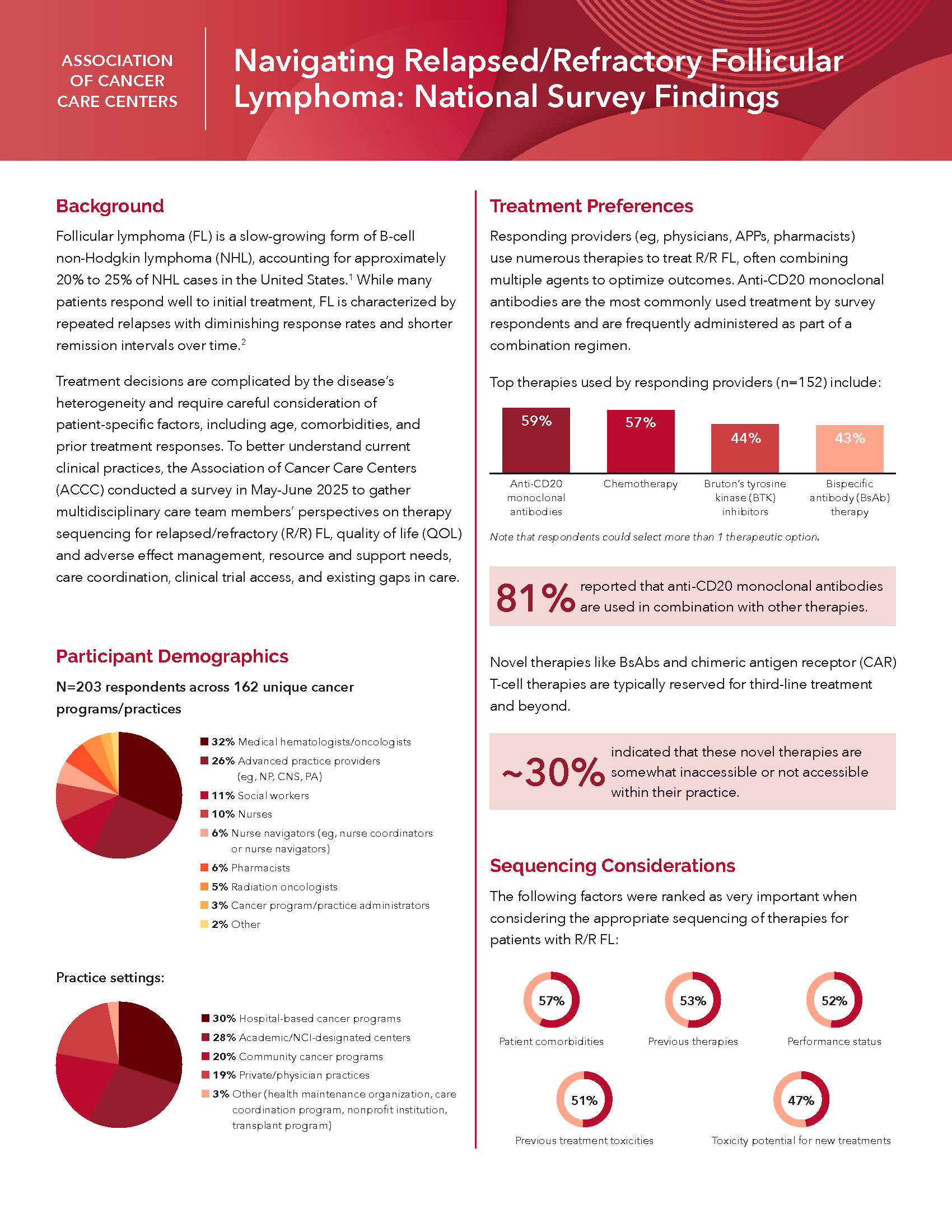
This infographic highlights real-world practice patterns, barriers, and resource needs shaping R/R FL care. Explore national survey findings on treatment sequencing, quality of life, and care coordination.
In recognition of Leukemia and Lymphoma Awareness Month, ACCC compiled a group of resources to help care teams navigate two of the most commonly diagnosed adult leukemias: acute myeloid leukemia and chronic lymphocytic leukemia.
CAR T-cell therapy is a potentially life-saving treatment for patients with certain hematologic malignancies. Yet, the logistical challenges and the need for specialized management of adverse events have limited its availability in community settings. In this episode, CANCER BUZZ speaks with Jeremy M. Pantin, MD, FACP, clinical director of the Adult Transplant and Cellular Therapy Program at TriStar Centennial Medical Center, part of the Sarah Cannon Transplant and Cellular Therapy Network. Dr. Pantin discusses the cancer center’s community-based, outpatient model, impact on outcomes for patients with hematologic malignancies, and shares his perspective on future changes needed to help further expand access to CAR T-cell therapy.
Relapsed/refractory follicular lymphoma (R/R FL) is challenging to treat, requiring thoughtful clinical decision-making during treatment selection and sequencing. In this episode, CANCER BUZZ speaks with Benjamin Heyman, MD, hematologist and clinical associate professor at City of Hope, about the importance of individualized care, shared decision-making, clinical trial referrals, and multidisciplinary collaboration. CANCER BUZZ also speaks with Laurie Adami, patient advocate with R/R FL, about her real-world experience with multiple lines of therapy, clinical trials, and patient advocacy.
In this episode, CANCER BUZZ speaks with Keri Halsema, NP, MSN, RN, nurse practitioner in the Blood Disorders Center at the University of Colorado Anschutz about the factors that influence treatment choices and the use of menin inhibitors to treat relapsed or refractory AML.
Personalized therapeutic approaches for the treatment of chronic lymphocytic leukemia (CLL), guided by shared decision-making, can improve outcomes by aligning treatment with a patient’s unique clinical profile, preferences and goals. The Association of Cancer Care Centers (ACCC) is dedicated to providing up-to-date information on CLL management and treatment strategies. In this episode, CANCER BUZZ speaks with Christopher Nelson, ACNP, MBA, certified oncology nurse practitioner at Avera Medical Group Oncology & Hematology, to explore the importance of shared decision-making and patient communication in CLL. Additionally, CANCER BUZZ speaks with Meghan McGrath, MSN, RN, AGACNP, clinical trial nurse navigator at The Leukemia and Lymphoma Society (LLS), who discusses ways to incorporate clinical trials in the shared decision-making process and LLS services that are available to support patients and providers.
Bispecific antibodies (BsAbs) have the potential to transform cancer treatment and are being actively integrated into community oncology practices. To support oncology practices as they introduce BsAbs into their treatment protocols, the Association of Cancer Care Centers (ACCC) has developed a comprehensive blueprint for this process. This resource highlights key strategies, best practices, and considerations for successful implementation. It gives guidance on capacity building, care coordination, and adverse event management, reflecting ACCC’s commitment to providing education and expanding access to this innovative treatment for patients with cancer. In this episode, CANCER BUZZ speaks with Donald Moore, PharmD, clinical oncology pharmacy manager at Atrium Health Levine Cancer, about the role of bispecific antibodies in oncology care and unique challenges associated with interdisciplinary collaboration. Dr Moore also discusses how the new Blueprint is designed to empower cancer practices to optimize the rollout of these innovative therapies.
Development of this comprehensive bispecific antibody program included policy development; toxicity management; creation of patient and staff education documents; creation of clinician tools like a toxicity scoring and charting tool and an electronic order set that segregates treatment options; and a monitoring system to safely transition patients from inpatient to outpatient care.
In this episode, CANCER BUZZ speaks with Jean Louise Koff, MD, MSc, associate professor of hematology and medical oncology at Winship Cancer Institute of Emory University, to discuss the impact of bispecific antibodies on cancer treatment outcomes, and the challenges and opportunities of integrating this innovative approach into community oncology practices.
In this episode, CANCER BUZZ speaks with Jeff Sharman, MD, medical director of hematology research, US Oncology, and director of research, Willamette Valley Cancer Institute, about the role of biomarker testing in guiding treatment decisions and how evidence-basedmanagement of treatment-related adverse events can serve this patient population.
In this episode, CANCER BUZZ speaks with Nirav Shah, MD, MSHP, associate professor of medicine at Medical College of Wisconsin and Kirollos Hanna, PharmD, BCOP, PCOP, FACCC, assistant professor of pharmacy at Mayo Clinic and director of pharmacy at Minnesota Oncology, about shared decision making in the management of relapsed or refractory mantle cell lymphoma.
In this episode, CANCER BUZZ speaks with Karen Fancher, PharmD, BCOP, clinical pharmacy specialist in oncology at University of Pittsburgh – Passavant Hospital, and Victoria Nachar, PharmD, BCOP, clinical pharmacist specialist in ambulatory hematology and adjunct clinical instructor at the University of Michigan, about strategies to address common adverse events experienced by patients with mantle cell lymphoma.
In this episode, CANCER BUZZ speaks with Jean Louise Koff, MD, MSc, associate professor at Emory University School of Medicine in Atlanta, Georgia, about fostering trust, rapport, and collaboration in the patient-provider relationship.
In this episode, CANCER BUZZ speaks with David Sallman, MD, associate member in the Department of Malignant Hematology at Moffitt Cancer Center, and Karley Trautman, DNP, ANP-BC, AGACNP-BC, senior instructor of Medical Oncology at Highlands Ranch Cancer Center, to discuss best practices in the management of anemia in low-risk MDS patients.