ACCC association of cancer care centers
Join/Renew
Login
Join/Renew
Login
Education & Resources
ACCC eXchange LogInCorporate Member Sponsored ResourcesPresentations & AbstractsPresident's ThemeACCC Connect eLearning LogIn
Publications
Oncology IssuesPatient Assistance & Reimbursement GuideTrending Now in Cancer Care
Events
2026 ACCC Leadership SummitAnnual Meeting & Cancer Center Business SummitCapitol Hill DayNational Oncology ConferenceOncology Reimbursement MeetingsOncology State Society Meetings
Policy & Advocacy
2024 Policy Wrap-Up and ACCC 2025 Policy PrioritiesLetters & StatementsAccess, Payment & Reimbursement ReformWhite Bagging & Brown BaggingAdvocacy ResourcesCancer Moonshot
Membership
Join | RenewWho We AreMembership Types & BenefitsCorporate MembersACCC Member Portal FAQMember Directory
Partners
Oncology State SocietiesPartner OrganizationsCME
News
News ReleasesAdvocacy News ReleasesOncology News
About ACCC
Timeline / 50th Anniversary2025 Impact ReportACCC Innovator AwardsACCC FellowsACCC Senior Staff
Breast CancerMetastatic Breast Cancer
Gastrointestinal CancerBiliary Tract CancerColorectal CancerGastric CancerLiver Cancer
Genitourinary CancerBladder CancerProstate CancerRenal Cell Carcinoma
Gynecologic CancerOvarian Cancer
Head & Neck Cancer
Hematologic MalignanciesAcute Lymphocytic Leukemia (ALL)Acute Myeloid Leukemia (AML)Chronic Lymphocytic Leukemia (CLL)Mantle Cell Lymphoma (MCL)Multiple Myeloma (MM)Myelodysplastic Syndromes (MDS)
Lung CancerNon-Small Cell Lung Cancer (NSCLC)Small Cell Lung Cancer (SCLC)
Sarcoma
Skin CancerMelanomaNon-Melanoma Skin Cancers (NMSC)
Clinical Practice & TreatmentCancer DiagnosticsCare CoordinationEHR Integration for Biomarker TestingQuality Improvement Collaboration: Integration of Precision Medicine in Community OncologyTreatment
Financial NavigationFAN Boot CampFinancial Advocacy Network (FAN) Resource LibraryPatient Assistance & Reimbursement GuidePrior Authorization
Health Equity & Access3, 2, 1, Go! Practical Solutions for Addressing Cancer Care DisparitiesAppalachian Community Cancer AllianceOncology Advanced PractitionersPersonalizing Care for Patients of All BackgroundsSocial Drivers of Health
Patient-Centered CareAddressing Care Disparities for VeteransAdolescent and Young Adult (AYA)Care Action Plans for People with CancerDermatologic ToxicitiesEmpowering CaregiversGeriatric OncologyHealth LiteracyNutritionOncology PharmacyPatient NavigationPsychosocial Care in OncologyShared Decision-MakingSupportive CareSurvivorship Care
Practice Management & OperationsCancer Program FundamentalsLeadership Sustainment and Engagement VideosOncology Practice Transformation and Integration CenterOncology Team Resiliency
ResearchACCC Community Oncology Research Institute (ACORI)
Technology & InnovationTelehealth & Digital Medicine
ACCCBuzz Blog
CANCER BUZZ Podcast
Oncology Issues
Join/Renew
Login
Breast CancerMetastatic Breast Cancer
Gastrointestinal CancerBiliary Tract CancerColorectal CancerGastric CancerLiver Cancer
Genitourinary CancerBladder CancerProstate CancerRenal Cell Carcinoma
Gynecologic CancerOvarian Cancer
Head & Neck Cancer
Hematologic MalignanciesAcute Lymphocytic Leukemia (ALL)Acute Myeloid Leukemia (AML)Chronic Lymphocytic Leukemia (CLL)Mantle Cell Lymphoma (MCL)Multiple Myeloma (MM)Myelodysplastic Syndromes (MDS)
Lung CancerNon-Small Cell Lung Cancer (NSCLC)Small Cell Lung Cancer (SCLC)
Sarcoma
Skin CancerMelanomaNon-Melanoma Skin Cancers (NMSC)
Clinical Practice & TreatmentCancer DiagnosticsCare CoordinationEHR Integration for Biomarker TestingQuality Improvement Collaboration: Integration of Precision Medicine in Community OncologyTreatment
Financial NavigationFAN Boot CampFinancial Advocacy Network (FAN) Resource LibraryPatient Assistance & Reimbursement GuidePrior Authorization
Health Equity & Access3, 2, 1, Go! Practical Solutions for Addressing Cancer Care DisparitiesAppalachian Community Cancer AllianceOncology Advanced PractitionersPersonalizing Care for Patients of All BackgroundsSocial Drivers of Health
Patient-Centered CareAddressing Care Disparities for VeteransAdolescent and Young Adult (AYA)Care Action Plans for People with CancerDermatologic ToxicitiesEmpowering CaregiversGeriatric OncologyHealth LiteracyNutritionOncology PharmacyPatient NavigationPsychosocial Care in OncologyShared Decision-MakingSupportive CareSurvivorship Care
Practice Management & OperationsCancer Program FundamentalsLeadership Sustainment and Engagement VideosOncology Practice Transformation and Integration CenterOncology Team Resiliency
ResearchACCC Community Oncology Research Institute (ACORI)
Technology & InnovationTelehealth & Digital Medicine
ACCCBuzz Blog
CANCER BUZZ Podcast
Oncology Issues
    • Education & Resources
    • Publications
    • Events
    • Policy & Advocacy
    • Membership
    • Partners
    • News
    • About ACCC
ACCC association of cancer care centers
1801 Research Boulevard, Suite 400, Rockville, MD 20850
Tel: 301.984.9496 Fax: 301.770.1949 Email Us
Contact UsVolunteers
Advertise
Career Center
Terms and Conditions
Privacy Policy
ACCC Rebranding
Copyright © 2026 Association of Cancer Care Centers. All Rights Reserved.
Advertisement

Publication

Article

Fast Facts

October 13, 2025
Oncology Issues
October 2025
Volume 40
Issue 5

Fast Facts Vol 40, No. 5

Fast Facts Vol 40, No. 5
Download Issue PDFDownload PDF

5 Common Errors That Prevent Timely, Accurate Diagnoses

  1. Misuse of testing equipment
  2. Mixed-up samples
  3. Mislabeled specimens
  4. Test performed on the wrong patient
  5. Failure to communicate test results to patient.

Source. Data Analysis Reveals Common Errors That Prevent Patients From Getting Timely, Accurate Diagnoses. ECRI. Published September 5, 2024.

Poll Shows That Many Patients Are Not Getting Health Screenings

Findings from this American Association of Nurse Practitioners survey found that:

  • 27% of respondents say they are not up to date with their health screenings and immunizations.
  • Nearly 40% travel more than 10 miles to access care. Those traveling over 10 miles to get care were much more likely to report access challenges (42%) than those who did not have to go as far (23%)
  • Nearly 1/3 of respondents, particularly those who are younger, Hispanic, or living in rural areas, report difficulty accessing health care services.
  • 73% of respondents support legislation that would make it easier to choose a nurse practitioner, up from 67% in 2022, and 61% in 2021.

Source. New Poll Shows a Large Number of Patients Are Not Getting Health Screenings. AANP. Published October 7, 2024.

Survey Finds Women Are Skipping Their OB/ GYN Exams

Of the more than 1100 adult women surveyed in a November poll:

  • 62% understand that cervical cancer is preventable with regular screenings
  • 72% report having delayed a gynecology visit, with 54% saying it was due to fear or discomfort and 49% citing scheduling related challenges.
  • 50% indicated that they have no idea how often they are supposed to get screened for cervical cancer.

Source. New Survey Finds Women Are Skipping Their OB/GYN Exams. Becton, Dickinson and Company. Published January 9, 2025.

2025 statistics from the American Cancer Society revealed that the incidence rate for women under 50 has increased from being 51% higher than men in 2002 to 82% higher than men in 2021.

Source. Cancer Incidence Rate for Women Under 50 Rises Above Men’s. American Cancer Society. Published January 16, 2025

Key Findings From 2024 Breastcancer.org Survey

  • Physical and cognitive side effects from treatment were reported by 99.9% of respondents, with chemotherapy patients experiencing severe physical symptoms.
  • While 96.8% of patients reported short-term side effects that were explained to them to some extent, 18.7% reported that long-term side effects were often not discussed.
  • 95.9% of patients turned to the internet for information, with 42.9% saying online communities were “extremely helpful” in managing their treatment journey.
  • 1 in 3 patients did not receive referrals to specialists such as physical therapists or mental health counselors.
  • 12.7% of respondents felt uncomfortable or embarrassed communicating side effects with their provider.
  • 12.2% expressed concerns about not receiving enough time to discuss their symptoms.
  • 12.8% said their provider did not believe their side effects were from medication, while 10.6% were made to feel they should be able to better handle side effects.

Source. Breastcancer.org Survey Reveals Severe Side Effects and Gaps in Long-Term Care Discussions for Breast Cancer Patients. Breastcancer.org. Published October 15, 2024.

more online @accc-cancer.org

Increasing Access and Representation in Clinical Trials

While clinical trials offer the most effective treatment options, large disparities exist in enrollment across race, ethnicity, geography, and type of cancer care center. This podcast highlights how Mary Bird Perkins Cancer Center uses local partnerships, culturally tailored outreach, and workforce innovation to drive sustainable and equitable participation in clinical trials.

Collaborative Care After CAR T-Cell Treatment

This checklist serves as a quick-reference tool for chimeric antigen receptor (CAR) T-cell therapy centers to communicate essential information with referring programs following a patient’s treatment, serving as a complement to the treatment summary.

Biomarker Testing for Gynecologic Malignancies

Gynecologic malignancies are projected to impact over 108,000 individuals annually, but fortunately the advancement of biomarker testing has proven highly effective in managing these malignancies. To better facilitate shared decision-making and improve provider knowledge of biomarker testing, ACCC developed a comprehensive guide to give an overview of germline and somatic testing, testing approaches, actionable biomarkers and FDA-approved therapies, and the role of biomarkers in precision medicine.

Improving Clinical Trial Access and Support: A Practical e-Course Designed for Patient Navigators

Only a small portion of eligible patients participate in clinical trials, with financial and logistical concerns acting as significant barriers to trial enrollment for many. In this ACCCBuzz blog, learn how Susan G. Komen partnered with breastcancertrials.org to develop a clinical trials navigation e-course designed to help patient navigators better support individuals in accessing trials.

Equitable Access to Quality Care for Unresectable HCC

This 3-part on-demand video series provides an overview of treatment access challenges for patients with hepatocellular carcinoma (HCC), treatment selection strategies, and a real-world case study examining barriers and potential solutions.
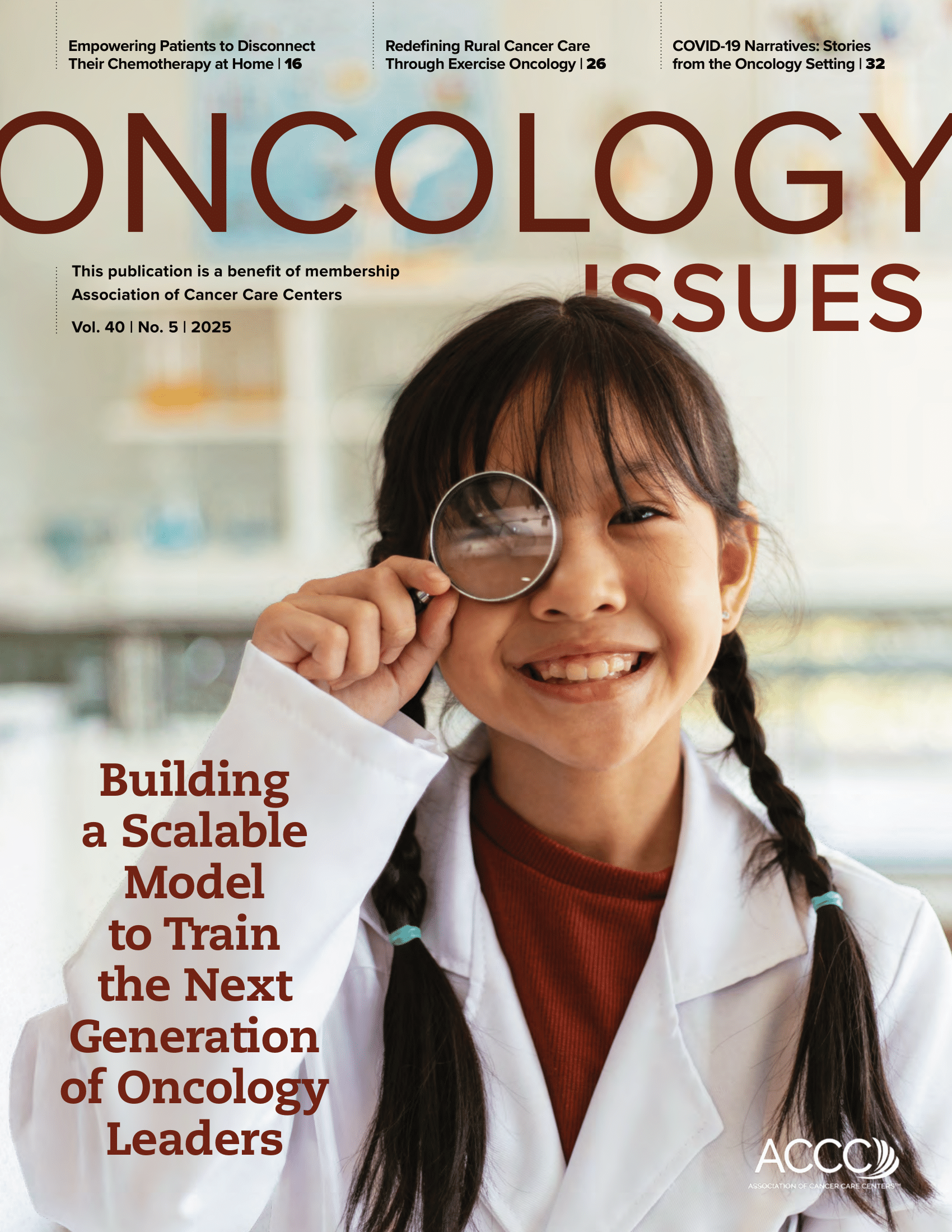
Articles in this issue

The Weight of Waiting: Humanizing Cancer Care in Times of Transition
Building the Future of Oncology Through Innovation and Equity
Building a Scalable Model to Train the Next Generation of Oncology Leaders
Empowering Patients to Disconnect Their Chemotherapy at Home
One Purpose, One Passion, 2 Directions:   How to Bring Together Clinical and Administrative Leaders
One Purpose, One Passion, 2 Directions: How to Bring Together Clinical and Administrative Leaders
From Fatigue to Function: Redefining Rural Cancer Care Through Exercise Oncology
COVID-19 Narratives: Stories from the Oncology Setting
Unlocking the Conversation: Navigating 𝘌𝘚𝘙1 Mutations in Metastatic Breast Cancer
Multidisciplinary Approaches to Treating Patients With Relapsed/Refractory Follicular Lymphoma
Fast Facts Vol 40, No. 5
Policy Town Hall: Advancing Care Through State-Level Advocacy
Highlights from CY 2026 MPFS and HOPPS Proposed Rules
Pocket Nodules: Encouraging Self-Efficacy Through Interactive Patient Education
Southern Cancer Center, Huntsville, Alabama
Action: Vol 40, No. 5