Expanding access to clinical trials is instrumental in achieving equitable cancer care delivery. Clinical trials can be a lifeline for patients with cancer, providing leading-edge care by clinicians dedicated to a specific disease. The oncology community is filled with stories of patients whose lives were improved and/or extended due to participation in a clinical trial. Yet, despite the potential of clinical research to improve outcomes for patients with cancer, enrollment in trials remains low.
The Association of Cancer Care Centers (ACCC) is dedicated to helping the oncology community advance new therapies, expand access to clinical trials, and to close the gap in cancer care delivery by offering the latest education and resources on real-world research, evidence, and clinical trials.
To help address challenges in navigating clinical trial conversations with patients, the ACCC Community Oncology Research Institute developed a practical, quick-reference resource that offers conversation guidance, suggested patient-friendly language, responses to common questions and concerns, and educational resources to support communication across the multidisciplinary cancer care team.

Decentralized clinical trial approaches, including remote consent, telehealth, local laboratory and imaging services, and more, can help reduce some of the many barriers that prevent eligible patients from participating in trials. But as the participants in ACCC’s Advancing Decentralized Clinical Trials in the Community Setting Roundtable Series emphasized, implementing DCT elements is not simply a matter of adopting new technology. Doing so successfully requires thoughtful workflows and oversight structures that consider equity, scalability, and sustainability.

Leaders at Mary Bird Perkins Cancer Center have rebuilt their now nationally recognized clinical trials program from the ground up, with diverse enrollment a cornerstone of their philosophy.

Recognizing the weight of the barriers to trial participation, Susan G. Komen partnered with breastcancertrials.org to develop a free clinical trials navigation e-course designed to help patient navigators better support individuals in accessing trials.
In this episode, CANCER BUZZ speaks with clinical research professionals about Sanford Health’s successful decentralized clinical trial (DCT) program and how each of their roles helps to expand access to clinical trials for patients across the region.
In this episode, CANCER BUZZ speaks with Erin Pierce, MSN, APRN, FNP-C, Associate Clinical Investigator and Nurse Practitioner at HonorHealth Research Institute, and Kristen Kipping-Johnsson, MPH, Director of Network Research Operations at the University of Chicago, about how each of their cancer programs are approaching DCT implementation. Their discussion explores how decentralized components, such as community-based treatment delivery, centralized research infrastructure, and hybrid trial designs, can increase participation opportunities for patients in both community and academic settings.
Clinical trials are vital to offering and developing the most effective treatment options. However, there are large disparities in enrollment across race, ethnicity, geography, and type of cancer care center. Mary Bird Perkins Cancer Center in Baton Rouge, LA uses local partnerships, culturally tailored outreach, and workforce innovation to drive sustainable and equitable participation in clinical trials. Minorities now make up 21% of their clinical trial participation, surpassing the national average. Following these meaningful gains in attracting local minority populations and underserved communities to take part in clinical trials, the Mary Bird Perkins research team received a grant to further support this work. In this episode of CANCER BUZZ, Victor Lin, MD, PhD, research medical director at Mary Bird Perkins Cancer Center, shares strategies for success in their community, including awareness campaigns and partnerships. CANCER BUZZ also speaks with TaeJeanne “TJ” Taylor-Lawrence, RN, registered nurse and patient navigator, about building relationships and supporting patients in clinical trials.
On October 29-30, 2024, the ACCC Community Oncology Research Institute (ACORI) hosted the Community Oncology Inclusive Clinical Trial Design Summit in Arlington, VA. The event brought together stakeholders including academic and community cancer center practitioners and researchers, advocacy organizations, government agencies, and industry partners to discuss strategies to increase patient access to clinical trials in the community setting. Five priority areas were identified that characterize actionable strategies to promote fair and accessible clinical trial design that is representative of all patients with cancer: strengthening the clinical trial workforce, optimizing trial design, engaging communities outside of clinical trial interactions, decentralizing clinical trials, and leveraging artificial intelligence/digital health tools for increased access and efficiency.
Expanding access to clinical trials in community oncology settings is essential to improving diversity, equity, and inclusion in cancer research. In this episode, CANCER BUZZ speaks with clinical research coordinator, Oluwakemi “Kemi” Oladipupo, MSHS, MPH, BSN, RN, CCRP, whose cancer center recently participated in a foundational oncology clinical trials course, developed by ACCC and the Association of Clinical Research Professionals (ACRP) to help cancer programs expand availability of trials to traditionally underserved communities. Oladipupo shares how this training prepared their center for the challenges of a growing research program, the progress they’ve made, and the pivotal role of clinical research coordinators in expanding research programs and improving patient access to clinical trials.
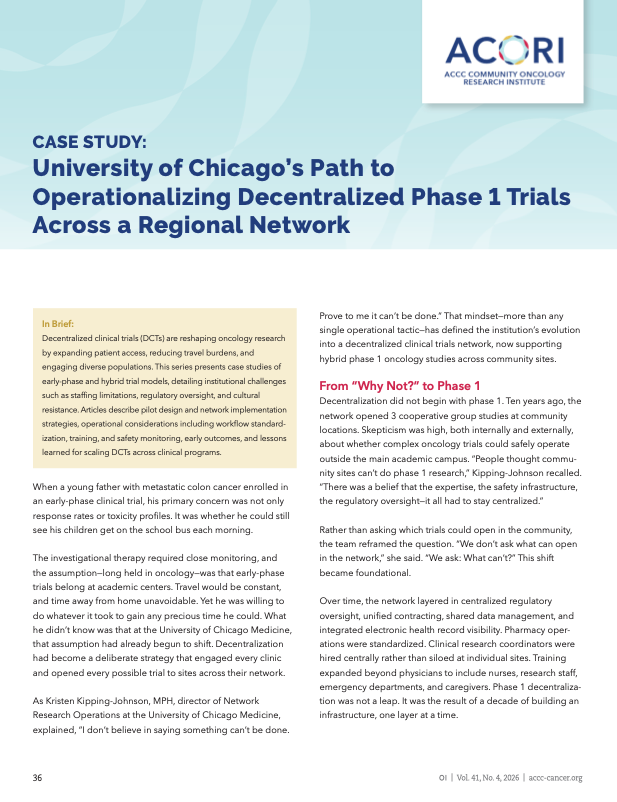
Examine how University of Chicago Medicine is implementing decentralized phase 1 trials through standardized operations, multidisciplinary training, and community-based research partnerships.
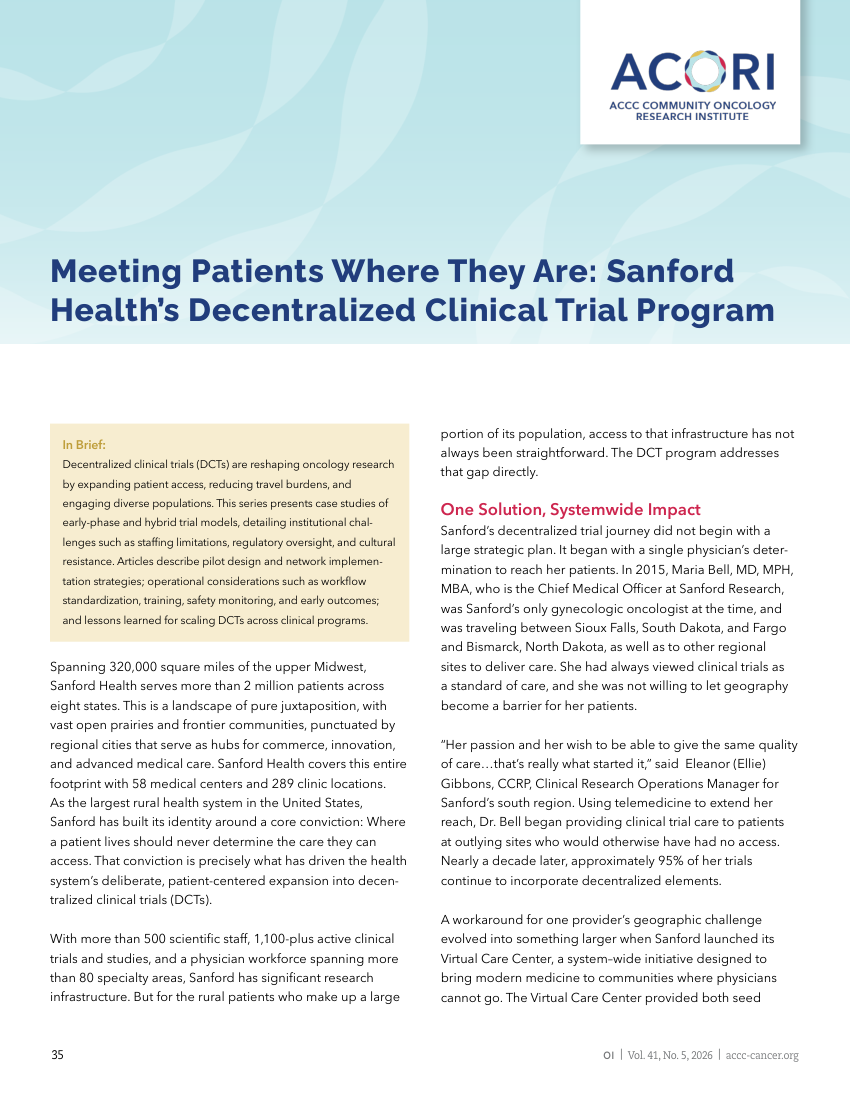
Explore how Sanford Health is expanding clinical trial access for rural patients through decentralized care models, cross-system collaboration, and dedicated research infrastructure.
Explore how HonorHealth Research Institute is piloting decentralized clinical trial models to expand patient access, strengthen community partnerships, and address implementation challenges.
Read about the impact of an ACCC pilot program to provide foundational, oncology-specific clinical research training and tools to build research capacity and increase clinical trial participation at community cancer centers.