Author(s):
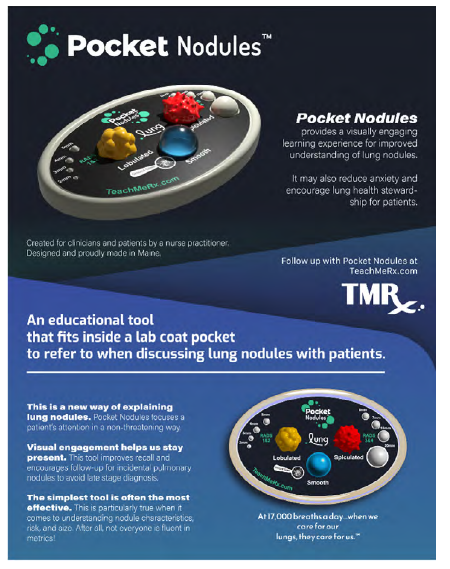
Early in my career as an adult nurse growth on the lungs that are typically practitioner at Maine Health Thoracic benign—and specifically, the significance of Oncology, I noticed that patients their size and appearance. To improve struggled to understand the concept of comprehension and alleviate patient distress pulmonary nodules—areas of abnormal about the cancer risks associated with nodules, I created the first 3D nodule-education tool in 2018 and began using the prototype in the clinic with patients. I saw immediate improvement in engaging patients in shared decision-making conversations. Preliminary data from a quality improvement survey among 31 patients indicated that the 3D tool helped increase their understanding of lung nodules and the significance of nodule size and appearance. The average score for helpfulness in nodule understanding was 9.4 out of 10, with 10 being extremely helpful. This tool led to a Maine Health Clinical Innovation award and an ACCC Innovator Award.
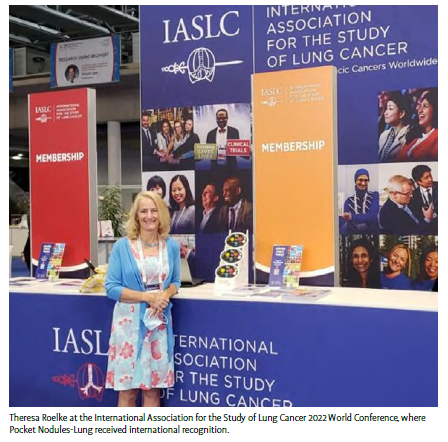
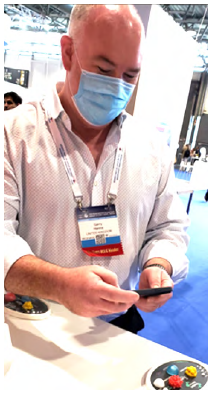
Initial use of the Pocket Nodules–Lung tool focused on enhancing shared decision-making conversations within the context of lung cancer screening at Maine Health. Since then, the tool has been embraced broadly by a heterogeneous group of clinicians in over 60 health care organizations across the US and has received international recognition with distribution to delegates in Vienna at the International Association for the Study of Lung Cancer 2022 World Conference. This increased awareness outside the US has led clinics to engage patients with Pocket Nodules–Lung across Europe, Africa, the Asian Pacific, and Australia.

Bolstered by the innovation’s success, Maine Health encouraged me to establish an LLC to ensure widespread adoption of Pocket Nodules– Lung. I named the company Teach Me Rx, reflecting my desire to improve self-efficacy and autonomy among patients by engaging them in conversation and inviting them to share the driver’s seat with providers.
Demand continues to grow for Pocket Nodules, which are now available in English, Spanish, Mandarin, and French. The tool has been embraced by for-profit and nonprofit organizations, including the Veterans Association, AstraZeneca, Lung Ambition Alliance, GO2 for Lung Cancer, and the American Cancer Society (ACS) regional networks. In November 2024, Kaitlyn Keen, Associate Director of the ACS Illinois Cancer Center Partnership and the ACS Illinois Lung Cancer Roundtable, held an event in a suburb of Chicago to increase awareness of lung cancer screening. Later, Keen shared a story about that event with me. On display was a Pocket Nodules–Lung education tool. A couple walking past paused, picked it up, and began to study it. They commented on the design, function, and utility of the tool, and said, “Both our parents died of lung cancer. If we had something like this when they were diagnosed, it would have been a lot easier.”
Expanding to Pocket Nodules–Breast
Breast cancer is one of the most common types of cancer diagnosed in women globally. Approximately 1 in 8 women will receive a breast cancer diagnosis during their lifetime.1 Some receive a breast cancer diagnosis twice.

I returned to school to receive my nurse practitioner degree later in life. During that time, I met a patient who had undergone a lumpectomy 7 years earlier and then experienced a recurrence of cancer in the opposite breast. The recommendation was a bilateral mastectomy. I was invited to be present throughout the entire course of her treatment—from surgery, to pathology, through recovery and rehabilitative therapy. During the procedure, the surgeon instructed me to bring the tray of tissue samples to pathology. I entered the lab and the pathologist asked, “You’re a student?” I nodded. “Get some gloves,” he said.
As I pulled on the gloves, he cut a thin slice of tissue from the sample. “I want you to understand what cancer feels like.” I held the tissue between my fingers. “Do you feel it rooting through the tissue? It’s like roots on a plant. It feels like the cartilage on the tip of your nose.” What I held between my fingers felt small and fragile, yet emotionally heavy. Twelve years have passed, but these visual and tactile experiences stay with me and help me recall what I had learned and felt that day.
Breast nodules are 3D lesions that reflect changes in breast tissue; they are often detected on mammography or breast ultrasound. Receiving a call after a mammogram is not uncommon. Approximately 10% of women who are screened have a suspicious breast nodule requiring further evaluation.2 Like lung nodules, most breast nodules are benign, but can cause significant fear, anxiety, and ongoing stress for patients as they wait for a biopsy to come back. Portable tools that educate patients on such a finding are limited; as a result, breast surgeons and oncologists may use a string of beads of varying widths to provide patients with an understanding of breast nodule diameter or resort to comparing nodule size to that of a pea, grape, or walnut.
In November 2024, I began to work on Pocket Nodules–Breast. I worked through the holiday season, preparing a grant proposal for the Maine Technology Institute Biotechnology Group. I was awarded funding early in 2025 and was encouraged to begin development.
Pocket Nodules–Breast targets patients who are navigating a finding they had not anticipated and clinicians whose job is to educate patients and families on the finding. Education offers a sense of autonomy and positions patients to make clinical decisions that are right for them, even when the best option means taking a significant detour in life. Clinicians find that using an engaging tactile tool helps alleviate tension and establishes trust by inviting patients and families into the conversation.
Addressing Anxiety Through Education
Using the Pocket Nodules–Lung and Pocket Nodules–Breast visual tools improves recall and mitigates distress that often occurs with both lung and breast screening. Evidence suggests that learning through multisensory stimulation can reduce anxiety.3-5 The left hemisphere of the brain is linked to logic, linear thought, and thinking in words, while the right hemisphere is linked with creativity, sensory and spatial awareness, holistic thinking, art, intuition, and emotional cognition.6 By using multisensory input, patients move from a place of overthinking and analysis occurring in the left hemisphere to utilizing the right hemisphere, evoking calmness and emotional regulation.5

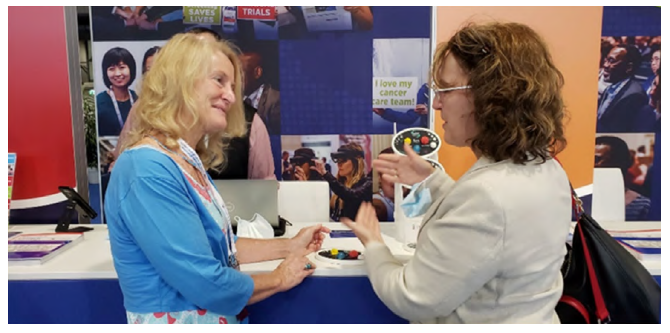
Studies reveal that using multisensory stimulation improves recall and accelerates decision-making when people engage with audiovisual stimuli compared to auditory information alone.6 Most patient education resources are text-based; meanwhile, the use of a visual, language-specific, tactile tool addresses barriers to health literacy in a unique format. These tools also have a way of breaking the ice by stimulating conversation and enhancing provider-patient interaction, establishing patient trust.

What’s Ahead
Clinical innovation is not easy. It requires significant funding, effort, and time, which is something most clinicians just don’t have when they’re working full-time caring for patients. Innovation also requires a degree of business acumen, manufacturing, networking, and building relationships outside of medicine. For these reasons, it’s difficult to bring a clinical innovation to fruition so it can broadly impact patients.
Throughout the development of Pocket Nodules, I have experienced these operational challenges, but what has encouraged me to stay the course are the numerous clinicians and patients who have expressed their love of the tool. The ACS recently expressed interest in conducting a randomized controlled trial using Pocket Nodules–Lung with patients to further validate the tool’s effectiveness. Another development under consideration is Pocket Nodules–Colon. With this addition, a clinical patient education tool would be available for 3 of the most common cancer diagnoses worldwide. My goal is to continue to build exceptional patient education tools that encourage shared decision-making conversations and improve patients’ health by instilling self-efficacy and promoting successful outcomes through education.
Theresa Roelke, MSN, RN, AGNP-C, is an adult nurse practitioner at Maine Medical Center Cancer Institute in Scarborough, Maine, and the founder of Teach Me Rx.
References
1. Breastcancer.org. Breast cancer facts and statistics. Updated July 3, 2025. Accessed August 27, 2025. https://www.breastcancer.org/facts-statistics.
2. Neal L, Sandhu NP, Hieken TJ, et al. Diagnosis and management of benign, atypical, and indeterminate breast lesions detected on core needle biopsy. Mayo Clin Proc. 2014;89(4):536-547. doi:10.1016/j. mayocp.2014.02.004
3. Opoku-Baah C, Schoenhaut AM, Vassall SG, Tovar DA, Ramachandran R, Wallace MT. Visual influences on auditory behavioral, neural, and perceptual processes: A review. J Assoc Res Otolaryngol. 2021;22(4):365-386. doi:10.1007/s10162-021-00789-0
4. Tyng C, Amin H, Saad M, Malik A. The influences of emotion on learning and memory. Front Psychol. 2017;8:1454. doi:10.3389/fpsyg.2017.01454
5. Marucci M, Di Flumeri G, Borghini G, et al. The impact of multisensory integration and perceptual load in virtual reality settings on performance, workload, and presence. Sci Rep. 2021;11(1):4831. doi:10.1038/s41598-021-84196-8
6. Gamma E. Left brain vs right brain: Hemisphere function. Simply Psychology. Updated October 20, 2023. Accessed August 27, 2025. https://www. simplypsychology.org/left-brain-vs-right-brain.html.





Recognizing the critical role advanced practice providers and allied health professionals play in the care continuum, the American Oncology Network provides infrastructure, leadership, and professional growth opportunities to empower these members of the cancer care team to practice at the top of their license.