ACCC association of cancer care centers
Join/Renew
Login
Join/Renew
Login
Education & Resources
ACCC eXchange LogInCorporate Member Sponsored ResourcesPresentations & AbstractsPresident's ThemeACCC Connect eLearning LogIn
Publications
Oncology IssuesPatient Assistance & Reimbursement GuideTrending Now in Cancer Care
Events
2026 ACCC Leadership SummitAnnual Meeting & Cancer Center Business SummitCapitol Hill DayNational Oncology ConferenceOncology Reimbursement MeetingsOncology State Society Meetings
Policy & Advocacy
2024 Policy Wrap-Up and ACCC 2025 Policy PrioritiesLetters & StatementsAccess, Payment & Reimbursement ReformWhite Bagging & Brown BaggingAdvocacy ResourcesCancer Moonshot
Membership
Join | RenewWho We AreMembership Types & BenefitsCorporate MembersACCC Member Portal FAQMember Directory
Partners
Oncology State SocietiesPartner OrganizationsCME
News
News ReleasesAdvocacy News ReleasesOncology News
About ACCC
Timeline / 50th Anniversary2025 Impact ReportACCC Innovator AwardsACCC FellowsACCC Senior Staff
Breast CancerMetastatic Breast Cancer
Gastrointestinal CancerBiliary Tract CancerColorectal CancerGastric CancerLiver Cancer
Genitourinary CancerBladder CancerProstate CancerRenal Cell Carcinoma
Gynecologic CancerOvarian Cancer
Head & Neck Cancer
Hematologic MalignanciesAcute Lymphocytic Leukemia (ALL)Acute Myeloid Leukemia (AML)Chronic Lymphocytic Leukemia (CLL)Mantle Cell Lymphoma (MCL)Multiple Myeloma (MM)Myelodysplastic Syndromes (MDS)
Lung CancerNon-Small Cell Lung Cancer (NSCLC)Small Cell Lung Cancer (SCLC)
Sarcoma
Skin CancerMelanomaNon-Melanoma Skin Cancers (NMSC)
Clinical Practice & TreatmentCancer DiagnosticsCare CoordinationEHR Integration for Biomarker TestingQuality Improvement Collaboration: Integration of Precision Medicine in Community OncologyTreatment
Financial NavigationFAN Boot CampFinancial Advocacy Network (FAN) Resource LibraryPatient Assistance & Reimbursement GuidePrior Authorization
Health Equity & Access3, 2, 1, Go! Practical Solutions for Addressing Cancer Care DisparitiesAppalachian Community Cancer AllianceOncology Advanced PractitionersPersonalizing Care for Patients of All BackgroundsSocial Drivers of Health
Patient-Centered CareAddressing Care Disparities for VeteransAdolescent and Young Adult (AYA)Care Action Plans for People with CancerDermatologic ToxicitiesEmpowering CaregiversGeriatric OncologyHealth LiteracyNutritionOncology PharmacyPatient NavigationPsychosocial Care in OncologyShared Decision-MakingSupportive CareSurvivorship Care
Practice Management & OperationsCancer Program FundamentalsLeadership Sustainment and Engagement VideosOncology Practice Transformation and Integration CenterOncology Team Resiliency
ResearchACCC Community Oncology Research Institute (ACORI)
Technology & InnovationTelehealth & Digital Medicine
ACCCBuzz Blog
CANCER BUZZ Podcast
Oncology Issues
Join/Renew
Login
Breast CancerMetastatic Breast Cancer
Gastrointestinal CancerBiliary Tract CancerColorectal CancerGastric CancerLiver Cancer
Genitourinary CancerBladder CancerProstate CancerRenal Cell Carcinoma
Gynecologic CancerOvarian Cancer
Head & Neck Cancer
Hematologic MalignanciesAcute Lymphocytic Leukemia (ALL)Acute Myeloid Leukemia (AML)Chronic Lymphocytic Leukemia (CLL)Mantle Cell Lymphoma (MCL)Multiple Myeloma (MM)Myelodysplastic Syndromes (MDS)
Lung CancerNon-Small Cell Lung Cancer (NSCLC)Small Cell Lung Cancer (SCLC)
Sarcoma
Skin CancerMelanomaNon-Melanoma Skin Cancers (NMSC)
Clinical Practice & TreatmentCancer DiagnosticsCare CoordinationEHR Integration for Biomarker TestingQuality Improvement Collaboration: Integration of Precision Medicine in Community OncologyTreatment
Financial NavigationFAN Boot CampFinancial Advocacy Network (FAN) Resource LibraryPatient Assistance & Reimbursement GuidePrior Authorization
Health Equity & Access3, 2, 1, Go! Practical Solutions for Addressing Cancer Care DisparitiesAppalachian Community Cancer AllianceOncology Advanced PractitionersPersonalizing Care for Patients of All BackgroundsSocial Drivers of Health
Patient-Centered CareAddressing Care Disparities for VeteransAdolescent and Young Adult (AYA)Care Action Plans for People with CancerDermatologic ToxicitiesEmpowering CaregiversGeriatric OncologyHealth LiteracyNutritionOncology PharmacyPatient NavigationPsychosocial Care in OncologyShared Decision-MakingSupportive CareSurvivorship Care
Practice Management & OperationsCancer Program FundamentalsLeadership Sustainment and Engagement VideosOncology Practice Transformation and Integration CenterOncology Team Resiliency
ResearchACCC Community Oncology Research Institute (ACORI)
Technology & InnovationTelehealth & Digital Medicine
ACCCBuzz Blog
CANCER BUZZ Podcast
Oncology Issues
    • Education & Resources
    • Publications
    • Events
    • Policy & Advocacy
    • Membership
    • Partners
    • News
    • About ACCC
ACCC association of cancer care centers
1801 Research Boulevard, Suite 400, Rockville, MD 20850
Tel: 301.984.9496 Fax: 301.770.1949 Email Us
Contact UsVolunteers
Advertise
Career Center
Terms and Conditions
Privacy Policy
ACCC Rebranding
Copyright © 2026 Association of Cancer Care Centers. All Rights Reserved.
Advertisement
Home / Education And Resources / Cancer Types / Breast Cancer / Metastatic Breast Cancer

METASTATIC BREAST CANCER

While breast cancer is a high-profile disease, receiving significant private and public research funding and focused awareness and prevention initiatives, patients with metastatic breast cancer face unique challenges. According to the Metastatic Breast Cancer (MBC) Alliance “public messaging about the [breast cancer] ‘cure’ and survivorship is so pervasive that people diagnosed at stage IV with metastatic breast cancer can be stigmatized by the perception that they’ve failed to take care of themselves or undergo annual screening.” In addition, many metastatic breast cancer patients face a number of communication challenges, including:

  • A perception that their cancer is curable, driven in part by a low-level of engagement during conversations with providers
  • Providers who use overly vague or overly technical medical language
  • Providers who may “minimize” the severity of the disease, perhaps in efforts to reduce patient distress or help patients stay positive, engaged, and compliant with treatment recommendations.

On-Demand Webinars


Featured Resources

Find Metastatic Breast Cancer Resources Fast

The new, online ACCC Metastatic Breast Cancer Resource Library connects you to curated materials (webinars, articles, blogs, and more) specific to supporting your MBC patients through specialized support tools and tailored education.

Search by topic, resource type (e.g., webinar, article, blog, tool), point of care, or by the effective practices identified in the ACCC Metastatic Breast Cancer project workbook—then share these nationally available, free resources with your patients.


Explore the Resource Library


Metastatic Breast Cancer: Effective Principles in Action

Building on principles to reframe the patient-provider conversation identified in the Metastatic Breast Cancer Workbook, Metastatic Breast Cancer: Effective Principles in Action explores how three differently structured cancer programs are creating and evolving approaches to implementing these principles.


ACCC thanks the following member programs for their participation:

Cowell Family Cancer Center Munson Healthcare, Traverse City, Michigan
Koontz Center for Advanced Breast Cancer, Saint Luke's Health System, Kansas City, Missouri
Providence Cancer Institute, Providence Health & Services, Portland, Oregon


Multidisciplinary MBC Summit: Executive Summary

Patients with metastatic breast cancer have unique needs that are not always best served by the supportive care offerings made available to other breast cancer patients. Determining the most pressing needs of this patient group, prioritizing those needs, and equitably distributing resources to meet the needs was the goal of the ACCC Metastatic Breast Cancer Summit, held October 7, 2019, in Washington, D.C.

Invitees included individuals from across the multidisciplinary cancer care team, including social workers, nurse practitioners, oncologists, chaplains, patient advocates, and financial navigators. After a day rich in discussion and interaction, the group came together to identify a series of actions that, if enacted, could significantly enhance the care of women with metastatic breast cancer.
Download Executive Summary


Multidisciplinary Team Communication Survey Highlights

ACCC conducted a Multidisciplinary Team Communication in MBC survey of over 100 care team members—representing 86 unique cancer programs—that measured progress and assessed areas for continued improvement in caring for patients with metastatic disease.
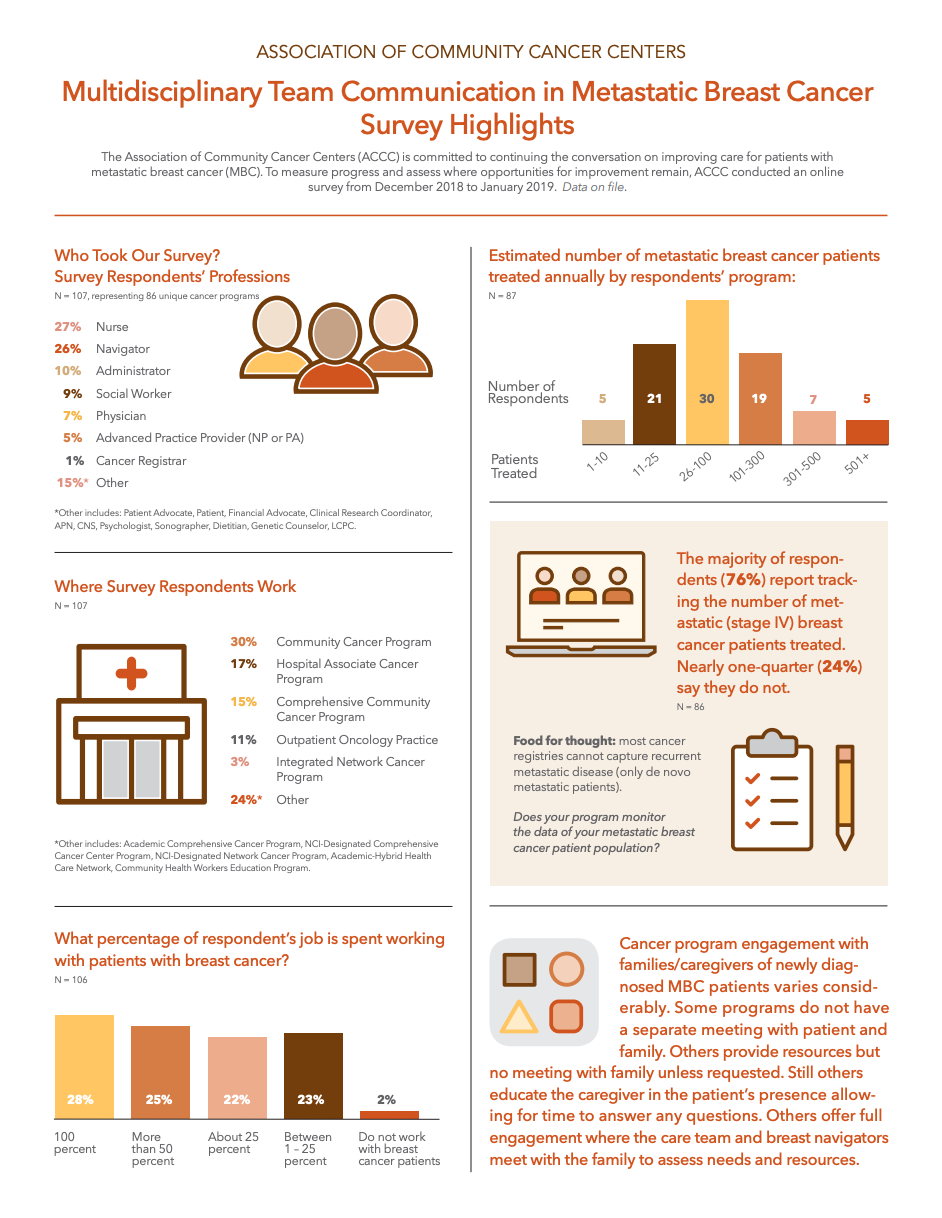
Download Survey Highlights


Workbook & Case Studies

Metastatic Breast Cancer: Effective Principles & Practices in Patient Support includes key highlights from the project's environmental scan, a communication process map that integrates 6 effective principles into the care continuum, helping to reframe and improve the conversation between providers and patients, and examples of how ACCC Cancer Program members are putting these principles into action to deliver holistic, patient-centered care.
Download Workbook
ACCC thanks the following member programs for their participation:

Gibbs Cancer Center, Spartanburg, South Carolina
Providence Cancer Center, Portland, Oregon
Sanford Cancer Center, Fargo, South Dakota

Abstracts and Presentations

[Abstract #186] Multidisciplinary Cancer Teams and Utilization of Resources for Metastatic Breast Cancer (MBC): A Landscape Analysis

Sep 7th 2019

Presented at the 2019 ASCO Quality Care Symposium in San Diego, CA.

[Abstract] The Unique Support Path for Metastatic Breast Cancer Patients

Jun 30th 2018

Presented at the 2018 Multinational Association of Supportive Cancer Care (MASCC) and International Society of Oral Oncology (ISOO) Annual Meeting in Vienna, Austria.


Our Sponsors

Sponsored by Pfizer Oncology.

Pfizer