
ACCC association of cancer care centers
Join/Renew
Login
Join/Renew
Login
Education & Resources
ACCC eXchange LogInCorporate Member Sponsored ResourcesPresentations & AbstractsPresident's ThemeACCC Connect eLearning LogIn
Publications
Oncology IssuesPatient Assistance & Reimbursement GuideTrending Now in Cancer Care
Events
2026 ACCC Leadership SummitAnnual Meeting & Cancer Center Business SummitCapitol Hill DayNational Oncology ConferenceOncology Reimbursement MeetingsOncology State Society Meetings
Policy & Advocacy
2024 Policy Wrap-Up and ACCC 2025 Policy PrioritiesLetters & StatementsAccess, Payment & Reimbursement ReformWhite Bagging & Brown BaggingAdvocacy ResourcesCancer Moonshot
Membership
Join | RenewWho We AreMembership Types & BenefitsCorporate MembersACCC Member Portal FAQMember Directory
Partners
Oncology State SocietiesPartner OrganizationsCME
News
News ReleasesAdvocacy News ReleasesOncology News
About ACCC
Timeline / 50th Anniversary2025 Impact ReportACCC Innovator AwardsACCC FellowsACCC Senior Staff
Breast CancerMetastatic Breast Cancer
Gastrointestinal CancerBiliary Tract CancerColorectal CancerGastric CancerLiver Cancer
Genitourinary CancerBladder CancerProstate CancerRenal Cell Carcinoma
Gynecologic CancerOvarian Cancer
Head & Neck Cancer
Hematologic MalignanciesAcute Lymphocytic Leukemia (ALL)Acute Myeloid Leukemia (AML)Chronic Lymphocytic Leukemia (CLL)Mantle Cell Lymphoma (MCL)Multiple Myeloma (MM)Myelodysplastic Syndromes (MDS)
Lung CancerNon-Small Cell Lung Cancer (NSCLC)Small Cell Lung Cancer (SCLC)
Sarcoma
Skin CancerMelanomaNon-Melanoma Skin Cancers (NMSC)
Clinical Practice & TreatmentCancer DiagnosticsCare CoordinationEHR Integration for Biomarker TestingQuality Improvement Collaboration: Integration of Precision Medicine in Community OncologyTreatment
Financial NavigationFAN Boot CampFinancial Advocacy Network (FAN) Resource LibraryPatient Assistance & Reimbursement GuidePrior Authorization
Health Equity & Access3, 2, 1, Go! Practical Solutions for Addressing Cancer Care DisparitiesAppalachian Community Cancer AllianceOncology Advanced PractitionersPersonalizing Care for Patients of All BackgroundsSocial Drivers of Health
Patient-Centered CareAddressing Care Disparities for VeteransAdolescent and Young Adult (AYA)Care Action Plans for People with CancerDermatologic ToxicitiesEmpowering CaregiversGeriatric OncologyHealth LiteracyNutritionOncology PharmacyPatient NavigationPsychosocial Care in OncologyShared Decision-MakingSupportive CareSurvivorship Care
Practice Management & OperationsCancer Program FundamentalsLeadership Sustainment and Engagement VideosOncology Practice Transformation and Integration CenterOncology Team Resiliency
ResearchACCC Community Oncology Research Institute (ACORI)
Technology & InnovationTelehealth & Digital Medicine
ACCCBuzz Blog
CANCER BUZZ Podcast
Oncology Issues
Join/Renew
Login
Breast CancerMetastatic Breast Cancer
Gastrointestinal CancerBiliary Tract CancerColorectal CancerGastric CancerLiver Cancer
Genitourinary CancerBladder CancerProstate CancerRenal Cell Carcinoma
Gynecologic CancerOvarian Cancer
Head & Neck Cancer
Hematologic MalignanciesAcute Lymphocytic Leukemia (ALL)Acute Myeloid Leukemia (AML)Chronic Lymphocytic Leukemia (CLL)Mantle Cell Lymphoma (MCL)Multiple Myeloma (MM)Myelodysplastic Syndromes (MDS)
Lung CancerNon-Small Cell Lung Cancer (NSCLC)Small Cell Lung Cancer (SCLC)
Sarcoma
Skin CancerMelanomaNon-Melanoma Skin Cancers (NMSC)
Clinical Practice & TreatmentCancer DiagnosticsCare CoordinationEHR Integration for Biomarker TestingQuality Improvement Collaboration: Integration of Precision Medicine in Community OncologyTreatment
Financial NavigationFAN Boot CampFinancial Advocacy Network (FAN) Resource LibraryPatient Assistance & Reimbursement GuidePrior Authorization
Health Equity & Access3, 2, 1, Go! Practical Solutions for Addressing Cancer Care DisparitiesAppalachian Community Cancer AllianceOncology Advanced PractitionersPersonalizing Care for Patients of All BackgroundsSocial Drivers of Health
Patient-Centered CareAddressing Care Disparities for VeteransAdolescent and Young Adult (AYA)Care Action Plans for People with CancerDermatologic ToxicitiesEmpowering CaregiversGeriatric OncologyHealth LiteracyNutritionOncology PharmacyPatient NavigationPsychosocial Care in OncologyShared Decision-MakingSupportive CareSurvivorship Care
Practice Management & OperationsCancer Program FundamentalsLeadership Sustainment and Engagement VideosOncology Practice Transformation and Integration CenterOncology Team Resiliency
ResearchACCC Community Oncology Research Institute (ACORI)
Technology & InnovationTelehealth & Digital Medicine
ACCCBuzz Blog
CANCER BUZZ Podcast
Oncology Issues
    • Education & Resources
    • Publications
    • Events
    • Policy & Advocacy
    • Membership
    • Partners
    • News
    • About ACCC
ACCC association of cancer care centers
1801 Research Boulevard, Suite 400, Rockville, MD 20850
Tel: 301.984.9496 Fax: 301.770.1949 Email Us
Contact UsVolunteers
Advertise
Career Center
Terms and Conditions
Privacy Policy
ACCC Rebranding
Copyright © 2026 Association of Cancer Care Centers. All Rights Reserved.
Advertisement
Home / Education And Resources / Cancer Types / Hematologic Malignancies / MCL

RELAPSED/REFRACTORY MANTLE CELL LYMPHOMA

Mantle cell lymphoma (MCL) is a rare and aggressive form of non-Hodgkin lymphoma (NHL). It begins in the mantle zone (the outer area of small lymphocytes surrounding a lymphatic nodule). Sometimes MCL cells enter the lymphatic channels and blood to spread to other lymph nodes or tissues (eg, bone marrow, liver, or gastrointestinal tract).

MCL accounts for approximately 5% of all NHL cases in the United States and Europe. Incidence is estimated at 4 to 8 people per million, per year. While rare, MCL is an aggressive form of NHL that is often diagnosed at an advanced stage. MCL is incurable in most people, however, prompt diagnosis and treatment can reduce disease progression and may result in complete remission for years.

In addition, there have been major advancements in treatment options in recent years. New drug approvals include Bruton Tyrosine Kinase (BTK) inhibitors, ibrutinib, acalabrutinib, zanubrutinib, and pirtobrutinib), proteosome inhibitors (bortezomib), and cellular therapies (ie, CAR T-cell therapies).

If you have any questions about this project, please contact the ACCC Provider Education department.

Mantle Cell Lymphoma Video Vignettes

This video series aims to provide an overview of the latest treatments available for patients with relapsed or refractory mantle cell lymphoma. The series covers recent trial results, potential new therapies, and an analysis of considerations to bear in mind when deciding on treatment options. The series will also include a case study presentation and discussion between panelists. The series will cover:

  • Updates on new therapies
  • BTK inhibitors
  • Case studies
Relapsed/Refractory Mantle Cell Lymphoma—Update on New Therapies

In this video, Dr. John Burke provides a brief overview of relapsed/refractory mantle cell lymphoma. He notes that mantle cell lymphoma is a relatively uncommon subtype of non-Hodgkin’s lymphoma, which is often diagnosed at advanced stages. Dr. Burke explores recent advancements in treating relapsed/refractory mantle cell lymphoma, including BTK inhibitors. He also examines chimeric antigen receptor (CAR) T-cell therapy in mantle cell lymphoma, focusing on patient eligibility, timing of therapy, and overall response rates. Although bispecific antibodies are not yet approved for mantle cell lymphoma, Dr. Burke reviews the results of early-phase trials. Finally, he reviews a novel BCL-2 inhibitor and highlights combination therapies from recent clinical trials, along with an additional overview of adverse effects.

BTK Inhibitors in Mantle Cell Lymphoma

Dr. Jeff Sharman discusses BTK inhibitors in this video, focusing on progression-free survival and overall survival based on lines of therapy. He reviews findings from clinical studies, including the withdrawal of ibrutinib from the mantle cell lymphoma market. Dr. Sharman also provides an overview of the adverse effects and toxicity profiles for each BTK inhibitor, taking into account comorbidities and prior treatments. Additionally, he covers BTK resistance and non-covalent BTK inhibitors that are being investigated for use in relapsed/refractory mantle cell lymphoma.


Relapsed/Refractory Mantle Cell Lymphoma Case Studies

In a collaborative discussion, Kirollos Hanna, Dr. Jeff Sharman, and Dr. John Burke reviewed patients who have been newly diagnosed with or have relapsed mantle cell lymphoma. Dr. Sharman discussed the expected initial management, as well as the factors that healthcare providers need to consider when treating patients with mantle cell lymphoma. The case studies reviewed included patients of varying ages, extent of disease, and comorbidities. Drs. Sharman and Burke also reviewed the recent clinical trials that were discussed in prior presentations and how to apply those in clinical practice when deciding on the treatment options for patients with mantle cell lymphoma.

Featured Resources

R/R MCL Resource Library

Explore resources ACCC has curated to assist community cancer programs with providing care for patients with relapsed/refractory mantle cell lymphoma. Discover videos, articles, podcasts, and other tools to help providers, patients, and caregivers navigate treatment options.

Learn More

Featured Publications

Treatment for Relapsed/Refractory Mantle Cell Lymphoma Tip Sheet

With recent advancements in therapy options for mantle cell lymphoma (MCL) and so few patients presenting with relapsed or refractory (R/R) disease in community settings, hematologists and oncologists are challenged to stay current on the latest targeted therapies. In response to this need, ACCC has developed this tip sheet to provide a snapshot of the latest information in treating patients with MCL, especially with R/R disease.
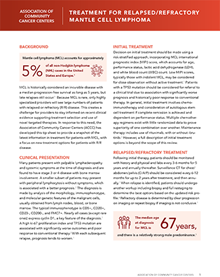

Download Tip Sheet
Treatment for Relapsed/Refractory Mantle Cell Lymphoma Tip Sheet

CANCER BUZZ TV

Establishing Goals of Treatment in Relapsed/Refractory Mantle Cell Lymphoma – [Video Podcast] Ep 51

Oct 2nd 2024

In this episode, CANCER BUZZ speaks with Jeff Sharman, MD, medical director of hematology research, US Oncology, and director of research, Willamette Valley Cancer Institute, about the role of biomarker testing in guiding treatment decisions and how evidence-basedmanagement of treatment-related adverse events can serve this patient population.