ACCC association of cancer care centers
Join/Renew
Login
Join/Renew
Login
Education & Resources
ACCC eXchange LogInCorporate Member Sponsored ResourcesPresentations & AbstractsPresident's ThemeACCC Connect eLearning LogIn
Publications
Oncology IssuesPatient Assistance & Reimbursement GuideTrending Now in Cancer Care
Events
2026 ACCC Leadership SummitAnnual Meeting & Cancer Center Business SummitCapitol Hill DayNational Oncology ConferenceOncology Reimbursement MeetingsOncology State Society Meetings
Policy & Advocacy
2024 Policy Wrap-Up and ACCC 2025 Policy PrioritiesLetters & StatementsAccess, Payment & Reimbursement ReformWhite Bagging & Brown BaggingAdvocacy ResourcesCancer Moonshot
Membership
Join | RenewWho We AreMembership Types & BenefitsCorporate MembersACCC Member Portal FAQMember Directory
Partners
Oncology State SocietiesPartner OrganizationsCME
News
News ReleasesAdvocacy News ReleasesOncology News
About ACCC
Timeline / 50th Anniversary2025 Impact ReportACCC Innovator AwardsACCC FellowsACCC Senior Staff
Breast CancerMetastatic Breast Cancer
Gastrointestinal CancerBiliary Tract CancerColorectal CancerGastric CancerLiver Cancer
Genitourinary CancerBladder CancerProstate CancerRenal Cell Carcinoma
Gynecologic CancerOvarian Cancer
Head & Neck Cancer
Hematologic MalignanciesAcute Lymphocytic Leukemia (ALL)Acute Myeloid Leukemia (AML)Chronic Lymphocytic Leukemia (CLL)Mantle Cell Lymphoma (MCL)Multiple Myeloma (MM)Myelodysplastic Syndromes (MDS)
Lung CancerNon-Small Cell Lung Cancer (NSCLC)Small Cell Lung Cancer (SCLC)
Sarcoma
Skin CancerMelanomaNon-Melanoma Skin Cancers (NMSC)
Clinical Practice & TreatmentCancer DiagnosticsCare CoordinationEHR Integration for Biomarker TestingQuality Improvement Collaboration: Integration of Precision Medicine in Community OncologyTreatment
Financial NavigationFAN Boot CampFinancial Advocacy Network (FAN) Resource LibraryPatient Assistance & Reimbursement GuidePrior Authorization
Health Equity & Access3, 2, 1, Go! Practical Solutions for Addressing Cancer Care DisparitiesAppalachian Community Cancer AllianceOncology Advanced PractitionersPersonalizing Care for Patients of All BackgroundsSocial Drivers of Health
Patient-Centered CareAddressing Care Disparities for VeteransAdolescent and Young Adult (AYA)Care Action Plans for People with CancerDermatologic ToxicitiesEmpowering CaregiversGeriatric OncologyHealth LiteracyNutritionOncology PharmacyPatient NavigationPsychosocial Care in OncologyShared Decision-MakingSupportive CareSurvivorship Care
Practice Management & OperationsCancer Program FundamentalsLeadership Sustainment and Engagement VideosOncology Practice Transformation and Integration CenterOncology Team Resiliency
ResearchACCC Community Oncology Research Institute (ACORI)
Technology & InnovationTelehealth & Digital Medicine
ACCCBuzz Blog
CANCER BUZZ Podcast
Oncology Issues
Join/Renew
Login
Breast CancerMetastatic Breast Cancer
Gastrointestinal CancerBiliary Tract CancerColorectal CancerGastric CancerLiver Cancer
Genitourinary CancerBladder CancerProstate CancerRenal Cell Carcinoma
Gynecologic CancerOvarian Cancer
Head & Neck Cancer
Hematologic MalignanciesAcute Lymphocytic Leukemia (ALL)Acute Myeloid Leukemia (AML)Chronic Lymphocytic Leukemia (CLL)Mantle Cell Lymphoma (MCL)Multiple Myeloma (MM)Myelodysplastic Syndromes (MDS)
Lung CancerNon-Small Cell Lung Cancer (NSCLC)Small Cell Lung Cancer (SCLC)
Sarcoma
Skin CancerMelanomaNon-Melanoma Skin Cancers (NMSC)
Clinical Practice & TreatmentCancer DiagnosticsCare CoordinationEHR Integration for Biomarker TestingQuality Improvement Collaboration: Integration of Precision Medicine in Community OncologyTreatment
Financial NavigationFAN Boot CampFinancial Advocacy Network (FAN) Resource LibraryPatient Assistance & Reimbursement GuidePrior Authorization
Health Equity & Access3, 2, 1, Go! Practical Solutions for Addressing Cancer Care DisparitiesAppalachian Community Cancer AllianceOncology Advanced PractitionersPersonalizing Care for Patients of All BackgroundsSocial Drivers of Health
Patient-Centered CareAddressing Care Disparities for VeteransAdolescent and Young Adult (AYA)Care Action Plans for People with CancerDermatologic ToxicitiesEmpowering CaregiversGeriatric OncologyHealth LiteracyNutritionOncology PharmacyPatient NavigationPsychosocial Care in OncologyShared Decision-MakingSupportive CareSurvivorship Care
Practice Management & OperationsCancer Program FundamentalsLeadership Sustainment and Engagement VideosOncology Practice Transformation and Integration CenterOncology Team Resiliency
ResearchACCC Community Oncology Research Institute (ACORI)
Technology & InnovationTelehealth & Digital Medicine
ACCCBuzz Blog
CANCER BUZZ Podcast
Oncology Issues
    • Education & Resources
    • Publications
    • Events
    • Policy & Advocacy
    • Membership
    • Partners
    • News
    • About ACCC
ACCC association of cancer care centers
1801 Research Boulevard, Suite 400, Rockville, MD 20850
Tel: 301.984.9496 Fax: 301.770.1949 Email Us
Contact UsVolunteers
Advertise
Career Center
Terms and Conditions
Privacy Policy
ACCC Rebranding
Copyright © 2026 Association of Cancer Care Centers. All Rights Reserved.
Advertisement
Home / Education And Resources / Health Equity Access / Personalizing Care For Patients Of ALL Backgrounds

PERSONALIZING CARE FOR PATIENTS OF ALL BACKGROUNDS

In oncology—as in all types of medicine—providers treat patients from all backgrounds with personal histories unique to each one. Recognizing and understanding patients’ personal characteristics such as culture, language, religion, financial status, education, lifestyle, and identity can be as important as clinical factors in choosing and customizing effective treatment plans. Cancer treatment regimens that do not take these variables into account can inadvertently perpetuate established disparities in cancer care and outcomes.


To best meet the individual needs of the diverse patient populations they serve, multidisciplinary cancer care teams must appreciate their patients’ distinct characteristics and personalize their care if they want to achieve optimal health outcomes. This begins with having an awareness of disparities in healthcare delivery, treatment, and outcomes, and cultivating a willingness to seek and mitigate past and current injustices in clinical practice.


According to information about health disparities cited by the National Cancer Institute:

  • Within all racial/ethnic groups, Black people have higher death rates for many cancer types.
  • Black women are more likely than White women to die of breast cancer.
  • People living in rural Appalachia have a higher incidence of colorectal, lung, and cervical cancer than people living in the region’s urban areas.
  • Regardless of race or ethnicity, people with more education are less likely to die prematurely from colorectal cancer than people with relatively less education.
  • While Hispanic and Black women experience cervical cancer more often than women in other racial/ethnic groups, Black women have the highest rates of cervical cancer death.

For more information on this project, please contact the ACCC Provider Education department.


Resource Library


ACCC has curated a comprehensive resource bank of nationally available publications, tools, videos, and other relevant assets to help multidisciplinary care teams identify and address implicit bias and healthcare injustice, as well as facilitate the personalization of care for patients. Access this collection of resources which explores key concepts related to health equity, health literacy, implicit bias, social determinants of health, vulnerable populations, language and cultural barriers, and culturally competent care.

Access Resource Library

Featured Resources

1/2

Infographic

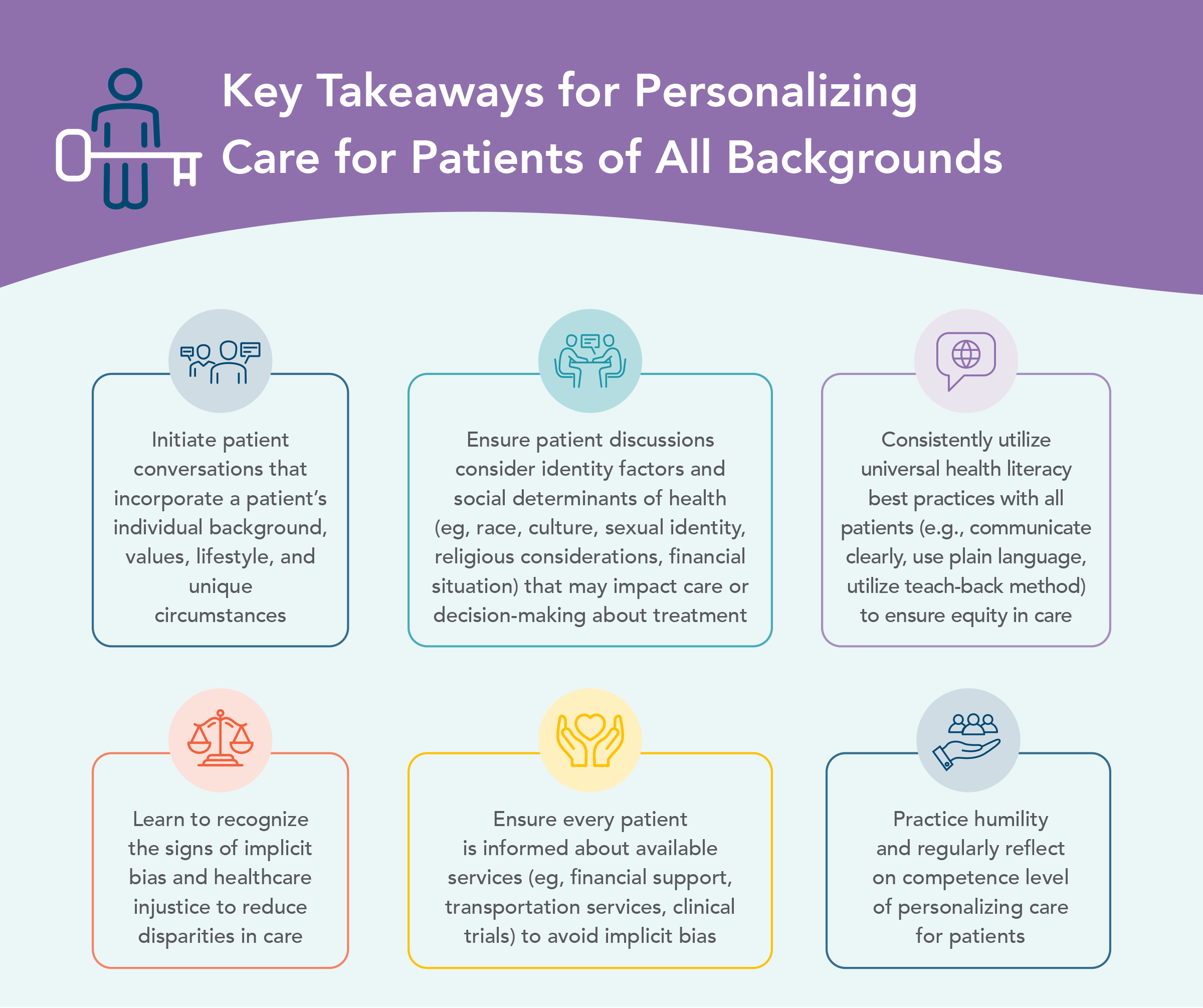
Learn how to identify and honor patients’ goals and preferences through strategies that personalize care around a patient’s unique identity. This downloadable infographic has been designed to help multidisciplinary care teams recognize healthcare injustice and offers tips and resources to better guide equitable care.
Download
Infographic

Video Series


Watch the Personalizing Care Video Series, a collection of 3 short videos (Beyond Labels: Personalize Care Conversations; Beyond Bias: Promote Equity in Care; and Beyond Barriers: Speak Clearly, Care Deeply) which portray real-world experiences observed in the community care setting. Created to help multidisciplinary care teams better understand how to personalize care, this video series explores and demonstrates best practices like gender-inclusive care, overcoming implicit bias, and clear communication.



Our Partners

CSC
Virginia Mae King Foundation
Share Cancer Support
The Latino Cancer Institute
Stupid Cancer

Our Supporters

Funding and support provided by Pfizer Oncology.

Pfizer