ACCC association of cancer care centers
Join/Renew
Login
Join/Renew
Login
Education & Resources
ACCC eXchange LogInCorporate Member Sponsored ResourcesPresentations & AbstractsPresident's ThemeACCC Connect eLearning LogIn
Publications
Oncology IssuesPatient Assistance & Reimbursement GuideTrending Now in Cancer Care
Events
2026 ACCC Leadership SummitAnnual Meeting & Cancer Center Business SummitCapitol Hill DayNational Oncology ConferenceOncology Reimbursement MeetingsOncology State Society Meetings
Policy & Advocacy
2024 Policy Wrap-Up and ACCC 2025 Policy PrioritiesLetters & StatementsAccess, Payment & Reimbursement ReformWhite Bagging & Brown BaggingAdvocacy ResourcesCancer Moonshot
Membership
Join | RenewWho We AreMembership Types & BenefitsCorporate MembersACCC Member Portal FAQMember Directory
Partners
Oncology State SocietiesPartner OrganizationsCME
News
News ReleasesAdvocacy News ReleasesOncology News
About ACCC
Timeline / 50th Anniversary2025 Impact ReportACCC Innovator AwardsACCC FellowsACCC Senior Staff
Breast CancerMetastatic Breast Cancer
Gastrointestinal CancerBiliary Tract CancerColorectal CancerGastric CancerLiver Cancer
Genitourinary CancerBladder CancerProstate CancerRenal Cell Carcinoma
Gynecologic CancerOvarian Cancer
Head & Neck Cancer
Hematologic MalignanciesAcute Lymphocytic Leukemia (ALL)Acute Myeloid Leukemia (AML)Chronic Lymphocytic Leukemia (CLL)Mantle Cell Lymphoma (MCL)Multiple Myeloma (MM)Myelodysplastic Syndromes (MDS)
Lung CancerNon-Small Cell Lung Cancer (NSCLC)Small Cell Lung Cancer (SCLC)
Sarcoma
Skin CancerMelanomaNon-Melanoma Skin Cancers (NMSC)
Clinical Practice & TreatmentCancer DiagnosticsCare CoordinationEHR Integration for Biomarker TestingQuality Improvement Collaboration: Integration of Precision Medicine in Community OncologyTreatment
Financial NavigationFAN Boot CampFinancial Advocacy Network (FAN) Resource LibraryPatient Assistance & Reimbursement GuidePrior Authorization
Health Equity & Access3, 2, 1, Go! Practical Solutions for Addressing Cancer Care DisparitiesAppalachian Community Cancer AllianceOncology Advanced PractitionersPersonalizing Care for Patients of All BackgroundsSocial Drivers of Health
Patient-Centered CareAddressing Care Disparities for VeteransAdolescent and Young Adult (AYA)Care Action Plans for People with CancerDermatologic ToxicitiesEmpowering CaregiversGeriatric OncologyHealth LiteracyNutritionOncology PharmacyPatient NavigationPsychosocial Care in OncologyShared Decision-MakingSupportive CareSurvivorship Care
Practice Management & OperationsCancer Program FundamentalsLeadership Sustainment and Engagement VideosOncology Practice Transformation and Integration CenterOncology Team Resiliency
ResearchACCC Community Oncology Research Institute (ACORI)
Technology & InnovationTelehealth & Digital Medicine
ACCCBuzz Blog
CANCER BUZZ Podcast
Oncology Issues
Join/Renew
Login
Breast CancerMetastatic Breast Cancer
Gastrointestinal CancerBiliary Tract CancerColorectal CancerGastric CancerLiver Cancer
Genitourinary CancerBladder CancerProstate CancerRenal Cell Carcinoma
Gynecologic CancerOvarian Cancer
Head & Neck Cancer
Hematologic MalignanciesAcute Lymphocytic Leukemia (ALL)Acute Myeloid Leukemia (AML)Chronic Lymphocytic Leukemia (CLL)Mantle Cell Lymphoma (MCL)Multiple Myeloma (MM)Myelodysplastic Syndromes (MDS)
Lung CancerNon-Small Cell Lung Cancer (NSCLC)Small Cell Lung Cancer (SCLC)
Sarcoma
Skin CancerMelanomaNon-Melanoma Skin Cancers (NMSC)
Clinical Practice & TreatmentCancer DiagnosticsCare CoordinationEHR Integration for Biomarker TestingQuality Improvement Collaboration: Integration of Precision Medicine in Community OncologyTreatment
Financial NavigationFAN Boot CampFinancial Advocacy Network (FAN) Resource LibraryPatient Assistance & Reimbursement GuidePrior Authorization
Health Equity & Access3, 2, 1, Go! Practical Solutions for Addressing Cancer Care DisparitiesAppalachian Community Cancer AllianceOncology Advanced PractitionersPersonalizing Care for Patients of All BackgroundsSocial Drivers of Health
Patient-Centered CareAddressing Care Disparities for VeteransAdolescent and Young Adult (AYA)Care Action Plans for People with CancerDermatologic ToxicitiesEmpowering CaregiversGeriatric OncologyHealth LiteracyNutritionOncology PharmacyPatient NavigationPsychosocial Care in OncologyShared Decision-MakingSupportive CareSurvivorship Care
Practice Management & OperationsCancer Program FundamentalsLeadership Sustainment and Engagement VideosOncology Practice Transformation and Integration CenterOncology Team Resiliency
ResearchACCC Community Oncology Research Institute (ACORI)
Technology & InnovationTelehealth & Digital Medicine
ACCCBuzz Blog
CANCER BUZZ Podcast
Oncology Issues
    • Education & Resources
    • Publications
    • Events
    • Policy & Advocacy
    • Membership
    • Partners
    • News
    • About ACCC
ACCC association of cancer care centers
1801 Research Boulevard, Suite 400, Rockville, MD 20850
Tel: 301.984.9496 Fax: 301.770.1949 Email Us
Contact UsVolunteers
Advertise
Career Center
Terms and Conditions
Privacy Policy
ACCC Rebranding
Copyright Š 2026 Association of Cancer Care Centers. All Rights Reserved.
Advertisement

Publication

Article

From the Editor

October 13, 2025
Oncology Issues
October 2025
Volume 40
Issue 5

The Weight of Waiting: Humanizing Cancer Care in Times of Transition

Author(s):

Krista Nelson, MSW, LCSW, OSW-C, FAOSW

The Weight of Waiting: Humanizing Cancer Care in Times of Transition
Download Issue PDFDownload PDF

As we move through the transition of seasons, we are reminded of change. The crisp air, shorter days, and vibrant colors invite us to pause and reflect—on what has passed, and on what matters most in the time we are given.

In oncology, change is constant. There are new treatments, evolving care models, shifting policies—all of which require us to adapt quickly as professionals. But sitting with a support group comprising women, all under age 40 and all living with stage IV breast cancer, I was reminded that for our patients, change carries a very different weight. They spoke not of policies or systems, but of waiting—waiting for an injection that took 3 hours to receive, waiting for a clinical trial to open, waiting for medication or scan results while the days stretched on, painfully silent. For them, these delays are not inconveniences; they are lived moments in what may be the final chapters of life.

What struck me most was how clearly these women equated waiting with not being valued. And yet, as health care providers, we know how deeply we do value our patients. Every system, every protocol, every effort is meant to ease suffering and extend life. Still, when the system leaves someone sitting in uncertainty, the message they receive is often the opposite.

Since meeting with this group, I have found myself asking: What can we do or say to ensure that no matter how long the wait or the news they receive, our patients feel seen, valued, and essential? How do we let them know that their lives matter, not just in terms of trial participation or treatment protocols, but as human beings, whose presence is a gift to us all?

In this issue, we spotlight innovative programs that are translating this awareness into action—designing solutions that respond to patients’ needs with both efficiency and empathy. From Wilmot Cancer Institute's patient-led 5-FU self-disconnect initiative to VCU Massey’s expansive pipeline for training future oncology leaders, health care teams are embracing scalable solutions that prioritize patient-centered care. Exercise oncology programs in rural settings are redefining survivorship and enhancing patient quality of life for historically underserved communities. Meanwhile, qualitative research highlights the emotional toll of COVID-19 on patients with cancer, underscoring the need for culturally sensitive care to meaningfully address disparities in cancer care and research participation. Finally, insights into clinician administrator collaboration remind us that trust and effective communication are foundational to building health care systems where every patient and provider is seen and supported.

Together, these stories reveal a cancer care landscape that is not only adapting to workforce and systemic pressures but also prioritizing human connection, patient and provider empowerment, and equity. The future of oncology lies in these integrated efforts— where care begins with community, leadership is shared, and every patient and provider is supported so they can thrive. Perhaps this season can teach us a valuable lesson: Change is inevitable, but how we acknowledge and honor people undergoing drastic change is a choice.
Articles in this issue

The Weight of Waiting: Humanizing Cancer Care in Times of Transition
Building the Future of Oncology Through Innovation and Equity
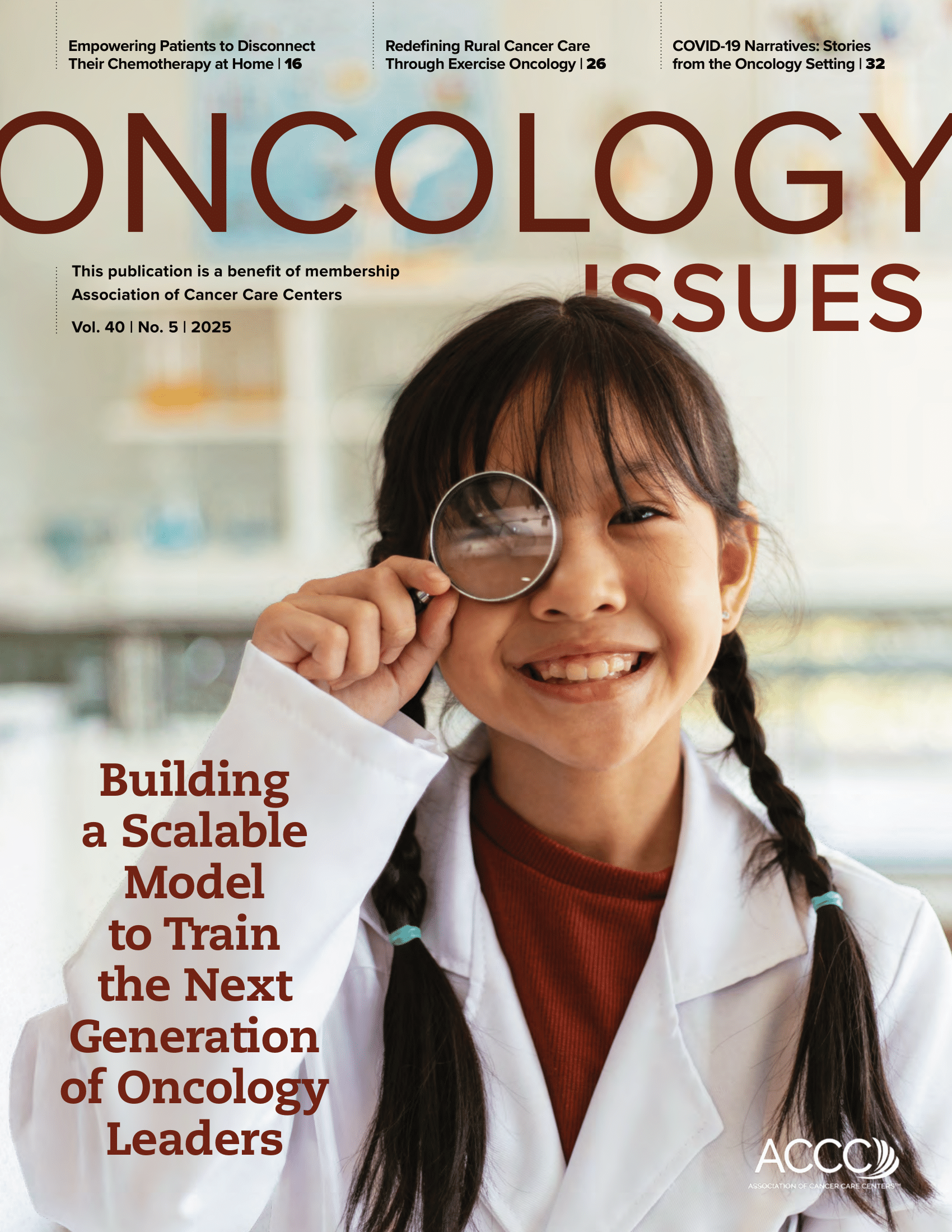
Building a Scalable Model to Train the Next Generation of Oncology Leaders
Empowering Patients to Disconnect Their Chemotherapy at Home
One Purpose, One Passion, 2 Directions:   How to Bring Together Clinical and Administrative Leaders
One Purpose, One Passion, 2 Directions: How to Bring Together Clinical and Administrative Leaders
From Fatigue to Function: Redefining Rural Cancer Care Through Exercise Oncology
COVID-19 Narratives: Stories from the Oncology Setting
Unlocking the Conversation: Navigating 𝘌𝘚𝘙1 Mutations in Metastatic Breast Cancer
Multidisciplinary Approaches to Treating Patients With Relapsed/Refractory Follicular Lymphoma
Fast Facts Vol 40, No. 5
Policy Town Hall: Advancing Care Through State-Level Advocacy
Highlights from CY 2026 MPFS and HOPPS Proposed Rules
Pocket Nodules: Encouraging Self-Efficacy Through Interactive Patient Education
Southern Cancer Center, Huntsville, Alabama
Action: Vol 40, No. 5