ACCC association of cancer care centers
Join/Renew
Login
Join/Renew
Login
Education & Resources
ACCC eXchange LogInCorporate Member Sponsored ResourcesPresentations & AbstractsPresident's ThemeACCC Connect eLearning LogIn
Publications
Oncology IssuesPatient Assistance & Reimbursement GuideTrending Now in Cancer Care
Events
2026 ACCC Leadership SummitAnnual Meeting & Cancer Center Business SummitCapitol Hill DayNational Oncology ConferenceOncology Reimbursement MeetingsOncology State Society Meetings
Policy & Advocacy
2024 Policy Wrap-Up and ACCC 2025 Policy PrioritiesLetters & StatementsAccess, Payment & Reimbursement ReformWhite Bagging & Brown BaggingAdvocacy ResourcesCancer Moonshot
Membership
Join | RenewWho We AreMembership Types & BenefitsCorporate MembersACCC Member Portal FAQMember Directory
Partners
Oncology State SocietiesPartner OrganizationsCME
News
News ReleasesAdvocacy News ReleasesOncology News
About ACCC
Timeline / 50th Anniversary2025 Impact ReportACCC Innovator AwardsACCC FellowsACCC Senior Staff
Breast CancerMetastatic Breast Cancer
Gastrointestinal CancerBiliary Tract CancerColorectal CancerGastric CancerLiver Cancer
Genitourinary CancerBladder CancerProstate CancerRenal Cell Carcinoma
Gynecologic CancerOvarian Cancer
Head & Neck Cancer
Hematologic MalignanciesAcute Lymphocytic Leukemia (ALL)Acute Myeloid Leukemia (AML)Chronic Lymphocytic Leukemia (CLL)Mantle Cell Lymphoma (MCL)Multiple Myeloma (MM)Myelodysplastic Syndromes (MDS)
Lung CancerNon-Small Cell Lung Cancer (NSCLC)Small Cell Lung Cancer (SCLC)
Sarcoma
Skin CancerMelanomaNon-Melanoma Skin Cancers (NMSC)
Clinical Practice & TreatmentCancer DiagnosticsCare CoordinationEHR Integration for Biomarker TestingQuality Improvement Collaboration: Integration of Precision Medicine in Community OncologyTreatment
Financial NavigationFAN Boot CampFinancial Advocacy Network (FAN) Resource LibraryPatient Assistance & Reimbursement GuidePrior Authorization
Health Equity & Access3, 2, 1, Go! Practical Solutions for Addressing Cancer Care DisparitiesAppalachian Community Cancer AllianceOncology Advanced PractitionersPersonalizing Care for Patients of All BackgroundsSocial Drivers of Health
Patient-Centered CareAddressing Care Disparities for VeteransAdolescent and Young Adult (AYA)Care Action Plans for People with CancerDermatologic ToxicitiesEmpowering CaregiversGeriatric OncologyHealth LiteracyNutritionOncology PharmacyPatient NavigationPsychosocial Care in OncologyShared Decision-MakingSupportive CareSurvivorship Care
Practice Management & OperationsCancer Program FundamentalsLeadership Sustainment and Engagement VideosOncology Practice Transformation and Integration CenterOncology Team Resiliency
ResearchACCC Community Oncology Research Institute (ACORI)
Technology & InnovationTelehealth & Digital Medicine
ACCCBuzz Blog
CANCER BUZZ Podcast
Oncology Issues
Join/Renew
Login
Breast CancerMetastatic Breast Cancer
Gastrointestinal CancerBiliary Tract CancerColorectal CancerGastric CancerLiver Cancer
Genitourinary CancerBladder CancerProstate CancerRenal Cell Carcinoma
Gynecologic CancerOvarian Cancer
Head & Neck Cancer
Hematologic MalignanciesAcute Lymphocytic Leukemia (ALL)Acute Myeloid Leukemia (AML)Chronic Lymphocytic Leukemia (CLL)Mantle Cell Lymphoma (MCL)Multiple Myeloma (MM)Myelodysplastic Syndromes (MDS)
Lung CancerNon-Small Cell Lung Cancer (NSCLC)Small Cell Lung Cancer (SCLC)
Sarcoma
Skin CancerMelanomaNon-Melanoma Skin Cancers (NMSC)
Clinical Practice & TreatmentCancer DiagnosticsCare CoordinationEHR Integration for Biomarker TestingQuality Improvement Collaboration: Integration of Precision Medicine in Community OncologyTreatment
Financial NavigationFAN Boot CampFinancial Advocacy Network (FAN) Resource LibraryPatient Assistance & Reimbursement GuidePrior Authorization
Health Equity & Access3, 2, 1, Go! Practical Solutions for Addressing Cancer Care DisparitiesAppalachian Community Cancer AllianceOncology Advanced PractitionersPersonalizing Care for Patients of All BackgroundsSocial Drivers of Health
Patient-Centered CareAddressing Care Disparities for VeteransAdolescent and Young Adult (AYA)Care Action Plans for People with CancerDermatologic ToxicitiesEmpowering CaregiversGeriatric OncologyHealth LiteracyNutritionOncology PharmacyPatient NavigationPsychosocial Care in OncologyShared Decision-MakingSupportive CareSurvivorship Care
Practice Management & OperationsCancer Program FundamentalsLeadership Sustainment and Engagement VideosOncology Practice Transformation and Integration CenterOncology Team Resiliency
ResearchACCC Community Oncology Research Institute (ACORI)
Technology & InnovationTelehealth & Digital Medicine
ACCCBuzz Blog
CANCER BUZZ Podcast
Oncology Issues
    • Education & Resources
    • Publications
    • Events
    • Policy & Advocacy
    • Membership
    • Partners
    • News
    • About ACCC
ACCC association of cancer care centers
1801 Research Boulevard, Suite 400, Rockville, MD 20850
Tel: 301.984.9496 Fax: 301.770.1949 Email Us
Contact UsVolunteers
Advertise
Career Center
Terms and Conditions
Privacy Policy
ACCC Rebranding
Copyright © 2026 Association of Cancer Care Centers. All Rights Reserved.
Advertisement

Publication

Article

Article

October 13, 2025
Oncology Issues
October 2025
Volume 40
Issue 5

Empowering Patients to Disconnect Their Chemotherapy at Home

Author(s):

Colleen Tantalo OCN, MNE, RN
Julie Berkhof, DNP, RN, MS, FNP-C
Colleen Tantalo OCN, MNE, RN
Julie Berkhof, DNP, RN, MS, FNP-C
Elizabeth Kiss, DNP, RN, FNP-BC
Timothy J. Warner, RPH, MBA

Empowering Patients to Disconnect Their Chemotherapy at Home
Download Issue PDFDownload PDF

The COVID-19 pandemic significantly impacted the health care workforce, with 5% of the nursing workforce—approximately 195,000 registered nurses (RNs)—leaving the workforce due to the pandemic.1 While 43% of nurses planned to return, 19% indicated that they did not intend to come back, according to data released in 2024 by the Health Resources & Services Administration.1 The nursing shortage is expected to continue due to limited nurse educators, retirements, and a high turnover rate.2 With so many nurses leaving the profession, cancer programs have been challenged to fill vacancies. These nursing shortages—and a need to support their existing nurses—have caused many cancer programs to rethink how care is delivered and to identify ways to empower patients to manage certain aspects of their own care, such as administering antibiotics, fluids, and total parenteral nutrition, as well as disconnecting from chemotherapy pumps. Teaching patients and caregivers how to care for their central lines and how to disconnect their chemotherapy can be a win-win for all, fostering a sense of control and autonomy for patients and caregivers and removing tasks from busy providers. At least that has been the experience here at Wilmot Cancer Institute, in Rochester, NY, when we have empowered our patients with cancer to independently disconnect their own chemotherapy at home.

In 2025, Una Hopkins, DNP, MSN, FNP-BC, NE-BC, RN, FACCC, announced that her ACCC President’s Theme would be Designing Oncology Care to Meet the Needs of a Growing Patient Population. Wilmot Cancer Institute’s initiative to empower patients and caregivers to self-disconnect from certain chemotherapy infusions directly supports this theme by illustrating a practical and scalable solution to workforce shortages by:

  • Reducing the burden on clinical staff. By shifting appropriate self-care tasks to patients, cancer programs, infusion centers, and home care services can reallocate resources to patients with more complex needs.
  • Enhancing patient autonomy and engagement. Patients report feeling more in control and less stressed, which contributes to better satisfaction and outcomes.
  • Improving care accessibility and efficiency. 5-fluorouracil (5-FU) self-disconnection reduces travel and wait times, making care more convenient and cost-effective.
  • Supporting scalable oncology care models. This model demonstrates feasibility and safety, backed by positive survey data.

Our Implementation Story

To explore the feasibility of patient self-disconnection, cancer program and nursing leadership convened a discussion regarding potential options. Next, a multidisciplinary committee was established, including nurses from clinic settings, infusion centers, and home care (the University of Rochester [UR] Home Infusion). Over the course of 8 months, the committee met monthly to evaluate and plan implementation. Several key considerations were identified, including ensuring patient safety and resource availability, as well as securing buy-in from both clinicians and staff.

Education is critical to ensuring that patients can perform tasks independently following a 5-FU self-disconnect teaching session. The decision on whether a patient is a suitable candidate for this self-care task is based on the clinical judgment of the nurse or provider performing the self-disconnect teaching session. This decision often includes an assessment of a caregiver’s ability to disconnect the chemo.

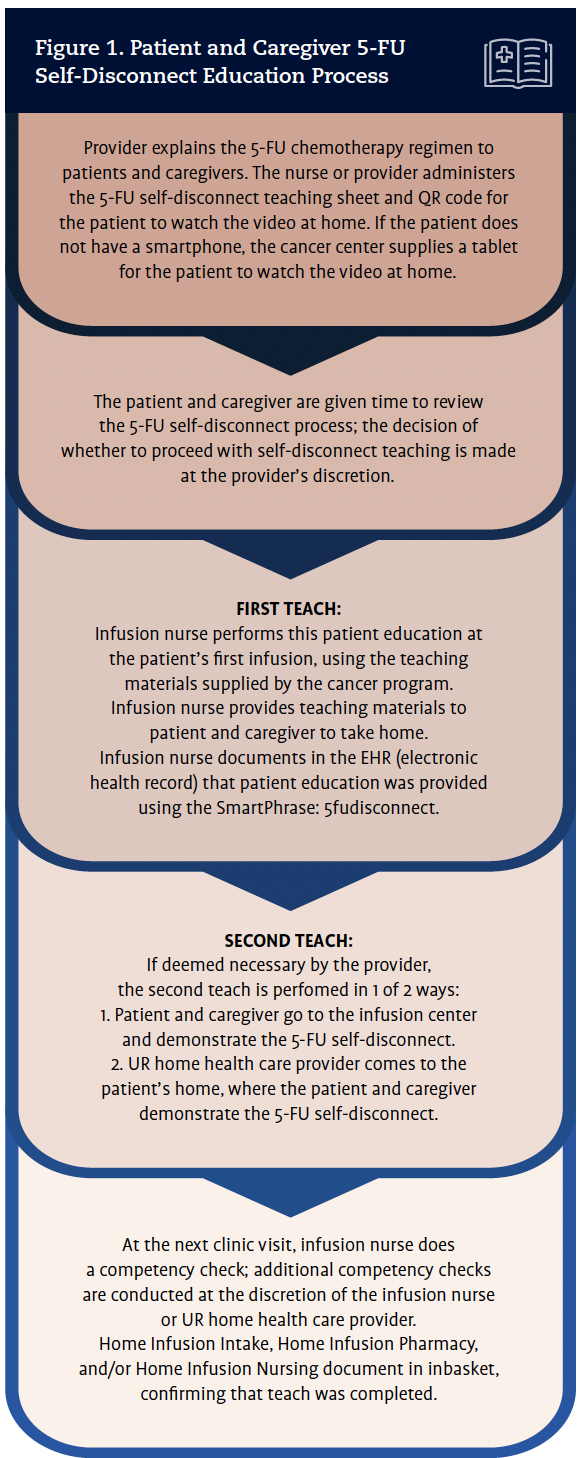
Our team created a teaching sheet, including visual instructions and a QR code for the patient to watch a video. Prior to the patient’s first self-disconnect teaching session, a referral to a certified home care agency is made. If both provider and patient feel confident and comfortable with the process after the teaching session, the home care referral is canceled. Otherwise, the referral will remain in place. Patients are given resource sheets to troubleshoot the most common issues, including if the IV pump is not functioning appropriately, and other helpful information to facilitate successful 5-FU self-disconnects. Patients receive phone numbers for UR Home Infusion and for the Eclipse hotline to help answer questions related to the eclipse bulb (the balloon-shaped device that delivers IV medication). Patients also receive a yellow chemotherapy bucket with a preprinted mailing label and instructions; when filled, patients return the bucket by mail. Figure 1 illustrates our 5-FU self-disconnect education process.

Wilmot Cancer Institute operates 10 infusion centers that administer 5-FU. When the patient self-connect initiative was rolled out, the cancer center had 358 patients currently on continuous chemotherapy of 5-FU.

Our Outcomes

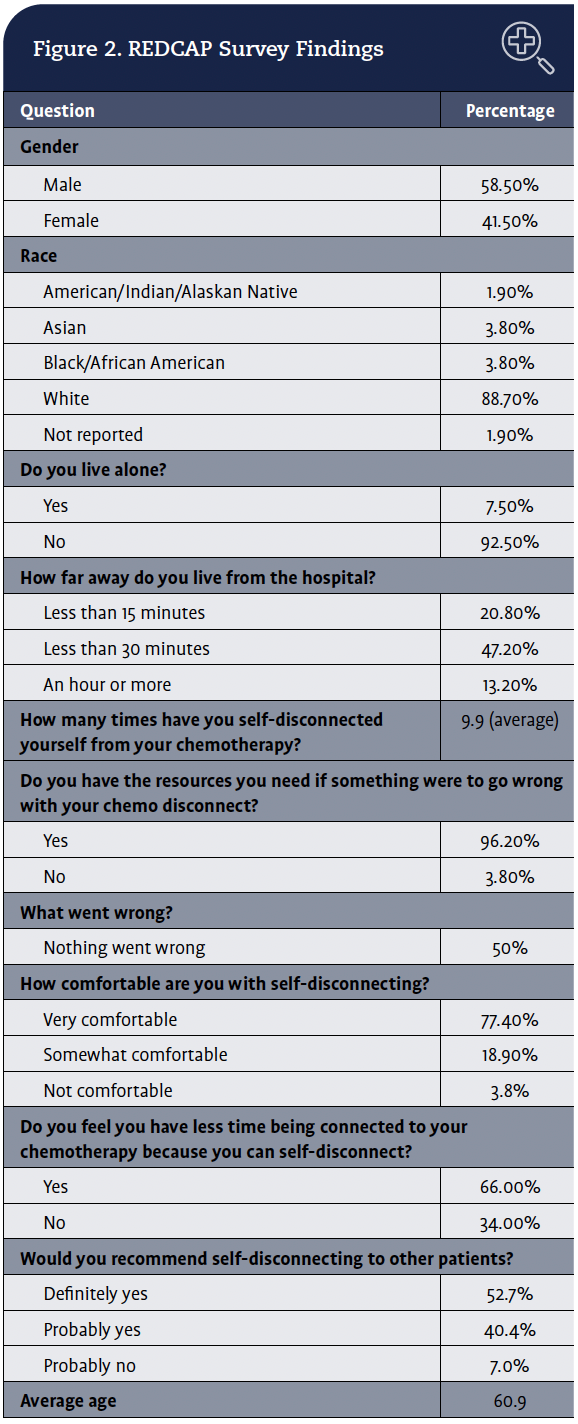
Of these 358 patients, 136 received education and were deemed suitable to safely self-disconnect from home. Based on REDCAP survey data, these patients performed this task without any issues. Specifically, 122 surveys were sent to patients, and a total of 55 responses were returned—a 45% response rate. Patient demographics and survey responses are shown in Figure 2. Patient feedback indicated that 5-FU self-disconnects in the home is feasible and allows patients to take part in their care safely. Open-ended comments included:

  • [I felt] “enthusiastic and positive about the experience.”
  • [I] “felt the step-by-step instructions were very helpful, along with having a person who can help if needed.”
  • [My] husband does [the] disconnect, and it’s very easy.”
  • “[There are fewer] appointments and [it’s] easier than having someone come to the house.”
  • “[It’s a] better experience than going to a facility.”
  • “It was a learning curve, but it is easy.”
  • [I] “felt empowered having some control [over] the disease, and it is less stressful.”

For our team at Wilmot Cancer Institute, empowering patients to self-disconnect from their chemotherapy infusions represents a significant innovation in patient care. This approach enhances patient competence by giving them the skills and confidence to manage their treatment, fostering a greater sense of control over their health. It also builds trusting relationships between patients and health care providers, as patients are given the tools and support they need to take an active role in their care. The method promotes patient autonomy, allowing them to direct their care and make decisions that best suit their lifestyles and preferences. Specifically, this initiative:

  • Improved patient satisfaction. Patients reported feeling more empowered and less stressed, contributing to improved overall satisfaction with their care.
  • Increased convenience. Patients can disconnect at home and on their own schedule, reducing the need for the travel and wait times associated with clinic visits.
  • Reduced health care costs. These patient self-disconnects minimized the need for home care nurses, reduced the workload of infusion nurses, and helped to streamline infusion center operations, leading to cost savings.
  • Better resource allocation. Patient self-disconnect also freed up health care resources, allowing these resources to be utilized more efficiently for other patients in need.

Colleen Tantalo OCN, MNE, RN, is the nurse manager of the UR Home Infusion Pharmacy; Julie Berkhof, DNP, RN, MS, FNP-C, is director at the Wilmot Cancer Institute regional locations; Elizabeth Kiss, DNP, RN, FNP-BC, is assistant director of Wilmot Cancer Institute Quality and Safety; and Timothy J. Warner, RPh, MBA, is director of UR Home Infusion Pharmacy at Wilmot Cancer Institute in Rochester, New York

References
  1. 2022 national sample survey of registered nurses snapshot. HRSA Workforce. Published March 2024. Accessed August 15, 2025. https://bhw. hrsa.gov/sites/default/files/bureau-health-workforce/Nurse-Survey-Fact-Sheet-2024.pdf
  2. Haddad LM, Annamaraju P, Toney-Butler TJ. Nursing shortage. In: StatPearls [Internet]. Treasure Island (FL): StatPearls Publishing. Updated Feb 13, 2023. Accessed September 2, 2025. https://www.ncbi.nlm.nih.gov/books/NBK493175
Articles in this issue

The Weight of Waiting: Humanizing Cancer Care in Times of Transition
Building the Future of Oncology Through Innovation and Equity
Building a Scalable Model to Train the Next Generation of Oncology Leaders
Empowering Patients to Disconnect Their Chemotherapy at Home
One Purpose, One Passion, 2 Directions:   How to Bring Together Clinical and Administrative Leaders
One Purpose, One Passion, 2 Directions: How to Bring Together Clinical and Administrative Leaders
From Fatigue to Function: Redefining Rural Cancer Care Through Exercise Oncology
COVID-19 Narratives: Stories from the Oncology Setting
Unlocking the Conversation: Navigating 𝘌𝘚𝘙1 Mutations in Metastatic Breast Cancer
Multidisciplinary Approaches to Treating Patients With Relapsed/Refractory Follicular Lymphoma
Fast Facts Vol 40, No. 5
Policy Town Hall: Advancing Care Through State-Level Advocacy
Highlights from CY 2026 MPFS and HOPPS Proposed Rules
Pocket Nodules: Encouraging Self-Efficacy Through Interactive Patient Education
Southern Cancer Center, Huntsville, Alabama
Action: Vol 40, No. 5