ACCC association of cancer care centers
Join/Renew
Login
Join/Renew
Login
Education & Resources
ACCC eXchange LogInSponsored Education from ACCC Corporate PartnersACCC eLearning LogInPresentations & Abstracts
Publications
Oncology IssuesPatient Assistance & Reimbursement GuideTrending Now in Cancer CareBusiness Case Studies for Hiring New Staff
Events
2026 ACCC Leadership SummitAnnual Meeting & Cancer Center Business SummitCapitol Hill DayNational Oncology ConferenceOncology Reimbursement MeetingsOncology State Society Meetings
Policy & Advocacy
ACCC 2026 Policy PrioritiesLetters & StatementsAccess, Payment & Reimbursement ReformWhite Bagging & Brown BaggingAdvocacy ResourcesCancer Moonshot
Membership
Join | RenewWho We AreMembership Types & BenefitsCorporate MembersACCC Member Portal FAQMember Directory
Partners
Oncology State SocietiesPartner OrganizationsCME
News
News ReleasesAdvocacy News ReleasesOncology News
About ACCC
Timeline / 50th Anniversary2025 Impact ReportPresident's ThemeACCC Innovator AwardsACCC FellowsBoard of TrusteesACCC Senior Staff
Breast CancerMetastatic Breast Cancer
Gastrointestinal CancerBiliary Tract CancerColorectal CancerGastric CancerLiver Cancer
Genitourinary CancerBladder CancerProstate CancerRenal Cell Carcinoma
Gynecologic Cancer
Head & Neck Cancer
Hematologic MalignanciesAcute Lymphocytic Leukemia (ALL)Acute Myeloid Leukemia (AML)Chronic Lymphocytic Leukemia (CLL)Mantle Cell Lymphoma (MCL)Multiple Myeloma (MM)Myelodysplastic Syndromes (MDS)
Lung CancerNon-Small Cell Lung Cancer (NSCLC)Small Cell Lung Cancer (SCLC)
Sarcoma
Skin CancerMelanomaNon-Melanoma Skin Cancers (NMSC)
Clinical Practice & TreatmentCancer DiagnosticsCare CoordinationEHR Integration for Biomarker TestingQuality Improvement Collaboration: Integration of Precision Medicine in Community OncologyTreatment
Financial NavigationFAN Boot CampFinancial Advocacy Network (FAN) Resource LibraryPatient Assistance & Reimbursement GuidePrior Authorization
Health Equity & Access3, 2, 1, Go! Practical Solutions for Addressing Cancer Care DisparitiesAppalachian Community Cancer AllianceOncology Advanced PractitionersPersonalizing Care for Patients of All BackgroundsSocial Drivers of Health
Patient-Centered CareAddressing Care Disparities for VeteransAdolescent and Young Adult (AYA)Care Action Plans for People with CancerDermatologic ToxicitiesEmpowering CaregiversGeriatric OncologyHealth LiteracyNutritionOncology PharmacyPatient NavigationPsychosocial Care in OncologyShared Decision-MakingSupportive CareSurvivorship Care
Practice Management & OperationsCancer Program FundamentalsLeadership Sustainment and Engagement VideosOncology Practice Transformation and Integration CenterOncology Team Resiliency
ResearchACCC Community Oncology Research Institute (ACORI)
Technology & InnovationTelehealth & Digital Medicine
ACCCBuzz Blog
CANCER BUZZ Podcast
Oncology Issues
Join/Renew
Login
Breast CancerMetastatic Breast Cancer
Gastrointestinal CancerBiliary Tract CancerColorectal CancerGastric CancerLiver Cancer
Genitourinary CancerBladder CancerProstate CancerRenal Cell Carcinoma
Gynecologic Cancer
Head & Neck Cancer
Hematologic MalignanciesAcute Lymphocytic Leukemia (ALL)Acute Myeloid Leukemia (AML)Chronic Lymphocytic Leukemia (CLL)Mantle Cell Lymphoma (MCL)Multiple Myeloma (MM)Myelodysplastic Syndromes (MDS)
Lung CancerNon-Small Cell Lung Cancer (NSCLC)Small Cell Lung Cancer (SCLC)
Sarcoma
Skin CancerMelanomaNon-Melanoma Skin Cancers (NMSC)
Clinical Practice & TreatmentCancer DiagnosticsCare CoordinationEHR Integration for Biomarker TestingQuality Improvement Collaboration: Integration of Precision Medicine in Community OncologyTreatment
Financial NavigationFAN Boot CampFinancial Advocacy Network (FAN) Resource LibraryPatient Assistance & Reimbursement GuidePrior Authorization
Health Equity & Access3, 2, 1, Go! Practical Solutions for Addressing Cancer Care DisparitiesAppalachian Community Cancer AllianceOncology Advanced PractitionersPersonalizing Care for Patients of All BackgroundsSocial Drivers of Health
Patient-Centered CareAddressing Care Disparities for VeteransAdolescent and Young Adult (AYA)Care Action Plans for People with CancerDermatologic ToxicitiesEmpowering CaregiversGeriatric OncologyHealth LiteracyNutritionOncology PharmacyPatient NavigationPsychosocial Care in OncologyShared Decision-MakingSupportive CareSurvivorship Care
Practice Management & OperationsCancer Program FundamentalsLeadership Sustainment and Engagement VideosOncology Practice Transformation and Integration CenterOncology Team Resiliency
ResearchACCC Community Oncology Research Institute (ACORI)
Technology & InnovationTelehealth & Digital Medicine
ACCCBuzz Blog
CANCER BUZZ Podcast
Oncology Issues
    • Education & Resources
    • Publications
    • Events
    • Policy & Advocacy
    • Membership
    • Partners
    • News
    • About ACCC
ACCC association of cancer care centers
5425 Wisconsin Ave #600, Chevy Chase, MD 20815
Tel: 301.984.9496 Email Us
Contact UsVolunteers
Advertise
Career Center
Terms and Conditions
Privacy Policy
ACCC Rebranding
Copyright © 2026 Association of Cancer Care Centers. All Rights Reserved.
Home / Education And Resources / Presidents Theme / Presidents Theme 2026 2027
ACCC President's Theme
  • President's Theme 2026-2027
  • President's Theme 2025-2026
  • President's Theme 2024-2025
  • President's Theme 2023-2024
  • President's Theme 2022-2023
  • President's Theme 2021-2022
  • President's Theme 2020-2021

PRESIDENT'S THEME 2026-2027

View President's Theme Archives

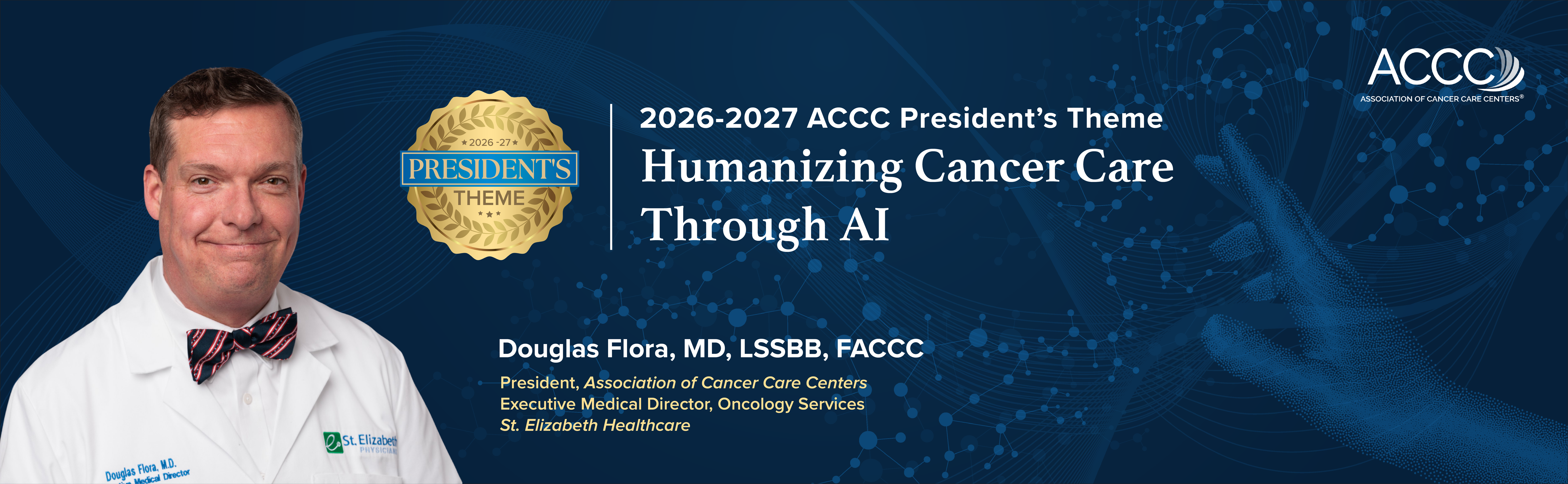
Photo of Douglas Flora, MD, with text reading "2026-2027 President's Theme: Humanizing Cancer Care Through AI."

As artificial intelligence (AI) moves from pilot projects into daily use across patient scheduling, medical documentation, imaging review, and treatment planning, cancer programs are being asked to adopt these tools faster than most other areas of medicine—often without a clear playbook for keeping patients, not algorithms, at the center of care.

On October 21, 2026, Douglas Flora, MD, LSSBB, FACCC, executive medical director of Oncology Services at St Elizabeth Healthcare in Edgewood, Kentucky, was named president of the Association of Cancer Care Centers at the ACCC 43rd National Oncology Conference in Boston, Massachusetts.

The conference kicked off with Dr Flora's presidential address, where he announced his 2026–2027 theme, Humanizing Cancer Care Through AI, assuring his colleagues in the audience that AI is not a replacement for clinical judgment or human connection. Rather, he urged adoption of AI as a tool that—used thoughtfully and effectively—can lift the administrative burden weighing on oncology teams, sharpen early detection and decision-making, and give clinicians more time back for the conversations that matter most to patients.

Over the coming year, this page will be the place to find the practical resources, case studies, and tools ACCC develops around that theme—so check back often as your program works through what responsible, human-centered AI adoption looks like in cancer care.

Member Survey Insights & Tips Sheet

AI in Cancer Care Delivery and Operations presents findings from ACCC's 2025 member survey on AI adoption, revealing current usage trends, top motivators and concerns, governance practices, and the education and policy support cancer programs say they need to implement AI safely and effectively.

Getting Started With Generative AI in Cancer Care Delivery and Operations offers practical tips, dos and don'ts, and a real-world example for cancer programs looking to use generative AI tools safely and effectively in day-to-day operations.

On-Demand Webinars

In Slow Down to Speed Up: Practical Insights About AI in Cancer Care, Highlands Oncology Group shares real-world frameworks for building AI governance, evaluating vendors, and deploying AI tools in cancer care programs.

The Future of Psychosocial Oncology: AI, Innovation, and the Next Era of Supportive Care examines how AI can expand access and streamline distress screening and navigation while preserving empathetic, patient-centered care.

From the 2026 ACCC Leadership Summit

The 2026 ACCC Leadership Summit session AI in Oncology: Tools for Today, Breaking and Remaking for Tomorrow distilled 10 key takeaways on what cancer programs need to turn AI adoption into practice, from operational readiness and change management to clinician-centered design.

Download the Infographic

From Oncology Issues

In Unlocking Precision Oncology Through Smarter Data, Bayhealth shares how its partnership with N-Power Medicine harmonized fragmented clinical and molecular data to power a molecular tumor board, expand biomarker testing, and advance clinical research.

The Future of Cancer Care Is Predictive explains how Rutgers Cancer Institute built the first validated risk-prediction model for early-stage Hodgkin lymphoma, providing clinicians and patients personalized, data-driven estimates of progression-free survival.

Scaling Early Detection Across Rural America: Lifepoint Health's Healthy Person Program highlights an enterprise model that pairs AI-driven identification with nurse navigation to catch and follow up on high-risk findings—boosting lung cancer screening volume, shifting diagnoses to earlier stages, and expanding equitable early detection.

Precision With Purpose: Transforming Oncology Care Through Predictive Insights describes how an electronic health record alert—built on a validated mortality-risk model—boosted timely palliative care referrals by 84% and cut in-hospital deaths and costs for patients with stage IV cancer.

Artificial Intelligence: The Legalities of AI in Health Care and the Day-to-Day Use of AI in the Clinical Setting explores medical malpractice and liability questions around AI usage in oncology and offers guidance for clinicians on using AI tools thoughtfully in daily practice.

A Sustainable Model for Pancreatic Cyst Surveillance and Early Pancreatic Cancer Detection describes how an AI-driven patient identification and tracking platform expanded pancreatic cyst surveillance more than fourfold and enabled earlier detection of pancreatic cancers that would otherwise have gone unfollowed.

Creating a Community-Wide Safety Net With Centralized Tracking and Management of Incidental Lung Nodules shows how an AI-driven tracking platform boosted actively managed incidental lung nodule patients more than 25-fold, sharply improved follow-up adherence, and helped catch 40% of resulting lung cancers at stage I.

From the ACCCBuzz Blog

A Leadership Playbook for Responsible AI Adoption argues that successful AI adoption in cancer programs hinges less on the technology itself than on starting small with administrative tasks, building governance first, and earning clinician trust through structured decision-making.

Making AI Practical in Oncology: Lessons From Highlands Oncology tells the story of how one practice built governance, piloted tools with small groups, and held vendors accountable to integrate AI as a clinician support tool—not a decision-maker—across documentation, scheduling, and referral workflows.