For many patients with cancer, the place where they receive care is more than a hospital. Over the months or years that they receive treatment, ancillary services, and survivorship care, it can become a place of deep connection, compassion, and understanding—where health care providers are like family and community is everything. Cultivating such a space requires not only high-quality oncology care that patients can trust but also staff who keep human kindness at the core of care.
No where is this better understood than at St. Luke’s Hospital in Chesterfield, Missouri. A nonprofit, faith-based organization serving the St. Louis area,
St. Luke’s recently celebrated its 160th year of operation. It began as a single hospital and has since grown into an advanced network of care. Today, it is the only independent hospital in the St. Louis market, with a 493-bed acute care hospital in Chesterfield and nearly 30 outpatient locations across the region.
Though small compared with the larger health systems in the region, St. Luke’s is accredited through the Commission on Cancer, was recognized as a 2025-2026 Best Regional Hospital in 18 categories by US News & World Report for the St. Louis Metro area, and received Healthgrades awards for colorectal surgery and outpatient prostate care in 2026.

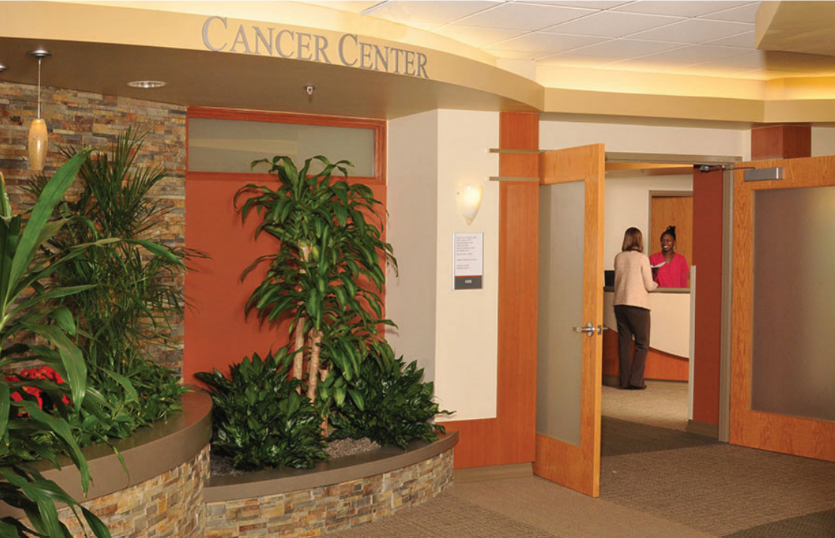
Cancer center entrance at St. Luke’s Hospital
Community Outreach and Services That Center Patient Needs
Accreditations and awards tell only part of the story. As a faith-based organization, St. Luke’s is deeply committed to supporting the community it serves in pursuit of its mission to provide exceptional care to every single patient. St. Luke’s positions itself as a leader in health education by engaging in a wide array of community outreach initiatives, from workplace programs and education classes to mobile cancer screenings.
“We have a mobile mammography van that goes out to our outreach clinics, churches, and workplaces to make it really easy for patients to get a mammogram,” said Michelle Eichelmann, executive director for oncology services at St. Luke’s. Bringing these preventive care services directly to the community is a cornerstone of St. Luke’s mission, as it both mitigates barriers to care, such as transportation and time off work, while positioning the hospital’s providers as fellow community members.
“We also have a low-dose CT program,” Eichelmann shared. “We focus on ensuring that qualifying patients are quickly identified, connected to their low-dose CT, and receive tracking and follow-up after the fact.” If a nodule is identified and surveillance is required, a navigator manages and tracks the case so that no patients are lost to follow-up. According to Eichelmann, the most prominent challenges for the surrounding communities include patient awareness of services and their importance, and for rural communities in particular, transportation.

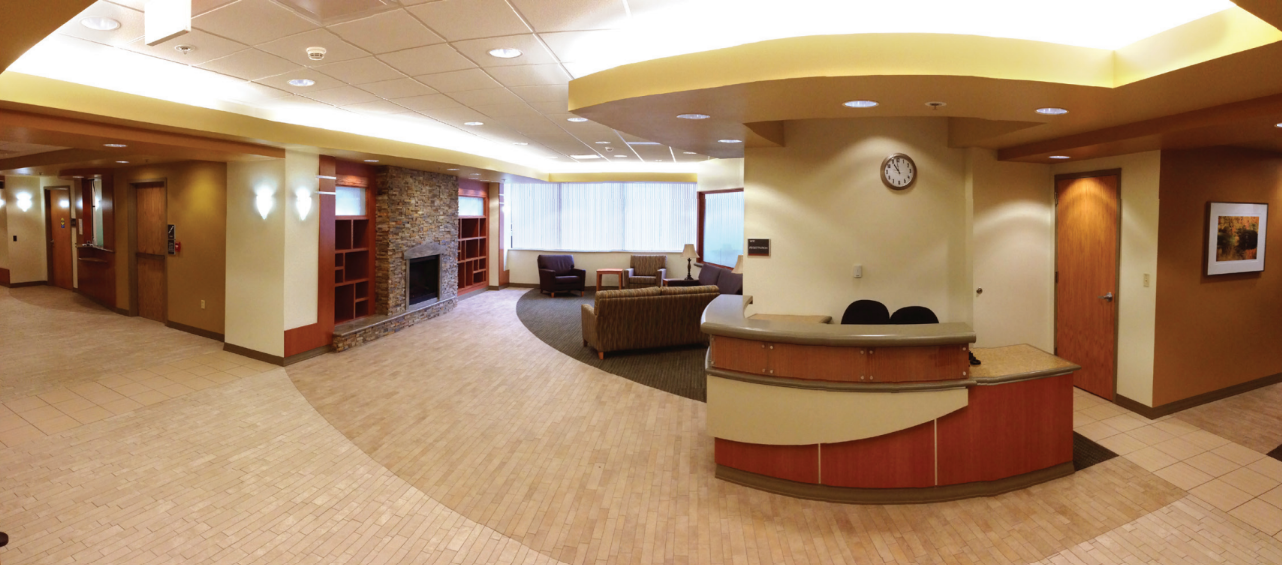
Patient registration area at St. Luke’s Hospital.
“We’re also seeing a high number of underinsured and uninsured patients,” she added. To address these barriers to care, St. Luke’s partners with local organizations as well as the American Cancer Society to connect patients with resources for food, transportation, and financial assistance. “Our financial navigator coordinates foundation funds, copay assistance, and drug replacement as well,” Eichelmann noted. St. Luke’s also offers a diverse array of supportive care services at its main campus, including social work, consultations with a dietitian, oncology rehabilitation, lymphedema therapy, and massage therapy.
Real-Time Multidisciplinary Care Coordination
The availability of all these patient-centered services combines to create an environment that is safe, trustworthy, and deeply empathetic to St. Luke’s patients and caregivers. “Patients at our cancer center tell us that they feel like they’re at home,” Eichelmann shared. “Patients see the same doctor and care team every visit, and they get to know each other very well. Our center is smaller and more intimate, and they don’t get lost trying to navigate a huge campus and seeing a different person every time they walk in the door. This is a frightening time for patients. Our providers strive to provide stability and to be a person patients feel they can really trust.”
Patients have access to the entire multidisciplinary care team at St. Luke’s main campus in Chesterfield. This both eases appointment scheduling and allows for deliberate care coordination across teams. “If a patient is here as a new consult and feels on edge, we’ll have the radiation oncologist run upstairs and meet with the patient right there in the room,” Eichelmann said. “The same is true for palliative care—they’ll come talk to the patient in their comfort zone with the medical oncologist.”
Though it seems simple, this direct link between care teams fosters familiarity and trust, especially for patients unfamiliar with various aspects of the care continuum. They can see firsthand that the provider they already know and trust will be actively involved with all other providers on their case, assuaging any fears that they’re being handed off to a stranger.

Healing garden outside the cancer center at St. Luke’s main campus in Chesterfield, Missouri.

Comprehensive Care Close to Home
St. Luke’s is proud to offer treatment for blood cancers, which is relatively uncommon for most small hospitals. “We partner with a health system in St. Louis for stem cell transplants,” Eichelmann said, “but we treat patients with blood cancer before and after that transition, so they can receive the majority of their care here.”
The blood cancer program has a dedicated physician, advanced practice provider, and patient treatment, including a bispecific antibodies program. “It’s like a well-oiled machine between inpatient care management, authorization, and pharmacy,” said Eichelmann. “We have a sound process in place to treat these patients safely and effectively.”

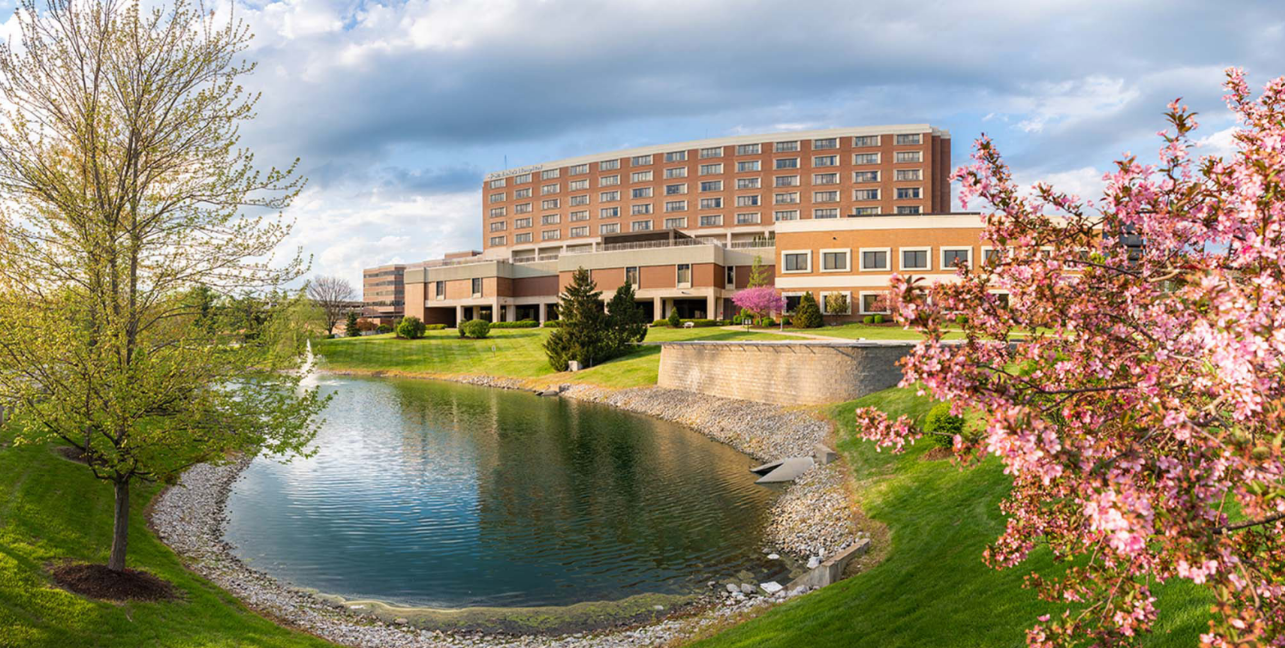
St. Luke’s Hospital in Chesterfield, Missouri.
Celebrating Survivorship
Eichelmann, who joined St. Luke’s in 2025, noted that its survivorship program continues to evolve to better meet patient needs. “The mental and emotional support for patients during the transition from treatment to survivorship is so important. We’ve shifted the focus of our program to prevention by adopting a healthy lifestyle after cancer— namely through healthy eating and exercise,” she said.
In June, the hospital is holding an inaugural survivorship event in accordance with National Cancer Survivors Awareness Month for patients, their families, and St. Luke’s staff. “Patients love their doctors, but they only see them in the clinic,” said Eichelmann. “This will be an opportunity for patients to see their care team outside of the hospital setting and forge personal connections with others on the same journey as them
In addition to presentations about research, mental health, and general cancer prevention, the day will include food, music, and activities to bring the community together, including the creation of a survivorship tree, where each participant dips their thumb in paint the color that represents their cancer to make the leaves on the tree branches.
“It’s about making fond memories associated with our cancer center and creating something physical that they can look at every time they come here to recognize that they are a part of our community,” Eichelmann said.
Innovations on the Horizon
As a 2020 and 2024 ACCC Innovator Award winner—first for the development of a predictive algorithm that manages patients receiving chemotherapy who are at high risk of hospital readmissions or emergency department visits, then for the expansion of this model to include smart texting driven by artificial intelligence—Eichelmann has big plans to bring her ideas from her previous experiences to St. Luke’s.
“Proactive symptom management is a top priority,” she stated. “We’re currently working to implement smart-texting here. It looks a little different and has a different name, but at its core, it will still be proactive symptom management for patients undergoing treatment.”
A cardiologist recently joined the team as well, opening up an opportunity to develop a cardiotoxicity program for patients with cancer and survivors. “Improvements in therapies are helping patients live longer, but the risk that cardiovascular adverse effects pose both during and after treatment is significant and must be accounted for in treatment planning,” Eichelmann said. A partnership between the oncology and cardiology service lines would be instrumental in identifying which patients are at greatest risk of cardiotoxicity from treatment and raising awareness of this risk for survivors.
As a relative newcomer to St. Luke’s, Eichelmann appreciates the energetic, vivacious group of physicians on her team. “I was interested in moving to a smaller organization to have more flexibility and autonomy,” she said. “Of course, that comes with its own set of challenges, such as the need to standardize so many things. But coming to a group that is so patient-centric, down to earth, and excited to partner with me has been incredibly rewarding.”





Recognizing the critical role advanced practice providers and allied health professionals play in the care continuum, the American Oncology Network provides infrastructure, leadership, and professional growth opportunities to empower these members of the cancer care team to practice at the top of their license.