Author(s):
Based in Tulsa, Oklahoma, Oklahoma Cancer Specialists and Research Institute is a community-focused cancer center serving the northeast region of Oklahoma and the surrounding area. A recent need to replace a piece of radiotherapy equipment that had reached the end of its life created challenges and opportunities for our program. We believe our approach to selecting replacement equipment may provide a road map to other cancer centers facing similar needs.
Our Program At a Glance
Oklahoma Cancer Specialists provides full-service oncology care that has been recognized by multiple accreditation organizations:
Oklahoma Cancer Specialists also offers additional wraparound services, such as nutrition counseling and social services. With this reputation for high-quality care using advanced technologies, Oklahoma Cancer Specialists draws patients from Kansas, Missouri, Arkansas, and Texas. With this expanded patient base, the program’s radiation oncology service provides 100 to 120 daily treatments and an average of 30 simulations per week.
In 2020, Oklahoma Cancer Specialists faced a challenge common to many cancer centers: how to replace a medical device that was nearing the end of its life. The device in question was a robotic linear accelerator (linac) system used for stereotactic radiosurgery (SRS) and stereotactic body radiation therapy (SBRT). The system, which was approximately 15 years old, had been purchased by a partner in a joint venture and was housed at a satellite facility outside of our main radiation oncology service.
Our decision to replace this device took multiple priorities into consideration, including near-term goals related to improving patient care, maximizing workforce efficiencies, and leveraging the capabilities of existing equipment within our radiation oncology service line. We also considered how our decision would help us in positioning Oklahoma Cancer Specialists to thrive in an evolving reimbursement landscape, which is poised to drive a much-needed shift toward regimens that require fewer treatment sessions. Evaluating these priorities with key stakeholders enabled us to implement a replacement strategy that achieved these priorities while increasing our SRS and SBRT treatment capacity. We believe our experience may help guide other community cancer centers that are considering replacing or implementing new radiation oncology technologies.
Two Paths Forward
Oklahoma Cancer Specialists began by considering 2 potential options. The first option was to replace the existing functionality provided by the robotic linac system, which offered a more straight-forward approach to procurement and implementation. This approach would allow us to continue working with the same vendor and largely maintain existing clinical workflows. The second option was to re-envision device functionality in the larger context of optimizing workflow efficiency, care delivery, and patient outcomes. This second option would enable critical evolution and establish a foundation for success in a rapidly changing therapeutic and reimbursement landscape. It would also require a much greater investment in time and personnel to evaluate alternative options and significant changes to the existing clinical workflow.
In evaluating these options, we focused our discussions on 3 key areas: device end-of-life considerations, staffing considerations, and scheduling considerations. We prioritized selecting a device that would enhance our ability to provide stereotactic ablative radiation therapy (SABR) and allow us to access advanced, highest-quality imaging. We considered whether the new device could make good use of—and help justify the cost of—the 6Degrees of Freedom (6DOF) treatment couch we had already purchased. (Editor’s Note: A 6DOF couch allows extremely precise patient positioning: up/down, left/right, forward/back, plus pitch, roll, and yaw adjustments). Device costs, including initial equipment costs, annual service con-tracts, and potential need for additional patient devices, and service considerations, such as up-time guarantee and location of engineers, were also factored into our decision-making process.
When evaluating the impact of device selection on staffing needs, a key consideration was whether to continue staffing the satellite location where the existing robotic system was housed or to install the new device at our in-house radiation oncology service. We considered how the implementation of the new device would impact existing staff as well as the potential need for additional staff.
Finally, we considered how the new device would impact scheduling and clinical efficiency. The existing robotic linac system offered treatment times of 60 to 90 minutes and retreatment times of 30 to 60 minutes, allowing us to schedule 6 to 7 patients per day. The existing device also used fiducials to provide internal reference points for treatment planning, patient positioning, and target-beam alignment during treatment, adding complexity to each patient’s treatment.
Data-Driven Decision-Making
As an organization grounded in data-driven cancer care, we applied a similar approach to evaluating and selecting our purchase. Significant time and energy were spent in detailed discussions with potential vendors about specific device capabilities, costs, and the vendor’s service capabilities, including participation in product- specific webinars. We held one-on-one meetings with sales representatives and undertook multiple site visits to comparable cancer centers to speak with staff about their experiences with potential devices and vendor candidates, asking about workflows, up-time, and service.
Feedback from our radiotherapy staff was an integral part of our decision-making approach. In multiple group and individual meetings, we shared our goals and sought staff input on 4 key questions:
Engaging with our radiotherapy staff early in the process helped to ensure that their concerns and priorities were integrated into our research and factored into decision-making. It also established the trust and respect that would be essential for the successful implementation and adoption of the new device.
Device Selection and Rationale
After 12 months of research, Oklahoma Cancer Specialists opted for a new nonrobotic linac with SRS and SBRT capabilities (Versa HD, Elekta). With this option, we consolidated all our radiotherapy services in-house, eliminating the need for off-site staffing at our satellite facility. It also enabled expansion of our treatment capabilities into new indications. Another key driver of our decision was the option for beam-matching the new device to our other radiotherapy system. Beam-matching provides enhanced flexibility to continue treating patients during planned maintenance and/or machine downtime and can allow patients to be treated on a different machine if the machine for which they were scheduled is running behind. It also allows us to better accommodate patients’ scheduling preferences by enabling treatment on multiple machines. Beam-matching across multiple radiotherapy devices simplifies physics quality assurance, reducing the burden on our medical physicists. Collectively, we believed that these features provided a path for improving both patient and staff satisfaction.

Implementing Our Replacement Solution
As with any new piece of radiotherapy equipment, implementation of the new linac required staff training, vault and control room optimization, and new dosimetry templates. Ensuring that our staff understood and were comfortable with implementing new workflows and processes was a key priority. Toward this end, we held multiple training sessions, including on-site training, off-site training that helped to minimize interruptions, and virtual training to make it easy for staff to participate. These efforts included prelaunch training to prepare our team for “go-live” of the new system and follow-up training to address real-world questions once the system was up and running.
We leveraged our knowledge of our prior system to optimize the vault and control panel for the new system. This included optimizing the room configuration and placement of equipment for maximum patient comfort and workflow efficiency. Fully realizing the functional potential of the new linac also required creating new treatment planning templates per disease site and dose level. These templates helped to ensure consistency of dosing while decreasing planning time. We also adjusted the technical parameters of the new linac system to reduce the number of monitor units per plan without sacrificing plan quality. We decreased beam-on time, improving the device’s energy efficiency.
Our Outcomes
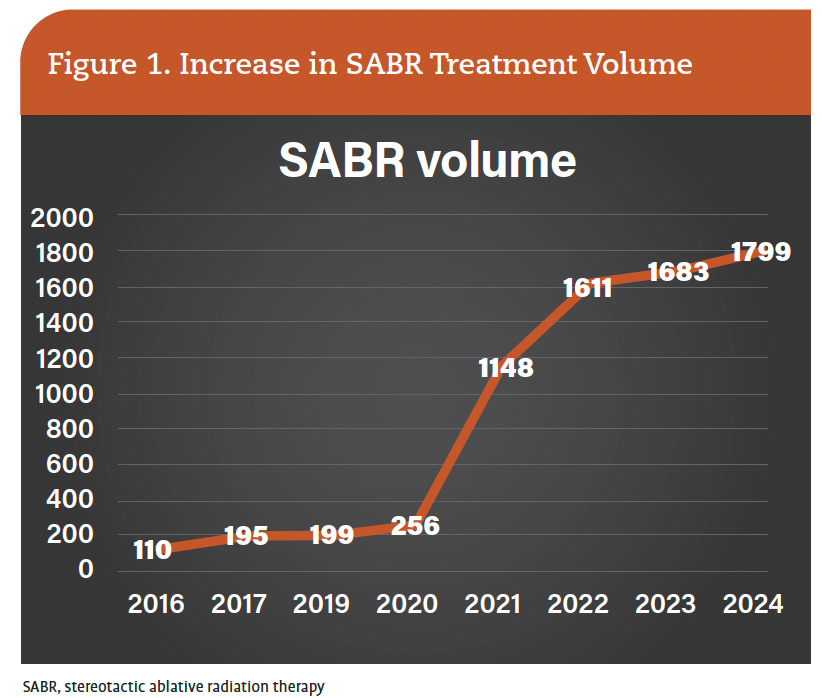
The research and deliberation that went into our decision-making process for replacing our robotic linac system have paid off, resulting in improved clinical and workflow efficiency. Today, 50% to 70% of radiotherapy treatments are now stereotactic—a 7-fold increase in SABR treatment volume over a 5-year period (Figure 1).
We can now treat 6 to 20 patient isocenters per day—a 2.5-fold increase over the previous system. Dry-run time has been reduced from 30 to 60 minutes to just 15 minutes, and we have also decreased treatment set-up time. Standardized workflows have produced consistent results across 3D, deep inspiration breath hold, intensity-modulated radiation therapy, SABR, and volumetric modulated arc therapy treatments. Importantly, our new linac has also given Oklahoma Cancer Specialists access to improved imaging that allows our providers to plan and deliver tailored radiation therapy regimens designed for each patient. We also have realized dosimetry benefits that have significantly reduced beam-on time without changing our treatment planning process due to increased use of 6 MV (megavoltage) flattening filter-free radiotherapy.
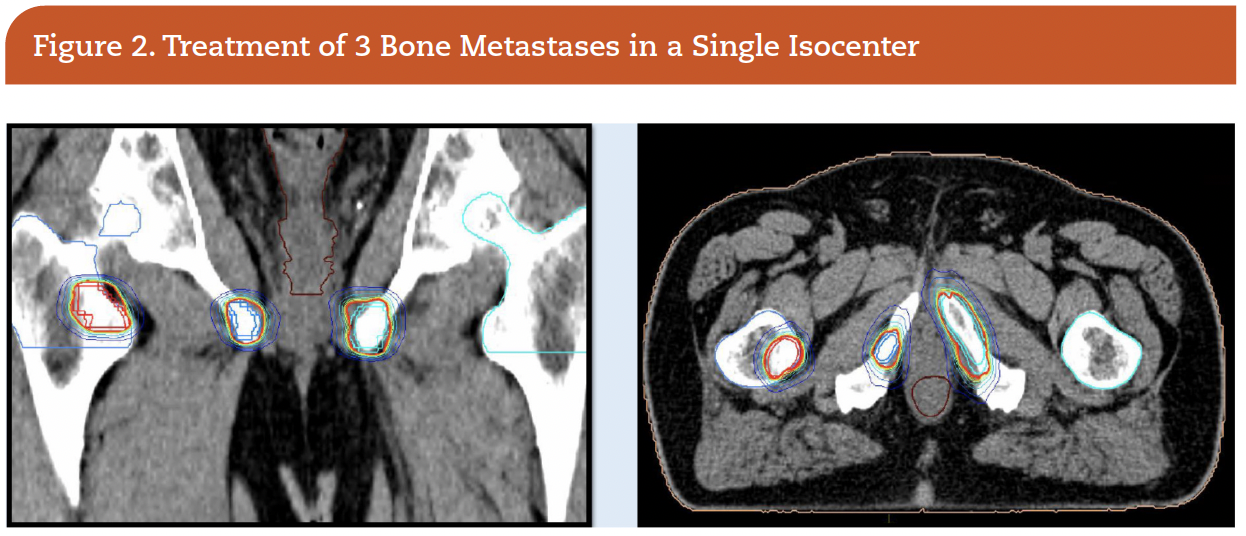
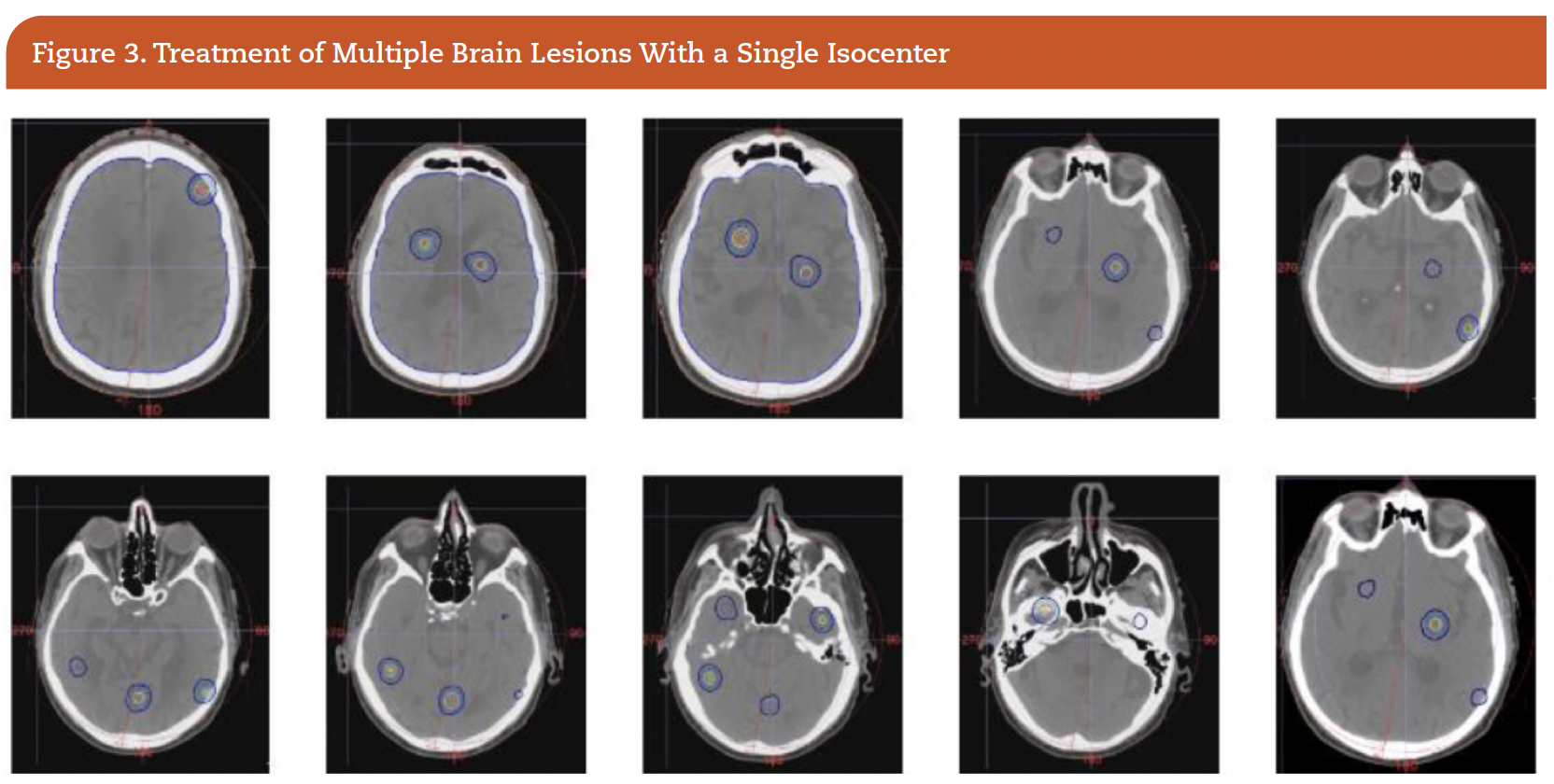
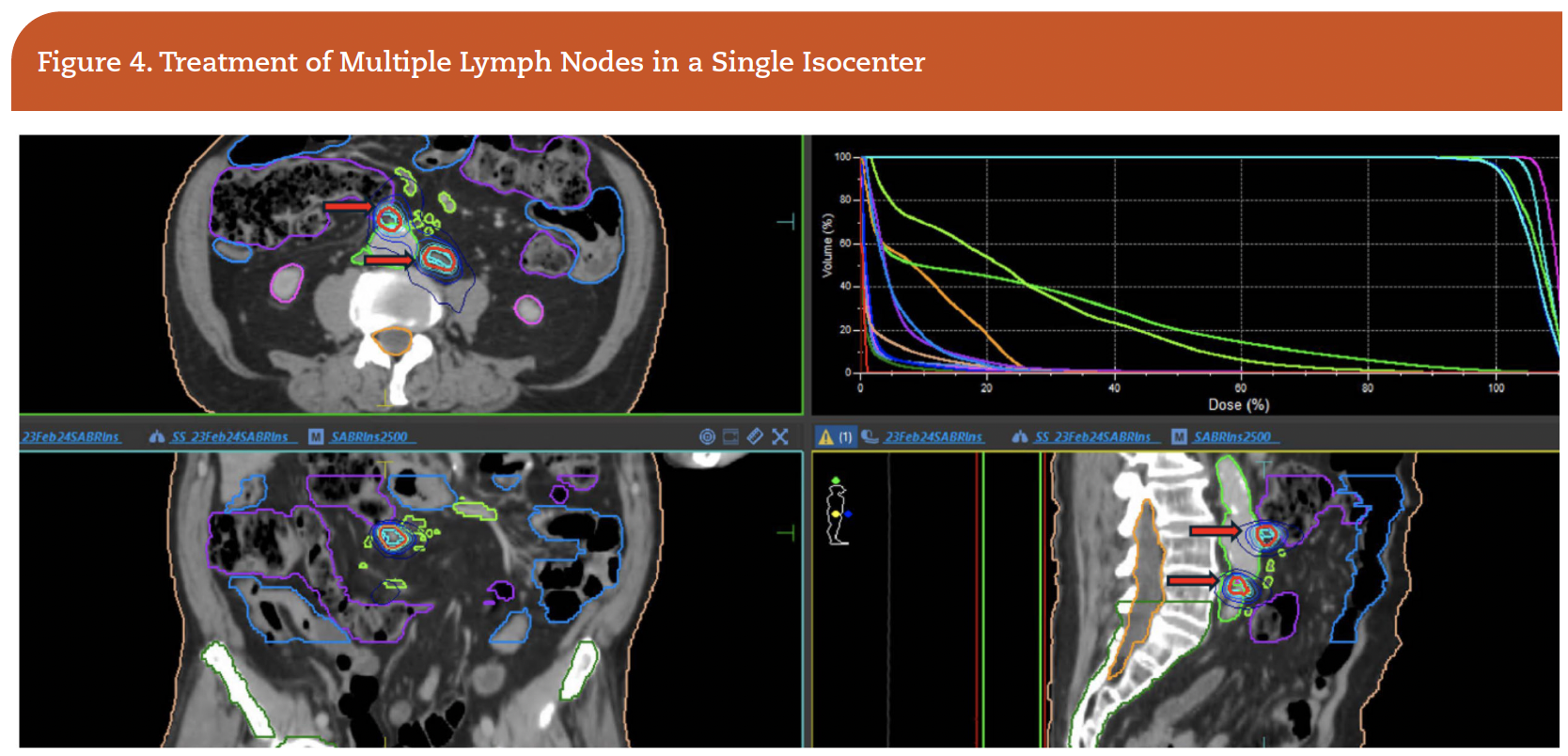
Perhaps more importantly, our decision has allowed us to begin treating multiple new indications with radiotherapy, including bone metastases, multiple brain metastases, and oligometastatic disease. For example, our providers are now able to treat multiple bone metastases, multiple brain lesions, and multiple lymph nodes, all in a single isocenter (Figures 2-4). This allows Oklahoma Cancer Specialists to provide better care for more patients, which is a fundamental pillar of our mission.

Positioned for Success in an Evolving Reimbursement Landscape
New legislation currently before Congress (the Radiation Oncology Case Rate [ROCR] Value Based Program Act) would provide a fixed reimbursement fee to treat a particular type of cancer. In contrast to current reimbursement paradigms in which cancer centers and clinicians are paid for each treatment visit, ROCR is expected to accelerate the adoption of radiotherapy regimens that equire fewer treatment sessions. The ability to adopt hypofractionated regimens that allow a full course of radiation to be delivered in fewer fractions requires advanced technologies with the precision to deliver a higher dose per fraction while sparing nearby healthy tissue and organs at risk.


With the implementation of our new SRT/SRT-enabled linac system, we have expanded Oklahoma Cancer Specialists’s capa-bilities to offer hypofractionated regimens in a growing number of cancer indications. In addition to potential reimbursement benefits, these regimens also reduce patients’ treatment burdens and improve their quality of life by reducing the number of times they need to come in for treatment. This is especially beneficial to patients who travel to Oklahoma Cancer Specialists from outside Tulsa, and especially to those who come to us for care from out of state.
While replacing aging equipment is challenging, it is also an opportunity to reevaluate how a particular device or technology supports current needs and objectives while ensuring the capabilities that will serve patients, staff, and financial goals in the future.
Liz Hyde, MBA, RTT, ODS, is director of Radiation, Imaging, and Special Support Services, and Les Yonemoto, MD, is a radiation oncologist at Oklahoma Cancer Specialists and Research Institute in Tulsa, Oklahoma.






Recognizing the critical role advanced practice providers and allied health professionals play in the care continuum, the American Oncology Network provides infrastructure, leadership, and professional growth opportunities to empower these members of the cancer care team to practice at the top of their license.