Author(s):
IN BRIEF
Registered dietitian nutritionists (RDNs) are integral to personalized nutrition plans, yet are often a limited resource at cancer programs. While optimizing lifestyle changes during the cancer continuum can be challenging, RDN-led nutrition classes can improve health education. This study describes a series of nutrition classes offered at Atrium Health Levine Cancer, in Charlotte, North Carolina. Seven classes were offered monthly from 2016 to 2022. Classes prior to 2020 were both in-person and virtual, but have been exclusively virtual since March 2020 due to COVID-19. Annual attendance was recorded, and in 2022, patient satisfaction and feedback were evaluated via an electronic survey. Data found that attendance increased by 302% throughout the studied period, to a total of 2343 attendees in 2022. Ninety-one patients completed the survey, of which 89% reported being very or extremely satisfied. Common suggestions were to increase virtual options and record classes. This substantial increase in attendance from 2016 to 2022 highlights a growing demand and interest in nutrition education.
It is estimated that 40% to 80% of patients with cancer are malnourished at some point during active disease or treatment.1-4 Poor nutrition can negatively impact treatment completion and outcomes, including delayed wound healing, impaired muscle function, higher risk of postoperative complications, impaired absorption of chemotherapies, and overall poor survival.5,6 Compared with the general population, patients with cancer often have complex nutritional needs that are impacted by the type, location, and stage of the cancer and may change throughout treatment.7 Cancer treatment itself can further complicate a patient s nutritional status, as common adverse effects include diarrhea, nausea, vomiting, and loss of appetite.8 Severe nutritional deficiencies can progress to cachexia, a complex metabolic syndrome observed in up to 33% of patients with cancer.9
To decrease the prevalence and prevent the negative effects of malnutrition, registered dietitian nutritionists (RDNs) are often employed to manage patients nutrition. RDNs are board-certified professionals responsible for conducting nutrition screening and assessment, developing nutrition interventions and treatment plans, and monitoring nutritional status.10 RDNs are integral to establishing personalized nutrition care plans to better assist patients, yet they are often a limited resource at cancer programs.11
While optimizing lifestyle changes during the cancer continuum can be challenging for many patients, nutrition and wellness education facilitated by RDNs could improve patients health status and access to health education. Nutritional support is recommended for all patients receiving cancer treatment to provide early interventions, which have been shown to improve quality of life, promote treatment tolerance, and encourage adequate nutrient intake, thereby bolstering weight maintenance and increasing lean body mass.12,13 Additionally, offering virtual class options creates the potential to reach a greater number of patients, as it is a more convenient option, especially for immunocompromised patients, and is noninferior to in-person care in terms of knowledge, stress, cancer distress, and satisfaction.14 This cross-sectional survey study describes a series of classes focused on nutritional eating offered by the Section of Oncology Nutrition at Atrium Health Levine Cancer with the goal of determining the qualitative value of RDN-led nutrition classes for patients with cancer.

Methods
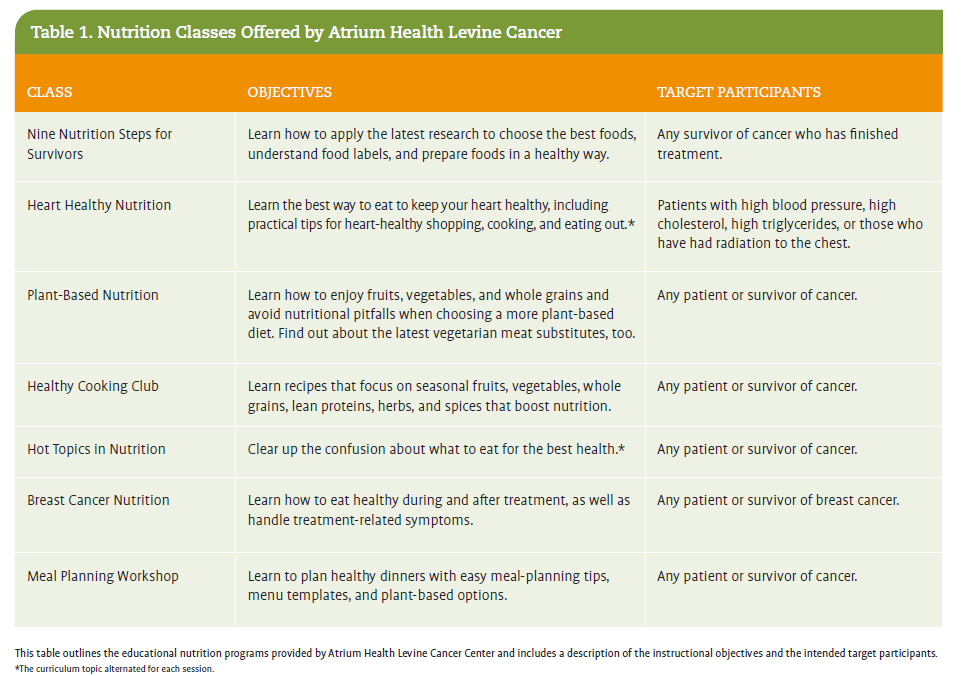
Atrium Health Levine Cancer Center’s nutrition and wellness education program offered 7 nutrition classes to patients with cancer, free of charge:
1. Breast Cancer Nutrition
2. Healthy Cooking Club
3. Heart Healthy Nutrition
4. Hot Topics in Nutrition
5. Meal Planning Workshop
6. Nine Nutrition Steps for Survivors
7. Plant-Based Nutrition.
Class objectives and the intended participants of each class are summarized in Table 1. While the curriculum of the classes was consistent, the curriculum of Healthy Cooking Club and Hot Topics in Nutrition alternated for each class. Classes lasted between 60 and 90 minutes and were offered at a scheduled time in the morning or afternoon. Due to poor attendance, evening classes were discontinued. Four classes (Healthy Cooking Club, Breast Cancer Nutrition, Nine Nutrition Steps for Survivors, and Plant-Based Nutrition) were offered every month. Heart Healthy Nutrition alternated monthly with the Meal Planning Workshop. Hot Topics in Nutrition was offered 8 months of the year with rotating subject matter. The classes were taught by an RDN with a master’s degree in nutrition with additional training in culinary nutrition and food allergies and more than 30 years of experience, including over 10 years at Atrium Health Levine Cancer Center.
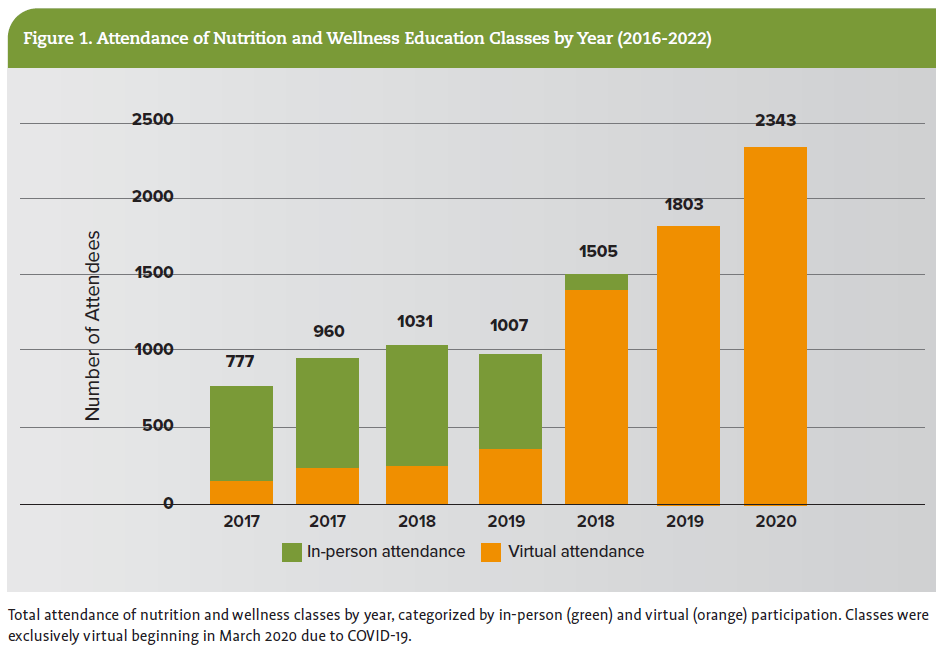
Class attendance was recorded over 7 years, from January 2016 through December 2022. Classes were offered virtually and in person until March 2020, when the COVID-19 pandemic necessitated a shift to exclusively virtual classes. At the end of 2022, a one-time electronic survey was emailed to patients who registered for a 2022 class. The survey asked, “How satisfied are you with the nutrition classes offered by Atrium Health Levine Cancer Center?” with the answer choices of extremely satisfied, very satisfied, somewhat satisfied, dissatisfied, and very dissatisfied. Patients were also able to submit free responses about their experiences, feedback regarding accessibility, and suggestions for program improvements. Descriptive statistics were utilized to analyze patients experiences of the nutrition and wellness education program.


Results
From January 2016 to December 2022, class attendance increased by 302 percent (777 attendees in 2016 to 2343 attendees in 2022, Figure 1). Virtual attendance increased from 19% in 2016 to 37% in 2019, and then to 100% in 2021 and 2022 when classes were only offered virtually.
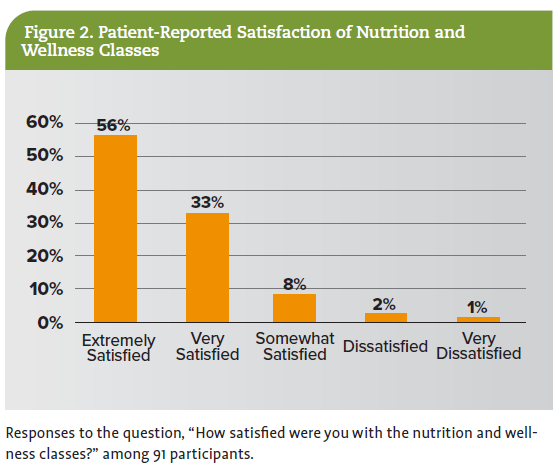
Of the 2343 patients who attended a class in 2022, 91 patients completed the electronic survey. Of these patients, 89% reported being either very satisfied or extremely satisfied with the nutrition and wellness classes (Figure 2). Patient feedback reflected the impact of the nutrition classes and the RDN who taught the classes. Recurring themes included empowerment, improved health behaviors, and hope. Patients appreciated the ability to attend the same classes as reinforcement, and reminders were helpful. The most frequent suggestions for improvement included expanding virtual options, recording classes, and publishing educational materials online for easier access. Selected patient quotes are below.
Discussion
This study shows that RDN-led nutrition classes can be a valuable resource for patients with cancer to optimize healthy lifestyles. The substantial increase in attendance from 2016 to 2022 highlights a growing demand and interest in nutrition education. In addition, patient feedback suggests that the classes helped patients recognize the value of nutrition, especially in the context of a cancer diagnosis and treatment. The increase in virtual attendance, even while in-person classes were offered, and the marked increase in attendance when only virtual classes were offered, suggest that virtual education increased patient participation. Other efforts utilizing virtual education have been shown to be effective within oncology, corroborating study findings.14 The results demonstrate the utility of virtual nutritional offerings and serve as validation for expanding the program. Patient retention was likely due to marketing efforts to increase awareness of the nutrition and wellness classes, email reminders, and the ability of patients to attend the free classes without financial barriers.
Patient satisfaction, demonstrated by 89% of survey respondents reporting being very or extremely satisfied, along with the positive qualitative feedback, represents the positive impact the nutrition classes have on participants. The classes helped patients feel empowered, knowledgeable, and healthier. Patients also benefited from an RDN who was knowledgeable, supportive, and attentive to patients during an emotionally vulnerable time.
Limitations of this study include the lack of sociodemographic characteristics of the attendees and the small sample size of the survey respondents. Future research should quantitatively assess the effects of these classes by comparing health status before and after attending classes. This could be accomplished by measuring BMI, caloric intake, strength assessments, quality of life measures, and diet using the Automated Self- Administered 24-hour Dietary Assessment Tool or Food Frequency Questionnaire.15,16 More frequent surveys, including an online survey after each class, could evaluate the effectiveness of the nutrition classes on long-term patient wellness to understand patient preferences.
In concordance with patient feedback, other class modalities should be considered, including recorded classes posted on an accessible platform, such as YouTube. Recorded classes that maintain patient anonymity for privacy could further increase participation, especially for patients who are unable to attend due to health issues and/or scheduling conflicts. This offering could potentially boost knowledge retention by allowing patients to rewatch classes for reinforcement and clarification. However, due to the complexity of some of the material covered in the classes, we observed value when patients have the opportunity to ask questions during a live class. Recorded classes may also obstruct the community between patients because recorded classes, compared to live virtual classes, limit participant interaction.
Markers of nutritional status should be compared among patients who watch recorded classes and those who attend the current virtual live-streamed classes to assess any difference in patient engagement or knowledge retention. Additionally, direct feedback from participants is essential to improve curriculum and patient access, and more frequent feedback could better assess the evolving needs of patients. This information would further guide program expansion.
These data support continued development and expansion of the 7 nutrition classes offered by Atrium Health Levine Cancer Center as a pragmatic and patient-friendly method to improve understanding and knowledge of nutrition. The large increase in patient volume and positive patient feedback demonstrates the utility of virtual nutrition classes. Utilization trends and feedback support expansion of the current nutrition education program. There is a significant demand for these educational classes when they are provided virtually and conveniently.
Avery Z. Wright, BS, is a fourth-year medical student at Wake Forest School of Medicine. Courtney Huddle, MS, RDN, CSPCC, LDN, is a clinical nutrition manager at Atrium Health Levine Cancer Center in Charlotte, North Carolina. Patricia M. Fogarty, MS, RD, LDN, is the nutrition class teacher and leader. Aynur Aktas, MS, MD, is a research scientist at Atrium Health Levine Cancer Center and an assistant professor at Wake Forest School of Medicine. Declan Walsh, MD, MSc, developed the first palliative care program in the United States, is the Chair of the Department of Supportive Oncology at Atrium Health Levine Cancer Center, and is a Professor of Medicine at Wake Forest School of Medicine. Kunal C. Kadakia, MD, is the Section Chief of Oncology Nutrition at Atrium Health Levine Cancer and Associate Professor of Medicine at Wake Forest School of Medicine.
References
1. Ravasco P. Nutrition in cancer patients. J Clin Med. 2019;8(8):1211. doi:10.3390/jcm8081211
2. Aktas A, Walsh D, Boselli D, Finch L, Wallander ML, Kadakia KC. Screening, identification, and diagnosis of malnutrition in hospitalized patients with solid tumors: a retrospective cohort study. Nutr Clin Pract. 2024;39(6):1452-1463. doi:10.1002/ncp.11233
3. Kadakia KC, Symanowski JT, Aktas A, et al. Malnutrition risk at solid tumor diagnosis: the malnutrition screening tool in a large US cancer institute. Support Care Cancer. 2022;30(3):2237-2244. doi:10.1007/s00520-021-06612-z
4. Trujillo EB, Kadakia KC, Thomson C, et al. Malnutrition risk screening in adult oncology outpatients: an ASPEN systematic review and clinical recommendations. J Parenter Enteral Nutr. 2024;48(8):874-894. doi:10.1002/jpen.2688
5. McFarlane TL, Symanowski JT, Walsh D, et al. Malnutrition risk and overall survival at solid tumour diagnosis. BMJ Support Palliat Care. Published online January 15, 2025. doi:10.1136/spcare-2024-004906
6. P rez-Pitarch A, Guglieri-L pez B, Nacher A, Merino V, Merino-Sanju n M. Impact of undernutrition on the pharmacokinetics and pharmacodynamics of anticancer drugs: a literature review. Nutr Cancer. 2017;69(4):555-563. doi:10.1080/01635581.2017.1299878
7. Richards J, Arensberg MB, Thomas S, Kerr KW, Hegazi R, Bastasch M. (2020). Impact of early incorporation of nutrition interventions as a component of cancer therapy in adults: a review. Nutrients. 2020;12(11):3403. doi:10.3390/nu12113403
8. Katta B, Vijayakumar C, Dutta S, Dubashi B, Nelamangala Ramakrishna iah VP. The incidence and severity of patient-reported side effects of chemo therapy in routine clinical care: a prospective observational study. Cureus. 2023;15(4):e38301. doi:10.7759/cureus.38301
9. Takaoka T, Yaegashi A, Watanabe D. Prevalence of and survival with cachexia among patients with cancer: a systematic review and meta-analysis. Adv Nutr. 2024;15(9):100282. doi:10.1016/j.advnut.2024.100282
10. Commission on Dietetic Registration Scope and Standards of Practice Task Force. Revised 2024 scope and standards of practice for the registered dietitian nutritionist. Accessed March 4, 2026. https://www.cdrnet.org/vault/2459/web/Scope%20Standards%20of%20Practice%202024%20RDN_FINAL.pdf
11. Trujillo EB, Claghorn K, Dixon SW, et al. Inadequate nutrition coverage in outpatient cancer centers: results of a national survey. J Oncol. 2019;2019:7462940. doi:10.1155/2019/7462940
12. Arends J, Strasser F, Gonella S, et al. Cancer cachexia in adult patients: ESMO clinical practice guidelines. ESMO Open. 2021;6(3). doi:10.1016/j.esmoop.2021.100092
13. Leis C, Arthur AE, Chen X, Greene MW, Frug AD. Systematic review of nutrition interventions to improve short term outcomes in head and neck cancer patients. Cancers. 2023;15(3):822. doi:10.3390/cancers15030822
14. Singh S, Fletcher GG, Yao X, Sussman J. Virtual care in patients with cancer: a systematic review. Curr Oncol. 2021;28(5):3488-3506. doi:10.3390/curroncol28050301
15. Automated self-administered 24-hour (ASA24) dietary assessment tool. ASA24 Dietary Assessment Tool. EGRP/DCCPS/NCI/NIH. Accessed March 4, 2026. https://epi.grants.cancer.gov/asa24/
16. Food frequency questionnaire at a glance. National Cancer Institute Dietary Assessment Primer. Accessed March 4, 2026. https://epi.grants.cancer.gov/dietary-assessment-primer/profiles/questionnaire/
Statement of Authors Contribution to Manuscript: CH, AA, DW, and KCK designed the research. PMF and KCK conducted research. AZW, CH, AA, DW, and KCK analyzed data. AZW, CH, PMF, DW, and KCK wrote the paper. AZW and KCK had primary responsibility for final content. All authors have read and approved the final manuscript.
Presented at the 2025 NCCN Conference in Orlando, Florida, on March 28, 2025: Elevating Cancer Care: Launching a Comprehensive Nutrition and Wellness Program at a Multisite Cancer Center. Abstract HSR25-158.
Conflicts of Interest: The authors declare that they have no known competing financial interests or personal relationships that could have appeared to influence the work reported in this paper.
Declaration of Generative AI and AI-assisted technologies in the writing process: No AI or AI-assisted technologies were used in the writing of this manuscript.
Ethics Approval: Approval was obtained from the Atrium Health Institution Review Board with a waiver of consent.






Recognizing the critical role advanced practice providers and allied health professionals play in the care continuum, the American Oncology Network provides infrastructure, leadership, and professional growth opportunities to empower these members of the cancer care team to practice at the top of their license.