ACCC association of cancer care centers
Join/Renew
Login
Join/Renew
Login
Education & Resources
ACCC eXchange LogInCorporate Member Sponsored ResourcesPresentations & AbstractsACCC Connect eLearning LogIn
Publications
Oncology IssuesPatient Assistance & Reimbursement GuideTrending Now in Cancer CareBusiness Case Studies for Hiring New Staff
Events
2026 ACCC Leadership SummitAnnual Meeting & Cancer Center Business SummitCapitol Hill DayNational Oncology ConferenceOncology Reimbursement MeetingsOncology State Society Meetings
Policy & Advocacy
ACCC 2026 Policy PrioritiesLetters & StatementsAccess, Payment & Reimbursement ReformWhite Bagging & Brown BaggingAdvocacy ResourcesCancer Moonshot
Membership
Join | RenewWho We AreMembership Types & BenefitsCorporate MembersACCC Member Portal FAQMember Directory
Partners
Oncology State SocietiesPartner OrganizationsCME
News
News ReleasesAdvocacy News ReleasesOncology News
About ACCC
Timeline / 50th Anniversary2025 Impact ReportPresident's ThemeACCC Innovator AwardsACCC FellowsBoard of TrusteesACCC Senior Staff
Breast CancerMetastatic Breast Cancer
Gastrointestinal CancerBiliary Tract CancerColorectal CancerGastric CancerLiver Cancer
Genitourinary CancerBladder CancerProstate CancerRenal Cell Carcinoma
Gynecologic CancerOvarian Cancer
Head & Neck Cancer
Hematologic MalignanciesAcute Lymphocytic Leukemia (ALL)Acute Myeloid Leukemia (AML)Chronic Lymphocytic Leukemia (CLL)Mantle Cell Lymphoma (MCL)Multiple Myeloma (MM)Myelodysplastic Syndromes (MDS)
Lung CancerNon-Small Cell Lung Cancer (NSCLC)Small Cell Lung Cancer (SCLC)
Sarcoma
Skin CancerMelanomaNon-Melanoma Skin Cancers (NMSC)
Clinical Practice & TreatmentCancer DiagnosticsCare CoordinationEHR Integration for Biomarker TestingQuality Improvement Collaboration: Integration of Precision Medicine in Community OncologyTreatment
Financial NavigationFAN Boot CampFinancial Advocacy Network (FAN) Resource LibraryPatient Assistance & Reimbursement GuidePrior Authorization
Health Equity & Access3, 2, 1, Go! Practical Solutions for Addressing Cancer Care DisparitiesAppalachian Community Cancer AllianceOncology Advanced PractitionersPersonalizing Care for Patients of All BackgroundsSocial Drivers of Health
Patient-Centered CareAddressing Care Disparities for VeteransAdolescent and Young Adult (AYA)Care Action Plans for People with CancerDermatologic ToxicitiesEmpowering CaregiversGeriatric OncologyHealth LiteracyNutritionOncology PharmacyPatient NavigationPsychosocial Care in OncologyShared Decision-MakingSupportive CareSurvivorship Care
Practice Management & OperationsCancer Program FundamentalsLeadership Sustainment and Engagement VideosOncology Practice Transformation and Integration CenterOncology Team Resiliency
ResearchACCC Community Oncology Research Institute (ACORI)
Technology & InnovationTelehealth & Digital Medicine
ACCCBuzz Blog
CANCER BUZZ Podcast
Oncology Issues
Join/Renew
Login
Breast CancerMetastatic Breast Cancer
Gastrointestinal CancerBiliary Tract CancerColorectal CancerGastric CancerLiver Cancer
Genitourinary CancerBladder CancerProstate CancerRenal Cell Carcinoma
Gynecologic CancerOvarian Cancer
Head & Neck Cancer
Hematologic MalignanciesAcute Lymphocytic Leukemia (ALL)Acute Myeloid Leukemia (AML)Chronic Lymphocytic Leukemia (CLL)Mantle Cell Lymphoma (MCL)Multiple Myeloma (MM)Myelodysplastic Syndromes (MDS)
Lung CancerNon-Small Cell Lung Cancer (NSCLC)Small Cell Lung Cancer (SCLC)
Sarcoma
Skin CancerMelanomaNon-Melanoma Skin Cancers (NMSC)
Clinical Practice & TreatmentCancer DiagnosticsCare CoordinationEHR Integration for Biomarker TestingQuality Improvement Collaboration: Integration of Precision Medicine in Community OncologyTreatment
Financial NavigationFAN Boot CampFinancial Advocacy Network (FAN) Resource LibraryPatient Assistance & Reimbursement GuidePrior Authorization
Health Equity & Access3, 2, 1, Go! Practical Solutions for Addressing Cancer Care DisparitiesAppalachian Community Cancer AllianceOncology Advanced PractitionersPersonalizing Care for Patients of All BackgroundsSocial Drivers of Health
Patient-Centered CareAddressing Care Disparities for VeteransAdolescent and Young Adult (AYA)Care Action Plans for People with CancerDermatologic ToxicitiesEmpowering CaregiversGeriatric OncologyHealth LiteracyNutritionOncology PharmacyPatient NavigationPsychosocial Care in OncologyShared Decision-MakingSupportive CareSurvivorship Care
Practice Management & OperationsCancer Program FundamentalsLeadership Sustainment and Engagement VideosOncology Practice Transformation and Integration CenterOncology Team Resiliency
ResearchACCC Community Oncology Research Institute (ACORI)
Technology & InnovationTelehealth & Digital Medicine
ACCCBuzz Blog
CANCER BUZZ Podcast
Oncology Issues
    • Education & Resources
    • Publications
    • Events
    • Policy & Advocacy
    • Membership
    • Partners
    • News
    • About ACCC
ACCC association of cancer care centers
5425 Wisconsin Ave #600, Chevy Chase, MD 20815
Tel: 301.984.9496 Email Us
Contact UsVolunteers
Advertise
Career Center
Terms and Conditions
Privacy Policy
ACCC Rebranding
Copyright © 2026 Association of Cancer Care Centers. All Rights Reserved.
HomePublicationsOncology Issues

Language as Care: Transforming Patient Experience Through Better Communication

April 13, 2026
Oncology Issues
April 2026
Volume 41
Issue 2

Author(s):

Kathryn Mullen Mechtly, PT, DPT
Angela Reynolds, PT, DPT, NCS, CBIS
Kathryn Mullen Mechtly, PT, DPT
Angela Reynolds, PT, DPT, NCS, CBIS
Tim Reynolds, PT, DPT, OCS, CSCS

Language as Care: Transforming Patient Experience Through Better Communication
Download Issue PDFDownload PDF

Receiving a cancer diagnosis profoundly affects patients, requiring thoughtful consideration throughout the entirety of their health care journey. One of the most modifiable yet impactful aspects of care is the language used by the patient’s care team. Research suggests that patients’ perceptions of care are shaped as much by communication style as by clinical interventions. For example, phrases such as “Nothing more can be done” may unintentionally convey hopelessness, while reframing the statement as “We still have options to help with your comfort and quality of life” can maintain dignity and empowerment.1,2 Oncology professionals, therefore, have an ethical responsibility to reflect intentionally on their language and shift their communication practices to heal rather than harm.

A study by Westendorp et al. explored communication by oncologists regarding the delivery of diagnosis, prognosis, and decision-making, and revealed how language can be unintentionally harmful, particularly in this patient population.3 For example, statements such as “You must start your chemo within a certain time frame” may be perceived negatively, as the phrasing does not foster a team dynamic, especially if there is no explanation included for the urgency. Continuing with the concept of time frames, practitioners must be mindful when discussing the prognosis of a given pathology. Westendorp found that tailoring prognostic information to the patient, rather than speaking generally about the given disease, was better received by the patient.3

When looking specifically at multiple myeloma, one systematic review highlighted the need for personalized care within this patient population due to the chronicity of the pathology. The review emphasized the physical, emotional, and social impact this disease had on patients and recommended that health care professionals incorporate an understanding of the patient experience into treatment.4 While suggestions for supportive strategies were offered, specific words or communication styles were not identified.

Although numerous qualitative studies exploring harmful communication in health care have been conducted,1–3 there is still limited understanding regarding which specific words or phrases may be perceived as harmful within oncology care. The purpose of this article is to provide a detailed exploration of the lived experience of a patient diagnosed with multiple myeloma, highlighting nocebic language used by health care professionals. Through this analysis, key terminology that negatively impacted the patient’s health care experience will be identified, and alternatives will be provided both as a framework and to encourage clinicians to engage in effective dialogue with patients when diagnosing and treating all cancer types. Additionally, examples of “words that harm” and “words that heal” are included to serve as a framework for providers to improve patient-centered word choices.

Patient Description

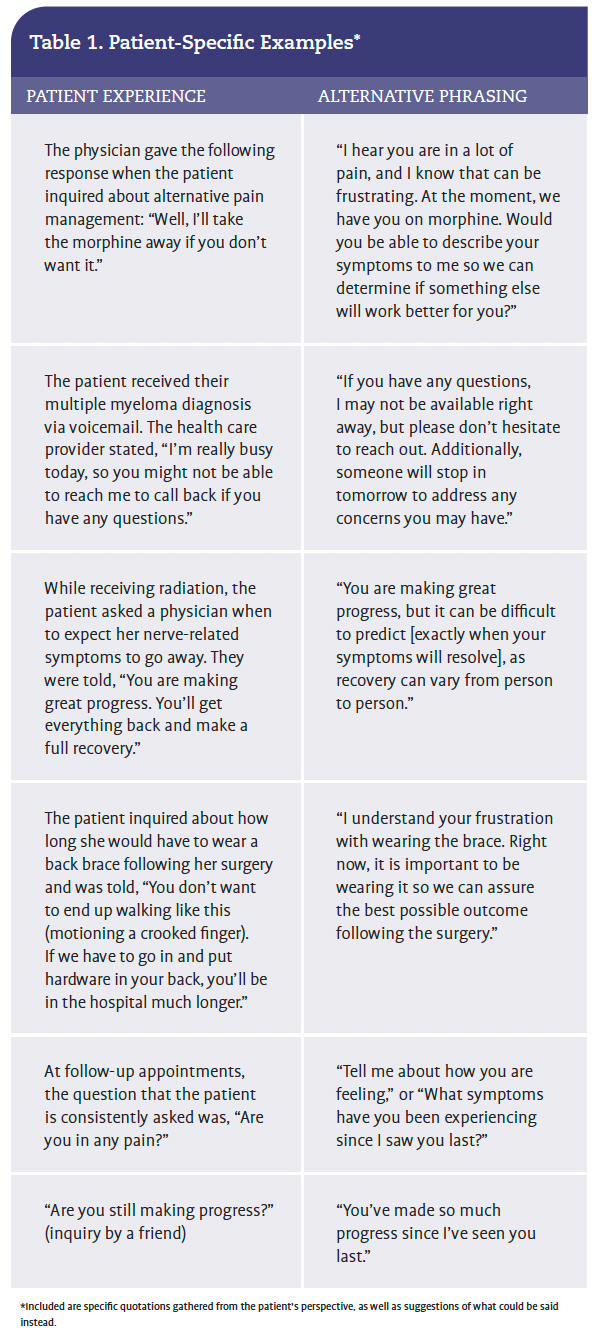
A 78-year-old woman was diagnosed with multiple myeloma complicated by an incomplete spinal cord injury. In June 2023, she presented with new-onset numbness and tingling in her lower extremities. She was taken to the emergency department, where CT imaging revealed lesions in the vertebral column and skull. Surgery was performed to remove the spinal lesions, and a biopsy was obtained. The patient remained in inpatient rehabilitation while awaiting the results of the biopsy, which were eventually provided in a troubling manner. Specific phrases and language that were used in this patient case study are presented in Table 1, along with suggestions for alternative ways to communicate more effectively based on how the patient perceived the impact of the conversation on their care.

Discussion

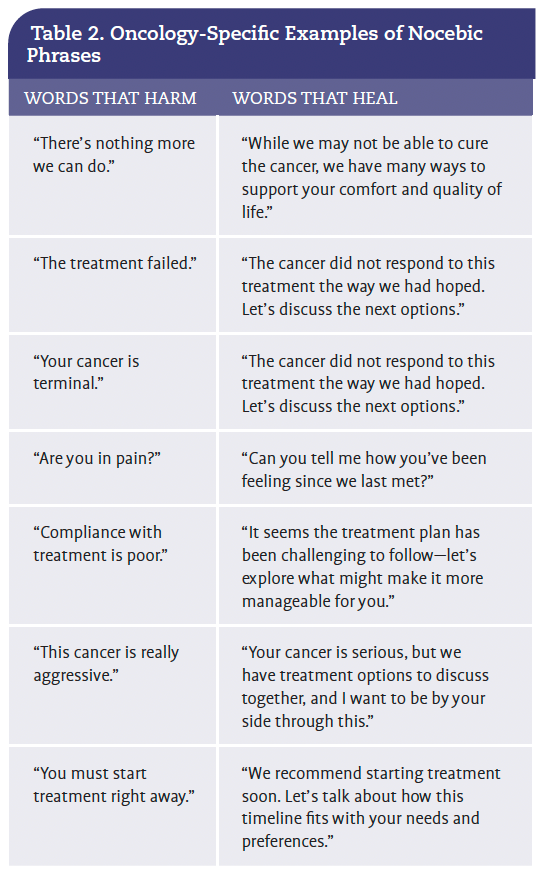
Shifting communication from harmful to healing language (Table 2) requires self-awareness, training, and team reflection. Oncology care is inherently multidisciplinary, and consistent messaging across providers—physicians, nurses, physical therapists, social workers, and so forth—is essential to avoid mixed signals that can confuse or distress patients. Embedding communication training within continuing professional development, onboarding processes, and team huddles can help cultivate a culture of mindful communication. Cancer programs can also integrate structured tools, such as reflective practice groups, standardized patient role-plays, or communication checklists, to reinforce best practices.

Conclusion

In health care, there is often an emphasis on the technical skills of medicine: examination techniques, diagnostic testing, and pharmacological treatments. While this reflection highlights specific elements of a given case, it is important to recognize that communication styles should also be individualized to the patient, as each patient’s experience is unique. A cancer diagnosis marks only the beginning of a patient’s health care journey, and when the news is delivered poorly or without adequate support, the experience becomes more difficult, as demonstrated in this patient case study. Patients with cancer commonly report that friends and family can make remarks that have a lasting impact on their social support and relationships; a theme commonly reported among individuals diagnosed with multiple myeloma.5 Therefore, it is imperative that clinicians and medical staff do not do further harm or add to this impact; they must remember that language is not neutral in oncology care.

Language has the power to heal or to harm. By committing to patient-centered communication, oncology professionals can build trust, enhance patient outcomes, and promote dignity during one of the most vulnerable times in patients’ lives.

Kathryn Mullen Mechtly, PT, DPT, graduated from Ithaca College’s Doctor of Physical Therapy Program in 2025. Angela Reynolds, PT, DPT, NCS, CBIS, is a residency-trained neurological physical therapist and clinical assistant professor at Ithaca College whose research focuses on neurorehabilitation, interprofessional education, and community-based care. Tim Reynolds, PT, DPT, OCS, CSCS, completed an orthopedic residency and spine fellowship through Cayuga Medical Center and is currently an assistant professor at Ithaca College, teaching anatomy and physiology courses to undergraduate allied-health students.

References
  1. Epstein RM, Duberstein PR, Fenton JJ, et al. Effect of a patient-centered communication intervention on oncologist-patient communication, quality of life, and health care utilization in advanced cancer: the VOICE randomized clinical trial. JAMA Oncol. 2017;3(1):92–100. doi:10.1001/jamaoncol.2016.4373
  2. Gilligan T, Coyle N, Frankel RM, et al. Patient-clinician communication: American Society of Clinical Oncology consensus guideline. J Clin Oncol. 2017;35(31):3618–3632. doi:10.1200/JCO.2017.75.2311
  3. Westendorp J, Evers AWM, Stouthard JML, et al. Mind your words: oncologists’ communication that potentially harms patients with advanced cancer: a survey on patient perspectives. Cancer. 2022;128(5):1133–1140. doi:10.1002/cncr.34018
  4. Hauksdóttir B, Klinke ME, Gunnarsdóttir S, Björnsdóttir K. Patients’ experiences with multiple myeloma: a meta-aggregation of qualitative studies. Oncol Nurs Forum. 2017;44(2):E64–E81. doi:10.1188/17.ONF.E64-E81
  5. LeBlanc MR, LeBlanc TW, Leak Bryant A, Pollak KI, Bailey DE, Smith SK. A qualitative study of the experiences of living with multiple myeloma. Oncol Nurs Forum. 2021;48(2):151–160. doi:10.1188/21.ONF.151-160
Articles in this issue

Honoring Progress, Inspiring What Comes Next in Oncology
Designing the Future of Oncology Care—Together
Primary Care Meets Cancer Prevention: Insights From Sanford World Clinic – Ghana
On Target: A Data-Driven Approach to Upgrading Radiotherapy Equipment
Demystifying Decentralization in Therapeutic Clinical Trials
Language as Care: Transforming Patient Experience Through Better Communication
Impact of RDN-Led Nutrition Education: A Multiyear Study
Patient-Derived Organoids Streamline Development and Testing of Drugs for Individualized Cancer Care
Artistic Interventions in Cancer Care: Orlando Health Cancer Institute's Evidence-Based Arts in Medicine Program
Fast Facts Vol. 41, No. 2
Legislative and Regulatory Updates
Due Diligence in Limiting Payer Denials
Restoring Wholeness: The Role of Paramedical Tattooing in Continuous Cancer Care
St. Luke’s Hospital,  Chesterfield, Missouri
St. Luke’s Hospital, Chesterfield, Missouri
Action: Vol. 41, No. 2

Upcoming Events

ACCC 43rd National Oncology Conference
Oncology

ACCC 43rd National Oncology Conference

In Person Conference & ConventionOctober 21, 2026 at 8:00 AM MDT450 Summer St, Boston, MA 02210Omni Boston Hotel at the Seaport, Boston
Register Now!
HSCO 2026 August Dinner Symposium
Oncology

HSCO 2026 August Dinner Symposium

In Person Conference & ConventionAugust 12, 2026 at 5:30 PM HST6600 Kalanianaʻole Highway suite 110, Honolulu, HI 96825, USARoy's Restaurants – Hawaii Kai, Honolulu
Register Now!
LOS 2026 Cancer Congress - National Oncology Updates
Oncology

LOS 2026 Cancer Congress - National Oncology Updates

In Person Conference & ConventionAugust 14, 2026 at 11:00 AM CDT859 Convention Center Blvd, New Orleans, LA, USANew Orleans Marriott Warehouse Art District, New Orleans
Register Now!
LOS Cancer Congress After-Hours: Bowling Social
Oncology

LOS Cancer Congress After-Hours: Bowling Social

In Person Conference & ConventionAugust 14, 2026 at 6:30 PM CDT600 Fulton St, New Orleans, LA 70130, USAFulton Alley, New Orleans
Register Now!
IOS Evansville Meeting
Oncology

IOS Evansville Meeting

In Person Conference & ConventionAugust 18, 2026 at 5:30 PM CDT4011 Gateway Blvd, Newburgh, IN 47630, USADeaconess Gateway Hospital , Newburgh
Register Now!
2026 Carolinas Cancer Conference
Oncology

2026 Carolinas Cancer Conference

In Person Conference & ConventionAugust 22, 2026 at 7:00 AM EDT5757 Palm Blvd, Isle of Palms, SC, USAWild Dunes, Isle of Palms
Register Now!
IOS 2026 Best of ASCO
Oncology

IOS 2026 Best of ASCO

In Person Conference & ConventionAugust 22, 2026 at 6:30 AM CDT300 East 9th Street, Coralville, IA, USAHyatt Regency Coralville Hotel & Conference Center, Coralville
Register Now!
NMSCO 2026 Fall Conference
Oncology

NMSCO 2026 Fall Conference

In Person Conference & ConventionSeptember 12, 2026 at 7:30 AM MDT2101 Louisiana Boulevard NE Albuquerque, NM, 87110Marriott Albuquerque, Albuquerque
Register Now!
Advertisement
Advertisement

Trending Now on
ACCCBuzz Blog

Designing a Safe, Fully Outpatient CAR T-Cell Program in the Community

Designing a Safe, Fully Outpatient CAR T-Cell Program in the Community

Local Staff, Lasting Impact: A New Model for Rural Cancer Prevention

Local Staff, Lasting Impact: A New Model for Rural Cancer Prevention

To better reach its patients living in rural communities throughout Georgia with targeted interventions, 2026 ACCC Innovator Award winner Winship Cancer Institute developed an Embedded Community Staff model, which leverages the experiential knowledge of local community members.

A Pharmacist-Led Strategy to Improve Care With Oncolytic Virus Treatments

A Pharmacist-Led Strategy to Improve Care With Oncolytic Virus Treatments

2026 ACCC Innovator Award Winner UNC Lineberger Comprehensive Cancer Center noticed a common pain point among patients who received oncolytic virus treatment for advanced melanoma: time spent in appointments. To minimize the need for multiple lengthy appointments, the center developed a pharmacist-led strategy that utilized virtual visits and premixing doses prior to in-person visits.

Extending Patient-Centered Cancer Care to Transgender and Nonbinary Individuals

Extending Patient-Centered Cancer Care to Transgender and Nonbinary Individuals

In a recent article from Oncology Issues, authors conducted a systematic literature review and found that two main drivers of care disparities exist for transgender and nonbinary individuals with cancer: rigid binary gender frameworks and gaps in mental health care.

View All ACCCBuzz Blogs

Recently Heard on
CANCER BUZZ Podcast

A Team Approach to ADCs in Bladder Cancer – [Video Podcast] Ep. 62

MDS: Low Risk Isn’t No Risk - [Podcast] Ep. 235

Beyond Body Art: Restoring Wholeness Through Paramedical Tattooing - [Podcast] Ep. 234

Bridging Radiation and Oncology in SCLC Care - [Podcast] Ep. 233

View All Podcasts

Latest from Oncology Issues

June 2026
June 2026
April 2026
February 2026
December 2025
October 2025
View All Oncology Issues

Join the Conversation

ACCC eXchange Digital Banner
Login