Author(s):
From the moment a woman hears the words “You have breast cancer,” her life as she knows it is forever changed. Her schedule suddenly fills with scans, biopsies, surgeries, chemotherapy, and radiation. Her body becomes a battleground. Her identity, once rooted in a sense of control, femininity, and confidence, begins to shift as she moves through a medical system focused on survival. While surviving cancer is a profound victory, for many, what follows is not the peace they expected, but a complex, lingering sense of incompleteness.
Even after active treatment ends, survivors often find themselves navigating the invisible terrain of emotional healing, identity restoration, and physical acceptance. The scars left behind are not just on the skin—they live in mirrors, in quiet moments, and in the vulnerability of intimacy. Yet this deeply personal phase of the cancer journey is rarely addressed with the same urgency and compassion as diagnosis and treatment.
A Niche but Growing Field
This is where continuous cancer care becomes essential. Within this continuum, paramedical tattooing—specifically, areola restoration—has a profoundly important role. Paramedical means supplementing the work of highly trained medical professionals. When you describe a paramedical tattoo artist, you are talking about an artist specializing in work that follows or enhances treatments of medical conditions. This is a very important credential for patients seeking areola restoration, because there are thousands of talented tattoo artists in the world, but not all have the proper training and experience to work with skin that has been altered and often compromised due to various medical treatments and conditions.
Despite the remarkable progress the breast cancer community has made—targeted therapies, innovative surgical options, increasing survival rates—there remains a significant gap in postoperative care. Far too many patients complete reconstruction only to be left with breasts that feel unfinished. While their doctors may consider the process “complete,” the patient often does not.
When I began my career in paramedical tattooing in 2020, I first heard about it through Instagram, where it is very popular in the United Kingdom and supported by a thriving community of full-time artists. I started researching training courses in the United States and quickly discovered that there was almost nothing available—only 3 artists in the entire country that I could find—so my resources for learning the profession were extremely limited. From the women I speak with who have gone through the reconstructive process, I have learned that they often are not receiving this information either.
An Underutilized but Crucial Service
I have met countless survivors who were unaware that realistic areola tattoos were an option. Many were never told. Others were told they could receive tattoos, only to be referred to someone who lacked the training necessary to work with their delicate, surgically altered skin. Some patients, like my great aunt, endured the pain of receiving subpar results from an in-house provider who lacked both technical skill and trauma-informed awareness. These stories are not outliers—they are alarmingly common.
To recognize this gap, New York State introduced Bill A5729A in 2024, legislation that requires certain insurers to provide coverage for tattooing performed by a physician as part of breast reconstruction.1 While this bill marks an important shift in acknowledging the medical value of areola tattooing, its implementation and impact remain limited.
This bill was passed with the good intention of providing coverage for areola tattoos as part of breast cancer care in New York through medical insurance. But it specifically notes that a physician must be the one to perform the tattooing, so that comes with limitations. As a professional tattoo artist, I am not covered under the bill, and physicians are often forced to take time away from their schedules to learn a new skill. As a result, the bill does not afford patients the best opportunity for optimal outcomes.
Under the Women’s Health and Cancer Rights Act in 1998, most group health plans that cover mastectomies are required to also cover breast cancer reconstruction and related procedures.2 But it does not specifically mention tattoos as part of the reconstructive process, so it leaves their inclusion up to the interpretation of the insurance company state by state. As a result, survivors face additional complications during what is meant to be the final step in the breast cancer care continuum.

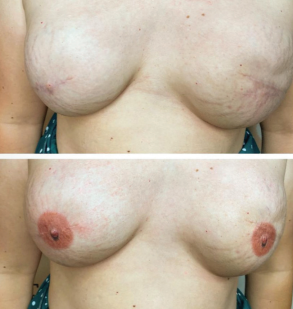
Top: Before paramedical tattoos (areola restoration)
Bottom: After paramedical tattoos
Beyond Body Art
The recognition of paramedical tattoo artists’ ability is particularly key for this procedure, because the skin that remains after grafting, radiation, and reconstructive surgeries is not the same as untouched skin. It is often fibrotic, thinned, and heavily scarred. Tattooing on such a canvas requires more than artistic talent—it demands clinical sensitivity, advanced knowledge of various techniques, and a deep understanding of skin trauma.
Even experienced traditional tattoo artists may feel unprepared or intimidated by the complexity of this work. And rightly so—this is not simply body art. Medical tattooing is emotional, nuanced, and often sacred work. Survivors come to the table with grief, anxiety, fear, and hope. To serve them profound, timeless results, artists must be trained in both skill and compassion.
I have spent years refining the techniques necessary to safely and effectively tattoo compromised skin. I assess not just color and symmetry, but tissue density, healing timelines, and scar behavior. Still, no 2 patients are the same. Some cry with relief when they see the finished result. Others sit in silence, taking in the sight of a body that finally feels like their own again. The effect of areola restoration tattoos extends far beyond cosmetic aesthetics. For many survivors, it is the final piece of the healing puzzle, a deeply personal symbol that says, “I am me again.”
Clients have confided in me about the discomfort they have felt when undressing in front of their loved ones. Some say they avoid mirrors. Others admit they still only see cancer when they look at their reflection, even years after their last treatment. The scars left by cancer are not just physical—they are often accompanied by immense mental strain.
Areola tattoos, when done well, can begin to rewrite that story. They transform a visible reminder of illness into a quiet return to normalcy. Normalcy in the wake of breast cancer is not a small thing. It is everything.
Providing Comprehensive, Restorative Care
As the need for areola tattoos becomes increasingly prevalent within the cancer community, it is important that the tattoos being produced are up to par. Physicians, understandably, have limited time and a long list of priorities throughout the reconstruction process. However, the post-reconstruction phase is an opportunity to provide truly comprehensive care—care that sees the patient not just as a body to be treated, but as a person to be restored. Here are 3 practical, scalable ways that health care facilities can incorporate paramedical tattooing into continuous care without increasing physicians’ workload:
Each of these approaches creates a more intentional, patient-centered pathway—one that does not treat tattooing as an afterthought, but as a respected and essential part of the healing continuum.
Financial Barriers to Paramedical Tattooing
Another barrier patients face is cost. While financial access should not be the obstacle that keeps a survivor from feeling whole, unfortunately, it often is.
At this time, many insurance providers do not fully cover the upfront costs of areola tattooing. In many cases, areola restoration is the final step of reconstruction, so patients have exhausted their financial resources over the last year or 2 years of treatment. Consequently, many women must forego this crucial service, despite its benefits for their self-image, self-acceptance, and mental health. Facilities incorporating paramedical tattoos can ease this financial burden by:
An Opportunity to Restore Dignity and Confidence
One of the most profound parts of my work is being present at the very end of someone’s breast cancer journey. I meet patients when the surgeries are over, the chemotherapy is complete, and the radiation is behind them—and still, something is missing. We can give it back to them. The gratitude I receive at the end of each session is overwhelming: tears, hugs, quiet disbelief. One woman confided the previous shame she had felt when her younger daughter first saw her reconstructed breasts. Another told me, “This is the first time I’ve recognized myself in years.”
These moments remind me that breast cancer care should not end at the removal of disease. It should continue until the person feels fully seen, fully whole, and fully themselves again. If we are to truly support survivors—not just as patients, but as human beings—we must expand the definition of care. Continuous cancer care does not mean never-ending medical appointments and therapy sessions. It means acknowledging that healing is a journey with many layers, some of which extend far beyond the hospital walls.
Paramedical tattooing is one of the most human, impactful, and underutilized tools we have in this space. It is time we give it the recognition, respect, and integration it deserves. Cancer steals so much—health, time, peace, identity. But through thoughtful, continuous care, we have the power to give something back. We have the chance to restore dignity, confidence, and even joy.
Areola restoration tattoos are not simply cosmetic procedures. They are acts of closure, healing, and reclamation. They help survivors feel like themselves again—not just survivors, but women, partners, mothers, professionals, and individuals who have endured the unimaginable and emerged with strength, grace, and resilience.
Breast cancer survivors deserve nothing less than care that honors their entire journey, from diagnosis to full restoration. As phenomenal as it is to ring the bell that screams you are cancer-free, for some, it is even more remarkable to finally embody again what many of us take for granted: normalcy.
Taylor Keeney is an areola restoration tattoo artist, a licensed esthetician, and the owner of TayK Cosmetics.
References
1. Assembly Bill A5729A. The New York State Senate. Accessed November 13, 2025. https://www.nysenate.gov/legislation/bills/2023/A5729/amendment/A
2. Women’s health and cancer rights act (WHCRA). CMS.gov. Updated September 10, 2024. Accessed November 13, 2025. https://www.cms.gov/cciio/ programs-and-initiatives/other-insurance-protections/whcra_factsheet





Recognizing the critical role advanced practice providers and allied health professionals play in the care continuum, the American Oncology Network provides infrastructure, leadership, and professional growth opportunities to empower these members of the cancer care team to practice at the top of their license.