ACCC association of cancer care centers
Join/Renew
Login
Join/Renew
Login
Education & Resources
ACCC eXchange LogInCorporate Member Sponsored ResourcesPresentations & AbstractsACCC Connect eLearning LogIn
Publications
Oncology IssuesPatient Assistance & Reimbursement GuideTrending Now in Cancer CareBusiness Case Studies for Hiring New Staff
Events
2026 ACCC Leadership SummitAnnual Meeting & Cancer Center Business SummitCapitol Hill DayNational Oncology ConferenceOncology Reimbursement MeetingsOncology State Society Meetings
Policy & Advocacy
ACCC 2026 Policy PrioritiesLetters & StatementsAccess, Payment & Reimbursement ReformWhite Bagging & Brown BaggingAdvocacy ResourcesCancer Moonshot
Membership
Join | RenewWho We AreMembership Types & BenefitsCorporate MembersACCC Member Portal FAQMember Directory
Partners
Oncology State SocietiesPartner OrganizationsCME
News
News ReleasesAdvocacy News ReleasesOncology News
About ACCC
Timeline / 50th Anniversary2025 Impact ReportPresident's ThemeACCC Innovator AwardsACCC FellowsBoard of TrusteesACCC Senior Staff
Breast CancerMetastatic Breast Cancer
Gastrointestinal CancerBiliary Tract CancerColorectal CancerGastric CancerLiver Cancer
Genitourinary CancerBladder CancerProstate CancerRenal Cell Carcinoma
Gynecologic CancerOvarian Cancer
Head & Neck Cancer
Hematologic MalignanciesAcute Lymphocytic Leukemia (ALL)Acute Myeloid Leukemia (AML)Chronic Lymphocytic Leukemia (CLL)Mantle Cell Lymphoma (MCL)Multiple Myeloma (MM)Myelodysplastic Syndromes (MDS)
Lung CancerNon-Small Cell Lung Cancer (NSCLC)Small Cell Lung Cancer (SCLC)
Sarcoma
Skin CancerMelanomaNon-Melanoma Skin Cancers (NMSC)
Clinical Practice & TreatmentCancer DiagnosticsCare CoordinationEHR Integration for Biomarker TestingQuality Improvement Collaboration: Integration of Precision Medicine in Community OncologyTreatment
Financial NavigationFAN Boot CampFinancial Advocacy Network (FAN) Resource LibraryPatient Assistance & Reimbursement GuidePrior Authorization
Health Equity & Access3, 2, 1, Go! Practical Solutions for Addressing Cancer Care DisparitiesAppalachian Community Cancer AllianceOncology Advanced PractitionersPersonalizing Care for Patients of All BackgroundsSocial Drivers of Health
Patient-Centered CareAddressing Care Disparities for VeteransAdolescent and Young Adult (AYA)Care Action Plans for People with CancerDermatologic ToxicitiesEmpowering CaregiversGeriatric OncologyHealth LiteracyNutritionOncology PharmacyPatient NavigationPsychosocial Care in OncologyShared Decision-MakingSupportive CareSurvivorship Care
Practice Management & OperationsCancer Program FundamentalsLeadership Sustainment and Engagement VideosOncology Practice Transformation and Integration CenterOncology Team Resiliency
ResearchACCC Community Oncology Research Institute (ACORI)
Technology & InnovationTelehealth & Digital Medicine
ACCCBuzz Blog
CANCER BUZZ Podcast
Oncology Issues
Join/Renew
Login
Breast CancerMetastatic Breast Cancer
Gastrointestinal CancerBiliary Tract CancerColorectal CancerGastric CancerLiver Cancer
Genitourinary CancerBladder CancerProstate CancerRenal Cell Carcinoma
Gynecologic CancerOvarian Cancer
Head & Neck Cancer
Hematologic MalignanciesAcute Lymphocytic Leukemia (ALL)Acute Myeloid Leukemia (AML)Chronic Lymphocytic Leukemia (CLL)Mantle Cell Lymphoma (MCL)Multiple Myeloma (MM)Myelodysplastic Syndromes (MDS)
Lung CancerNon-Small Cell Lung Cancer (NSCLC)Small Cell Lung Cancer (SCLC)
Sarcoma
Skin CancerMelanomaNon-Melanoma Skin Cancers (NMSC)
Clinical Practice & TreatmentCancer DiagnosticsCare CoordinationEHR Integration for Biomarker TestingQuality Improvement Collaboration: Integration of Precision Medicine in Community OncologyTreatment
Financial NavigationFAN Boot CampFinancial Advocacy Network (FAN) Resource LibraryPatient Assistance & Reimbursement GuidePrior Authorization
Health Equity & Access3, 2, 1, Go! Practical Solutions for Addressing Cancer Care DisparitiesAppalachian Community Cancer AllianceOncology Advanced PractitionersPersonalizing Care for Patients of All BackgroundsSocial Drivers of Health
Patient-Centered CareAddressing Care Disparities for VeteransAdolescent and Young Adult (AYA)Care Action Plans for People with CancerDermatologic ToxicitiesEmpowering CaregiversGeriatric OncologyHealth LiteracyNutritionOncology PharmacyPatient NavigationPsychosocial Care in OncologyShared Decision-MakingSupportive CareSurvivorship Care
Practice Management & OperationsCancer Program FundamentalsLeadership Sustainment and Engagement VideosOncology Practice Transformation and Integration CenterOncology Team Resiliency
ResearchACCC Community Oncology Research Institute (ACORI)
Technology & InnovationTelehealth & Digital Medicine
ACCCBuzz Blog
CANCER BUZZ Podcast
Oncology Issues
    • Education & Resources
    • Publications
    • Events
    • Policy & Advocacy
    • Membership
    • Partners
    • News
    • About ACCC
ACCC association of cancer care centers
5425 Wisconsin Ave #600, Chevy Chase, MD 20815
Tel: 301.984.9496 Email Us
Contact UsVolunteers
Advertise
Career Center
Terms and Conditions
Privacy Policy
ACCC Rebranding
Copyright © 2026 Association of Cancer Care Centers. All Rights Reserved.
HomePublicationsOncology Issues

Tools: Vol. 41, No.3

June 15, 2026
Oncology Issues
June 2026
Volume 41
Issue 3

Tools

Tools: Vol. 41, No.3
Download Issue PDFDownload PDF

Approved Drugs

  • On March 5, 2026, the FDA approved Tecvayli® (teclistamab) (Janssen Biotech) in combination with Darzalex Faspro® (daratumumab hyaluronidase-fihj) for adult patients with relapsed or refractory multiple myeloma who have received at least 1 prior line of therapy including a proteasome inhibitor and an immunomodulatory agent.
  • On March 20, the FDA approved Opdivo® (nivolumab) (Bristol Myers Squibb) with doxorubicin, vinblastine, and dacarbazine for adult and pediatric patients 12 years and older with previously untreated stage III or IV classical Hodgkin lymphoma.
  • On March 25, the FDA approved Lifyorli™ (relacorilant) (Corcept Therapeutics), a glucocorticoid receptor antagonist, in combination with nab-paclitaxel for the treatment of adults with platinum-resistant epithelial ovarian, fallopian tube, or primary peritoneal cancer who have received 1 to 3 prior systemic treatment regimens, at least 1 of which included bevacizumab.

Drugs in the News

  • The FDA granted priority review to rusfertide (Takeda and Protagonist Therapeutics), an investigational, first-in-class hepcidin mimetic peptide therapeutic for the treatment of adults with polycythemia vera.
  • The FDA accepted and granted priority review to the supplemental biologics license application for Enhertu (trastuzumab deruxtecan) (AstraZeneca and Daiichi Sankyo) for the treatment of adult patients with HER2-positive breast cancer who have residual invasive disease after neoadjuvant HER2-targeted treatment.
  • The FDA granted orphan drug designation to zolucatetide (Parabilis Medicines), an investigational Helicon™ peptide and a direct inhibitor of β-catenin:TCF interaction, for the treatment of desmoid tumors.
  • The FDA granted orphan drug designation to AMXT 1501 (Aminex Therapeutics) in combination with difluoromethylornithine for the treatment of malignant glioma, including diffuse intrinsic pontine glioma.
  • The FDA granted orphan drug designation to irinotecan (CRISM Therapeutics) for the treatment of malignant glioma.
  • The FDA granted fast track designation to FG001 (FluoGuide) as an intraoperative imaging agent to guide surgical resection of high-grade glioma.
  • The FDA granted fast track designation to small molecule MYB mRNA degrader REM-422 (Remix Therapeutics) for the treatment of patients with recurrent, metastatic or unresectable adenoid cystic carcinoma whose tumors express MYB transcripts containing a poison exon.
  • The FDA granted orphan drug designation to RCT1213 (ReCerise Therapeutics), an antibody targeting TM4SF5, for the treatment of hepatocellular carcinoma.
  • The FDA granted fast track designation to TRI-611 (TRIANA Biomedicines), an investigational molecular glue degrader therapy, for the treatment of anaplastic lymphoma kinase–positive non-small cell lung cancer.
  • The FDA granted breakthrough therapy designation to WU-CART-007 (soficabtagene geleucel), a cell-based immunotherapy developed by Washington University School of Medicine, for the treatment of T-cell acute lymphoblastic leukemia and T-cell lymphoblastic lymphoma.
  • The FDA granted fast track designation to ZW191 (Zymeworks), an antibody-drug conjugate targeting folate receptor-α, for the treatment of patients with advanced or metastatic platinum-resistant ovarian cancer.
  • The FDA granted priority review to the new drug application for lirafugratinib (Elevar Therapeutics), an investigational therapy for the treatment of patients with cholangiocarcinoma with FGFR2 fusions or rearrangements who have received prior therapy.
  • The FDA granted regenerative medicine advanced therapy designation to CB-011 (Caribou Biosciences), an allogeneic anti-BCMA CAR T-cell therapy, for relapsed or refractory multiple myeloma.
  • The FDA granted fast track designation to PAS-004 (Pasithea Therapeutics) for the treatment of neurofibromatosis type 1-associated plexiform neurofibromas causing significant morbidity.
  • The FDA granted fast track designation to A2B543 (A2 Biotherapeutics), an autologous chimeric antigen receptor (CAR) T-cell therapy designed for the treatment of germline heterozygous HLA-A02 adults with recurrent unresectable, locally advanced, or metastatic solid tumors that express mesothelin and have lost HLA-A02 expression.
  • The FDA granted breakthrough therapy designation to plixorafenib (FORE Biotherapeutics) for the treatment of adult patients with BRAF V600E-mutated high-grade glioma.
  • The FDA granted fast track designation to CTIM-76 (Context Therapeutics), a CLDN6 x CD3 T cell engaging bispecific antibody, for the treatment of platinum-resistant ovarian cancer in patients that have received all standard of care therapies.
  • The FDA granted fast track designation to SIM0505 (NextCure), an investigational antibody-drug conjugate comprised of an antibody that targets Cadherin-6 and a proprietary topoisomerase 1 inhibitor payload, for the treatment of platinum-resistant ovarian cancer.
  • The FDA granted orphan drug designation to Tovecimig (CTX-009/ABL001) (ABL Bio), a bispecific antibody, for the treatment of bile duct cancer.
  • The FDA granted orphan drug designation to REYOBIQ™ (rhenium Re186 obisbemeda) (Plus Therapeutics) for the treatment of pediatric malignant gliomas.
  • The FDA granted fast track designation to CT-P71 (Celltrion), an antibody-drug conjugate, for the treatment of patients with locally advanced or metastatic urothelial carcinoma.
  • The FDA accepted and granted priority review to Daiichi Sankyo and Merck’s biologics license application for I-DXd (ifinatamab deruxtecan) for the treatment of adult patients with extensive-stage small cell lung cancer with disease progression on or after platinum-based chemotherapy.
  • The FDA granted fast track designation to Daretabart (hu1418K322A) (Renaissance Pharma), a novel anti-GD2 monoclonal antibody in development for the treatment of high-risk neuroblastoma.
  • The FDA granted orphan drug designation to eftilagimod alfa (Immutep) for the treatment of soft tissue sarcoma.
  • The FDA granted fast track designation to OPN-6602 (Opna Bio), a dual EP300/CBP inhibitor, for the treatment of patients with relapsed/refractory multiple myeloma who have received at least 4 prior lines of therapy.
  • The FDA accepted for priority review a supplemental biologics license application for perioperative PADCEV™ (enfortumab vedotin-ejfv) (Astellas Pharma), a Nectin-4 directed antibody-drug conjugate, in combination with the PD-1 inhibitor Keytruda® (pembrolizumab) or Keytruda QLEX™ (pembrolizumab and berahyaluronidase alfa-pmph) (Merck) as treatment for patients with muscle-invasive bladder cancer.
  • The FDA granted orphan drug designation to ODM-212 (Orion Pharma) for the treatment of mesothelioma.
  • The FDA granted fast track designation to lunresertib (Debio2513) (Debiopharm), a PKMYT1 inhibitor, in combination with zedoresertib (Debio 0123), a WEE1 inhibitor.
  • The FDA granted fast track designation to BBO-11818 (BridgeBio Oncology Therapeutics) for the treatment of adult patients with advanced KRAS-mutant pancreatic ductal adenocarcinoma.
  • The FDA granted breakthrough therapy designation to TERN-701 (Terns Pharmaceuticals), a novel, oral allosteric BCR::ABL1 inhibitor, for the treatment of adult patients with Philadelphia chromosome-positive chronic myeloid leukemia in the chronic phase without the T315I mutation, previously treated with 2 or more tyrosine kinase inhibitors.
  • The FDA granted fast track designation to ImmunoBody® iSCIB1+ (Scancell) for the treatment of advanced melanoma.
  • The FDA granted regenerative medicine advanced therapy designation to Orca-Q® (Orca Bio), a second-generation investigational allogeneic T-cell immunotherapy, for the treatment of high-risk hematologic malignancies.
  • The FDA granted priority review to a supplemental biologics license application for TEVIMBRA® (tislelizumab) (BeOne) in combination with ZIIHERA® (zanidatamab) and chemotherapy for the first-line treatment of unresectable locally advanced/metastatic HER2-positive gastric, gastroesophageal junction, or esophageal adenocarcinoma. The FDA has also granted breakthrough therapy designation to the regimen of ZIIHERA in combination with fluoropyrimidine- and platinum-containing chemotherapy, with and without TEVIMBRA, in this indication.

Devices and Assays

  • The FDA granted breakthrough device designation to Cognita Chest X-Ray™ (Mosaic Clinical Technologies™), an industry-first generative vision-language model designed to assist radiologists in the interpretation of chest X-rays.
  • The FDA granted breakthrough device designation to TOBY’s non-invasive, urine-based multi-cancer early detection test.
  • The FDA granted breakthrough device designation to CatCHimera (TCM Biotech), a liquid biopsy MRD platform for hepatocellular carcinoma.
  • The FDA granted breakthrough device designation to the AidaBREAST® test (PreludeDx), an early-stage invasive breast cancer assay.
Articles in this issue

Lessons From the ACCC Leadership Summit: Aligning  People, Purpose, and Systems
Lessons From the ACCC Leadership Summit: Aligning People, Purpose, and Systems
Who Should Be at the Table Next? A Call to Identify Emerging Leaders
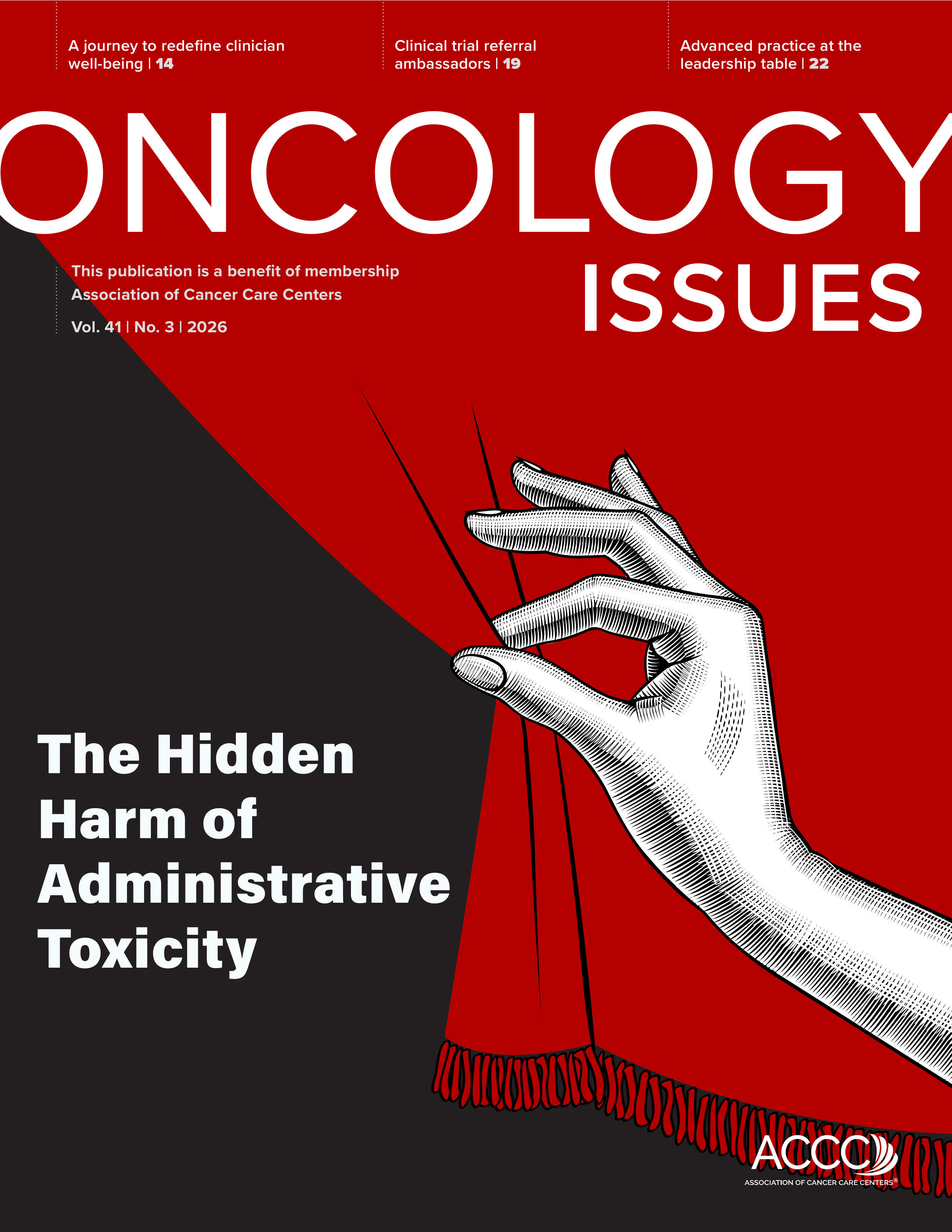
The Hidden Harm of Administrative Toxicity
PeaceHealth’s Journey to Redefine Clinician Well-Being
From Conversation  to Connection:  Clinical Trial Referral Ambassadors
From Conversation to Connection: Clinical Trial Referral Ambassadors
Advanced Practice at the Leadership Table
A Patient-Centered Framework for Transgender and Nonbinary Health
Executive Insights: The Future of Cancer Care Delivery
AI in Oncology: Tools for Today, Breaking and Remaking For Tomorrow
Health Policy: Provider Voices Outlook
Value-Based Care in Oncology: From Pilots to Scale
Strategic Partnerships: Creating a Thriving Innovation Oncology Ecosystem
HonorHealth Research Institute’s First Steps to Approaching Decentralized Clinical Trials (DCTs)
The AI That’s Already Here: Promise, Risk, and the Governance Gap
Fast Facts Vol. 41, No. 3


Upcoming Events

ACCC 43rd National Oncology Conference
Oncology

ACCC 43rd National Oncology Conference

In Person Conference & ConventionOctober 21, 2026 at 8:00 AM MDT450 Summer St, Boston, MA 02210Omni Boston Hotel at the Seaport, Boston
Register Now!
HSCO 2026 August Dinner Symposium
Oncology

HSCO 2026 August Dinner Symposium

In Person Conference & ConventionAugust 12, 2026 at 5:30 PM HST6600 Kalanianaʻole Highway suite 110, Honolulu, HI 96825, USARoy's Restaurants – Hawaii Kai, Honolulu
Register Now!
LOS 2026 Cancer Congress - National Oncology Updates
Oncology

LOS 2026 Cancer Congress - National Oncology Updates

In Person Conference & ConventionAugust 14, 2026 at 11:00 AM CDT859 Convention Center Blvd, New Orleans, LA, USANew Orleans Marriott Warehouse Art District, New Orleans
Register Now!
LOS Cancer Congress After-Hours: Bowling Social
Oncology

LOS Cancer Congress After-Hours: Bowling Social

In Person Conference & ConventionAugust 14, 2026 at 6:30 PM CDT600 Fulton St, New Orleans, LA 70130, USAFulton Alley, New Orleans
Register Now!
IOS Evansville Meeting
Oncology

IOS Evansville Meeting

In Person Conference & ConventionAugust 18, 2026 at 5:30 PM CDT4011 Gateway Blvd, Newburgh, IN 47630, USADeaconess Gateway Hospital , Newburgh
Register Now!
2026 Carolinas Cancer Conference
Oncology

2026 Carolinas Cancer Conference

In Person Conference & ConventionAugust 22, 2026 at 7:00 AM EDT5757 Palm Blvd, Isle of Palms, SC, USAWild Dunes, Isle of Palms
Register Now!
IOS 2026 Best of ASCO
Oncology

IOS 2026 Best of ASCO

In Person Conference & ConventionAugust 22, 2026 at 6:30 AM CDT300 East 9th Street, Coralville, IA, USAHyatt Regency Coralville Hotel & Conference Center, Coralville
Register Now!
NMSCO 2026 Fall Conference
Oncology

NMSCO 2026 Fall Conference

In Person Conference & ConventionSeptember 12, 2026 at 7:30 AM MDT2101 Louisiana Boulevard NE Albuquerque, NM, 87110Marriott Albuquerque, Albuquerque
Register Now!
Advertisement
Advertisement

Trending Now on
ACCCBuzz Blog

Designing a Safe, Fully Outpatient CAR T-Cell Program in the Community

Designing a Safe, Fully Outpatient CAR T-Cell Program in the Community

Local Staff, Lasting Impact: A New Model for Rural Cancer Prevention

Local Staff, Lasting Impact: A New Model for Rural Cancer Prevention

To better reach its patients living in rural communities throughout Georgia with targeted interventions, 2026 ACCC Innovator Award winner Winship Cancer Institute developed an Embedded Community Staff model, which leverages the experiential knowledge of local community members.

A Pharmacist-Led Strategy to Improve Care With Oncolytic Virus Treatments

A Pharmacist-Led Strategy to Improve Care With Oncolytic Virus Treatments

2026 ACCC Innovator Award Winner UNC Lineberger Comprehensive Cancer Center noticed a common pain point among patients who received oncolytic virus treatment for advanced melanoma: time spent in appointments. To minimize the need for multiple lengthy appointments, the center developed a pharmacist-led strategy that utilized virtual visits and premixing doses prior to in-person visits.

Extending Patient-Centered Cancer Care to Transgender and Nonbinary Individuals

Extending Patient-Centered Cancer Care to Transgender and Nonbinary Individuals

In a recent article from Oncology Issues, authors conducted a systematic literature review and found that two main drivers of care disparities exist for transgender and nonbinary individuals with cancer: rigid binary gender frameworks and gaps in mental health care.

View All ACCCBuzz Blogs

Recently Heard on
CANCER BUZZ Podcast

A Team Approach to ADCs in Bladder Cancer – [Video Podcast] Ep. 62

MDS: Low Risk Isn’t No Risk - [Podcast] Ep. 235

Beyond Body Art: Restoring Wholeness Through Paramedical Tattooing - [Podcast] Ep. 234

Bridging Radiation and Oncology in SCLC Care - [Podcast] Ep. 233

View All Podcasts

Latest from Oncology Issues

June 2026
June 2026
April 2026
February 2026
December 2025
October 2025
View All Oncology Issues

Join the Conversation

ACCC eXchange Digital Banner
Login