ACCC association of cancer care centers
Join/Renew
Login
Join/Renew
Login
Education & Resources
ACCC eXchange LogInCorporate Member Sponsored ResourcesPresentations & AbstractsACCC Connect eLearning LogIn
Publications
Oncology IssuesPatient Assistance & Reimbursement GuideTrending Now in Cancer CareBusiness Case Studies for Hiring New Staff
Events
2026 ACCC Leadership SummitAnnual Meeting & Cancer Center Business SummitCapitol Hill DayNational Oncology ConferenceOncology Reimbursement MeetingsOncology State Society Meetings
Policy & Advocacy
ACCC 2026 Policy PrioritiesLetters & StatementsAccess, Payment & Reimbursement ReformWhite Bagging & Brown BaggingAdvocacy ResourcesCancer Moonshot
Membership
Join | RenewWho We AreMembership Types & BenefitsCorporate MembersACCC Member Portal FAQMember Directory
Partners
Oncology State SocietiesPartner OrganizationsCME
News
News ReleasesAdvocacy News ReleasesOncology News
About ACCC
Timeline / 50th Anniversary2025 Impact ReportPresident's ThemeACCC Innovator AwardsACCC FellowsBoard of TrusteesACCC Senior Staff
Breast CancerMetastatic Breast Cancer
Gastrointestinal CancerBiliary Tract CancerColorectal CancerGastric CancerLiver Cancer
Genitourinary CancerBladder CancerProstate CancerRenal Cell Carcinoma
Gynecologic CancerOvarian Cancer
Head & Neck Cancer
Hematologic MalignanciesAcute Lymphocytic Leukemia (ALL)Acute Myeloid Leukemia (AML)Chronic Lymphocytic Leukemia (CLL)Mantle Cell Lymphoma (MCL)Multiple Myeloma (MM)Myelodysplastic Syndromes (MDS)
Lung CancerNon-Small Cell Lung Cancer (NSCLC)Small Cell Lung Cancer (SCLC)
Sarcoma
Skin CancerMelanomaNon-Melanoma Skin Cancers (NMSC)
Clinical Practice & TreatmentCancer DiagnosticsCare CoordinationEHR Integration for Biomarker TestingQuality Improvement Collaboration: Integration of Precision Medicine in Community OncologyTreatment
Financial NavigationFAN Boot CampFinancial Advocacy Network (FAN) Resource LibraryPatient Assistance & Reimbursement GuidePrior Authorization
Health Equity & Access3, 2, 1, Go! Practical Solutions for Addressing Cancer Care DisparitiesAppalachian Community Cancer AllianceOncology Advanced PractitionersPersonalizing Care for Patients of All BackgroundsSocial Drivers of Health
Patient-Centered CareAddressing Care Disparities for VeteransAdolescent and Young Adult (AYA)Care Action Plans for People with CancerDermatologic ToxicitiesEmpowering CaregiversGeriatric OncologyHealth LiteracyNutritionOncology PharmacyPatient NavigationPsychosocial Care in OncologyShared Decision-MakingSupportive CareSurvivorship Care
Practice Management & OperationsCancer Program FundamentalsLeadership Sustainment and Engagement VideosOncology Practice Transformation and Integration CenterOncology Team Resiliency
ResearchACCC Community Oncology Research Institute (ACORI)
Technology & InnovationTelehealth & Digital Medicine
ACCCBuzz Blog
CANCER BUZZ Podcast
Oncology Issues
Join/Renew
Login
Breast CancerMetastatic Breast Cancer
Gastrointestinal CancerBiliary Tract CancerColorectal CancerGastric CancerLiver Cancer
Genitourinary CancerBladder CancerProstate CancerRenal Cell Carcinoma
Gynecologic CancerOvarian Cancer
Head & Neck Cancer
Hematologic MalignanciesAcute Lymphocytic Leukemia (ALL)Acute Myeloid Leukemia (AML)Chronic Lymphocytic Leukemia (CLL)Mantle Cell Lymphoma (MCL)Multiple Myeloma (MM)Myelodysplastic Syndromes (MDS)
Lung CancerNon-Small Cell Lung Cancer (NSCLC)Small Cell Lung Cancer (SCLC)
Sarcoma
Skin CancerMelanomaNon-Melanoma Skin Cancers (NMSC)
Clinical Practice & TreatmentCancer DiagnosticsCare CoordinationEHR Integration for Biomarker TestingQuality Improvement Collaboration: Integration of Precision Medicine in Community OncologyTreatment
Financial NavigationFAN Boot CampFinancial Advocacy Network (FAN) Resource LibraryPatient Assistance & Reimbursement GuidePrior Authorization
Health Equity & Access3, 2, 1, Go! Practical Solutions for Addressing Cancer Care DisparitiesAppalachian Community Cancer AllianceOncology Advanced PractitionersPersonalizing Care for Patients of All BackgroundsSocial Drivers of Health
Patient-Centered CareAddressing Care Disparities for VeteransAdolescent and Young Adult (AYA)Care Action Plans for People with CancerDermatologic ToxicitiesEmpowering CaregiversGeriatric OncologyHealth LiteracyNutritionOncology PharmacyPatient NavigationPsychosocial Care in OncologyShared Decision-MakingSupportive CareSurvivorship Care
Practice Management & OperationsCancer Program FundamentalsLeadership Sustainment and Engagement VideosOncology Practice Transformation and Integration CenterOncology Team Resiliency
ResearchACCC Community Oncology Research Institute (ACORI)
Technology & InnovationTelehealth & Digital Medicine
ACCCBuzz Blog
CANCER BUZZ Podcast
Oncology Issues
    • Education & Resources
    • Publications
    • Events
    • Policy & Advocacy
    • Membership
    • Partners
    • News
    • About ACCC
ACCC association of cancer care centers
5425 Wisconsin Ave #600, Chevy Chase, MD 20815
Tel: 301.984.9496 Email Us
Contact UsVolunteers
Advertise
Career Center
Terms and Conditions
Privacy Policy
ACCC Rebranding
Copyright © 2026 Association of Cancer Care Centers. All Rights Reserved.
HomePublicationsOncology Issues

The Hidden Harm of Administrative Toxicity

June 15, 2026
Oncology Issues
June 2026
Volume 41
Issue 3

Author(s):

Frantz M. Berthaud, MPH, FACHE
Christabel K. Cheung, PhD, MSW

Article

The Hidden Harm of Administrative Toxicity
Download Issue PDFDownload PDF

Over the past 2 decades, oncology has witnessed unprecedented advances—from molecular diagnostics and immunotherapies to precision medicine and the early integration of machine learning. As these clinical innovations accelerate, attention rightly centers on breakthroughs in diagnosis and treatment. Yet beneath these highly visible advancements lies a growing and far less acknowledged malignancy that quietly threatens patient outcomes, clinician well-being, and the operational integrity of cancer programs: administrative toxicity. We define administrative toxicity as the cumulative burden of nonclinical processes—such as authorization requirements, documentation, coordination demands, and coverage determinations—that create delays, distress, and disruptions in the delivery of timely, evidence-based cancer care.

As Jodi-Ann Burey describes in Authentic, administrative toxicity is not merely bureaucratic friction but a lived experience that exacerbates vulnerabilities and can trigger avoidance, delay, and disengagement from needed care. Her reflections illustrate how layers of paperwork, phone calls, documentation loops, and hostile accommodations generate emotional and material clutter that actively obstruct timely diagnosis and treatment.¹

Clinical toxicity is expected and financial toxicity is now widely recognized. However, administrative toxicity—and its related construct, "logistic toxicity"²—remains underdefined, undertheorized, and insufficiently measured. Although commonly framed as a clinician or system inconvenience, administrative toxicity is a direct, material harm experienced by patients. Delays in care, misaligned incentives, duplicative documentation requirements, opaque payer processes, and fragmented coordination can convert bureaucratic friction into clinical consequences. In oncology—where even short delays may shift prognosis—burdens represent not only inefficiencies but system-generated hazards that endanger timely access to evidence-based care.

Administrative toxicity manifests across multiple domains, including prior authorization, payer communications, coverage appeals, documentation demands, claims adjudication, and fragmented electronic health records (EHRs). These burdens erode clinician capacity, siphon organizational resources, and disproportionately impact rural and under-resourced cancer programs. Within the past 2 decades, we have added language to the cancer care lexicon to define and establish the varying adverse effects of cancer care: financial toxicity, time toxicity, and administrative burdens.³⁻⁵

Given the time-critical nature of oncology, cancer programs must treat administrative toxicity not as an inconvenience, but as an operational and quality-of-care emergency. In this article, we:

  • Define administrative toxicity as a multidimensional construct
  • Summarize the evidence demonstrating its clinical and equity consequences
  • Examine how administrative toxicity manifests across contemporary oncology practices
  • Outline actionable, pragmatic strategies health systems can implement to reduce the toll on patients, caregivers, clinicians, and cancer programs.

Conceptualizing Administrative Toxicity

Administrative toxicity is distinct from financial and time toxicity, though closely related to both through the delays, denials, and coordination failures embedded in health system bureaucracy and utilization management. It encompasses the operational and policy-driven requirements—often justified in the name of cost containment, compliance, or utilization oversight—that can ultimately obstruct rather than facilitate timely, equitable care.⁶ Though designed to promote accountability, these processes frequently produce friction, delay, and distress that erode both the patient experience and clinical efficacy.

Administrative toxicity can be conceptualized across 4 interrelated domains, as shown in the Figure:

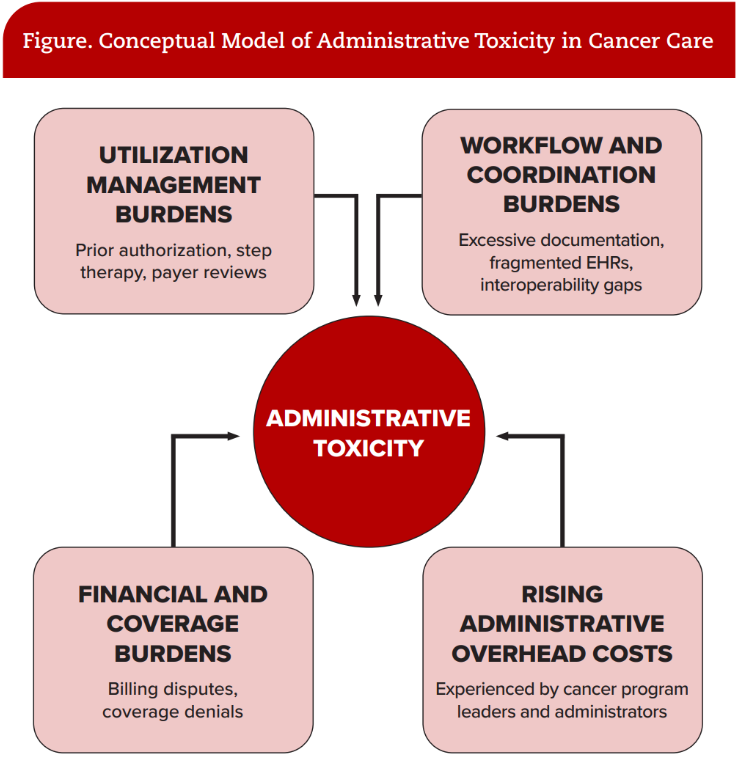
  1. Utilization management burdens. Requirements such as prior authorizations, step therapy, and frequent payer reviews that delay or deny clinically indicated care.
  2. Workflow and coordination burdens. Excessive documentation, fragmented EHRs, interoperability gaps, and redundant communication loops that divert staff effort from patient-facing work.
  3. Financial and coverage burdens. Billing disputes, coding constraints, coverage denials, and opaque appeals processes that generate uncertainty and financial stress for both patients and cancer programs.
  4. Rising overhead costs and resource diversion. Administrators and cancer program leaders face rising costs and resources diverted from quality improvement and supportive services.

Administrative toxicity imposes burdens on patients, caregivers, clinicians, and cancer programs alike. Patients and caregivers lose time, emotional energy, and often trust as they attempt to navigate opaque insurance or social service systems. Clinicians and staff are forced to spend hours on non-value-added tasks, leading to burnout and moral injury.

Recent conceptual models illustrate how administrative burden, time burden, and financial burden intersect, compounding and intensifying inequities in cancer care.⁷ In our framework, administrative toxicity functions as a systemic exposure that depletes both patient capacity and institutional resources, ultimately influencing outcomes, access, and sustainability. Common manifestations of administrative toxicity in oncology include:

  • Prior authorization and utilization management requirements
  • Frequent documentation, reporting, and audit obligations
  • Payer communications, coverage appeals, and denials
  • Complex billing, clinicians' coding constraints, and claims adjudication
  • Fragmented EHRs and medical record requests
  • Disjointed navigation across health systems, care settings, and insurers
  • Compliance and reporting burden that consumes clinician and staff time.

In aggregate, these forces undermine the core mission of oncology care—timely, person-centered treatment—by introducing delay, cognitive load, and inefficiency. Like other toxicities in oncology, administrative toxicity has dose-dependent consequences, with the heaviest burden borne by rural and under-resourced cancer programs where staffing, technology, and administrative capacity are most limited.

Delayed Care, Denied Care, Damaged Outcomes

Administrative delays are not rare or peripheral; rather, they are systemic and consequential. Oncology care is inherently time-critical, with many treatments—including adjuvant chemotherapy, radiation, and targeted therapy—being highly time-sensitive. Delays of days or weeks may allow tumor progression, reduce the window of operability, or lower relative survival rates. A national cross-sectional study found that 22% of oncology patients reported being denied or delayed in receiving their recommended cancer care due to prior authorization issues.⁸ Among those who faced delays, nearly three-quarters waited at least 2 weeks.

These delays are more than inconvenient. They are dangerous. A broad review of 25 US studies found prior authorization was associated with disease progression, preventable hospitalizations, prolonged inpatient stays, and lower rates of disease-free survival. Even when approvals are eventually granted (often after exhausting appeals), the damage may already be done.⁹ A national CancerCare survey found that although 95% of requested authorizations were ultimately approved, 40% of patients still experienced treatment delays. Nearly 1 in 3 had diagnostic delays.¹⁰ These are not isolated cases; they reflect a system in dysfunction. Radiation oncologists report seeing this firsthand. In a 2024 survey by the American Society for Radiation Oncology (ASTRO), 92% of respondents said prior authorization caused treatment delays. Nearly a third observed that those delays contributed to emergency department visits, hospitalizations, or even permanent disability. Alarmingly, 7% reported that the delays contributed to patient deaths.¹¹

Distrust, Distress, and Other Consequences of Administrative Toxicity

Beyond clinical harm, administrative toxicity has significant emotional and psychological consequences. Patients frequently describe payer interactions, denials, and repetitive documentation requests as confusing, degrading, and dehumanizing. The cognitive load required to navigate these processes—particularly during active treatment—may intensify distress, weaken engagement in shared decision-making, and impair adherence to medical advice.5,12,13 Patients and their caregivers experience this time and energy depletion when they spend hours on phone calls, appeals, and paperwork to secure care that clinicians have already deemed medically appropriate.14,15 Qualitative analyses capture themes such as "blinded navigation" and "intersecting burdens," illustrating how patients feel lost in a maze of bureaucracy while simultaneously managing cancer-related fatigue, pain, or emotional overwhelm.12,13

Survey data show that 40% of patients rate prior authorization as "bad" and 32% as "horrible." These negative interactions erode trust, not only in insurers (89%) but in the broader health care system (83%).⁸

The consequences of diminished trust are operationally significant. Patients may delay asking clarifying questions, hesitate to challenge denials, or disengage altogether. Administrative hurdles may drive therapy substitutions toward less effective or more toxic regimens, simply because they are easier to authorize. Financial toxicity—often a downstream effect of administrative coverage disputes and delays—can lead to patient non-adherence to therapy, treatment interruptions, or outright abandonment.¹⁵

Disproportionate Harm in Rural and Low-Resource Settings

Administrative toxicity does not fall evenly across the oncology landscape. It amplifies existing disparities and has the most severe consequences in rural clinics and under-resourced communities. Patients who rely on small community oncology programs—many of which operate with limited staffing and administrative infrastructure—are more likely to experience longer delays in prior authorization, reduced access to appeals expertise, and fewer navigation supports.

Empirical evidence consistently demonstrates that younger patients and Black patients report higher administrative burdens and are more likely to delay or skip care altogether due to the complexity or cost of administrative requirements. Patients with limited English proficiency or low health literacy encounter even greater barriers when navigating insurance appeals and paperwork-heavy processes.¹²

These systems were not designed for patients with limited time, resources, or support.

Rural and community oncology clinics face particular vulnerabilities: fewer authorization specialists, limited broadband Internet access to online payer portals, and staffing shortages that make it difficult to absorb the heavy administrative load. These constraints widen equity gaps and ultimately threaten the sustainability of smaller practices that are already under economic strain.¹⁶ For some rural patients, administrative delays may be the tipping point between receiving timely care locally or needing to travel long distances—if travel is even feasible.

Provider Burden, Moral Injury, and Organizational Strain

Administrative toxicity does not affect only patients; it places a substantial and escalating burden on oncology clinicians, support staff, and cancer program operations. Prior authorization alone consumes an average of 13 hours per physician per week—nearly 2 full working days—with documentation, coverage verification, and claims adjudication adding further to that load.¹⁷ These demands erode professional satisfaction, contribute to burnout and moral injury, and divert resources from direct patient care.

In oncology specifically, the impact is even more pronounced. In the ASTRO survey, 94% of radiation oncologists reported that prior authorization exacerbates staff burnout, compounding the same administrative burdens that impair patient outcomes.¹¹ Many cancer programs have had to reassign clinical staff or hire additional personnel solely to manage administrative workflows, diverting resources from quality improvement, survivorship care, or patient education.

In modern oncology programs, large teams of nonclinical staff, such as authorization specialists, financial navigators, and billing coordinators, have become essential. Yet these roles largely exist to manage payer friction, not to enhance clinical care. The opportunity cost is significant: Staff and funds that could be deployed for supportive services, patient education, or research are instead focused on bureaucratic navigation.

This administrative overload contributes not only to burnout but to moral injury—the distress clinicians experience when systemic barriers prevent them from delivering the timely, evidence-based care they know is appropriate. When treatment must be delayed, modified, or rationed due to payer requirements rather than clinical judgment, clinicians face an ethical tension that undermines their sense of professional purpose.¹⁸ Several studies have shown that these conditions degrade patient–clinician relationships, as clinicians spend more time navigating bureaucratic hurdles and less time in conversation, shared decision-making, and holistic care.19,20

The burden is especially acute in rural and small community oncology practices. These programs often lack the administrative depth and technological infrastructure to efficiently manage authorization queues, payer communications, and appeals. Without dedicated authorization specialists or financial navigators, delays lengthen, authorization backlogs accumulate, and already limited staff absorb excessive administrative duties.¹⁶ This dynamic threatens the viability of small cancer programs and, by extension, the stability of oncology access in underserved regions.

EHRs introduce parallel challenges. 2017 ASCO data indicate that 49% of physicians' time is spent on EHR and administrative activities, whereas only 27% of the clinical day is spent with patients.²¹ When clinicians spend nearly twice as much time on systems navigation as on direct care, the clinical mission of oncology becomes increasingly difficult to fulfill. These trends reveal that administrative toxicity functions as an organizational hazard—one that undermines clinician well-being, disrupts workflows, and threatens the sustainability of oncology practices, particularly in rural and resource-limited settings.

Proposed Strategies to Mitigate and Reduce Administrative Toxicity

The evidence is clear: Administrative barriers in oncology are not neutral safeguards but structural failures that impede timely care, widen disparities, and erode trust in the health care system. For cancer programs seeking to deliver equitable, guideline-concordant care, reducing administrative toxicity is not optional—it is essential to operational performance, clinical well-being, and patient outcomes.

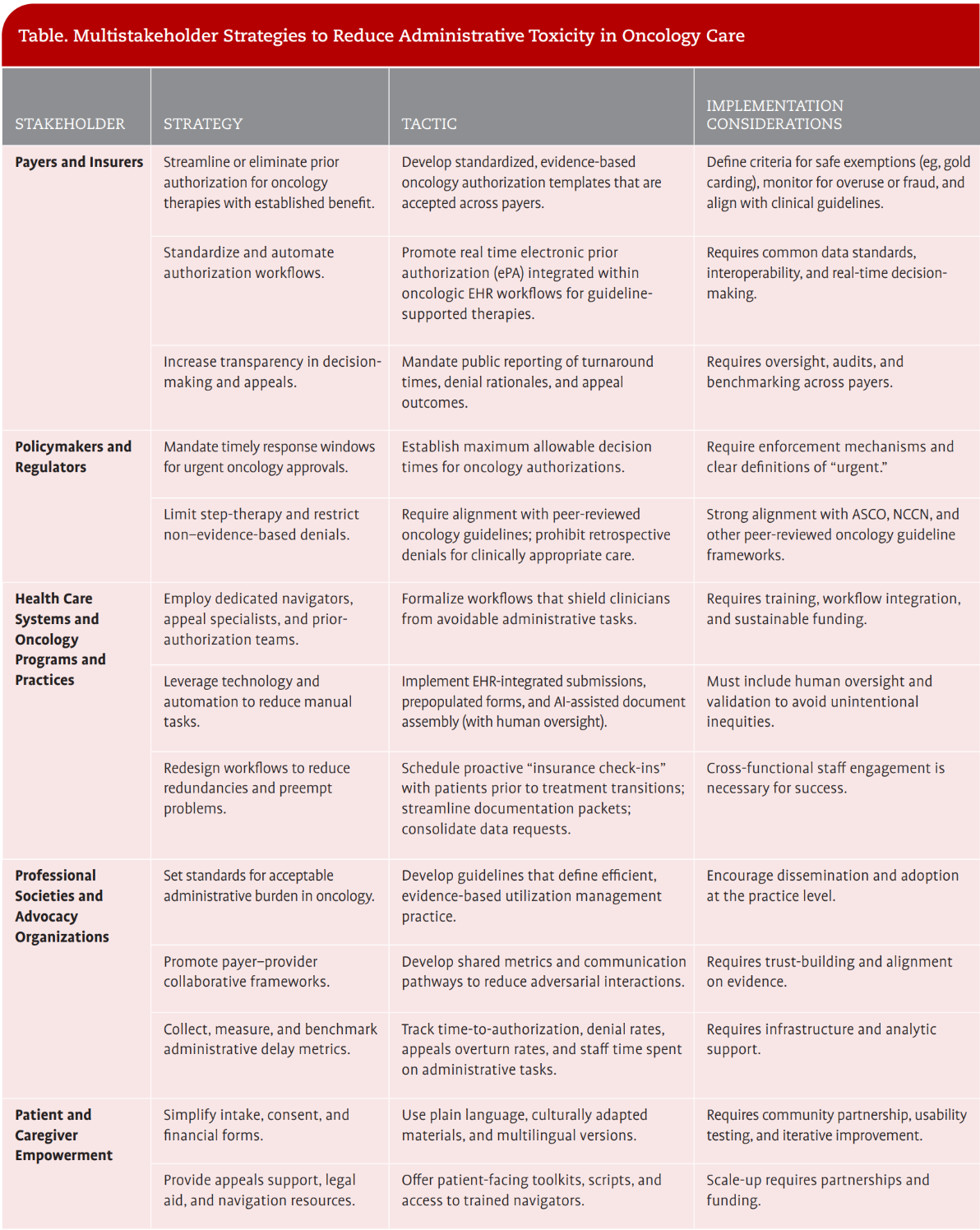
Because administrative toxicity arises from policy, payer practices, health system workflows, and patient-facing processes, meaningful reform requires multilevel, multistakeholder coordination. While some changes require systemic reform, many others can be implemented immediately within oncology programs to buffer patients and staff from administrative burden.

Challenges, Trade-Offs, and Future Directions

Efforts to reduce administrative toxicity must contend with practical, structural, and policy-level obstacles. While momentum is growing—particularly as some payers begin scaling back prior authorization requirements for selected diagnostic services22,23 reforms must be designed carefully to avoid unintended consequences. Emerging automation tools may streamline certain processes, but algorithmic decision-making can also entrench inequities or reduce clinical nuance if implemented without appropriate safeguards.24,25 Key considerations include:

  • Balancing utilization control and access. Insurers maintain that prior authorization and step-therapy help manage inappropriate or low-value care. Any reform must preserve essential oversight while eliminating redundant, non-evidence-based, or low-yield steps that delay medically necessary treatment.
  • Data infrastructure and interoperability limitations. Meaningful administrative simplification depends on shared data standards, interoperable systems, and secure application programming interfaces. Many oncology programs, particularly small or rural practices, lack the information technology capacity to implement or maintain these systems.
  • Resource constraints for smaller and rural programs. Administrative reforms often assume staffing and technology that smaller community oncology programs do not have. Grant-funded shared services, regional collaboratives, or payer-supported administrative staffing models may be necessary to prevent widening disparities in access.
  • Evidence gaps in linking administrative delays to outcomes. Prospective studies are needed to link administrative delays to survival, disease progression, quality of life, and cost.
  • Measurement and accountability structures. Integrating indicators into existing oncology quality frameworks would enhance accountability and drive continuous improvement.
  • Ensuring an equity-centered approach. Administrative reforms risk inadvertently widening disparities if they do not explicitly consider the needs of patients with limited English proficiency, low health literacy, disabilities, socioeconomic disadvantage, or rural residence. Algorithmic tools must be designed with attention to bias.

Future Directions

Key priorities for the field include:

  • Establishing national standards for oncology authorization timelines and evidence-based utilization management criteria
  • Building interoperable infrastructure that enables real-time data exchange and reduces redundant documentation
  • Embedding administrative burden metrics into oncology quality programs and publicly reported dashboards
  • Developing payer–provider compacts grounded in transparency, shared evidence, and collaborative problem-solving
  • Scaling technology solutions cautiously with rigorous equity and safety assessments
  • Investing in support for small and rural cancer programs to ensure reforms do not disproportionately benefit well-resourced systems.

Conclusion

Administrative toxicity is not a peripheral inconvenience; it is a substantive and growing threat to the safety, equity, and effectiveness of cancer care. In a field where timeliness is critical, delays and denials generated by administrative processes cause iatrogenic harm that undermines the very advances oncology has worked hard to achieve. Its consequences are measurable: disrupted treatment pathways, compromised outcomes, magnified disparities, clinician burnout, and operational strain across cancer programs.

As the oncology community continues to invest in scientific and therapeutic innovation, equal attention must be directed toward confronting the bureaucratic systems that impede the delivery of those advances. Reducing administrative toxicity requires intentional, coordinated action across payers, policymakers, health care systems, professional societies, and patient advocacy partners.

Every reduction in administrative burden is a meaningful gain—faster access to treatment, improved patient experience, reduced inequities, and a more resilient oncology workforce. These benefits make reducing administrative toxicity not only an operational priority but also an ethical imperative for cancer care systems that are committed to delivering timely, person-centered, and equitable care. The goal is straightforward: Restore time, clarity, and dignity to patients and capacity and agency to the clinicians who care for them.

Frantz M. Berthaud, MPH, FACHE, is senior vice president of Oncology Services at University Medical Center of El Paso in El Paso, Texas. Christabel K. Cheung, PhD, MSW, is an associate professor at the University of Maryland School of Social Work in Baltimore, Maryland.

References
  1. Burey JA. Authentic: The Myth of Bringing Your Full Self to Work. 1st ed. Flatiron Books; 2025.
  2. Schattner E. Logistic toxicity, an unmeasured burden of healthcare. Forbes. Published August 14, 2015. https://www.forbes.com/sites/elaineschattner/2015/08/14/logistic-toxicity-an-unmeasured-burden-of-health-care-for-people-with-cancer-and-other-illness/
  3. Zafar SY, Peppercorn JM, Schrag D, et al. The financial toxicity of cancer treatment: a pilot study assessing out-of-pocket expenses and the insured cancer patient's experience. Oncologist. 2013;18(4):381-390. doi:10.1634/theoncologist.2012-0279
  4. Gupta A, Eisenhauer EA, Booth CM. The time toxicity of cancer treatment. J Clin Oncol. 2022;40(15):1611-1615. doi:10.1200/JCO.21.02810
  5. Herd P, Moynihan D. Health care administrative burdens: centering patient experiences. Health Serv Res. 2021;56(5):751-754. doi:10.1111/1475-6773.13858
  6. Doherty M, Thom B, Gardner DS. Administrative burden associated with cost-related delays in care in U.S. cancer patients. Cancer Epidemiol Biomarkers Prev. 2023;32(11):1583-1590. doi:10.1158/1055-9965.EPI-23-0119
  7. Parsons HM, Gupta A, Jewett P, Vogel RI. The intersecting time, administrative, and financial burdens of a cancer diagnosis. J Natl Cancer Instit. 2025;117(4):595-600. doi:10.1093/jnci/djae252
  8. Chino F, Baez A, Elkins IB, Aviki EM, Ghazal LV, Thom B. The patient experience of prior authorization for cancer care. JAMA Netw Open. 2023;6(10):e2338182. doi:10.1001/jamanetworkopen.2023.38182
  9. Kyle MA, Keating NL. Prior authorization and association with delayed or discontinued prescription fills. J Clin Oncol. 2024;42(8):951-960. doi:10.1200/JCO.23.01693
  10. The health insurance maze: how cancer patients get lost in the red tape of utilization management. CancerCare; 2025. https://media.cancercare.org/documents/407/original/CancerCare_RedTape_Report.pdf
  11. How prior authorization harms cancer care: results of a nationwide physician survey, Dec. 2024. ASTRO; 2024. https://www.astro.org/ASTRO/media/ASTRO/News%20and%20Publications/PDFs/PriorAuthSurvey_2024ExecutiveSummary.pdf
  12. Doherty M, Thom B, Gardner DS. Administrative burden associated with cost-related delays in care in U.S. cancer patients. Cancer Epidemiol Biomarkers Prev. 2023;32(11):1583-1590. doi:10.1158/1055-9965.EPI-23-0119
  13. Thom B, Persaud S, Ghazal LV, Chino F. Patient perspectives on prior authorization for cancer care. JAMA Netw Open. 2025;8(7):e2523807. doi:10.1001/jamanetworkopen.2025.23807
  14. Lin K, Kagalwalla S, Gupta A. Characterizing and addressing the financial, time, and administrative burdens of cancer and its care. Curr Treat Options in Oncol. 2025;26(12):1078-1085. doi:10.1007/s11864-025-01358-w
  15. Collado L, Brownell I. The crippling financial toxicity of cancer in the United States. Cancer Biol Ther. 2019;20(10):1301-1303. doi:10.1080/15384047.2019.1632132
  16. Charlton M, Schlichting J, Chioreso C, Ward M, Vikas P. Challenges of rural cancer care in the United States. Oncology (Williston Park). 2015;29(9):633-640.
  17. 2024 AMA prior authorization physician survey. American Medical Association. https://www.ama-assn.org/system/files/prior-authorization-survey.pdf
  18. Davis MN, Keller JM. Moral distress among oncologists: when inability to treat due to payer restrictions collides with clinical judgment. Oncologist. 2020;25(12):e1887-e1894. doi:10.1634/theoncologist.2020-0123
  19. Christino MA, Matson AP, Fischer SA, Reinert SE, Digiovanni CW, Fadale PD. Paperwork versus patient care: a nationwide survey of residents' perceptions of clinical documentation requirements and patient care. J Grad Med Educ. 2013;5(4):600-604. doi:10.4300/JGME-D-12-00377.1
  20. Fowler FJ Jr, Gerstein BS, Barry MJ. How patient centered are medical decisions? Results of a national survey. JAMA Intern Med. 2013;173(13):1215-1221. doi:10.1001/jamainternmed.2013.6172
  21. ASCO. The state of cancer care in America, 2017: a report by the American Society of Clinical Oncology. J Oncol Pract. 2017;13(4):e353-e394. doi:10.1200/JOP.2016.020743
  22. Humana to reduce about one-third of prior authorization requirements by 2026. Reuters. Published July 22, 2025. https://www.reuters.com/business/healthcare-pharmaceuticals/humana-reduce-about-one-third-prior-authorization-requirements-2025-07-22
  23. Health insurers to work on easing prior authorization requirements, AHIP says. Reuters. Published June 23, 2025. https://www.reuters.com/business/healthcare-pharmaceuticals/health-insurers-work-easing-prior-authorization-requirements-ahip-says-2025-06-23
  24. Obermeyer Z, Emanuel EJ. Predicting the future—big data, machine learning, and clinical medicine. N Engl J Med. 2016;375(13):1216-1219. doi:10.1056/NEJMp1606181
  25. Obermeyer Z, Powers B, Vogeli C, Mullainathan S. Dissecting racial bias in an algorithm used to manage the health of populations. Science. 2019;366(6464):447-453. doi:10.1126/science.aax2342
Articles in this issue

Lessons From the ACCC Leadership Summit: Aligning  People, Purpose, and Systems
Lessons From the ACCC Leadership Summit: Aligning People, Purpose, and Systems
Who Should Be at the Table Next? A Call to Identify Emerging Leaders
The Hidden Harm of Administrative Toxicity
PeaceHealth’s Journey to Redefine Clinician Well-Being
From Conversation  to Connection:  Clinical Trial Referral Ambassadors
From Conversation to Connection: Clinical Trial Referral Ambassadors
Advanced Practice at the Leadership Table
A Patient-Centered Framework for Transgender and Nonbinary Health
Executive Insights: The Future of Cancer Care Delivery
AI in Oncology: Tools for Today, Breaking and Remaking For Tomorrow
Health Policy: Provider Voices Outlook
Value-Based Care in Oncology: From Pilots to Scale
Strategic Partnerships: Creating a Thriving Innovation Oncology Ecosystem
HonorHealth Research Institute’s First Steps to Approaching Decentralized Clinical Trials (DCTs)
The AI That’s Already Here: Promise, Risk, and the Governance Gap
Fast Facts Vol. 41, No. 3

Upcoming Events

ACCC 43rd National Oncology Conference
Oncology

ACCC 43rd National Oncology Conference

In Person Conference & ConventionOctober 21, 2026 at 8:00 AM MDT450 Summer St, Boston, MA 02210Omni Boston Hotel at the Seaport, Boston
Register Now!
HSCO 2026 August Dinner Symposium
Oncology

HSCO 2026 August Dinner Symposium

In Person Conference & ConventionAugust 12, 2026 at 5:30 PM HST6600 Kalanianaʻole Highway suite 110, Honolulu, HI 96825, USARoy's Restaurants – Hawaii Kai, Honolulu
Register Now!
LOS 2026 Cancer Congress - National Oncology Updates
Oncology

LOS 2026 Cancer Congress - National Oncology Updates

In Person Conference & ConventionAugust 14, 2026 at 11:00 AM CDT859 Convention Center Blvd, New Orleans, LA, USANew Orleans Marriott Warehouse Art District, New Orleans
Register Now!
LOS Cancer Congress After-Hours: Bowling Social
Oncology

LOS Cancer Congress After-Hours: Bowling Social

In Person Conference & ConventionAugust 14, 2026 at 6:30 PM CDT600 Fulton St, New Orleans, LA 70130, USAFulton Alley, New Orleans
Register Now!
IOS Evansville Meeting
Oncology

IOS Evansville Meeting

In Person Conference & ConventionAugust 18, 2026 at 5:30 PM CDT4011 Gateway Blvd, Newburgh, IN 47630, USADeaconess Gateway Hospital , Newburgh
Register Now!
2026 Carolinas Cancer Conference
Oncology

2026 Carolinas Cancer Conference

In Person Conference & ConventionAugust 22, 2026 at 7:00 AM EDT5757 Palm Blvd, Isle of Palms, SC, USAWild Dunes, Isle of Palms
Register Now!
IOS 2026 Best of ASCO
Oncology

IOS 2026 Best of ASCO

In Person Conference & ConventionAugust 22, 2026 at 6:30 AM CDT300 East 9th Street, Coralville, IA, USAHyatt Regency Coralville Hotel & Conference Center, Coralville
Register Now!
NMSCO 2026 Fall Conference
Oncology

NMSCO 2026 Fall Conference

In Person Conference & ConventionSeptember 12, 2026 at 7:30 AM MDT2101 Louisiana Boulevard NE Albuquerque, NM, 87110Marriott Albuquerque, Albuquerque
Register Now!
Advertisement
Advertisement

Trending Now on
ACCCBuzz Blog

Designing a Safe, Fully Outpatient CAR T-Cell Program in the Community

Designing a Safe, Fully Outpatient CAR T-Cell Program in the Community

Local Staff, Lasting Impact: A New Model for Rural Cancer Prevention

Local Staff, Lasting Impact: A New Model for Rural Cancer Prevention

To better reach its patients living in rural communities throughout Georgia with targeted interventions, 2026 ACCC Innovator Award winner Winship Cancer Institute developed an Embedded Community Staff model, which leverages the experiential knowledge of local community members.

A Pharmacist-Led Strategy to Improve Care With Oncolytic Virus Treatments

A Pharmacist-Led Strategy to Improve Care With Oncolytic Virus Treatments

2026 ACCC Innovator Award Winner UNC Lineberger Comprehensive Cancer Center noticed a common pain point among patients who received oncolytic virus treatment for advanced melanoma: time spent in appointments. To minimize the need for multiple lengthy appointments, the center developed a pharmacist-led strategy that utilized virtual visits and premixing doses prior to in-person visits.

Extending Patient-Centered Cancer Care to Transgender and Nonbinary Individuals

Extending Patient-Centered Cancer Care to Transgender and Nonbinary Individuals

In a recent article from Oncology Issues, authors conducted a systematic literature review and found that two main drivers of care disparities exist for transgender and nonbinary individuals with cancer: rigid binary gender frameworks and gaps in mental health care.

View All ACCCBuzz Blogs

Recently Heard on
CANCER BUZZ Podcast

A Team Approach to ADCs in Bladder Cancer – [Video Podcast] Ep. 62

MDS: Low Risk Isn’t No Risk - [Podcast] Ep. 235

Beyond Body Art: Restoring Wholeness Through Paramedical Tattooing - [Podcast] Ep. 234

Bridging Radiation and Oncology in SCLC Care - [Podcast] Ep. 233

View All Podcasts

Latest from Oncology Issues

June 2026
June 2026
April 2026
February 2026
December 2025
October 2025
View All Oncology Issues

Join the Conversation

ACCC eXchange Digital Banner
Login