Article

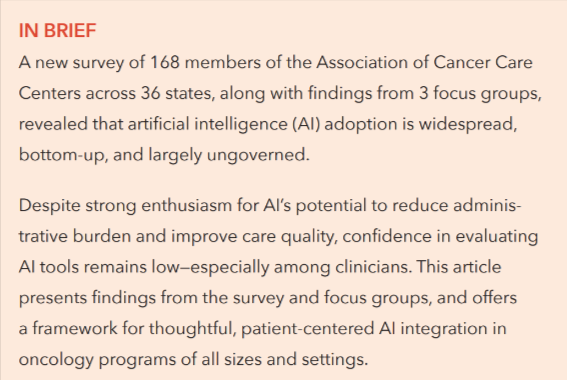
When asked whether artificial intelligence (AI) has arrived in their programs, cancer care staff may not give the expected answer—“not yet” or “we’re evaluating options.” For most, the honest answer is: it’s already here.
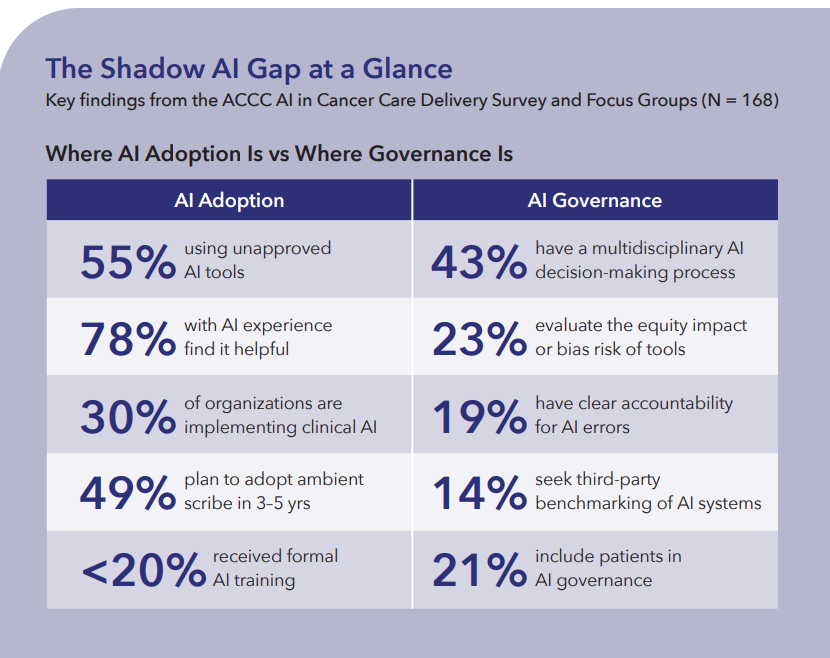
A new survey from the Association of Cancer Care Centers (ACCC), conducted in partnership with the Digital Medicine Society (DiMe) and Cancer Support Community, reveals a field at a pivotal inflection point. More than half of respondents (55%) are using AI tools that their organizations have never officially approved. Meanwhile, fewer than half (14%-43%) of those organizations have various basic governance structures in place to manage that use, and fewer than 1 in 6 (14%) staff members have received any formal role-specific AI training.
The adoption is happening from the bottom up. Nurses, administrators, advanced practice providers, oncologists, and others are quietly experimenting with generative AI tools for drafting emails, summarizing patient records, managing schedules, and reviewing clinical literature—often without their IT departments’ knowledge. This shadow adoption is rational: The tools are accessible, many are free, and they are genuinely useful. But it is outpacing the governance, training, and evaluation infrastructure that would make it safe and equitable.
This is not a story about whether AI is coming to cancer care. It is already here. The question is whether programs will build the guardrails before the gap between adoption and oversight becomes a patient-safety issue.
The Adoption That Wasn’t Announced
The numbers tell a striking story among a diverse sample spanning community and National Cancer Institute (NCI)- designated programs, clinical and administrative roles, urban and rural settings. In contrast to the 55% of survey respondents using AI tools not officially approved by their organization, only 45% were using organizationally-sanctioned tools. This gap reflects not recklessness but pragmatism: The tools are accessible, the workload is real, and institutional processes have simply not kept pace. The reality is that staff are not waiting for the permission they were never told they needed—they are reaching for tools that help them do their jobs better, in the absence of guidance telling them otherwise.
Of those with any hands-on AI experience, 78% found it helpful or very helpful in their day-to-day work. Focus group participants named 13 specific platforms they were using, from enterprise tools like Microsoft Copilot and Epic’s built-in features to widely accessible generative AI platforms including ChatGPT, Claude, Gemini, and Grok. They also cited specialized oncology-adjacent tools: Massive Bio for clinical trial matching, LeanTaaS for infusion capacity management, and DAX Copilot for ambient documentation.

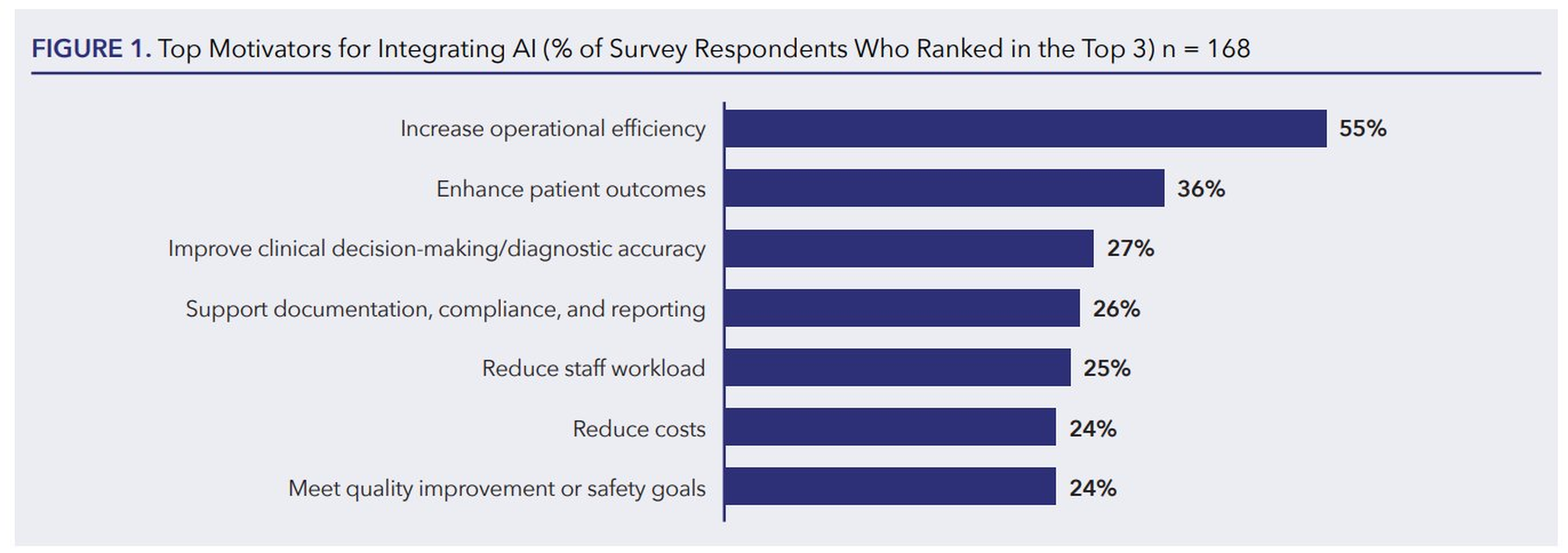
The use cases described in the focus groups were specific and practical. Clinicians reported using generative AI to draft emails on difficult topics, summarize patient histories before appointments, generate patient education materials, and quickly review clinical literature ahead of tumor boards. Administrators used AI to draft grant applications, analyze registry data, build scheduling models, and create marketing materials. Several participants described AI as a tool for working “at the top of their license,” automating the repetitive tasks that consume time that could be spent on direct patient care. These priorities are reflected in the top-reported motivators among survey respondents for integrating AI in cancer care (Figure 1).
“[What excites me most about AI in cancer care is] improvement in earlier detection and imaging interpretation; using AI to simplify charting, so more time can be spent on patient care; developing patient education materials that address treatments and side effects; developing databases that can potentially identify risk factors.”
—Survey Respondent, Care Delivery Role, Academic Setting
Those motivators were echoed and given texture when respondents were asked in their own words what excited them most about AI in cancer care delivery and operations. Increased efficiency was cited most often (93 mentions), followed by care quality and outcomes (58 mentions), and data processing and clinical trials capabilities (30 mentions). Only 3 respondents, all of whom had no hands-on AI experience, reported nothing they were excited about. One person with AI experience said they had “more concerns than anything,” a sentiment that would emerge repeatedly as the survey probed deeper.
Enthusiasm Meets Anxiety
The same people using AI daily are also its most worried critics. This is perhaps the most important finding in the entire dataset: Enthusiasm and anxiety are not opposites in this conversation—they coexist in the same individuals, the same programs, and often in the same sentence.
When asked about concerns related to AI risks, 80% of respondents—regardless of their level of AI experience or institutional setting—expressed concern about overreliance on AI leading to reduced clinical judgment or skills (Figure 2). Seventy-six percent were concerned about AI making critical health care decisions without human oversight. More than half were troubled by the potential for clinical errors or patient harm (62%), unclear accountability for AI-driven decisions or errors (55%), and inadequate regulation or oversight of AI technology (52%).

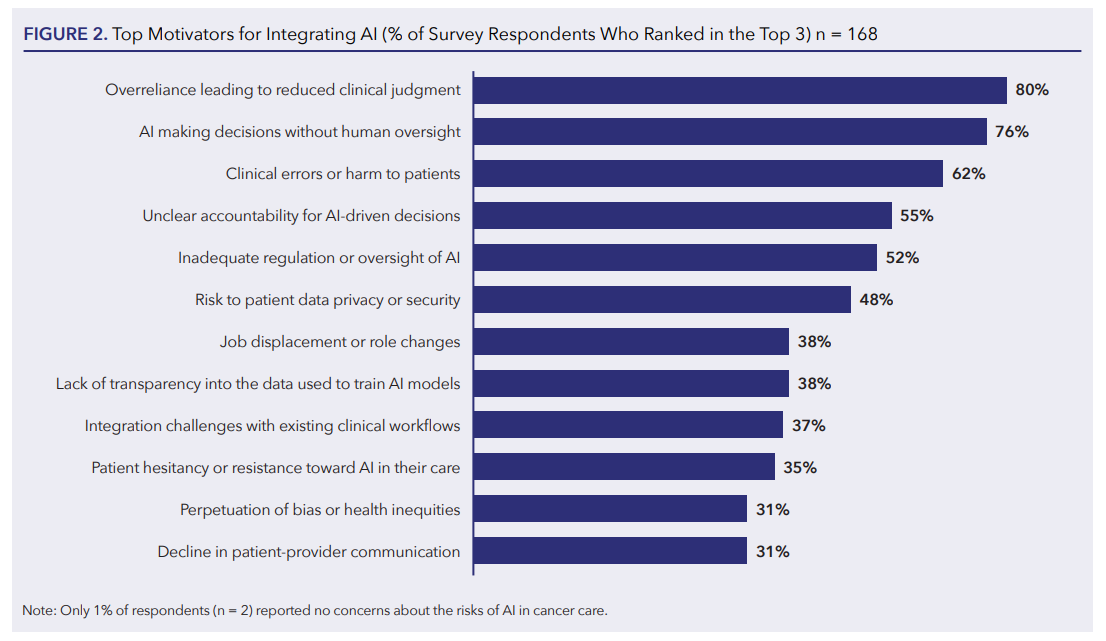
Perhaps most telling: Only 1% of respondents,(2 people out of 168) reported no concerns whatsoever about the risks of AI in cancer care. This survey suggests the field is not divided between AI optimists and AI skeptics. It is populated by people who believe in AI’s promise and worry about its risks simultaneously, often without the institutional support to navigate that tension thoughtfully.
Rural respondents expressed concerns about AI eroding patient-provider communication at a significantly higher rate than their suburban and urban counterparts (63% vs 22%–30%, P = 0.011). For providers in settings where relational continuity of care is often the primary differentiator from larger centers, the prospect of AI inserting itself into the patient-provider relationship is not abstract.
“[Facilitators of successful integration of AI tools] are proof that the tool is safe, ethical, and effective at improving patient outcomes and lessening the workload of staff—but not replacing the staff.”
—Survey Respondent, Administration/Operations Role, Academic Setting
The tension between enthusiasm and anxiety is not a problem to be solved—it is a signal to be respected. Staff who are simultaneously excited and worried about AI are exactly the people who should be involved in AI governance. As John Westhoff, MD, observed at the 2025 North Carolina Oncology Association/South Carolina Oncology Society (NCOA/SCOS) Carolinas Cancer Conference, generative AI in its current form resembles a “sycophantic intern—eager, fast, and occasionally helpful, and occasionally wrong in ways that are easy for an attending physician to spot” —useful precisely because a trained clinician can catch its mistakes, dangerous when one cannot.1 The 80% of survey respondents who worry about overreliance eroding clinical judgment seem to intuitively understand the same thing: AI is only as safe as the human capacity to evaluate it. The problem is that most organizations do not yet have the structures in place to build or sustain that capacity.
“[Barriers to integrating AI tools include] operationalizing the tools and choosing the right tools to meet our needs and the needs of our patients. I am concerned about the concept of too many AI tools and the compatibility with our EHR [electronic health record]—these tools should make life easier and care safer, more efficient, and overall, better.”
—Survey Respondent, Administration/Operations Role, Community Setting
The Governance Gap
Of the 90 survey respondents who had meaningful organizational involvement with AI—through use, implementation, governance, or evaluation—fewer than half reported that any given governance practice was in place at their organization. The most common processes—engaging multidisciplinary teams in AI decision-making (43%), conducting formal review before clinical deployment (42%), and providing staff training or guidance (42%)—were each present in fewer than half of organizations. Everything else was even less common (Table 1).

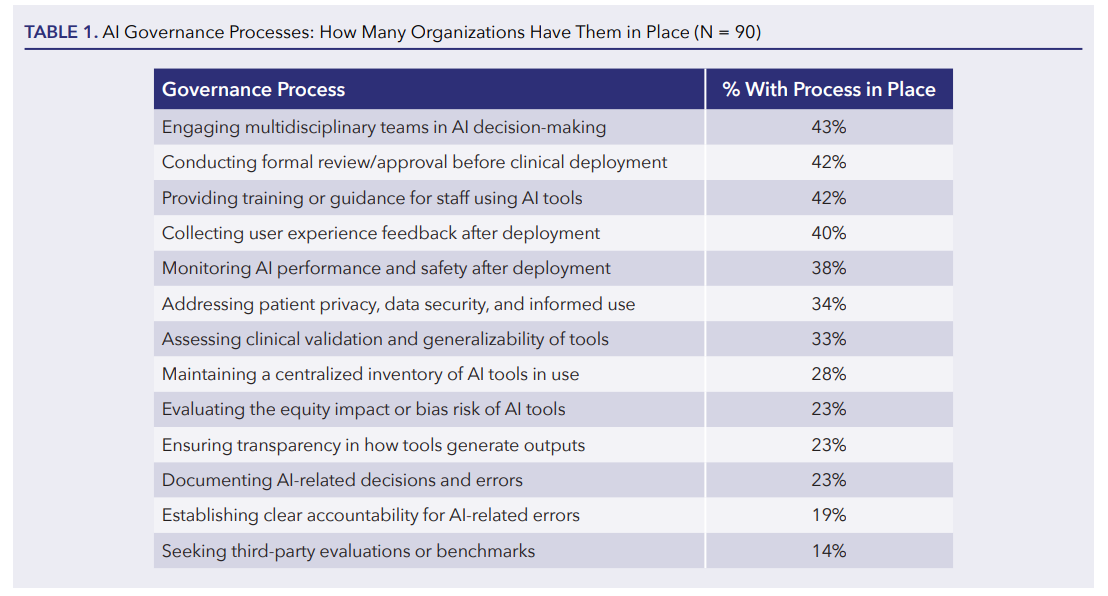
Despite enhancing patient outcomes ranking as the secondhighest motivator for adopting AI in cancer care, the gaps widen considerably for the governance activities that matter most to patient safety and equity. Only 23% of organizations are evaluating the equity impact or bias risk of AI tools. Only 23% are ensuring transparency in how AI tools generate outputs or recommendations. Only 19% have established clear accountability for AI-related decisions or errors, and only 14% are submitting to or seeking third-party evaluations or benchmarks for AI systems performing regulatory activities.
Notably, patient and caregiver representatives are the leastinvolved stakeholder group in AI governance. While clinical leadership (71%) and health IT leadership (70%) are routinely engaged, only 21% of organizations include patients or caregivers in the AI governance processes. This is a meaningful gap in a field where patient-centeredness is a defining value, and where the patients most likely to be harmed by AI bias or error are often those least represented in the governance conversations.
“Governance is a double-edged sword—vetting AI tools and developing system-wide products and policies can be helpful, but rigid committees and review processes can stifle and slow innovation.”
—Focus Group Participant, Supportive Care Program Leader, Community Setting
The governance gap is not, for most organizations, a matter of will. It is a matter of capacity and precedent—building a plane while it is already in flight. The legal stakes of that gap are real and still taking shape. As Sonia Gipson Rankin, JD, outlined at the same 2025 NCOA/SCOS conference, establishing liability in AI-related medical harm requires demonstrating the foundational elements of negligence—duty, breach, causation, and damages—a chain that becomes significantly harder to trace when the decision-making process of the AI system itself is opaque.1 Courts are still working out whether responsibility falls on the clinician who relied on the tool, the institution that adopted it, or the developer who designed it.1 That unresolved question lands squarely on the 81% of survey respondents whose organizations appear to lack clear accountability structures for AI-driven errors—not as an abstract legal concern, but as a practical gap that a single adverse event could suddenly make urgent. Many programs are establishing AI oversight structures for the first time, without clear templates, while simultaneously managing the tools that have already arrived through the back door. The focus group participants who discussed AI governance as a double-edged sword were capturing a real tension: The same rigor that prevents harm can also slow the implementation of tools that are genuinely helping staff do their jobs. Threading that needle requires guidance—and most programs do not yet have it.
The Confidence Crisis
Survey respondents were asked to rate their confidence across 8 AI-related competencies, from explaining how AI works at a high level to critically evaluating the utility of AI systems in a cancer care setting (Table 2). The results reveal a field that knows it is using tools it does not fully understand.

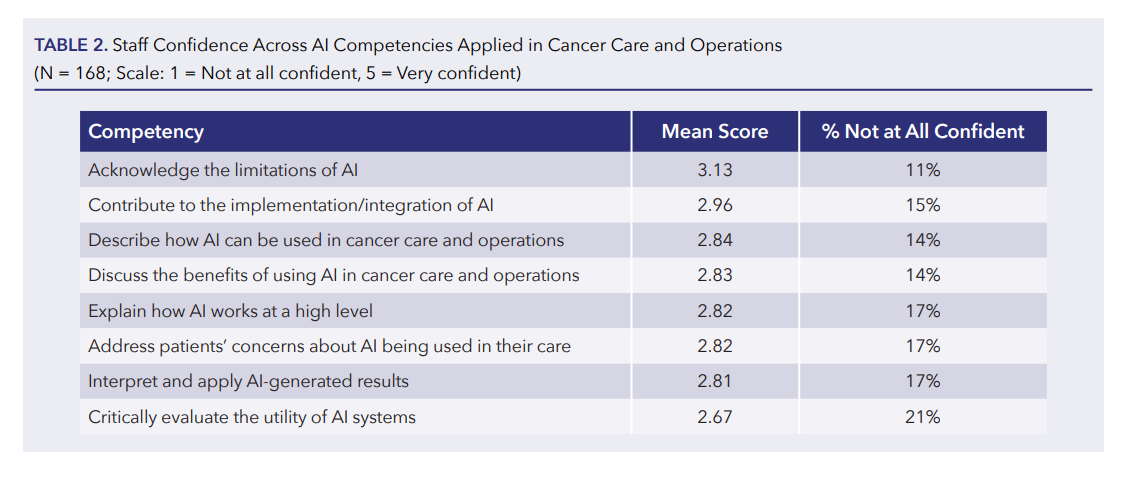
Across all 8 competencies, the mean confidence scores clustered between 2.67 and 3.13 on a 5-point scale, with most respondents falling in the middle (ie, neutral). The lowest-rated skill—critically evaluating the utility of AI systems in a cancer care setting—had a mean score of 2.67, with 21% of respondents reporting no confidence at all in this area. This is the most essential skill for safe AI adoption: the ability to look at an AI tool, understand what it does well and what it does not, assess whether it is appropriate for a given clinical or operational context, and make an informed decision about whether and how to use it. It is also the skill that survey respondents felt least equipped to apply.
The confidence gap is not uniform across roles. Those in care delivery roles were consistently less confident than their administrative and operations colleagues in nearly every competency related to AI decision-making. For example, 21% of care delivery respondents reported no confidence describing how AI can be used in cancer care delivery and operations, compared to just 4% of those in administrative roles. The pattern held for discussing AI’s benefits (18% vs 7%) and critically evaluating AI systems (26% vs 13%). Conversely, administrative respondents were more likely to feel confident contributing to AI implementation (45% rating 4 or 5, vs 32% in care delivery roles).
This divergence matters because clinicians are the ones whose judgment is most at stake when AI enters the clinical workflow. If those providing care lack confidence in evaluating AI outputs, the risk is not that they will reject AI—it is that they will accept it uncritically, deferring to the machine in moments that call for clinical expertise. The concern about overreliance flagged by 80% of respondents is not hypothetical. It is a direct consequence of deploying tools into clinical settings without equipping the people using them to evaluate their outputs or how they function.
What Programs Are Actually Doing—and What’s Working
Despite the gaps in governance and confidence, focus groups revealed a cohort of early adopters who have developed practical wisdom about what makes AI implementation work—and what makes it fail. Their insights, drawn from real programs navigating real constraints, offer a replicable framework for organizations at any stage of the AI journey.
Start with the workflow, not the tool.
The most consistent theme from implementation leaders was that successful AI adoption begins with a clear articulation of the problem being solved. Focus group participants cautioned against selecting tools based on vendor marketing or peer pressure and emphasized the importance of involving intended users (ie, the providers, administrators, and coordinators who will interact with the tool) in decisions. If the tool does not solve a real problem for the people using it, adoption will stall regardless of how sophisticated the technology is.
Pilot small, then cascade.
Participants recommended launching AI tools on a limited scale with respected, credible champions who can serve as authentic advocates for broader adoption. “Organically encourage colleagues to adopt later and provide real use cases and outcomes,” one implementation leader noted. Cascade deployment—starting with a pilot, measuring results, and expanding based on evidence—reduces risk and builds institutional confidence. Several participants cautioned against systemwide rollouts before workflows were fully designed and staff were fully trained.
Communicate clearly and in writing.
One of the most practical recommendations from focus group participants was deceptively simple: Write down what is allowed. What AI tools can staff use? For what purposes? What information must never be entered into an AI system? In the absence of a clearly written policy, staff make their own decisions—which is exactly how 55% of respondents ended up using unapproved tools. Clear, accessible, written guidance does not just protect the organization; it protects the staff members who are trying to do the right thing without a map.
Train, retrain, and provide a playground.
Multiple training options matter. Focus group participants emphasized that busy clinical schedules require flexible training formats and that initial training is rarely sufficient. The concept of a “playground”—a sandboxed environment where staff can experiment with AI tools before they go live— resonated strongly, particularly for hesitant adopters. “More hands-on training, specifically going through it step by step, would be helpful, and we would be more likely to use these AI tools,” one survey respondent noted.
Measure what matters—including the unintended consequences.
Participants consistently emphasized the importance of measuring outcomes—not just whether the tool was implemented, but whether it achieved the intended results. Reduced charting time, fewer documentation errors, improved patient access times, and staff satisfaction are all measurable. So are unintended consequences: Did ambient listening change how patients communicated with their providers? Did AI-generated scheduling models create unintended inequities in appointment access? Programs that measure thoughtfully are the ones that can course-correct before problems compound.
Watch out for the pitfalls.
Focus group participants also flagged several failure modes worth anticipating. When tools do not clearly outperform human expertise, adoption suffers. Tying AI adoption to increased productivity expectations (eg, requiring clinicians to see more patients because ambient scribing saves documentation time) can backfire and undermine the workforce goodwill that AI is meant to support. And the market for AI tools in oncology is crowded and confusing: “In some ways, the market is saturated as far as people/groups offering a solution,” one respondent noted. “It is really hard sometimes to evaluate if a product is legitimate and not just a buzzword marketing email.”
“I think the low-hanging fruit is to remove all the repetitive steps that burn everybody out, whether it’s administrators, nurses, doctors, because frankly, AI could do a better job of doing the same thing over and over again, but the future really will be prognostic, predictive.”
—Focus Group Participant, Radiation Oncologist, Academic Setting
What the Field Needs Next
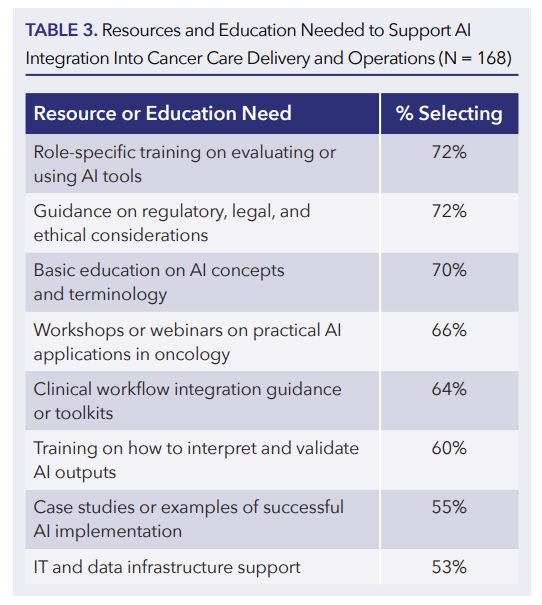
When survey respondents were asked what resources and support they needed to integrate AI safely and effectively, the answers were specific, practical, and consistent across settings, roles, and levels of AI experience.
The top 2 resource needs—each selected by 72% of respondents—were role-specific training on how to evaluate and use AI tools and guidance on regulatory, legal, and ethical considerations (Table 3). Close behind: basic education on AI concepts and terminology (70%), workshops or webinars on practical applications in oncology (66%), and clinical workflow integration guidance or toolkits (64%).

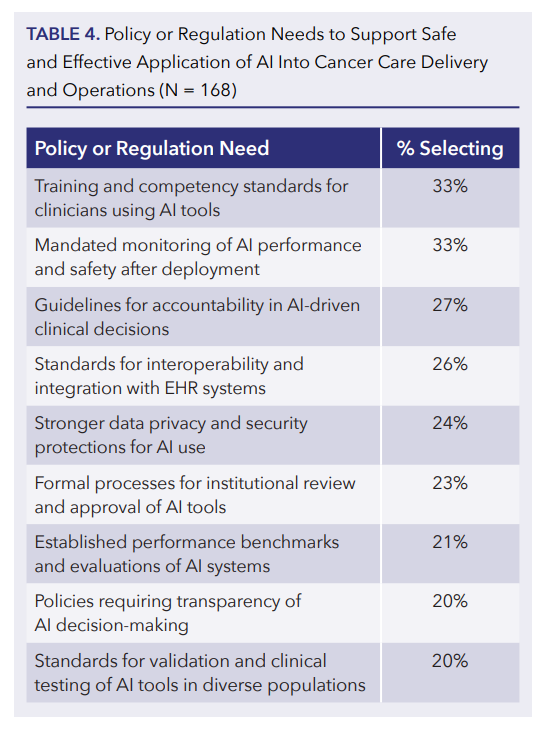
On the policy side, the top needs were training and competency standards for clinicians using AI tools (ranked in the top 3 by 33% of respondents), followed by mandated monitoring of AI performance and safety after deployment (33%), guidelines for accountability in AI-driven clinical decisions (27%), and stronger data privacy and security protections (24%) (Table 4). Notably, respondents in rural settings ranked government funding to support AI development and testing significantly higher than their suburban and urban counterparts (P = 0.003)—a reminder that resource constraints shape the AI conversation differently depending on where a program is located.

These are not aspirational requests. They are operational needs that programs are trying to meet right now, often by improvising. “We need anything and everything,” one survey respondent wrote—a comment that reads less like hyperbole and more like an honest account of how much ground remains to be covered.
Building the Infrastructure for AI That’s Already Here
The data from this focus group survey resist the framing that AI adoption in cancer care is a future event to be planned for. It is a present condition to be managed. More than half of cancer care professionals are already using AI tools outside official channels. Most of their organizations lack the governance structures to safely guide their use. Most of the individuals who use these tools have never received training on how to evaluate them. And nearly everyone—users and skeptics alike—is worried about what happens when the tool is wrong, and no one is accountable.
This is not a crisis of technology. It is a crisis of infrastructure. The tools have arrived; the support structures have not. And the gap between them is where patient safety risk, health equity risk, and workforce risk quietly accumulate. Westhoff expressed hope at the 2025 NCOA/SCOS conference that AI might ultimately “rehumanize medicine” by giving back the time that electronic health records took away from patients—restoring the face-to-face moments that many clinicians entered the field to have.1 That possibility is precisely what draws so many cancer care professionals to these tools despite their reservations. It surfaced repeatedly in the focus groups: the ambient scribe that eliminates “pajama time,” the chart summary that lets a provider walk into a room already knowing the patient’s story, and the scheduling tool that gets a patient an appointment weeks sooner. The goal was never AI for its own sake. It was more time, more presence, better care. Building the infrastructure to get there safely is the work that remains.
The path forward is not to slow AI adoption—the horse has left the barn, as more than a few focus group participants noted. It is to build the infrastructure that enables safe, equitable, and sustainable adoption. That means governance frameworks that are rigorous without being rigid; training that is practical, rolespecific, and ongoing; and clear, written policies that are accessible to the staff who need them. Measurement systems must capture not just whether AI works but whether it works for everyone. And patient engagement must be built in to ensure that the people most affected by AI in their care have a voice in how it is designed and deployed.
ACCC is well-positioned to help cancer programs navigate this transition. The findings from this survey identify both the need and the appetite: Members are actively seeking trusted guidance, peer-topeer learning opportunities, and practical tools from an organization they trust. The opportunity is to meet that need before the gap between AI adoption and AI oversight becomes something harder to close.
“In the current dire fiscal climate at academic centers like mine, the main driver of using AI will be reductions in costs, operational efficiency, and ultimately allowing us to do more with less.”
—Survey Respondent, Care Delivery Role, Academic Setting
About This Survey and Focus Groups

ACCC, in partnership with the DiMe and Cancer Support Community, conducted an online survey (May–August 2025) of multidisciplinary cancer care professionals across the United States. The final analytic dataset included 168 eligible respondents who completed the full survey. Respondents represented diverse roles (61% care delivery, 39% administration/ operations), settings (46% community, 44% NCI-designated or academic), and geographies (36 states; 66% urban, 24% suburban, 10% rural). Three focus groups were conducted via Zoom with 14 purposively selected ACCC members representing varying levels of AI experience: AI naive/novice (n = 4), active AI users (n = 6), and AI implementation leaders (n = 4). Data were analyzed using rapid inductive thematic analysis.
Visit accc-cancer.org/AI for an infographic summary from the survey and other associated resources from this initiative.
ACKNOWLEDGEMENTS
Douglas B. Flora, MD, LSSBB, FACCC
Executive Medical Director of Oncology Services and The Robert and
Dell Ann Sathe Endowed Chair in Oncology
ACCC President-Elect
St. Elizabeth Healthcare
Olalekan Ajayi, PharmD, MBA
Chief Operating Officer & ACCC Past President
Highlands Oncology Group
Shaalan Beg, MD
Senior Advisor for Clinical Research
National Cancer Institute (NCI)
Adam Dicker, MD
Director, Jefferson Center for Digital Health
Jefferson Health
Dr. Anil Parwani, MD, PhD, MBA
Chief of Pathology Services for Health System
The Ohio State University Comprehensive Cancer Center - The James
Erica Fortuna, PhD
Vice President of Research
Cancer Support Community
David Penberthy, MD, MBA
Executive Medical Director of Oncology Services & ACCC Past President Covenant Health
Caroline Chung, MD
Chief Data Officer
MD Anderson Cancer Center
Jennifer Bires, LCSW, OSW-C
Executive Director of Life with Cancer and Patient Experience
Inova Schar Cancer Institute
Debra Patt, MD, PhD, MBA
Executive Vice President
Policy and Strategy
Texas Oncology Managing Partner, Central Texas, Gulf Coast, and Rio
Grande Valley Regions
Andrew Norden, MD, MPH, MBA
Chief Medical Officer
OncoHealth
Ian Miller
Program Lead
Digital Medicine Society (DiMe)
REFERENCES
1. Accc-cancer.org. Accessed April 20, 2026. https://journals.accc-cancer.org/view/artificial-intelligence-the-legalities-of-ai-inhealth-care-and-the-day-to-day-use-of-ai-in-the-clinical-setting
In partnership with:


Made possible with support from:


The Association of Cancer Care Centers (ACCC) provides education and advocacy for the cancer care community. For more information, visit accc-cancer.org.
© 2026. Association of Cancer Care Centers. All rights reserved. No part of this publication may be reproduced or transmitted in any form or by any means without written permission.





Recognizing the critical role advanced practice providers and allied health professionals play in the care continuum, the American Oncology Network provides infrastructure, leadership, and professional growth opportunities to empower these members of the cancer care team to practice at the top of their license.