Author(s):
IN BRIEF
Patient-centered integration of mental health, gender affirming care, and cancer services is essential for addressing disparities faced by transgender and nonbinary populations. These individuals experience twice the risk of death from certain cancers and triple the rates of anxiety and depression during treatment. Disparities stem from binary health care frameworks that oversimplify the relationship between cancer treatment and gender-affirming care, alongside political restrictions creating additional barriers. Current siloed approaches treat cancer and mental health separately, compromising treatment adherence and outcomes. We propose strategies across individual (individualized assessment), interpersonal (trauma-informed provider education), and structural (systems integration) levels. This integrated framework recognizes the inseparable connection between cancer treatment, gender-affirming care, and mental health while providing pathways for implementation despite political constraints.
Cancer remains a leading cause of death in the United States, with recent advances reducing overall mortality rates.1 However, these improvements have largely bypassed transgender and nonbinary individuals, who face persistent disparities in both access to care and outcomes. Transgender and nonbinary persons have more than twice the risk of death from lymphoma, prostate cancer, and urinary bladder cancer compared to cisgender individuals, with approximately 20% not receiving needed cancer treatment.2 Federal executive orders (eg, Executive Order 141683) and state restrictions create additional barriers to care and may have a deleterious impact on mental and physical health outcomes for transgender and nonbinary populations,4,5 including for those with cancer.6 We argue that these disparities stem from 2 intersecting shortcomings within current health care systems: a rigid binary gender framework that systemically only recognizes male and female genders, thereby ignoring transgender and nonbinary health needs (ie, cisgenderism7), and significant gaps in mental health integration within cancer care protocols. While patients with cancer report greater mental distress compared to persons without cancer, there is no reported difference between these 2 groups in rates of seeking mental health services.8 However, for transgender and nonbinary persons with cancer who are being viewed through a gender-specific lens,9 the mental distress of cancer has the potential to be exacerbated by their gender identities.8 Studies have documented that cancer survivors with minoritized gender and sexual identities, including transgender and nonbinary populations, report higher psychological distress, including depression symptoms and difficulties with social relationships, compared with heterosexual survivors.10 Current care models rarely address this complex intersection, treating cancer and mental health as separate concerns rather than inherently connected aspects of patient well-being. By centering the individual’s full experience—including their gender identity goals, mental health needs, and cancer diagnosis—health care providers can develop integrated care plans that address the whole person. A patient-centered approach to this challenge is not merely beneficial but essential to all.2
Limitations of Current Cancer Care Models for Transgender and Nonbinary Patients
The inadequacy of siloed health care approaches becomes starkly evident when examining the experiences of transgender and nonbinary patients with cancer. For those undergoing gender-affirming hormonal treatments, clinical teams frequently do not provide sufficient attention to gender-affirming care goals while attending to patients’ cancer treatment goals.6,11 The complex interplay between gender-affirming hormonal treatments and cancer care often leave transgender and nonbinary patients in nebulous situations where they must navigate conflicting medical advice. For example, Cathcart-Rake and colleagues2 illustrate how transgender and nonbinary individuals frequently face overwhelming pressure to prioritize life-saving cancer treatments over their mental health needs or gender-affirming treatment goals. In their study, one patient expressed that halting testosterone therapy would drastically diminish his quality of life, underscoring the psychological implications of inadequate integration of oncological and gender-affirming treatments. Additionally, it is imperative to highlight that exogenous hormone therapy used in gender-affirming care has no significant impact on cancer risk in reproductive organs.2,11 Other researchers noted that the insufficient awareness among cancer care professionals regarding the effectiveness and benefits of gender affirmation on mental health complicates medical decision-making for transgender and nonbinary patients, making it difficult to navigate the dual needs of cancer care and gender-affirming hormone therapy.12-14
The lack of integration between cancer care, gender-affirming care, and mental health maintenance places patients in a position where they must choose between maintaining treatments that support their psychological well-being or discontinuing them for cancer care, which in turn impacts treatment adherence and outcomes.2,11 Researchers have noted that increasing access to mental health resources can improve treatment adherence and significantly enhance quality of life for transgender and nonbinary individuals during cancer care and other distressing periods.3 This finding aligns with previous studies that have reported that the absence of comprehensive gender-affirming care introduces additional barriers (eg, gender dysphoria, institutional discrimination, and medical mistrust) that may inhibit treatment adherence and overall quality of life for this population.2,6 A focus on the role that gender-affirming care may play in cancer treatment highlights the importance of integrating patient-centered approaches to cancer care for all. Research on the role that patient-centered care15-18 plays in cancer care found that care provided with an understanding of patients’ preferences and values increased patients’ self-efficacy, perceived quality of treatment, and trust in doctors and health care institutions. Additionally, researchers have found strong evidence that patient-centered care supports the symptom experience and promotes patient survival.16
Toward a Patient-Centered Approach
Given the importance of effective integration of mental health and cancer care services for transgender and nonbinary populations, we propose foundational strategies across individual, interpersonal, and structural levels to move toward a patient-centered approach that aims to assist the alignment of cancer treatment with gender-affirming care goals to promote mental health, while also providing immense benefits for a variety of individuals (Table). Each component highlights specific barriers that transgender and nonbinary patients with cancer encounter, and delineates the benefits of addressing these barriers and offering practical implementation strategies that health care staff can adopt. The persistent disparities in cancer treatment outcomes for transgender and nonbinary individuals require systematic changes in the conceptualization and delivery of health care that are rooted in gender equity.19 Recognizing that such integration is nascent, we offer these strategies as a starting point for this approach, providing practical, concrete pathways to transform care delivery in ways that recognize the inseparable connection between cancer treatment, gender-affirming medical care, and mental health.
The implementation strategies detailed in the table acknowledge the real-world constraints of health care systems, while prioritizing changes that can significantly impact patient experiences and outcomes. For instance, the shared decision-making protocols outlined at the individual level can transform routine clinical encounters into collaborative spaces where transgender patients with cancer actively participate in weighing cancer treatment options against their mental health and gender-affirming goals. Tools like the Shared Decision-Making Questionnaire20,21 can help providers assess whether this type of decision-making is being effectively implemented during clinical visits. While this measure has been validated in general populations and in an oncology setting,20 further validation with transgender and nonbinary cancer patients is needed to ensure it captures their unique experiences while navigating both cancer and gender-affirming care. Specifically for transgender and nonbinary patients, the documentation of patient preferences regarding gender-affirming care is crucial during cancer treatment to ensure that these priorities remain visible throughout the care journey,2 preventing the common scenario where initial acknowledgments of gender identity goals fade as cancer treatment intensifies.
At the interpersonal level, addressing barriers and factors, including transgender and nonbinary people’s experiences of high rates of mistreatment and trauma in health care settings,2,11 is essential. Trauma-informed care practices become critical for provider education.22 These practices equip providers to recognize trauma responses, avoid re-traumatization during vulnerable cancer procedures, and create safety through consistent validation of gender identity goals. Trauma-informed care moves beyond basic cultural competency to address the specific histories of discrimination many transgender and nonbinary patients bring to cancer care.

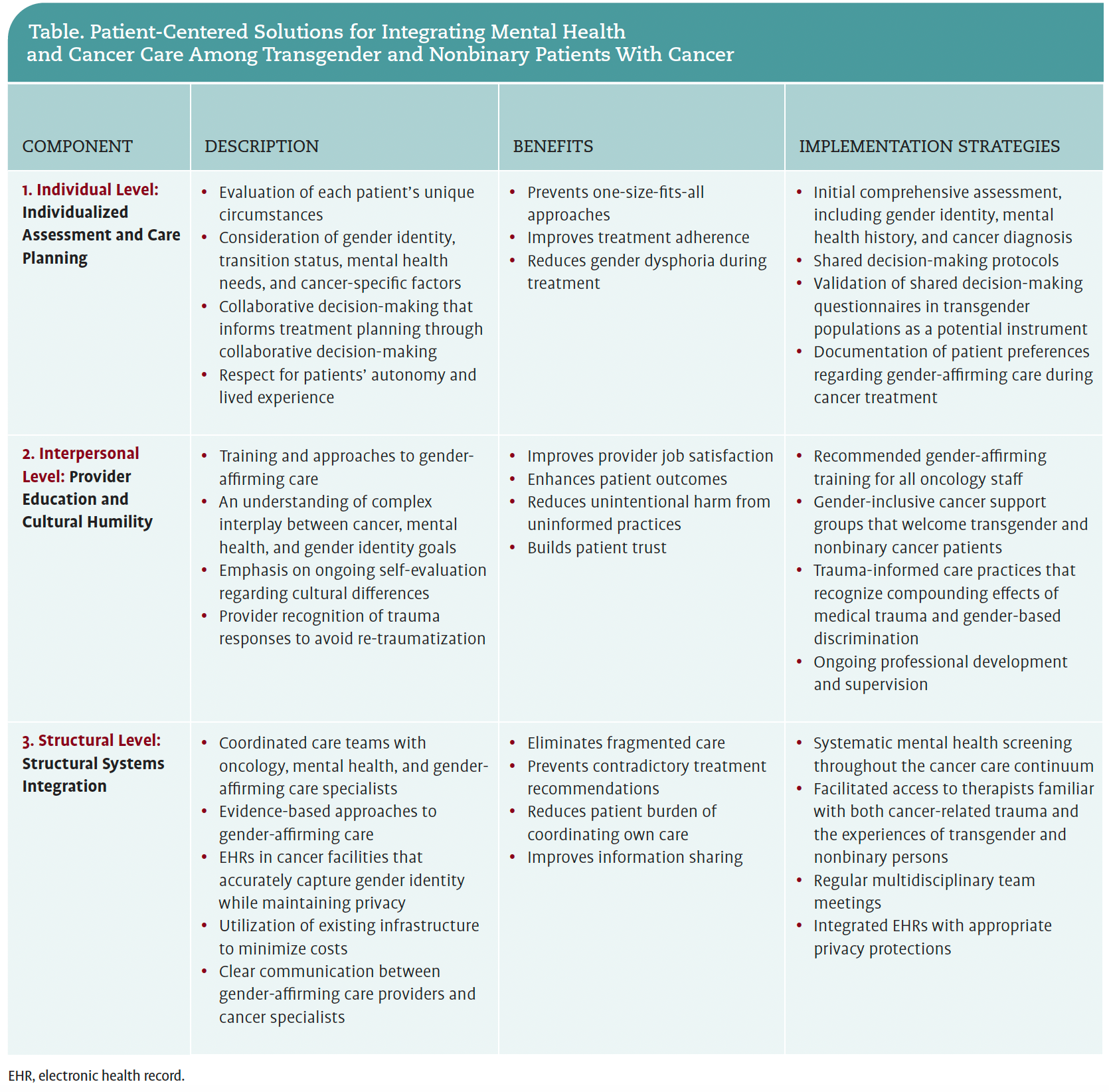
Similarly, at the structural level, systematic mental health screening as part of systems integration represents a pragmatic intervention that can be implemented universally in cancer programs.19 By establishing routine screening at key treatment stages: screening, detection, diagnosis, pre-surgery, during treatment, and into survivorship, providers can identify warning signs of adverse mental health outcomes (eg, anxiety, depression, suicidality) associated with gender dysphoria before they escalate to crisis levels, enabling preventive steps that could otherwise disrupt cancer treatment and recovery.
Moreover, while resource constraints remain a challenge for clinical integration, evidence from other chronic conditions suggests that patient-centered care approaches may offer cost-effective solutions. Patient-centered care interventions in HIV care showed cost savings alongside improved outcomes, with similar findings in psoriasis and palliative care management.23-25 The approaches outlined (ie, shared decision-making, trauma-informed care, and systematic screening) could potentially be integrated into existing workflows through training current staff, utilizing existing documentation systems, and incorporating brief validated tools into routine visits. Though initial implementation requires investment in training, these approaches may reduce long-term costs by improving treatment adherence and facilitating fewer crisis interventions.
However, further research is needed to determine the specific resource requirements and cost-effectiveness of these integrated approaches in oncology settings serving transgender and nonbinary populations.
A Look Forward
Applying a patient-centered approach to integrating mental health and cancer services for transgender and nonbinary populations is not merely a matter of inclusivity—it is a promising approach that directly impacts survival rates, treatment adherence, and quality of life for all. By recognizing the inseparable connection between physical health, mental well-being, and affirmation of gender identity goals, cancer care programs can develop more effective, equitable care models that address the whole person rather than treating cancer and mental health as unrelated concerns. The implementation of integrated care frameworks demonstrates to transgender and nonbinary patients that their identities are valued and their comprehensive health needs are legitimate; this helps to break down the medical mistrust and discomfort that many have experienced in health care settings. This holistic approach, while designed to be inclusive of the unique experiences of transgender and nonbinary patients with cancer, ultimately benefits all patients by acknowledging the diverse mental health needs that arise within the context of cancer care.
Despite researchers’ findings that these evidence-based approaches are beneficial, their real-world implementation faces unprecedented challenges. The current political climate, including federal and state restrictions on gender-affirming care, creates significant challenges for health care providers seeking to implement these recommendations.5 In states with restrictive policies, providers may face legal or institutional barriers to explicitly addressing gender identity in cancer care. The patient-centered care framework we describe may offer a pathway for using protective language that emphasizes individualized care and patient preferences without triggering restrictive policies, though further evaluation of its feasibility in restrictive environments is warranted. Similarly, shared decision-making and trauma-informed care are evidence-based practices endorsed by researchers26,27 and are gaining traction as part of clinical care standards in oncology care,28,29 which may provide institutional support for their use. While the broader political environment remains uncertain, focusing on the universal benefits of these approaches, such as improved treatment adherence, potential cost reductions, and better survival outcomes, may help providers sustain their use in ways that also affirm the needs of transgender and nonbinary patients.
Moving forward, the development of these approaches requires meaningful consultation with members of the transgender and nonbinary cancer community to ensure cultural competence and authentic representation of lived experiences. The principles we outline represent more than incremental improvements to cancer care; they represent a fundamental shift toward recognizing that optimal cancer treatment cannot be separated from a patient’s whole self, including their gender identity, mental health, and life goals. As cancer care systems evolve, this patient-centered approach offers a path forward where quality care is not determined by political climate or geographic location, but by evidence-based practices that honor the full humanity of every patient. Ultimately, when we create systems capable of serving those facing the greatest barriers, as transgender and nonbinary patients with cancer often do, we create better cancer care for everyone.
Maximillian Morris, MSPH, is a Research and Evaluation Associate at the Weitzman Institute, Moses Weitzman Health Care System. Elizabeth Collins is a recent graduate of the Department of Psychology at Wesleyan University. Miles Horner is a recent graduate of the Department of Science and Technology Studies at Wesleyan University. Arjee Javellana Restar, PhD, MPH, is a Senior Research Scientist at the Weitzman Institute, Moses Weitzman Health Care System in Middletown, Connecticut, and an Associate Research Scientist in the Department of Social and Behavior Sciences at Yale University in New Haven, Connecticut.
References






Recognizing the critical role advanced practice providers and allied health professionals play in the care continuum, the American Oncology Network provides infrastructure, leadership, and professional growth opportunities to empower these members of the cancer care team to practice at the top of their license.