ACCC association of cancer care centers
Join/Renew
Login
Join/Renew
Login
Education & Resources
ACCC eXchange LogInCorporate Member Sponsored ResourcesPresentations & AbstractsPresident's ThemeACCC Connect eLearning LogIn
Publications
Oncology IssuesPatient Assistance & Reimbursement GuideTrending Now in Cancer Care
Events
2026 ACCC Leadership SummitAnnual Meeting & Cancer Center Business SummitCapitol Hill DayNational Oncology ConferenceOncology Reimbursement MeetingsOncology State Society Meetings
Policy & Advocacy
2024 Policy Wrap-Up and ACCC 2025 Policy PrioritiesLetters & StatementsAccess, Payment & Reimbursement ReformWhite Bagging & Brown BaggingAdvocacy ResourcesCancer Moonshot
Membership
Join | RenewWho We AreMembership Types & BenefitsCorporate MembersACCC Member Portal FAQMember Directory
Partners
Oncology State SocietiesPartner OrganizationsCME
News
News ReleasesAdvocacy News ReleasesOncology News
About ACCC
Timeline / 50th Anniversary2025 Impact ReportACCC Innovator AwardsACCC FellowsACCC Senior Staff
Breast CancerMetastatic Breast Cancer
Gastrointestinal CancerBiliary Tract CancerColorectal CancerGastric CancerLiver Cancer
Genitourinary CancerBladder CancerProstate CancerRenal Cell Carcinoma
Gynecologic CancerOvarian Cancer
Head & Neck Cancer
Hematologic MalignanciesAcute Lymphocytic Leukemia (ALL)Acute Myeloid Leukemia (AML)Chronic Lymphocytic Leukemia (CLL)Mantle Cell Lymphoma (MCL)Multiple Myeloma (MM)Myelodysplastic Syndromes (MDS)
Lung CancerNon-Small Cell Lung Cancer (NSCLC)Small Cell Lung Cancer (SCLC)
Sarcoma
Skin CancerMelanomaNon-Melanoma Skin Cancers (NMSC)
Clinical Practice & TreatmentCancer DiagnosticsCare CoordinationEHR Integration for Biomarker TestingQuality Improvement Collaboration: Integration of Precision Medicine in Community OncologyTreatment
Financial NavigationFAN Boot CampFinancial Advocacy Network (FAN) Resource LibraryPatient Assistance & Reimbursement GuidePrior Authorization
Health Equity & Access3, 2, 1, Go! Practical Solutions for Addressing Cancer Care DisparitiesAppalachian Community Cancer AllianceOncology Advanced PractitionersPersonalizing Care for Patients of All BackgroundsSocial Drivers of Health
Patient-Centered CareAddressing Care Disparities for VeteransAdolescent and Young Adult (AYA)Care Action Plans for People with CancerDermatologic ToxicitiesEmpowering CaregiversGeriatric OncologyHealth LiteracyNutritionOncology PharmacyPatient NavigationPsychosocial Care in OncologyShared Decision-MakingSupportive CareSurvivorship Care
Practice Management & OperationsCancer Program FundamentalsLeadership Sustainment and Engagement VideosOncology Practice Transformation and Integration CenterOncology Team Resiliency
ResearchACCC Community Oncology Research Institute (ACORI)
Technology & InnovationTelehealth & Digital Medicine
ACCCBuzz Blog
CANCER BUZZ Podcast
Oncology Issues
Join/Renew
Login
Breast CancerMetastatic Breast Cancer
Gastrointestinal CancerBiliary Tract CancerColorectal CancerGastric CancerLiver Cancer
Genitourinary CancerBladder CancerProstate CancerRenal Cell Carcinoma
Gynecologic CancerOvarian Cancer
Head & Neck Cancer
Hematologic MalignanciesAcute Lymphocytic Leukemia (ALL)Acute Myeloid Leukemia (AML)Chronic Lymphocytic Leukemia (CLL)Mantle Cell Lymphoma (MCL)Multiple Myeloma (MM)Myelodysplastic Syndromes (MDS)
Lung CancerNon-Small Cell Lung Cancer (NSCLC)Small Cell Lung Cancer (SCLC)
Sarcoma
Skin CancerMelanomaNon-Melanoma Skin Cancers (NMSC)
Clinical Practice & TreatmentCancer DiagnosticsCare CoordinationEHR Integration for Biomarker TestingQuality Improvement Collaboration: Integration of Precision Medicine in Community OncologyTreatment
Financial NavigationFAN Boot CampFinancial Advocacy Network (FAN) Resource LibraryPatient Assistance & Reimbursement GuidePrior Authorization
Health Equity & Access3, 2, 1, Go! Practical Solutions for Addressing Cancer Care DisparitiesAppalachian Community Cancer AllianceOncology Advanced PractitionersPersonalizing Care for Patients of All BackgroundsSocial Drivers of Health
Patient-Centered CareAddressing Care Disparities for VeteransAdolescent and Young Adult (AYA)Care Action Plans for People with CancerDermatologic ToxicitiesEmpowering CaregiversGeriatric OncologyHealth LiteracyNutritionOncology PharmacyPatient NavigationPsychosocial Care in OncologyShared Decision-MakingSupportive CareSurvivorship Care
Practice Management & OperationsCancer Program FundamentalsLeadership Sustainment and Engagement VideosOncology Practice Transformation and Integration CenterOncology Team Resiliency
ResearchACCC Community Oncology Research Institute (ACORI)
Technology & InnovationTelehealth & Digital Medicine
ACCCBuzz Blog
CANCER BUZZ Podcast
Oncology Issues
    • Education & Resources
    • Publications
    • Events
    • Policy & Advocacy
    • Membership
    • Partners
    • News
    • About ACCC
ACCC association of cancer care centers
1801 Research Boulevard, Suite 400, Rockville, MD 20850
Tel: 301.984.9496 Fax: 301.770.1949 Email Us
Contact UsVolunteers
Advertise
Career Center
Terms and Conditions
Privacy Policy
ACCC Rebranding
Copyright © 2026 Association of Cancer Care Centers. All Rights Reserved.
Advertisement

Publication

Article

Fast Facts

August 18, 2025
Oncology Issues
August 2025
Volume 40
Issue 4

Fast Facts: Vol 40, No. 4

Fast Facts: Vol 40, No. 4
Download Issue PDFDownload PDF

Study Finds At-Home Palliative Care by Paramedics Saves Money, Time, and Trips to the ER


Study researchers found that:

  • Of the 911 calls in the pilot program, 60% of calls enabled people to avoid transport to the emergency department and receive palliative care at home.
  • Treating people at home saved paramedics an average of 31 min.
  • The pilot was associated with a cost savings of $2773per 911 call when paramedics provided person-centered care in the homes of people living with cancer and other life-limiting conditions.

The pilot realized a return on investment of $4.6 for every $1 spent.

Source. Tarride JE, Stennett D, Coronado AC, et al. Economic evaluation of the “paramedics and palliative care: bringing vital services to Canadians” program compared to the status quo. Can J Emerg Med. 2024;26:671-680. https://doi.org/10.1007/s43678-024-00738-9

Nurses Maintain Top Spot as America’s Most Trusted Profession

  • 3 in 4 Americans consider nurses highly honest and ethical, making them the most trusted of 23 professions rated in Gallup’s annual survey.
  • Grade-school teachers rank second, with 61% viewing them highly.
    Military officers, pharmacists, and medical doctors also earn high trust from majority of Americans.
  • The least trusted professions— with more than half of US adults saying their ethics are low or very low—are lobbyists, members of Congress, and TV reporters.


Source. Americans’ Ratings of U.S. Professions Stay Historically Low. Gallup. Published January 13, 2025.

Americans Lack Awareness of Colon Cancer Risk

  • A nationwide survey found that 80% of adults living in the US did not know if a first-degree relative had been diagnosed with colorectal cancer.
  • Colorectal cancer is the leading cause of cancer death in men who are <50 years old and the second leading cause of death in women <50 years old.
  • People who have an immediate family member—a child, sibling, or parent—who has colorectal cancer are an estimated 2-4 times more likely to develop the disease themselves compared with people who do not have an immediate family member diagnosed with colorectal cancer.
  • With the rate of death related to colorectal cancer rising by1-2% in younger people each year, it is important to identify those at highest risk.


Source. Bonavitacola J. Majority of US adults unclear about family history of CRC. AJMC. Published August 20, 2024.

A 2024 study found that Medicaid expansion under the Affordable Care Act was associated with more timely treatment and improved
survival among people newly diagnosed with HR-negative, HER2-positive breast cancer.

Source. Shi KS, Ji X, Jiang C, et al. Association of Medicaid expansion with timely receipt of treatment and survival among patients with HR-negative, HER2-positive breast cancer. JNCCN. 2024;22(9). doi:10.6004/ jnccn.2024.7041

Highlights From an Annual Survey of HR Benefits Leaders
Survey data show that while benefits leaders acknowledge the need for a more comprehensive approach to cancer care, most employer-sponsored programs remain primarily focused on treatment and management. Key findings include:

  • 93% of benefits leaders agree that their organization should invest more in supporting cancer survivors as they transition from treatment back to health–but only 1 in 3 (33%) offered dedicated cancer survivorship programs in 2024.
  • In 2023 and 2024, nearly 3 in 4 (72%) agreed their health plan is not getting enough employees screened for cancer.
  • Most benefits leaders agree that the best ways to reduce cancer costs are through cancer prevention and screening (56%) and comprehensive benefits programs (52%) that span the full cancer journey.
  • Benefits leaders cited support for employees’ mental and emotional health as their top concern—but only half (54%) offer enhanced mental health and emotional support services for cancer patients and survivors.

Source. Employer Insights Report 2025: The State of Cancer. A Color Health survey conducted by The Harris Poll.

more online @accc-cancer.org

Improving Care in Early-Stage NSCLC: Optimizing Biomarker Testing, Treatment Planning, and Care Coordination
Developed from a series of quality improvement workshops, this webinar explores strategies for multidisciplinary cancer care teams to better understand and address barriers to care and streamline the treatment process for early-stage non-small cell lung cancer.

Delivering High-Quality Bladder Cancer Care in the Community
To navigate the growing complexity of bladder cancer care, this infographic outlines 10 essential elements of excellence in 4 key areas: core clinical services and expertise, multidisciplinary collaboration and communication, patient support and navigation, and program infrastructure, analytics, and oversight.

Harnessing AI to Empower the Community Oncology Workforce
A key challenge facing community oncology programs is the complex, time-consuming process of matching patients to appropriate clinical trials. This blog highlights insights from a session at the 46th Annual Meeting of the Society for Clinical Trials, which proposed using artificial intelligence to support and streamline patient-trial matching in real-world clinical environments.

Preventing and Managing Common Dermatologic Toxicities
Dermatologic toxicities can cause significant discomfort, emotional distress, and, in severe cases, serious harm or treatment disruption. This guide reviews common dermatologic toxicities associated with cancer treatments, opportunities for prevention, and management.

Lung Cancer Screening & Tobacco Cessation: Identifying, Engaging, and Supporting Patients
Accurately identifying eligible patients for lung cancer screening is critical to early detection and improved outcomes. This webinar provides an overview of current screening guidelines, best practices for calculating pack years, and effective approaches to discussing smoking cessation.
Articles in this issue

Anchored in Purpose: Navigating Oncology’s Shifting Landscape
Empowering Oncology Professionals with Holistic Support to Cultivate Compassion and Resilience
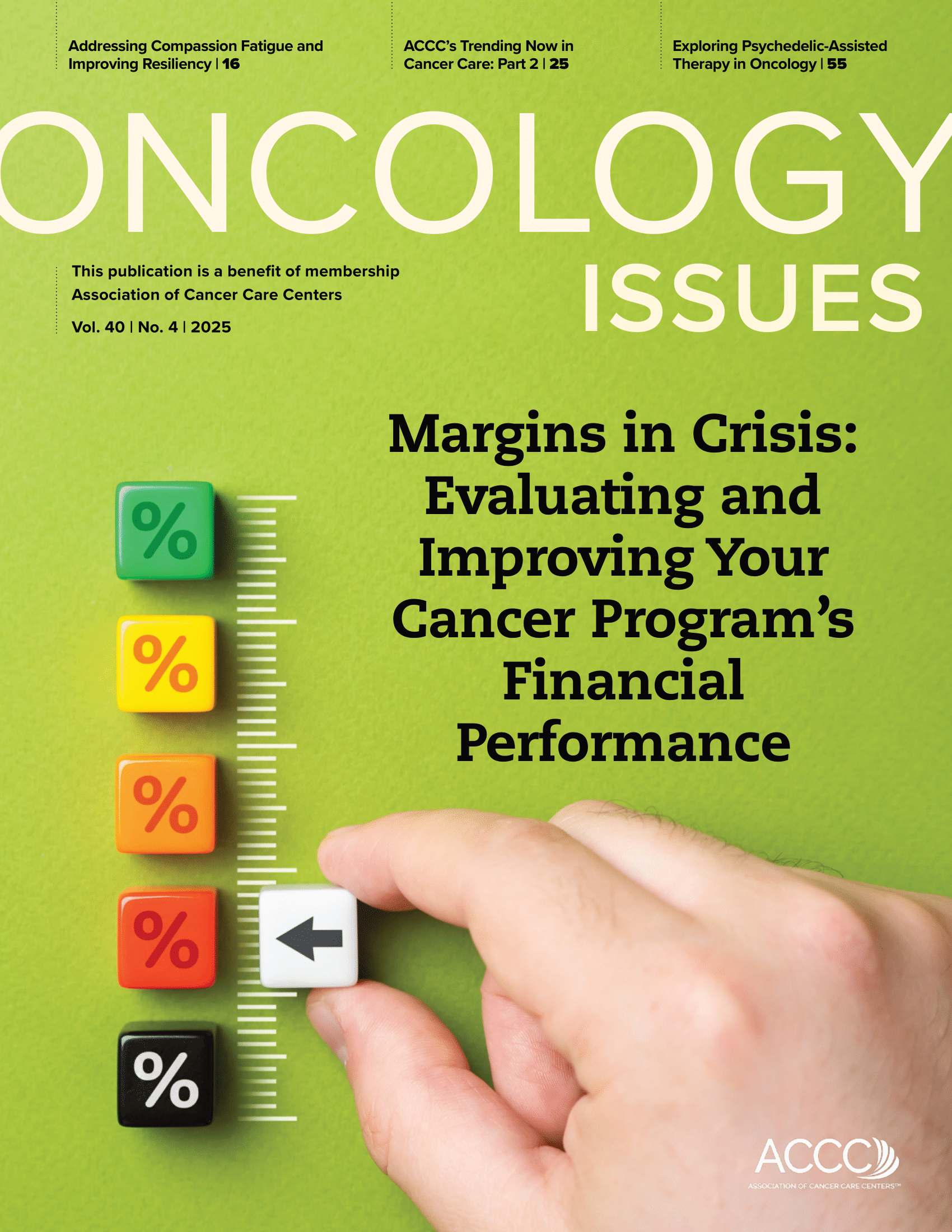
Margins in Crisis: Evaluating and Improving Your Cancer Program’s Financial Performance
Care Code® and Holistic Interventions: Addressing Compassion Fatigue and Improving Resiliency Among Staff
2025 Trending Now in Cancer Care: Part 2
Exploring Psychedelic-Assisted Therapy in Oncology
Breast Cancer Knowledge Gaps and Misconceptions Among Non-Medical Female University Students in Southwestern Nigeria
Lymphedema After Breast Cancer: Addressing Barriers and Building Strategies to Improve Long-Term Self-Management
Advancing Skin Cancer Care With a Specialized Melanoma Clinic
Integrating EHRs With Reference Labs for Biomarker Testing
Fast Facts: Vol 40, No. 4
CMS Drug Price Negotiation
The Physician Is Out: How to Bill Appropriately
Seven Steps to Achieve a Culture of Happiness at Work
Columbia Memorial Hospital-OHSU Knight Cancer Collaborative