ACCC association of cancer care centers
Join/Renew
Login
Join/Renew
Login
Education & Resources
ACCC eXchange LogInCorporate Member Sponsored ResourcesPresentations & AbstractsPresident's ThemeACCC Connect eLearning LogIn
Publications
Oncology IssuesPatient Assistance & Reimbursement GuideTrending Now in Cancer Care
Events
2026 ACCC Leadership SummitAnnual Meeting & Cancer Center Business SummitCapitol Hill DayNational Oncology ConferenceOncology Reimbursement MeetingsOncology State Society Meetings
Policy & Advocacy
2024 Policy Wrap-Up and ACCC 2025 Policy PrioritiesLetters & StatementsAccess, Payment & Reimbursement ReformWhite Bagging & Brown BaggingAdvocacy ResourcesCancer Moonshot
Membership
Join | RenewWho We AreMembership Types & BenefitsCorporate MembersACCC Member Portal FAQMember Directory
Partners
Oncology State SocietiesPartner OrganizationsCME
News
News ReleasesAdvocacy News ReleasesOncology News
About ACCC
Timeline / 50th Anniversary2025 Impact ReportACCC Innovator AwardsACCC FellowsACCC Senior Staff
Breast CancerMetastatic Breast Cancer
Gastrointestinal CancerBiliary Tract CancerColorectal CancerGastric CancerLiver Cancer
Genitourinary CancerBladder CancerProstate CancerRenal Cell Carcinoma
Gynecologic CancerOvarian Cancer
Head & Neck Cancer
Hematologic MalignanciesAcute Lymphocytic Leukemia (ALL)Acute Myeloid Leukemia (AML)Chronic Lymphocytic Leukemia (CLL)Mantle Cell Lymphoma (MCL)Multiple Myeloma (MM)Myelodysplastic Syndromes (MDS)
Lung CancerNon-Small Cell Lung Cancer (NSCLC)Small Cell Lung Cancer (SCLC)
Sarcoma
Skin CancerMelanomaNon-Melanoma Skin Cancers (NMSC)
Clinical Practice & TreatmentCancer DiagnosticsCare CoordinationEHR Integration for Biomarker TestingQuality Improvement Collaboration: Integration of Precision Medicine in Community OncologyTreatment
Financial NavigationFAN Boot CampFinancial Advocacy Network (FAN) Resource LibraryPatient Assistance & Reimbursement GuidePrior Authorization
Health Equity & Access3, 2, 1, Go! Practical Solutions for Addressing Cancer Care DisparitiesAppalachian Community Cancer AllianceOncology Advanced PractitionersPersonalizing Care for Patients of All BackgroundsSocial Drivers of Health
Patient-Centered CareAddressing Care Disparities for VeteransAdolescent and Young Adult (AYA)Care Action Plans for People with CancerDermatologic ToxicitiesEmpowering CaregiversGeriatric OncologyHealth LiteracyNutritionOncology PharmacyPatient NavigationPsychosocial Care in OncologyShared Decision-MakingSupportive CareSurvivorship Care
Practice Management & OperationsCancer Program FundamentalsLeadership Sustainment and Engagement VideosOncology Practice Transformation and Integration CenterOncology Team Resiliency
ResearchACCC Community Oncology Research Institute (ACORI)
Technology & InnovationTelehealth & Digital Medicine
ACCCBuzz Blog
CANCER BUZZ Podcast
Oncology Issues
Join/Renew
Login
Breast CancerMetastatic Breast Cancer
Gastrointestinal CancerBiliary Tract CancerColorectal CancerGastric CancerLiver Cancer
Genitourinary CancerBladder CancerProstate CancerRenal Cell Carcinoma
Gynecologic CancerOvarian Cancer
Head & Neck Cancer
Hematologic MalignanciesAcute Lymphocytic Leukemia (ALL)Acute Myeloid Leukemia (AML)Chronic Lymphocytic Leukemia (CLL)Mantle Cell Lymphoma (MCL)Multiple Myeloma (MM)Myelodysplastic Syndromes (MDS)
Lung CancerNon-Small Cell Lung Cancer (NSCLC)Small Cell Lung Cancer (SCLC)
Sarcoma
Skin CancerMelanomaNon-Melanoma Skin Cancers (NMSC)
Clinical Practice & TreatmentCancer DiagnosticsCare CoordinationEHR Integration for Biomarker TestingQuality Improvement Collaboration: Integration of Precision Medicine in Community OncologyTreatment
Financial NavigationFAN Boot CampFinancial Advocacy Network (FAN) Resource LibraryPatient Assistance & Reimbursement GuidePrior Authorization
Health Equity & Access3, 2, 1, Go! Practical Solutions for Addressing Cancer Care DisparitiesAppalachian Community Cancer AllianceOncology Advanced PractitionersPersonalizing Care for Patients of All BackgroundsSocial Drivers of Health
Patient-Centered CareAddressing Care Disparities for VeteransAdolescent and Young Adult (AYA)Care Action Plans for People with CancerDermatologic ToxicitiesEmpowering CaregiversGeriatric OncologyHealth LiteracyNutritionOncology PharmacyPatient NavigationPsychosocial Care in OncologyShared Decision-MakingSupportive CareSurvivorship Care
Practice Management & OperationsCancer Program FundamentalsLeadership Sustainment and Engagement VideosOncology Practice Transformation and Integration CenterOncology Team Resiliency
ResearchACCC Community Oncology Research Institute (ACORI)
Technology & InnovationTelehealth & Digital Medicine
ACCCBuzz Blog
CANCER BUZZ Podcast
Oncology Issues
    • Education & Resources
    • Publications
    • Events
    • Policy & Advocacy
    • Membership
    • Partners
    • News
    • About ACCC
ACCC association of cancer care centers
1801 Research Boulevard, Suite 400, Rockville, MD 20850
Tel: 301.984.9496 Fax: 301.770.1949 Email Us
Contact UsVolunteers
Advertise
Career Center
Terms and Conditions
Privacy Policy
ACCC Rebranding
Copyright © 2026 Association of Cancer Care Centers. All Rights Reserved.
Advertisement

Publication

Article

ACCC President's Message

August 18, 2025
Oncology Issues
August 2025
Volume 40
Issue 4

Empowering Oncology Professionals with Holistic Support to Cultivate Compassion and Resilience

Author(s):

Una Hopkins, DNP, MSN, BSN, FNP-BC, NE-BC, FACCC, RN

Empowering Oncology Professionals with Holistic Support to Cultivate Compassion and Resilience
Download Issue PDFDownload PDF

In the oncology landscape, where clinical complexity and emotional intensity intersect daily, the well-being of our care teams is not just a moral imperative—it’s a strategic necessity. During a time when cancer programs nationwide grapple with rising patient volumes and persistent workforce burnout, Oncology Issues features an innovative care model from White Plains Hospital that presents a deeply thoughtful and timely exploration of how structured, holistic interventions can meaningfully support oncology teams. At the heart of this model is Care Code®, which blends mindfulness, self-care, and integrative healing modalities to address the emotional toll of caring for seriously ill patients.

Oncology care providers are especially vulnerable to moral distress, burnout, and compassion fatigue—phenomena exacerbated in the post-COVID era. The strength of the Care Code model lies not only in its proactive and responsive structure (Levels 1 and 2) but also in its intentional integration of holistic practices like aromatherapy, breathing, guided meditation, and healing touch. These approaches offer both immediate emotional relief and long-term resiliency strategies. The program’s outcomes speak for themselves, with 94% of respondents affirming emotional or spiritual support and 83% reporting stress reduction after a Care Code intervention.

What is particularly powerful about Care Code is its recognition that healing must extend beyond the bedside and into the caregiver’s experience. By weaving together spiritual care, social work, holistic nursing, and clinical leadership, White Plains Hospital has created a replicable model that honors the humanity of the health care workforce.

At Montefiore, we recognize this same need through our own program, Code Lavender, an evidence-based rapid response for staff experiencing acute emotional distress. Initially launched to provide immediate psychological first aid, Code Lavender has evolved into a broader institutional commitment to staff well-being. It brings together spiritual care, wellness teams, and behavioral health clinicians to offer on-the-spot support following a traumatic event, loss, or morally distressing clinical experience. Like Care Code, it honors presence, active listening, and restorative care.

Both programs align directly with my 2025- 2026 ACCC Presidential Theme, “Designing Oncology Care to Meet the Needs of a Growing Patient Population.” As we face a growing cancer population, escalating workforce demands, and persistent burnout among providers, we must elevate models that care for the caregiver. Compassion is not an infinite resource; it requires replenishment, structure, and cultural permission. Programs like Care Code and Code Lavender exemplify how institutions can lead with empathy and accountability.

This theme calls us, as cancer care leaders, to institutionalize resilience—not as a platitude, but as a critical strategy. That means investing in trauma-informed leadership, formalizing peer support systems, integrating holistic modalities into clinical workflows, and prioritizing onboarding and education around moral resilience and self-care.

As the ACCC community continues to champion clinical innovation, let us also reimagine the emotional architecture of our cancer programs. The sustainability of our workforce—and the quality of our patient care—depends on it.
Articles in this issue

Anchored in Purpose: Navigating Oncology’s Shifting Landscape
Empowering Oncology Professionals with Holistic Support to Cultivate Compassion and Resilience
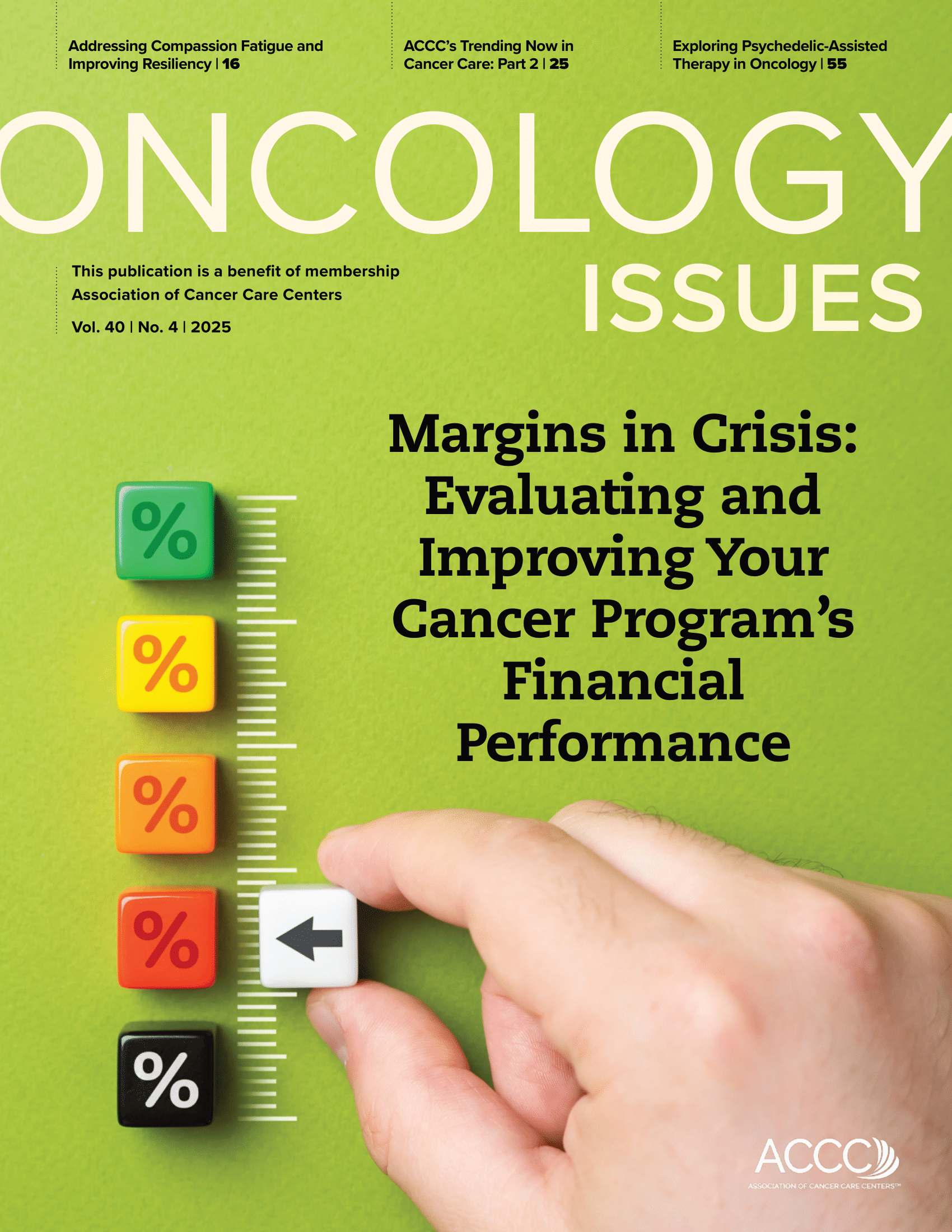
Margins in Crisis: Evaluating and Improving Your Cancer Program’s Financial Performance
Care Code® and Holistic Interventions: Addressing Compassion Fatigue and Improving Resiliency Among Staff
2025 Trending Now in Cancer Care: Part 2
Exploring Psychedelic-Assisted Therapy in Oncology
Breast Cancer Knowledge Gaps and Misconceptions Among Non-Medical Female University Students in Southwestern Nigeria
Lymphedema After Breast Cancer: Addressing Barriers and Building Strategies to Improve Long-Term Self-Management
Advancing Skin Cancer Care With a Specialized Melanoma Clinic
Integrating EHRs With Reference Labs for Biomarker Testing
Fast Facts: Vol 40, No. 4
CMS Drug Price Negotiation
The Physician Is Out: How to Bill Appropriately
Seven Steps to Achieve a Culture of Happiness at Work
Columbia Memorial Hospital-OHSU Knight Cancer Collaborative