Author(s):


The rapid evolution and proliferation of molecular testing is a multi-faceted challenge for community cancer centers, which must keep pace to provide the best available care to patients, including access to targeted therapies and clinical research.
In precision oncology—where treatment depends on a patient's molecular profile—the challenge includes knowledge, data, and technology dimensions.1,2,3 The rapid expansion of medical knowledge makes it challenging for clinicians to remain current; community cancer centers need to organize individual expertise collectively to stay up-to-date on the latest clinical evidence and best practices in the midst of very busy clinic schedules.4 A programmatic approach that invests in formal precision oncology and research programs is needed to meet this challenge.
On the data and technology fronts, the expanding knowledge of new molecular tests, relevant biomarkers, and the implications of biomarker results for targeted treatment generates emergent, complex data that need to be organized and deployed with technology to be useful for clinicians at the point of care and for oncology service lines monitoring the populations they care for at scale.
A Collaborative Partnership
This article reviews collaborative efforts between Bayhealth, Delaware's second largest health system, and N-Power Medicine, an oncology research network, data, technology, and services provider, to develop and expand Bayhealth's Precision Oncology Program. The partnership has included integrating the clinical and genomics data required to power Bayhealth's oncology precision medicine program, multidisciplinary molecular tumor board, and next-generation, "always-on" Prospective External Control Arm program (ProECA). The authors hope to provide a perspective on how community health systems and technology providers can partner to integrate data, generate insights, and then leverage these data and insights to improve patient care through precision oncology. The article will:
The authors offer a perspective on how community health systems can collaborate with technology and research service providers to integrate data, generate insights, and embed precision oncology and research at the point of care. Precision oncology and clinical research are inherently synergistic; much of clinical research in oncology is driven by the molecular data required for precision medicine. Through these partnerships, integrated precision medicine and research are no longer the sole purview of academic medical centers. Community oncology centers have a crucial role in providing access to precision medicine and research for all patients with cancer.
The Data Challenge
Fragmentation of clinical and molecular data is a common issue for community health systems. Clinical data are stored in the electronic health record (EHR), while molecular data are scattered across various laboratory databases. Most molecular testing is performed by commercial labs (eg, Foundation Medicine, Tempus, Caris) that offer both competing and complementary tests. In the community setting, providers frequently choose the tests based on individual preference. These choices result in a heterogeneous landscape of molecular data with key results living in different formats across siloed databases.
At the patient level, medical oncologists treating patients with cancer spend valuable time sifting through the EHR to find relevant pathology and molecular reports, which present key results in unstructured, narrative text that are difficult to decode. As a result, cancer registrars and care teams must manually extract, organize, and structure these data, which can be an inefficient "treasure hunt" for critical information.5 While these efforts eventually create a broader picture, the inefficient, manual process limits the ability to generate timely, actionable insights. Successful adoption of precision oncology requires accurate, complete, and timely collection and return of data, with knowledge for contextualization. Hence, systems for sharing and interpreting precision oncology information need to be embedded in clinical workflow.
At the population level, the heterogeneity and siloing of molecular data make it difficult for health systems and oncology service lines to track precision medicine testing patterns. Most commercial labs offer portals to help health system teams search their cancer populations. However, since provider choice still determines where results flow, each portal only provides part of the picture. To get a complete view, health systems must combine insights from all the labs used by their providers.
Linking molecular testing and other clinical trends is even more challenging since most of a patient's care journey—from screening to treatment—is stored in the EHR. Some community health systems use multiple EHRs, especially in oncology, where programs may adopt oncology-specific systems separate from the core EHR. Bayhealth standardized Epic for inpatient and outpatient oncology, but still needed a multiplatform approach to integrate genetic data from every commercial lab used.
Partnering to Implement Solutions
Diagnosing cancer is highly complex, and is becoming increasingly more so in the era of precision medicine, where diagnosis may also require additional molecular profiling to supplement traditional histologic assessment of tumor tissues.6,7 This complexity extends to test selection itself: ordering comprehensive molecular testing requires an up-to-date understanding of which biomarkers should be tested for a given cancer type. Testing for HER2 in lung cancer, for example, is not yet common practice, but targeted therapy options exist for patients that are HER2 positive. The Bayhealth and N-Power molecular data solutions and onsite staffing infrastructure help ensure all relevant testing options are considered for every patient.
Bayhealth originally partnered with N-Power Medicine to integrate clinical data from its EHR and cancer registry with results from the third-party molecular labs preferred by Bayhealth medical oncology, including Foundation Medicine, Caris, NeoGenomics, and Myriad. Implementation of this partnership involved multiple Bayhealth departments—oncology, pathology, research, registry, administration, and information technology (IT)—working closely with N-Power Medicine's customer success, implementation, data science, and engineering teams. The integration used existing N-Power application programming interfaces (APIs) for third-party labs and Epic EHRs and introduced new approaches to enhance the timeliness and actionability of oncology diagnoses and clinical data.
In parallel with work on the N-Power platform, Bayhealth also implemented the Epic Aura Network interface to send orders and receive results for Foundation Medicine, Natera, and Guardant Health tests. When the order has been generated, an embedded PDF of the lab result is automatically associated with the order, and discrete genomic variant results are integrated and searchable in Epic.
In addition to integrating molecular data, Bayhealth and N-Power also implemented technology to make surgical pathology data more useful at scale. The comprehensive pathologic diagnosis, including disease site, histology, and stage, is often captured in unstructured, narrative text in the reading pathologist's report and is not queryable de novo. Many EHRs offer workflows that allow pathologists to discretely capture site, stage, and histology, but structured data entry is time consuming, requiring more clicks, and the structured data fidelity is often lost in transmission through the EHR, or to other systems. Many health systems have not invested in these workflows, which require cost to EHR vendors and resources to implement.
To unlock pathology diagnostic data at scale and in a timely fashion, the N-Power Medicine implementation and data science teams worked with the Bayhealth IT team to run unstructured pathology reports through a natural language processing (NLP) pipeline. In real time, the NLP pipeline reviews surgical pathology reports flowing from the Bayhealth EHR, identifies patients with cancer, discretely extracts their cancer site and histology, and structures biomarkers from molecular tests performed in-house (eg, estrogen receptor [ER]/progesterone receptor [PR]/hormone receptor [HR] status in breast cancer).8
Using the unique patients identified by the case-finding pipeline, the integration queries, in real time, the Fast Healthcare Interoperability Resources (FHIR) APIs available in Bayhealth's EHR to automate the retrieval of clinical data. (Note: FHIR can only be queried for known patients.) Clinical data pulled from FHIR are matched via a patient-identifying management service with the molecular data incoming from the lab results pipelines, which produces unified, structured patient records that can be consistently queried at the population scale (Figure 1).

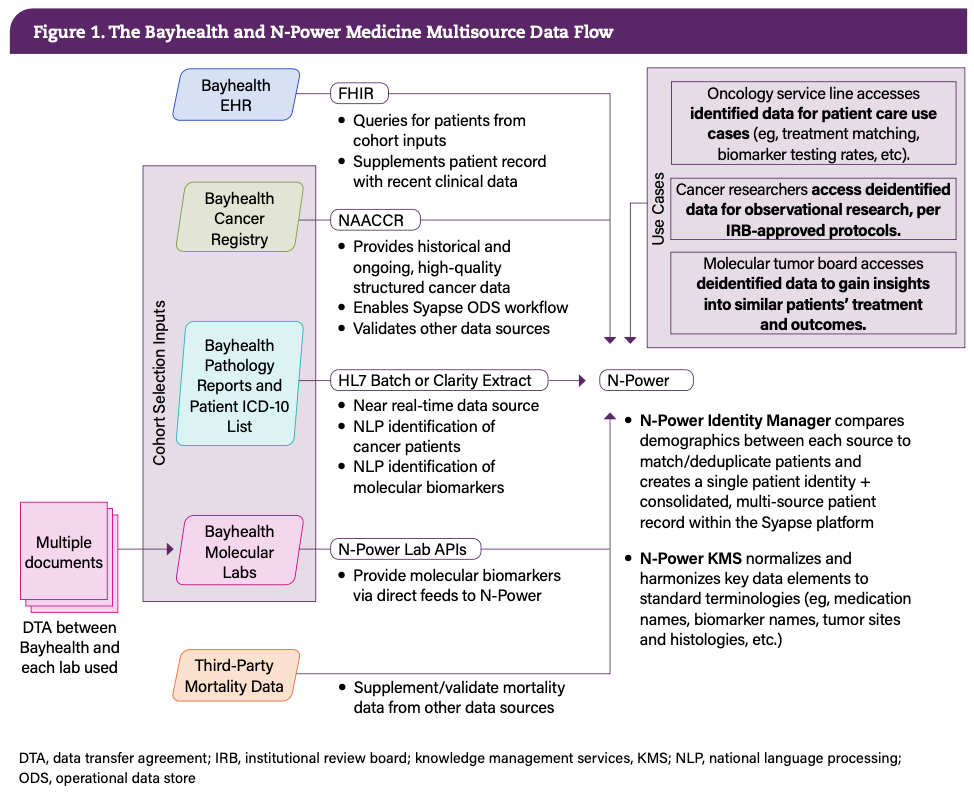
To date, the integration, which included a 5-year backload of Bayhealth molecular and clinical data in addition to the go-forward interfaces, has produced the following results:
In addition to providing Bayhealth insight into individual patients, data are deidentified and aggregated with data from all N-Power Medicine partners to create a large database of real-world oncology precision medicine data and patient cohorts that can be used for research. In the clinical care context, these data can also be used to identify "similar patients" for molecular tumor boards. Deidentified data can be accessed by the health system via several applications within the N-Power Medicine platform.
Leveraging Harmonized Data for Clinical, Quality, and Research Use Cases
Although necessary to enable oncology precision medicine and research, the integration of clinical and molecular data is not the end goal; the objective is to put the data to work to answer questions and make an impact in the clinical and research settings. Bayhealth has used the data and insights developed in partnership with N-Power Medicine to further several key initiatives, including:
Each of these initiatives merits elaboration beyond the scope of this article; we provide high-level details on how data and insights from the Bayhealth and N-Power Medicine partnership support these efforts.
Molecular Tumor Board
Bayhealth's molecular tumor is the rallying point of its oncology precision medicine program. In contrast to traditional, disease-site tumor boards, molecular tumor boards take a pan-tumor approach with a focus on the molecular drivers of disease. These boards convene multidisciplinary staff, including medical oncology, oncology pharmacy, pathology, nursing, research, genetic counseling, radiation oncology, and diagnostic and/or interventional radiology. Molecular tumor boards serve a crucial role in interpreting the actionability of molecular results and making recommendations for any molecularly indicated therapies or clinical trials.2,3,9 These boards effectively organize and extend institutional expertise, which is especially important in small, community health systems with limited resources. To illustrate Bayhealth's molecular tumor board in action, we offer the abridged case study below. Presented at the Bayhealth molecular tumor board, this patient case study leveraged data harmonized via the Bayhealth and N-Power integration. This case study illustrates the thesis of this paper and the partnership. Together, Bayhealth and N-Power Medicine supported a community
A Patient Case Study
A 53-year-old female presented with a cT2, NO, MO ER-positive, HER2neu-positive, right-sided breast cancer. After receiving neoadjuvant therapy, mastectomy, and subsequent adjuvant therapy, the patient subsequently developed brain metastases 4 years post diagnosis. Pathologic evaluation of the metastases revealed carcinoma, consistent with breast origin, now ER/PR negative, HER2neu-positive. The patient initiated trastuzumab/pertuzumab and completed radiation to the brain. The patient received molecular testing from Foundation Medicine, which revealed an ERBB2-TANG02 fusion.
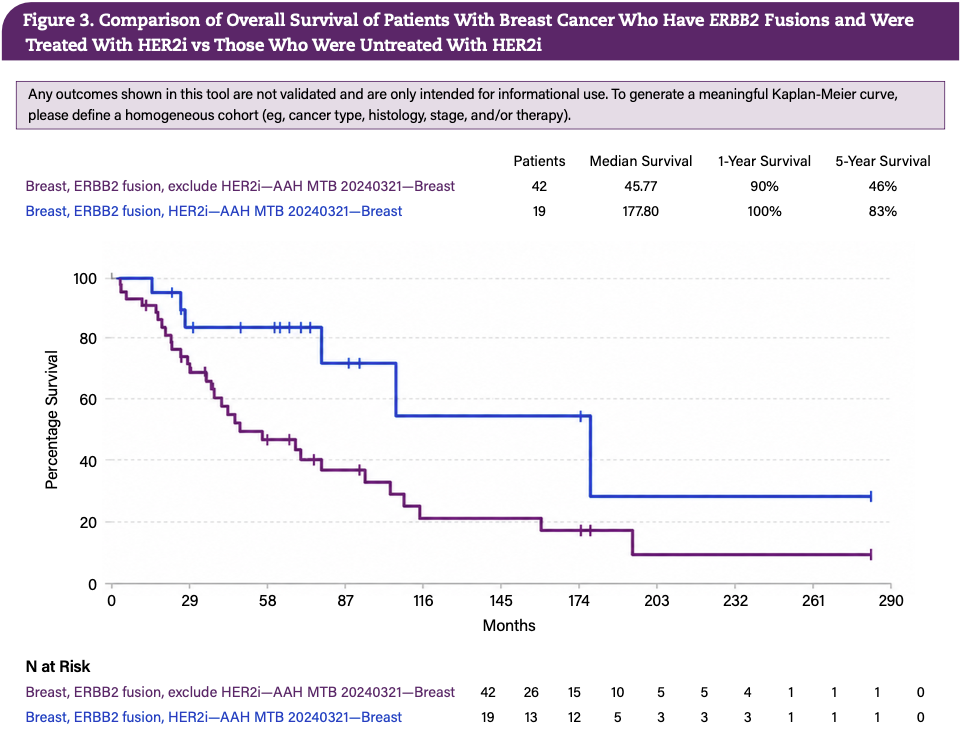
The Bayhealth molecular tumor board used the N-Power Medicine platform to search for similar patients treated at Bayhealth, specifically patients with breast cancer harboring ERRB2 fusions. No patients were found in the Bayhealth dataset, which was unsurprising given that ERRB2 fusions are rare events occurring in 0.7% to 1.89% of breast cancer cases.10,11 In the deidentified dataset aggregated from 5 N-Power Medicine health system partners, 61 patients with breast cancer were found harboring an ERBB2 fusion, and 19 of those patients received treatment with HER2-targeted therapy (Figure 2).

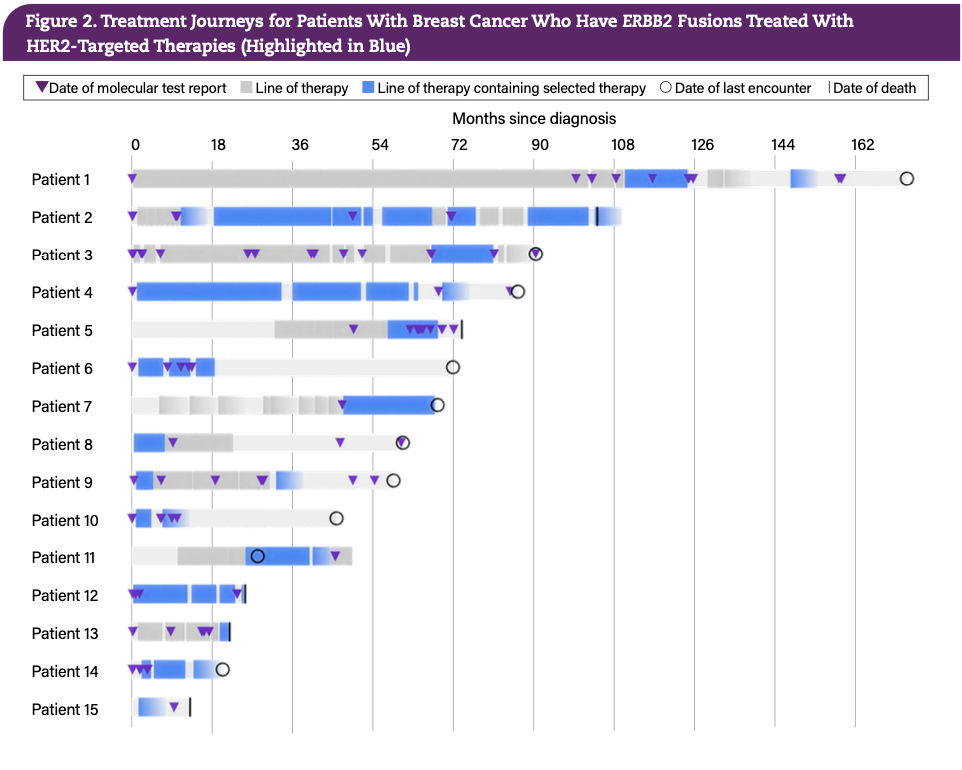
The 19 patients treated with HER2-targeted therapy were compared to the 42 patients with breast cancer also harboring ERBB2 fusions but not treated with HER2-directed therapy. The comparison shows improved median, 1-year, and 5-year survival for the patients treated with HER2-targeted therapy (Figure 3). This insight from real-world, similar patients supported the Bayhealth molecular tumor board recommendation to the treating oncologist to consider treating the patient with HER2-targeted therapy.

Expanding Reflex Testing to Early-Stage Lung Cancer
In addition to its molecular tumor board, Bayhealth maintains a robust reflex testing policy and process—a core competency in oncology precision medicine—where patients are tested at diagnosis for key biomarkers with approved targeted therapies. EGFR-targeted therapy in non–small cell lung cancer (NSCLC) is a hallmark of oncology precision medicine; drugs in this category, including osimertinib, erlotinib, and mobocertinib, have been shown to delay progression and prolong survival. Increasingly, these drugs have been shown to be effective in earlier stages of disease.12 However, optimal workflow for molecular testing in early-stage NSCLC (ie, stages I to IIIA) has not been well-defined.
At Bayhealth, patients with locally advanced and metastatic (ie, stage ≥ IIIB) NSCLC have been reflexively tested for standard-of-care biomarkers (eg, EGFR, ALK, ROS1, and PD-L1) since 2018—a well-established approach to improve the consistency and efficiency of a complex process with many handoffs between care teams and staff.13 For Bayhealth, insights generated from the N-Power Medicine integration showed an opportunity to improve testing rates for EGFR, ALK, and PD-L1 for patients with early-stage NSCLC.
Motivated by these insights, Bayhealth Pathology and Medical Oncology decided to expand the established reflex testing policy and process to include patients diagnosed with early-stage NSCLC. These updates were implemented in November 2024 and socialized with the oncology service line through a series of presentations and working sessions during tumor boards and cancer committee meetings. An early assessment suggests that the reflex policy update has doubled EGFR testing rates for the health system, a promising signal of significant impact on patient care. The Bayhealth and N-Power Medicine teams will continue to monitor testing rates throughout 2026 and beyond to quantify the impact of reflex testing expansion.
Powering Observational Research
As part of its expanding precision medicine and oncology research initiatives, Bayhealth launched a Hematology-Oncology Fellowship Program in 2024. This fellowship provides comprehensive training in contemporary cancer care, with a strong emphasis on molecularly guided treatment, clinical trial integration, and observational research. Embedded within a community health system known for its high-impact, collaborative approach, the program is designed to prepare fellows to contribute meaningfully to advancing precision oncology while addressing the needs of diverse patient populations.
Research is a cornerstone of cancer care, and recent brainstorming has focused on translational questions aimed at understanding how precision medicine and biomarker-targeted therapies should be integrated into care delivery in the community setting. For example, the Bayhealth team is considering examining molecular predictors of poor response to immunotherapy in lung cancer. In metastatic lung cancer, many patients are now treated with immunotherapy in the front line regardless of PD-L1 status. However, there have been reports and studies that have suggested STK11 and KEAP1 somatic mutations may predict poor response to immunotherapy, including a higher risk for hyperprogression.14
The Bayhealth oncology fellows will continue to develop interesting research questions and work with the retrospective datasets available through the N-Power Medicine partnership to democratize research.
Use Cases on the Horizon
Building on the strong partnership in molecular tumor boards, quality improvement, and observational research, Bayhealth and N-Power Medicine have initiated further innovation in clinical trials, including:
This next stage of the partnership is a natural progression to extend the integrated precision medicine and research approach from the oncologist and community cancer patient to access precision medicine evidence at the point of a real treatment decision.
Decentralization of molecular and clinical data is a key challenge that must be addressed to effectively deliver precision medicine to oncology patients in the community setting. Bayhealth and N-Power Medicine have demonstrated how a collegial partnership between community health systems and technology and service providers can harmonize siloed data and deliver unified insights on clinical, quality, and research questions. The remaining work requires:
We look forward to the work ahead and hope this article has been informative for community cancer centers searching for solutions to persistent, systemic challenges in the practice of precision medicine. There is no silver bullet, but the combination of data, technology, services, and most importantly, collaboration, can yield progress and impact.
Bayhealth and N-Power Medicine are eager to report on their collaboration's progress. Building on the success of the multidisciplinary tumor board forum, we are advancing an "always-on" prospective precision medicine and research program that enhances Bayhealth oncology through improved infrastructure, physician efficiency, and expanded research operations. This effort emphasizes leveraging data and insights in clinical research to generate research-grade data at the point of care, efficiently enroll more patients in studies, and deliver better treatments faster via broader use of ProECAs.
Rishi Sawhney, MD, is Clinical Division Leader, Oncology Division and Medical Director, Bayhealth Cancer Institute at Bayhealth, Dover, Delaware; John D. Shevock, FACHE, FACMPE, is Senior Director, Oncology Division and Executive Director, Bayhealth Cancer Institute at Bayhealth, Dover, Delaware; Jennifer Becke is Application Analyst III (Epic Beacon) at Bayhealth, Dover, Delaware; Stephanie McClellan, DNP, MBA, RN, CMSRN, NE-BC, is Associate Chief Nurse at Veterans Administration, Wilmington, Delaware; Adam Jonas is Clinical Data Lead at N-Power Medicine, Redwood City, California; and Luke Peterson is Strategic Partner Executive at N-Power Medicine, Redwood City, California.
References






In recognition of Leukemia and Lymphoma Awareness Month, ACCC compiled a group of resources to help care teams navigate two of the most commonly diagnosed adult leukemias: acute myeloid leukemia and chronic lymphocytic leukemia.