Author(s):
Early in the COVID-19 pandemic, CHRISTUS St. Vincent Regional Medical Center in Santa Fe, New Mexico identified significant gaps in care for its American Indian patients. Not only was the virus spreading rapidly through communities, but patients were facing significant delays in care due to the complex referral process from the Indian Health Service (IHS) to CHRISTUS St. Vincent.
IHS was established in 1955 to provide care for American Indians and Alaska Natives in their communities. Its clinics, located on or near federal Indian reservations, provide culturally responsive care to the unique Nations, Pueblos, and Tribes in their region. However, the IHS system does not offer all areas of specialty care, and patients are often referred to mainstream hospitals for complex cases or specialized treatments. During the COVID-19 pandemic, when health systems across the United States faced unprecedented capacity strains, the Albuquerque Area IHS relied on hospitals like CHRISTUS St. Vincent to fill the gaps.
One of CHRISTUS St. Vincent’s research nurses, who is Navajo and Tohono O’odham, stepped in during this period to support American Indian patients during their transition to the hospital. Offering culturally responsive care and communication based on her own knowledge and lived experience helped to build trust and address the challenges that were driving disparities for this patient population. This experience also highlighted the need for a more formal, sustained support role.
“It illuminated what we already knew, which was that Native patients needed a dedicated system of support,” said Shayna Grandbois-Herrera, OPN-CG, a member of the Turtle Mountain Band of Chippewa Indians, who would become the first Native patient navigator employed by CHRISTUS St. Vincent Regional Cancer Center. Since 2023, the Native Health Navigation Program has facilitated culturally sensitive cancer care for 126 patients and counting. In a role that combines navigation, provider education, and the embrace of cultural practices, Grandbois-Herrera has transformed the patient experience for American Indians and created a comprehensive program to address barriers to care for this diverse patient population.
Challenges of a Cross-System Transition
Transitioning care from IHS to CHRISTUS St. Vincent is much more complex than seeing a new physician or traveling to a new location. IHS operates separately from the traditional health care ecosystem, with major differences in treatment options, communication, and payment.
IHS is divided into 12 Areas, or regions, of the US, each supporting a unique group of American Indian communities. The Albuquerque Area, where CHRISTUS St. Vincent is located, includes 27 Nations, Pueblos, and Tribes, with distinct cultural practices and customs around health care. Although not all providers are members of these groups, over time they become familiar with the needs and priorities of the local population and provide culturally responsive care. This care may include addressing common health concerns, recognizing prevalent social drivers of health, and honoring preferences for culturally grounded language used to describe illness and death in each specific community. For example, American Indian populations have higher rates of diabetes and heart disease compared to the general population, so care teams are often experienced in communicating about and providing care for patients with these conditions in culturally responsive ways.
IHS clinics are federally funded, with treatment capacity limited by congressional appropriations. Although these budgets have fluctuated over time, recent years have seen decreases in funding and, in turn, in specialty care. Most clinics offer primary care, including cancer screening and prevention, but oncology and hematology treatments typically require a referral outside the IHS system. The process of coordinating these referrals is challenged by a mismatched communication infrastructure. For example, the clinics in CHRISTUS St. Vincent’s region largely rely on fax rather than messaging through the electronic health record (EHR).
Funding for care within IHS clinics is called Direct Care. IHS will also fund some outside referrals through the Purchased/Referred Care (PRC) program. PRC requires an application with strict eligibility criteria and is usually the payer of last resort. If a patient’s application is denied, Medicaid or other insurance programs are a viable option. However, patients unfamiliar with this system may interpret a denial to mean that any treatment for their cancer is out of reach and thus, they never seek care. This knowledge gap illustrates one of the greatest needs for a tailored navigation program.
When patients are referred from their IHS clinic to receive cancer care at CHRISTUS St. Vincent, they must navigate a new operational structure and interface with providers who are unfamiliar with their culture, all while facing a life-altering diagnosis. This overwhelming collision of challenges takes an emotional toll. “When you’re used to the IHS system, it’s extremely intimidating to go outside of that hub that is created for Native American patients,” Grandbois-Herrera said. “We really wanted to meet patients where they were and help them ease that transition.”
When designing the program, it was important to hire a navigator with American Indian ancestry and the lived experience to relate with patients. Although Grandbois-Herrera’s cultural upbringing was different—she is a member of the Turtle Mountain Band of Chippewa Indians in North Dakota—she grew up in New Mexico and has a deep understanding of the IHS system.
“As a patient navigator, I’ve learned how important an introduction is to my patients. I introduce myself properly with my tribal affiliation, where I’m from, and I usually will say something that they can relate to, like I’m a mother or I’m an artist,” Grandbois-Herrera explained. “These kinds of small acts build a real connection and trust with the patients.”
Cultural Understanding
The Native Health Navigation Program assists patients from 24 of the 27 Nations, Pueblos, and Tribes in New Mexico and beyond. Although these groups all fall into the census category of American Indian, each is unique, with distinct cultural practices, religious beliefs, and attitudes toward health care. Beliefs about death are particularly sensitive and vary across groups, underscoring the importance of having an expert navigator in the room to facilitate conversation.

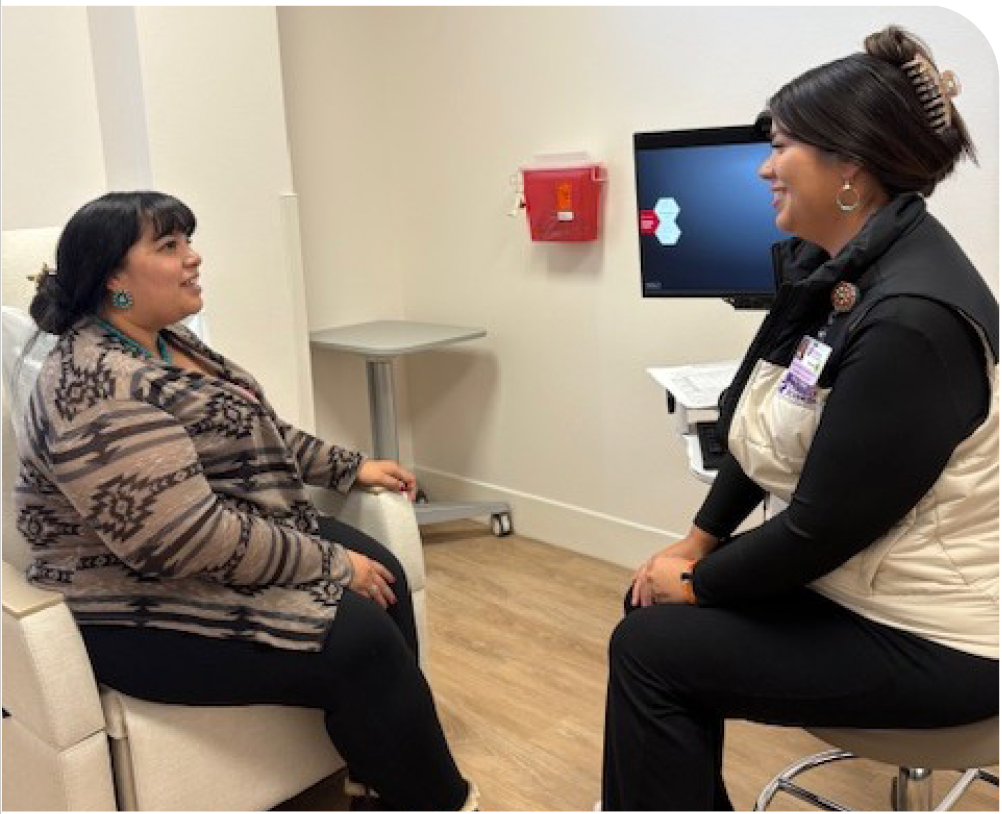
Grandbois-Herrera (right) offers one-on-one support to patients and helps to facilitate culturally responsive communication with their care team.
“There’s no way to know everything from each Tribe,” Grandbois-Herrera said. Instead, she encourages providers to “take a gentle approach, read patients’ body language, and see what they’re comfortable with and what they’re opening up to.” It requires compassion and awareness, and the Native Health Navigation Program ensures that providers are equipped for these conversations.
In addition to being in the room as a resource during delicate moments, Grandbois-Herrera works with providers to answer specific questions, either drawing on her cultural knowledge and experience or through established relationships with elders from the region’s Nations, Pueblos, and Tribes. To address larger or recurring themes, the Native Health Navigation Program hosts associate town halls.
Thus far, associate education has covered topics such as the unique barriers American Indian patients may face, strategies and tips on easing the transition from IHS to CHRISTUS St. Vincent, and operational approaches to ensure seamless care. For example, patients must have a referral from the IHS clinic documented in the EHR to process payments. After discussing this process at a provider town hall, Grandbois-Herrera received feedback from a clinic manager who, the very next day, noticed a patient missing this referral document. They were able to promptly address the issue to prevent future delays in payment or care.
Navigation Along the Patient Pathway
Along with the challenge of transitioning between health care systems, American Indian patients face both unique and familiar barriers to care. The Native Health Navigation Program addresses these challenges throughout the patient pathway, from referral onward. Grandbois-Herrera has developed relationships and procedures with local IHS clinics to minimize operational friction through the process. The primary care provider faxes the referral to the new patient team at CHRISTUS St. Vincent and directly to the Native Health Navigation Program to ensure the patient is identified for services early.
The first step for all new patients is an assessment of social drivers of health, including housing, financial security, and access to transportation. CHRISTUS St. Vincent serves a large catchment area across New Mexico and beyond, so local housing options and transportation cost grants are common forms of support. Patients also receive assistance in enrolling in Medicare or Medicaid at this point in the process, if necessary.
In many cases, Grandbois-Herrera must get more creative with personalized assistance, as in the case of a patient living in an unfinished tiny home on a reservation 45 minutes from the hospital. Recognizing the importance of housing security to the patient’s overall health during cancer treatment, Grandbois-Herrera coordinated with a local nonprofit and staff volunteers to purchase building materials, transport them to the patient’s reservation, and complete the home’s interior construction.
A one-size-fits-all approach to navigation is insufficient for patients with unique or complex barriers, which is why this kind of creative problem-solving and facilitation of resources is vital to the program’s success. For additional support in brainstorming tailored strategies, CHRISTUS St. Vincent holds cancer-center-wide navigation rounds, providing a forum for patient navigators, social workers, and patient experience coordinators to weigh in.
CHRISTUS St. Vincent aims to schedule initial appointments quickly, with approximately half of IHS patients receiving their first appointment within 1 week. Grandbois-Herrera offers to attend those appointments, especially if no family member is available. She can answer questions for both the patient and the provider in real time and will write a summary of the appointment, treatment plan, and next steps for future reference.
The goal is for patients to leave feeling comfortable and informed. They are armed with resources to understand their treatment, get to future appointments, and seek answers to future questions. Grandbois-Herrera also provides her contact information and remains available throughout the treatment journey. That ongoing support is one of the most important features of the program for patients. “I’ve had several patients who have told me how helpful it was just to have me walk alongside them throughout their journey,” she said.
Clinical Trial Education
CHRISTUS St. Vincent offers oncology clinical trials through industry and academic partners, as well as the Mayo Clinic Care Network, and a significant part of the Native Patient Navigator role is to make these opportunities available to American Indian patients. As research coordinators identify individuals who may be eligible for open clinical trials, they collaborate with Grandbois-Herrera on patient education.
Together, they explain the clinical trial in language tailored to the patient’s cultural context and health literacy level. Historical abuses enacted by medical establishments on American Indians have led to distrust in clinical research, particularly around data security.
These discussions address patients’ concerns and emphasize the benefits of participation for future generations of American Indians. Most patients served by the Native Health Navigation Program are older adults, who often bring children and grandchildren to their appointments. Grandbois-Herrera is intentional about building trust across ages and educating the whole family on how research today can reduce the burden of cancer on the next generation and beyond.
As of April 2026, CHRISTUS St. Vincent is a trial site for the JUNIPER study (NCT06569316),1 a clinical trial sponsored by the National Cancer Institute (NCI) in collaboration with the University of New Mexico and Mayo Clinic that aims to expand genetic testing for American Indians, who are historically underrepresented in both clinical research and genetic data. The trial offers comprehensive genetic testing to American Indians in the Southwest who have cancer or are cancer survivors. Participants with actionable biomarkers are connected to genetic counseling, and the data collected are used to better understand genetic risks of cancer in this population. CHRISTUS St. Vincent has created robust data use agreements to ensure that trial participants are protected, retain ownership of their data, and see the benefits of clinical research in their communities. Grandbois-Herrera is particularly excited about this clinical trial for both its immediate and future impacts on biomarker testing for American Indians.
Engaging the Community
From the beginning, members of the senior executive team at CHRISTUS St. Vincent were enthusiastic and engaged in the development of the Native Health Navigation Program. The hospital’s CEO, vice president of mission, and vice president of oncology all were internal champions, but long-term success has required external collaboration as well.
One of the key partnerships has been with referring physicians. “We had a lot of support from our local IHS clinics and those providers,” Grandbois-Herrera explained. “They were super big advocates for a program like this to start. They definitely saw the need for their patients.” Beyond establishing clear referral pathways, open lines of communication are essential to keep these community providers informed and prepared to support patients through survivorship. It is a collaborative and ongoing relationship to ensure long-term positive outcomes.
To better understand the needs of American Indians in the region, Grandbois-Herrera connected with staff from local nonprofit institutions, such as the Santa Fe Indigenous Center, and held events in partnership with local communities. One of the themes that emerged from these conversations is the need for oncology education before an individual receives a diagnosis. Educating community members about the referral pathway, clinical trials, and how traditional medicine can fit in with Western treatments makes the initiation of cancer care less overwhelming. To address this, CHRISTUS St. Vincent designed an annual symposium in partnership with the Cancer Foundation for New Mexico with education tailored to American Indians. Speakers include oncology providers from CHRISTUS St. Vincent, traditional healers, and advocates, all tackling the biggest concerns—medical or cultural—of communities in the region.
In addition to these local partnerships, CHRISTUS St. Vincent has earned national recognition and was awarded a $250,000 grant from Pfizer and the American Cancer Society to expand the Native Health Navigation Program. Over a 2-year period, this funding will support increased capacity, allowing the program to hire a second Native Health Navigator, develop more education programs for both staff and patients, expand the capabilities of the current EHR, and initiate additional community outreach. These strategic investments will help set the program up for longevity and better address present-day capacity.
In January 2026, the only other cancer center in Santa Fe closed, with many of its staff and patients transferring to CHRISTUS St. Vincent. That influx of patients illuminated the need for expansion. Fast growth has created operational challenges, but also big opportunities for impact.
The Native Patient Navigator role is rare, both in New Mexico and around the US. Grandbois-Herrera wants to see this work spread. “I would love to see a program like this on my reservation and all the other Tribal Nations out there that see the same disparities we do,” she said. In the early stages of developing the Native Health Navigation Program, she spoke with a Mayo Clinic team doing similar work to learn from their experiences. Three years after it started, CHRISTUS St. Vincent is sharing its successes with patients and the wider oncology community.
For other cancer programs interested in offering tailored navigation services for local American Indian populations, Grandbois-Herrera recommends listening to the cultural experts. She emphasized the importance of hiring individuals with American Indian ancestry, sourcing advice from elders and members of the local communities, and acknowledging the wide diversity of different Nations, Pueblos, and Tribes within the region. Above all, she said, “cultural connection is essential to care for patients and to ensure long-term success.”
Gabrielle Stearns is Associate Editor of Oncology Issues and Clinical Content Coordinator for the Association of Cancer Care Centers in Rockville, Maryland.
References






In recognition of Leukemia and Lymphoma Awareness Month, ACCC compiled a group of resources to help care teams navigate two of the most commonly diagnosed adult leukemias: acute myeloid leukemia and chronic lymphocytic leukemia.