ACCC association of cancer care centers
Join/Renew
Login
Join/Renew
Login
Education & Resources
ACCC eXchange LogInCorporate Member Sponsored ResourcesPresentations & AbstractsPresident's ThemeACCC Connect eLearning LogIn
Publications
Oncology IssuesPatient Assistance & Reimbursement GuideTrending Now in Cancer Care
Events
2026 ACCC Leadership SummitAnnual Meeting & Cancer Center Business SummitCapitol Hill DayNational Oncology ConferenceOncology Reimbursement MeetingsOncology State Society Meetings
Policy & Advocacy
2024 Policy Wrap-Up and ACCC 2025 Policy PrioritiesLetters & StatementsAccess, Payment & Reimbursement ReformWhite Bagging & Brown BaggingAdvocacy ResourcesCancer Moonshot
Membership
Join | RenewWho We AreMembership Types & BenefitsCorporate MembersACCC Member Portal FAQMember Directory
Partners
Oncology State SocietiesPartner OrganizationsCME
News
News ReleasesAdvocacy News ReleasesOncology News
About ACCC
Timeline / 50th Anniversary2025 Impact ReportACCC Innovator AwardsACCC FellowsACCC Senior Staff
Breast CancerMetastatic Breast Cancer
Gastrointestinal CancerBiliary Tract CancerColorectal CancerGastric CancerLiver Cancer
Genitourinary CancerBladder CancerProstate CancerRenal Cell Carcinoma
Gynecologic CancerOvarian Cancer
Head & Neck Cancer
Hematologic MalignanciesAcute Lymphocytic Leukemia (ALL)Acute Myeloid Leukemia (AML)Chronic Lymphocytic Leukemia (CLL)Mantle Cell Lymphoma (MCL)Multiple Myeloma (MM)Myelodysplastic Syndromes (MDS)
Lung CancerNon-Small Cell Lung Cancer (NSCLC)Small Cell Lung Cancer (SCLC)
Sarcoma
Skin CancerMelanomaNon-Melanoma Skin Cancers (NMSC)
Clinical Practice & TreatmentCancer DiagnosticsCare CoordinationEHR Integration for Biomarker TestingQuality Improvement Collaboration: Integration of Precision Medicine in Community OncologyTreatment
Financial NavigationFAN Boot CampFinancial Advocacy Network (FAN) Resource LibraryPatient Assistance & Reimbursement GuidePrior Authorization
Health Equity & Access3, 2, 1, Go! Practical Solutions for Addressing Cancer Care DisparitiesAppalachian Community Cancer AllianceOncology Advanced PractitionersPersonalizing Care for Patients of All BackgroundsSocial Drivers of Health
Patient-Centered CareAddressing Care Disparities for VeteransAdolescent and Young Adult (AYA)Care Action Plans for People with CancerDermatologic ToxicitiesEmpowering CaregiversGeriatric OncologyHealth LiteracyNutritionOncology PharmacyPatient NavigationPsychosocial Care in OncologyShared Decision-MakingSupportive CareSurvivorship Care
Practice Management & OperationsCancer Program FundamentalsLeadership Sustainment and Engagement VideosOncology Practice Transformation and Integration CenterOncology Team Resiliency
ResearchACCC Community Oncology Research Institute (ACORI)
Technology & InnovationTelehealth & Digital Medicine
ACCCBuzz Blog
CANCER BUZZ Podcast
Oncology Issues
Join/Renew
Login
Breast CancerMetastatic Breast Cancer
Gastrointestinal CancerBiliary Tract CancerColorectal CancerGastric CancerLiver Cancer
Genitourinary CancerBladder CancerProstate CancerRenal Cell Carcinoma
Gynecologic CancerOvarian Cancer
Head & Neck Cancer
Hematologic MalignanciesAcute Lymphocytic Leukemia (ALL)Acute Myeloid Leukemia (AML)Chronic Lymphocytic Leukemia (CLL)Mantle Cell Lymphoma (MCL)Multiple Myeloma (MM)Myelodysplastic Syndromes (MDS)
Lung CancerNon-Small Cell Lung Cancer (NSCLC)Small Cell Lung Cancer (SCLC)
Sarcoma
Skin CancerMelanomaNon-Melanoma Skin Cancers (NMSC)
Clinical Practice & TreatmentCancer DiagnosticsCare CoordinationEHR Integration for Biomarker TestingQuality Improvement Collaboration: Integration of Precision Medicine in Community OncologyTreatment
Financial NavigationFAN Boot CampFinancial Advocacy Network (FAN) Resource LibraryPatient Assistance & Reimbursement GuidePrior Authorization
Health Equity & Access3, 2, 1, Go! Practical Solutions for Addressing Cancer Care DisparitiesAppalachian Community Cancer AllianceOncology Advanced PractitionersPersonalizing Care for Patients of All BackgroundsSocial Drivers of Health
Patient-Centered CareAddressing Care Disparities for VeteransAdolescent and Young Adult (AYA)Care Action Plans for People with CancerDermatologic ToxicitiesEmpowering CaregiversGeriatric OncologyHealth LiteracyNutritionOncology PharmacyPatient NavigationPsychosocial Care in OncologyShared Decision-MakingSupportive CareSurvivorship Care
Practice Management & OperationsCancer Program FundamentalsLeadership Sustainment and Engagement VideosOncology Practice Transformation and Integration CenterOncology Team Resiliency
ResearchACCC Community Oncology Research Institute (ACORI)
Technology & InnovationTelehealth & Digital Medicine
ACCCBuzz Blog
CANCER BUZZ Podcast
Oncology Issues
    • Education & Resources
    • Publications
    • Events
    • Policy & Advocacy
    • Membership
    • Partners
    • News
    • About ACCC
ACCC association of cancer care centers
1801 Research Boulevard, Suite 400, Rockville, MD 20850
Tel: 301.984.9496 Fax: 301.770.1949 Email Us
Contact UsVolunteers
Advertise
Career Center
Terms and Conditions
Privacy Policy
ACCC Rebranding
Copyright © 2026 Association of Cancer Care Centers. All Rights Reserved.
Advertisement

Publication

Article

ACCC President's Message

April 14, 2025
Oncology Issues
April 2025
Volume 40
Issue 2

Meeting the Needs of a Growing Patient Population

Author(s):

Una Hopkins, DNP, MSN, BSN, FNP-BC, NE-BC, FACCC, RN

Meeting the Needs of a Growing Patient Population
Download Issue PDFDownload PDF

On March 7, I was elected president of the association of Cancer Care Centers (ACCC) at the association’s House of Delegates meeting. For readers who are not familiar with my background, I am a registered nurse with more than 30 years of experience in oncology, 25 as a nurse practitioner. Currently, I serve as the director for research and evidence-based practice at the Montefiore Medical Center in Bronx, New York, and I am fiercely dedicated to supporting and growing oncology teams. It is this dedication and passion that fueled my selection of Designing Oncology Care to Meet the Needs of a Growing Patient Population as the 2025-2026 ACCC President’s Theme.

This theme builds on the last 3 ACCC presidential themes, which focused on leveraging technology to improve the patient and provider experience; rebuilding the oncology workforce; and reimagining community engagement and equity in cancer. It is a natural progression that aims to integrate these elements into a cohesive strategy to meet the demands of a growing patient population. For the next 12 months, 4 key focus areas will collectively underpin this theme:

● Workforce Empowerment and Enablement.

Growing patient volume requires a fully utilized, well-supported workforce. To support this effort, ACCC will offer resources to help ensure all team members work in interdisciplinary collaboration and operate at the top of their license, as well as highlight how its members are supporting the oncology workforce by developing pipeline programs, innovative certification programs, mentorship opportunities, and career advancement pathways.

● Capacity-Building at Scale.

Health systems must scale their operations to meet the needs of a growing cancer patient population. ACCC will showcase how its members are implementing innovative care models such as community partnerships, virtual appointments, and decentralized care; elevating the role of advanced practice providers to expand care capacity and leadership within the cancer care team; and advocating for policies that support oncology capacity expansion.

● Technology as a Workforce Multiplier.

Integration of technology to enhance, rather than replace, the oncology workforce is crucial. We will share how our members are using AI and business intelligence tools to automate administrative and clinical tasks, improving efficiency and reducing burden. Enhancing interoperability for seamless information sharing across care settings and using digital tools to support provider efficiency and reduce burnout will lead to technology-driven care models that optimize resources, reduce clinician burden, and improve patient outcomes.

● Optimized Oncology Service Line Structures.

Comprehensive and coordinated or connected service lines are vital for ensuring reliable access to high-quality cancer care for all patients, regardless of who they are, where they live, or the location or setting in which they seek care. ACCC will showcase diverse examples of successful oncology care models tailored to different provider settings, establish governance structures for interdisciplinary service lines like oncology, and integrate clinical and nonclinical support services for a holistic patient experience. Expanding telehealth and virtual care will bridge geographic disparities, creating a seamless, equitable oncology care experience that prioritizes quality and accessibility for all patients.

I invite all ACCC member programs and practices to join us in designing oncology care to meet the needs of a growing patient population. Let us leverage our collective expertise, experience, and passion to create a future where every cancer patient receives the care they deserve.
Articles in this issue

Prioritizing Equitable Supportive Services
Meeting the Needs of a Growing Patient Population
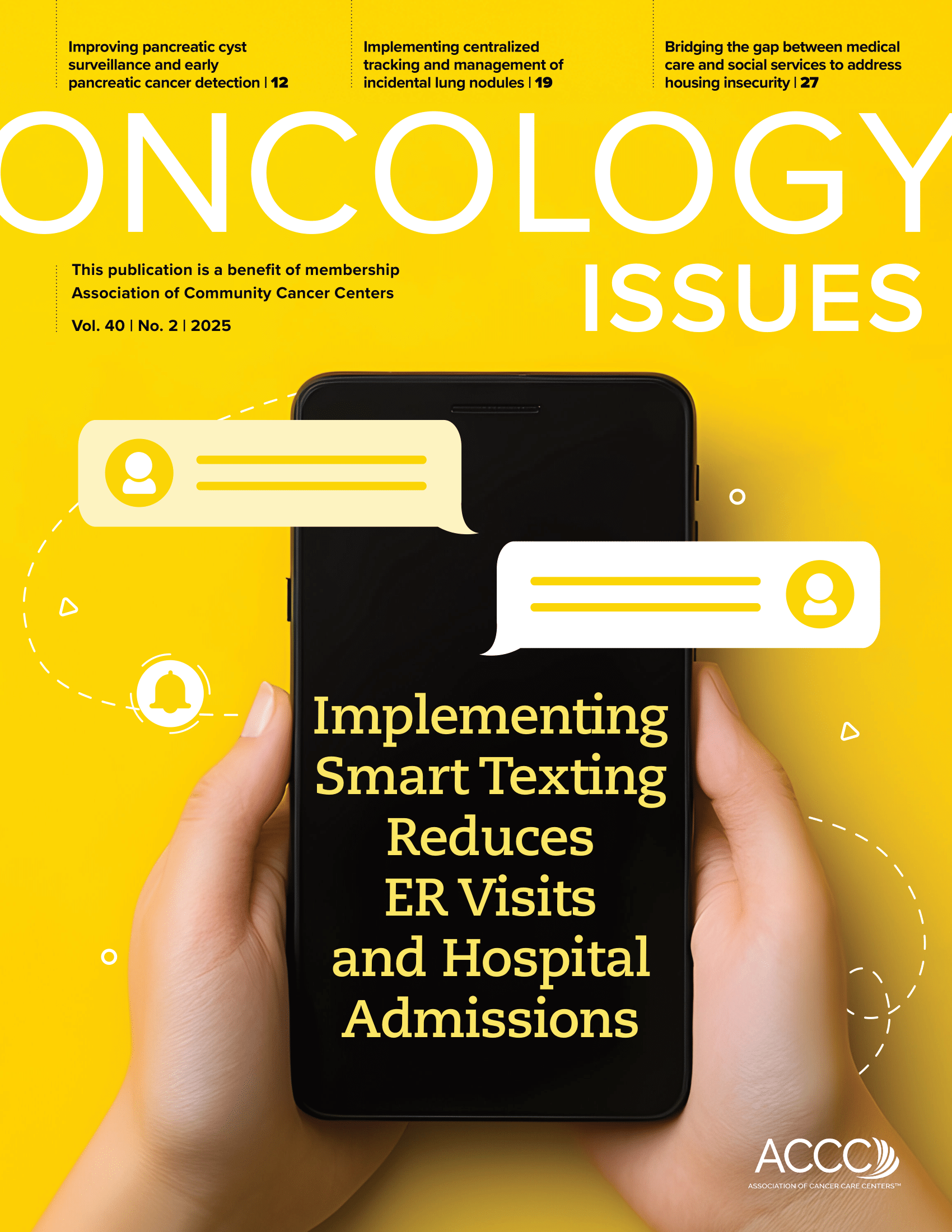
Implementing Smart Texting Reduces ER Visits and Hospital Admissions
A Sustainable Model for Pancreatic Cyst Surveillance and Early Pancreatic Cancer Detection
Creating a Community-Wide Safety Net with Centralized Tracking and Management of Incidental Lung Nodules
An Innovative Program Addresses Housing Insecurity
Adverse Event Management for CDK Inhibitors in Hormone Receptor–Positive Breast Cancer
Bridging Oncology and Dermatology: Integrating Dermatologic Toxicity Management Into Routine Cancer Care
Addressing Social Drivers of Health: A Quality Improvement Approach to Developing Oncology-Specific Screening Tools
Bringing Cancer Research to the Community: Strategic Approaches to Representative Oncology Clinical Trial Design
Treatment for Relapsed or Refractory Multiple Myeloma: Care Team Perspectives on a Bispecific Antibody
Fast Facts (April 2025)
The Inflation Reduction Act’s Potential Impact on Oncology Care: Patient Costs and Provider Reimbursement Implications
Accurate Diagnosis Coding in Oncology
Bridging the Gaps in Equitable Cancer Care