ACCC association of cancer care centers
Join/Renew
Login
Join/Renew
Login
Education & Resources
ACCC eXchange LogInCorporate Member Sponsored ResourcesPresentations & AbstractsPresident's ThemeACCC Connect eLearning LogIn
Publications
Oncology IssuesPatient Assistance & Reimbursement GuideTrending Now in Cancer Care
Events
2026 ACCC Leadership SummitAnnual Meeting & Cancer Center Business SummitCapitol Hill DayNational Oncology ConferenceOncology Reimbursement MeetingsOncology State Society Meetings
Policy & Advocacy
2024 Policy Wrap-Up and ACCC 2025 Policy PrioritiesLetters & StatementsAccess, Payment & Reimbursement ReformWhite Bagging & Brown BaggingAdvocacy ResourcesCancer Moonshot
Membership
Join | RenewWho We AreMembership Types & BenefitsCorporate MembersACCC Member Portal FAQMember Directory
Partners
Oncology State SocietiesPartner OrganizationsCME
News
News ReleasesAdvocacy News ReleasesOncology News
About ACCC
Timeline / 50th Anniversary2025 Impact ReportACCC Innovator AwardsACCC FellowsACCC Senior Staff
Breast CancerMetastatic Breast Cancer
Gastrointestinal CancerBiliary Tract CancerColorectal CancerGastric CancerLiver Cancer
Genitourinary CancerBladder CancerProstate CancerRenal Cell Carcinoma
Gynecologic CancerOvarian Cancer
Head & Neck Cancer
Hematologic MalignanciesAcute Lymphocytic Leukemia (ALL)Acute Myeloid Leukemia (AML)Chronic Lymphocytic Leukemia (CLL)Mantle Cell Lymphoma (MCL)Multiple Myeloma (MM)Myelodysplastic Syndromes (MDS)
Lung CancerNon-Small Cell Lung Cancer (NSCLC)Small Cell Lung Cancer (SCLC)
Sarcoma
Skin CancerMelanomaNon-Melanoma Skin Cancers (NMSC)
Clinical Practice & TreatmentCancer DiagnosticsCare CoordinationEHR Integration for Biomarker TestingQuality Improvement Collaboration: Integration of Precision Medicine in Community OncologyTreatment
Financial NavigationFAN Boot CampFinancial Advocacy Network (FAN) Resource LibraryPatient Assistance & Reimbursement GuidePrior Authorization
Health Equity & Access3, 2, 1, Go! Practical Solutions for Addressing Cancer Care DisparitiesAppalachian Community Cancer AllianceOncology Advanced PractitionersPersonalizing Care for Patients of All BackgroundsSocial Drivers of Health
Patient-Centered CareAddressing Care Disparities for VeteransAdolescent and Young Adult (AYA)Care Action Plans for People with CancerDermatologic ToxicitiesEmpowering CaregiversGeriatric OncologyHealth LiteracyNutritionOncology PharmacyPatient NavigationPsychosocial Care in OncologyShared Decision-MakingSupportive CareSurvivorship Care
Practice Management & OperationsCancer Program FundamentalsLeadership Sustainment and Engagement VideosOncology Practice Transformation and Integration CenterOncology Team Resiliency
ResearchACCC Community Oncology Research Institute (ACORI)
Technology & InnovationTelehealth & Digital Medicine
ACCCBuzz Blog
CANCER BUZZ Podcast
Oncology Issues
Join/Renew
Login
Breast CancerMetastatic Breast Cancer
Gastrointestinal CancerBiliary Tract CancerColorectal CancerGastric CancerLiver Cancer
Genitourinary CancerBladder CancerProstate CancerRenal Cell Carcinoma
Gynecologic CancerOvarian Cancer
Head & Neck Cancer
Hematologic MalignanciesAcute Lymphocytic Leukemia (ALL)Acute Myeloid Leukemia (AML)Chronic Lymphocytic Leukemia (CLL)Mantle Cell Lymphoma (MCL)Multiple Myeloma (MM)Myelodysplastic Syndromes (MDS)
Lung CancerNon-Small Cell Lung Cancer (NSCLC)Small Cell Lung Cancer (SCLC)
Sarcoma
Skin CancerMelanomaNon-Melanoma Skin Cancers (NMSC)
Clinical Practice & TreatmentCancer DiagnosticsCare CoordinationEHR Integration for Biomarker TestingQuality Improvement Collaboration: Integration of Precision Medicine in Community OncologyTreatment
Financial NavigationFAN Boot CampFinancial Advocacy Network (FAN) Resource LibraryPatient Assistance & Reimbursement GuidePrior Authorization
Health Equity & Access3, 2, 1, Go! Practical Solutions for Addressing Cancer Care DisparitiesAppalachian Community Cancer AllianceOncology Advanced PractitionersPersonalizing Care for Patients of All BackgroundsSocial Drivers of Health
Patient-Centered CareAddressing Care Disparities for VeteransAdolescent and Young Adult (AYA)Care Action Plans for People with CancerDermatologic ToxicitiesEmpowering CaregiversGeriatric OncologyHealth LiteracyNutritionOncology PharmacyPatient NavigationPsychosocial Care in OncologyShared Decision-MakingSupportive CareSurvivorship Care
Practice Management & OperationsCancer Program FundamentalsLeadership Sustainment and Engagement VideosOncology Practice Transformation and Integration CenterOncology Team Resiliency
ResearchACCC Community Oncology Research Institute (ACORI)
Technology & InnovationTelehealth & Digital Medicine
ACCCBuzz Blog
CANCER BUZZ Podcast
Oncology Issues
    • Education & Resources
    • Publications
    • Events
    • Policy & Advocacy
    • Membership
    • Partners
    • News
    • About ACCC
ACCC association of cancer care centers
1801 Research Boulevard, Suite 400, Rockville, MD 20850
Tel: 301.984.9496 Fax: 301.770.1949 Email Us
Contact UsVolunteers
Advertise
Career Center
Terms and Conditions
Privacy Policy
ACCC Rebranding
Copyright © 2026 Association of Cancer Care Centers. All Rights Reserved.
Advertisement

Publication

Article

Fast Facts

April 14, 2025
Oncology Issues
April 2025
Volume 40
Issue 2

Fast Facts (April 2025)

Fast Facts (April 2025)
Download Issue PDFDownload PDF

Cancer Prevention and Screening Saves Lives

In 5 cancer types, improvements in cancer prevention and screening have averted more deaths combined over the past 45 years than treatment advances, according to a modeling study led by researchers at the National Institutes of Health. From 1975 to 2020, prevention and screening efforts averted 4.75 million deaths from breast, cervical, colorectal, lung, and prostate cancer.

Source. In five cancer types, prevention and screening have been major contributors to saving lives. National Institutes of Health. Published December 5, 204. Accessed December 20, 2024.

BEAT Lung Cancer Initiative Aims to Beat Lung Cancer By...

  • Increasing awareness about biomarker testing and lung cancer screening nationwide
  • Raising awareness among Black patients with lung cancer and caregivers, as well as the larger Black community, about the availability and importance of biomarker testing and lung cancer screening
  • Empowering Black Americans to talk with their doctor about biomarker testing and lung cancer screening.

Source. Closing the gap: new campaign focuses on increasing biomarker testing in high-risk communities. Lung Cancer Association.

Tips for Becoming More Yoda and Less Superman

Leaders who want stronger, more self-sufficient teams, must let them do the work and not just fix everything by:

  • Pausing before you jump in. Instead of immediately fixing a problem, ask your team what they think should be done.
  • Giving your team room to struggle. It’s okay if your team doesn’t get it right the first time. We learn from our mistakes.
  • Setting boundaries. Not everything needs your immediate attention. Teach your team to handle more on their own.

A 2023 Kaiser Foundation survey of adults with health insurance found that 18% said they experienced denied claims in the past year. This figure increased to 22% for those with a mental health claim.

Source. Pollitz K, Pestaina K, Montero A, et al. KFF survey of consumer experiences with health insurance. Kaiser Family Foundation.

Key Findings From 2024 PODCAST Increasing Black Women’s Engagement in Breast Cancer Treatment Lung Health Barometer Survey Respondents

  • Only 28% knew that lung cancer is the leading cause of cancer deaths in the US.
  • Although lung cancer is the leading cause of cancer deaths, only 10% believed that lung cancer is among the most likely cancers to affect women while 35% believed that it was among those likely to affect men.
  • 38% were aware that lifesaving lung cancer screening is now available for those at high risk.
  • 70% agreed that they felt hopeful that the outcomes for those impacted by lung cancer improved over the past 10 years.
  • 73% have not spoken with their doctor about their risk for lung cancer and only 42% are concerned they might get the disease.
  • Only 15% of respondents were aware that the lung cancer survival rate increased by over 50% in the past 10 years.

Source. 2024 Lung Health Barometer. American Lung Association.

more online @ accc-cancer.org

Guiding Principles for Effective Management for CLL

Explore key principles for effectively managing chronic lymphocytic leukemia, with expert insights on treatment strategies, care coordination, and patient-centered approaches.

Optimizing Lung Cancer Care Through Patient Navigation

Learn how patient navigation enhances lung cancer care, with expert insights on improving patient outcomes, supporting care teams, and leveraging new reimbursement opportunities from the Centers for Medicare & Medicaid Services. Through real-world case examples, discover actionable strategies that have helped other cancer programs successfully integrate patient navigation into practice.

Increasing Black Women’s Engagement in Breast Cancer Treatment

Too often, Black women’s voices go unheard in patient-reported outcomes. In this CANCER BUZZ podcast, hear how the imPROVE study aims to bridge the gap in patient reported outcomes (PRO) data for Black women with breast cancer by enhancing engagement through tailored electronic PROs (ePROs) and partnering with community leaders to address barriers, ensuring accessibility and relevance in community cancer care settings.

Supportive Oncodermatology: Managing Skin, Hair, and Nail Toxicities in Cancer Care

This CANCER BUZZ TV podcast explores common onco-dermatological toxicities, like radiation dermatitis, hair loss, and nail changes, and discusses strategies to help providers intervene earlier and improve patients’ quality of life.

The Ripple Effect of Leadership: Inspiring Change in Cancer Care and Beyond

Barbara Schmidtman, PhD, vice president of cancer care operations at Corewell Health shares how leaders are in a unique position to continually create their own ripple effects. These can manifest in various ways—whether by helping someone advance to the next step in their career or by taking a few extra minutes while rounding to make a special connection with a patient.
Articles in this issue

Prioritizing Equitable Supportive Services
Meeting the Needs of a Growing Patient Population
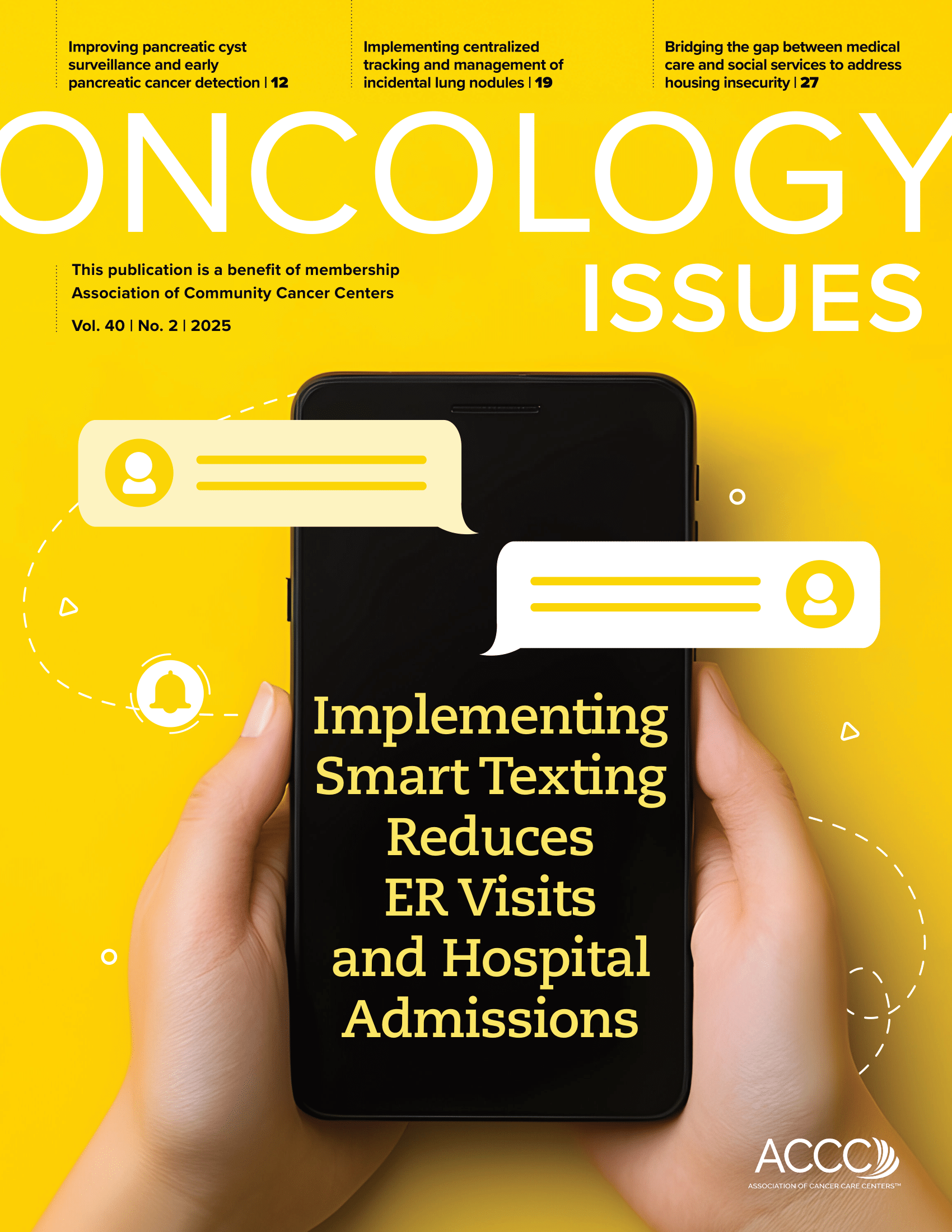
Implementing Smart Texting Reduces ER Visits and Hospital Admissions
A Sustainable Model for Pancreatic Cyst Surveillance and Early Pancreatic Cancer Detection
Creating a Community-Wide Safety Net with Centralized Tracking and Management of Incidental Lung Nodules
An Innovative Program Addresses Housing Insecurity
Adverse Event Management for CDK Inhibitors in Hormone Receptor–Positive Breast Cancer
Bridging Oncology and Dermatology: Integrating Dermatologic Toxicity Management Into Routine Cancer Care
Addressing Social Drivers of Health: A Quality Improvement Approach to Developing Oncology-Specific Screening Tools
Bringing Cancer Research to the Community: Strategic Approaches to Representative Oncology Clinical Trial Design
Treatment for Relapsed or Refractory Multiple Myeloma: Care Team Perspectives on a Bispecific Antibody
Fast Facts (April 2025)
The Inflation Reduction Act’s Potential Impact on Oncology Care: Patient Costs and Provider Reimbursement Implications
Accurate Diagnosis Coding in Oncology
Bridging the Gaps in Equitable Cancer Care