A unifying theme across much of the ACCC 46th Annual Meeting & Cancer Center Business Summit was the imperative to accelerate the integration of technology into the cancer care delivery infrastructure while also assessing how to enhance quality care with innovative practice models. On March 6, presenters at the final four sessions of the annual meeting challenged attendees to rethink how to leverage their expertise to best achieve these goals.
In the day’s first session, Lori Marcus—theDirect-to-Patient Workstream Lead at theKraft Precision Medicine Accelerator—and Anne Quinn Young, MPH—Chief Marketing and Development Officer at theMultiple Myeloma Research Foundation (MMRF) described how the Kraft Precision Medicine Accelerator project—the product of a generous endowment to Harvard Business School by the Kraft family—aims to speed the development and delivery of precision medicine therapies and clinical trials.
The Kraft Accelerator employs direct-to-patient methods (based on proven direct-to-consumer techniques used in the commercial sector) to invite the patients served by MMRF to share their genomic data and create a pool of synthesized clinical information available to everyone. Armedwiththatinformation,theprojectaims to better customize individual treatments and clinical research efforts, further bridging current gaps in clinical trials.
“Patients will be able to have much more robust conversations with their doctors about possible customized options,” said Quinn Young. “We are working hard to get all of the information we have gathered and put it out there, democratize it, so communities can take advantage of it.”
The data-sharing program—called MMRF CureCloud—has been collecting patient data since October 2019. In May 2020, it will begin offering users sequencing reports, trial matching, and counseling services.
In introducing this panel discussion, Al Benson III, MD, FACP, described the methodology behind ACCC’s Comprehensive Cancer Care Survey, whose results will be released later this year. The survey is a component of ACCC Immediate Past President Dr. Ali McBride’s 2019-2020 President’s Theme, which aims, in part, to demonstrate the need to adequately compensate cancer care teams for all of the services provided in the delivery of holistic, patient-centered care. These services, said Dr. Benson—which include nutrition counseling, patient navigation, financial navigation, social work, and survivorship care programming—are not just “nice to have” add-ons; they are essential to providing high-quality, patient-focused care.


But, added Dr. Benson—a professor of medicine in the Division of Hematology/Oncology at Northwestern University Feinberg School of Medicine and a past president of ACCC—these services are not always as valued as they should be. “There are significant gaps between costs and reimbursement for these services,” he said.
Following Dr. Benson’s remarks, a distinguished panel shared their insights into the crucial role supportive services play in comprehensive cancer care and the barriers to their delivery. Moderating the panel was Ali McBride, PharmD, MS, BCOP. Panelists included Dr. Benson, Rebecca Kirsch, JD, Executive Vice President of the National Patient Advocate Foundation; Barbara McAneny, MD, FASCO, MACP, Chief Executive Officer of New Mexico Oncology/Hematology Consultants Ltd. and Immediate Past President of the American Medical Association; Brenda Nevidjon, MSN, RN, FAAN, Chief Executive Officer of the Oncology Nursing Society; Randall A. Oyer, MD, Medical Director of Oncology at Penn Medicine Lancaster General Health and ACCC President 2020-2021; Melanie Smith, PharmD, BCACP, DPLA, American Society for Health-System Pharmacists; and Lara Strawbridge, MPH, Director of the Division of Ambulatory Payment Models at the Centers for Medicare and Medicaid Services.
The topic of patient navigation played a large role in the panel discussion. Dr. McAneny raised the need for compensating patient navigation in cancer programs and practices, stating, “Navigation is a service and not a job description.” She added, “Every person the patient comes into contact with has the responsibility to navigate that patient to the services he or she needs.”
Other panel members agreed, saying the end goal should be an integrated, team-based approach to patient care. A comprehensive care plan, they said, should include all of the essential services a given patient requires. “Cancer centers must talk to each patient, assess their needs, and connect them with the members of the team who can provide specific services,” said Dr. Benson. “We need to focus on the function of what we need to accomplish rather than on a specific role.”
Panel members also identified palliative care as an essential element in comprehensive cancer care, and the consensus was that this care should not be reserved for end of life. Dr. Oyer noted that providers often shy away from initiating conversations about palliative care with their patients, but this hesitation must be overcome. “Patients and families crave the opportunity to make more informed decisions,” said Dr. Oyer.
Survivorship services was another topic discussed by the panel. While the group agreed that survivorship care is essential, they questioned their ability to care for a burgeoning population of cancer survivors in the midst of provider shortages and escalating patient loads. “We have a system in which what we want to be able to do for patients is not reflected as it should be in the way we are reimbursed,” said Dr. McAneny.
A timely discussion moderated by Alexis Finkelberg Bortniker, a partner at Foley & Lardner LLP, addressed what lies ahead for alternative payment models (APMs). Panelists Anne Hubbard, Director of Health Policy at the American Society for Radiation Oncology; Ted Okon, Executive Director of the Community Oncology Alliance; Lalan Wilfong, MD, Vice President of Texas Oncology; and Dr. McAneny offered their retrospective thoughts on the Oncology Care Model (OCM), which is now winding down. While everyone agreed that the model had its flaws, they also agreed that it had long-term, positive effects on the delivery of oncology care.

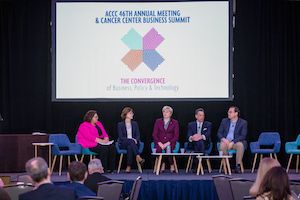
Ted Okon said he had seen practices fundamentally change under the OCM. “The OCM made us step back and look at how we treated the patient,” he explained. “I’ve seen practices go from revolving around the doctors who work there to places where the patient is at the center. Were there problems with the OCM? Yes. But we cannot overlook that the patient is now at the center of care.”
“These models give us the opportunity to try out new approaches and figure out what makes a difference,” added Dr. McAneny. She said the main obstacle to genuine payment reform remains: The fact that providers do not know the cost of their services. “If we are going to succeed in having affordable care in this country, we absolutely need to know how much healthcare services cost,” she said.
Dr. McAneny added that this inability to know costs and subsequently be able to control for them is contributing to uncontrolled spending on healthcare. “We need to know the optimal prices for the services we provide,” she said. “What is the most cost-effective model, and how can we restructure our practices to get the most competition into these systems so we can compete fairly with one another?”
Debra Patt, MD, MPH, MBA delivered the meeting’s final session. Dr. Patt, an executive vice president of TexasOncologyandEditor-in-Chiefof JCO Clinical Cancer Informatics, addressed the increasing importance of applied informatics in a world in which cancer diagnosis, prognosis, and treatment have become increasingly complex.

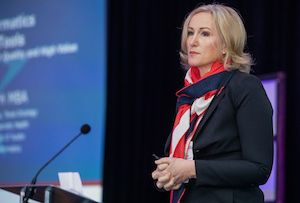
“Oncology is a totally different field than it was just a decade ago,” said Dr. Patt. The discovery of more cancer subtypes, an increasing number of available treatments, new combined therapies, the treatment of cancer as a chronic disease, and spiraling costs have brought us to the current state of oncology. In this treatment environment, said Dr. Patt, we need to make decision support as efficient and effective as possible. “We all want to navigate cancer care like we do our iPhones,” she said.
Dr. Patt described her practice’s clinical decision support system as a real-time tool for patient care. “At Texas Oncology, our support system is accessed through our electronic health record. When I write for a therapy for a patient, all of that patient’s data is collected in one place and I receive treatment options to choose from.” Dr. Patt called this tool “a nudge” that is meant to complement—not replace—individual physician judgement. Physicians receive clinical pathway-specific, evidence-based suggestions that they can choose to accept or provide a clinical reason to override.
Bringing together hundreds of leaders from organizations across the healthcare ecosystem, the ACCC 46th Annual Meeting & Cancer Center Business Summit explored the drivers of change at the crossroads of oncology, where business, clinical advances, policy, and patient-centered care intersect.
______________________________
Stay tuned to ACCCBuzz for more takeaways from the ACCC 46th Annual Meeting & Cancer Center Business Summit. On Twitter follow @ACCCBuzz and use the #AMCCBS hashtag.




In recognition of Leukemia and Lymphoma Awareness Month, ACCC compiled a group of resources to help care teams navigate two of the most commonly diagnosed adult leukemias: acute myeloid leukemia and chronic lymphocytic leukemia.