ACCC association of cancer care centers
Join/Renew
Login
Join/Renew
Login
Education & Resources
ACCC eXchange LogInCorporate Member Sponsored ResourcesPresentations & AbstractsACCC Connect eLearning LogIn
Publications
Oncology IssuesPatient Assistance & Reimbursement GuideTrending Now in Cancer CareBusiness Case Studies for Hiring New Staff
Events
2026 ACCC Leadership SummitAnnual Meeting & Cancer Center Business SummitCapitol Hill DayNational Oncology ConferenceOncology Reimbursement MeetingsOncology State Society Meetings
Policy & Advocacy
ACCC 2026 Policy PrioritiesLetters & StatementsAccess, Payment & Reimbursement ReformWhite Bagging & Brown BaggingAdvocacy ResourcesCancer Moonshot
Membership
Join | RenewWho We AreMembership Types & BenefitsCorporate MembersACCC Member Portal FAQMember Directory
Partners
Oncology State SocietiesPartner OrganizationsCME
News
News ReleasesAdvocacy News ReleasesOncology News
About ACCC
Timeline / 50th Anniversary2025 Impact ReportPresident's ThemeACCC Innovator AwardsACCC FellowsBoard of TrusteesACCC Senior Staff
Breast CancerMetastatic Breast Cancer
Gastrointestinal CancerBiliary Tract CancerColorectal CancerGastric CancerLiver Cancer
Genitourinary CancerBladder CancerProstate CancerRenal Cell Carcinoma
Gynecologic CancerOvarian Cancer
Head & Neck Cancer
Hematologic MalignanciesAcute Lymphocytic Leukemia (ALL)Acute Myeloid Leukemia (AML)Chronic Lymphocytic Leukemia (CLL)Mantle Cell Lymphoma (MCL)Multiple Myeloma (MM)Myelodysplastic Syndromes (MDS)
Lung CancerNon-Small Cell Lung Cancer (NSCLC)Small Cell Lung Cancer (SCLC)
Sarcoma
Skin CancerMelanomaNon-Melanoma Skin Cancers (NMSC)
Clinical Practice & TreatmentCancer DiagnosticsCare CoordinationEHR Integration for Biomarker TestingQuality Improvement Collaboration: Integration of Precision Medicine in Community OncologyTreatment
Financial NavigationFAN Boot CampFinancial Advocacy Network (FAN) Resource LibraryPatient Assistance & Reimbursement GuidePrior Authorization
Health Equity & Access3, 2, 1, Go! Practical Solutions for Addressing Cancer Care DisparitiesAppalachian Community Cancer AllianceOncology Advanced PractitionersPersonalizing Care for Patients of All BackgroundsSocial Drivers of Health
Patient-Centered CareAddressing Care Disparities for VeteransAdolescent and Young Adult (AYA)Care Action Plans for People with CancerDermatologic ToxicitiesEmpowering CaregiversGeriatric OncologyHealth LiteracyNutritionOncology PharmacyPatient NavigationPsychosocial Care in OncologyShared Decision-MakingSupportive CareSurvivorship Care
Practice Management & OperationsCancer Program FundamentalsLeadership Sustainment and Engagement VideosOncology Practice Transformation and Integration CenterOncology Team Resiliency
ResearchACCC Community Oncology Research Institute (ACORI)
Technology & InnovationTelehealth & Digital Medicine
ACCCBuzz Blog
CANCER BUZZ Podcast
Oncology Issues
Join/Renew
Login
Breast CancerMetastatic Breast Cancer
Gastrointestinal CancerBiliary Tract CancerColorectal CancerGastric CancerLiver Cancer
Genitourinary CancerBladder CancerProstate CancerRenal Cell Carcinoma
Gynecologic CancerOvarian Cancer
Head & Neck Cancer
Hematologic MalignanciesAcute Lymphocytic Leukemia (ALL)Acute Myeloid Leukemia (AML)Chronic Lymphocytic Leukemia (CLL)Mantle Cell Lymphoma (MCL)Multiple Myeloma (MM)Myelodysplastic Syndromes (MDS)
Lung CancerNon-Small Cell Lung Cancer (NSCLC)Small Cell Lung Cancer (SCLC)
Sarcoma
Skin CancerMelanomaNon-Melanoma Skin Cancers (NMSC)
Clinical Practice & TreatmentCancer DiagnosticsCare CoordinationEHR Integration for Biomarker TestingQuality Improvement Collaboration: Integration of Precision Medicine in Community OncologyTreatment
Financial NavigationFAN Boot CampFinancial Advocacy Network (FAN) Resource LibraryPatient Assistance & Reimbursement GuidePrior Authorization
Health Equity & Access3, 2, 1, Go! Practical Solutions for Addressing Cancer Care DisparitiesAppalachian Community Cancer AllianceOncology Advanced PractitionersPersonalizing Care for Patients of All BackgroundsSocial Drivers of Health
Patient-Centered CareAddressing Care Disparities for VeteransAdolescent and Young Adult (AYA)Care Action Plans for People with CancerDermatologic ToxicitiesEmpowering CaregiversGeriatric OncologyHealth LiteracyNutritionOncology PharmacyPatient NavigationPsychosocial Care in OncologyShared Decision-MakingSupportive CareSurvivorship Care
Practice Management & OperationsCancer Program FundamentalsLeadership Sustainment and Engagement VideosOncology Practice Transformation and Integration CenterOncology Team Resiliency
ResearchACCC Community Oncology Research Institute (ACORI)
Technology & InnovationTelehealth & Digital Medicine
ACCCBuzz Blog
CANCER BUZZ Podcast
Oncology Issues
    • Education & Resources
    • Publications
    • Events
    • Policy & Advocacy
    • Membership
    • Partners
    • News
    • About ACCC
ACCC association of cancer care centers
1801 Research Boulevard, Suite 400, Rockville, MD 20850
Tel: 301.984.9496 Email Us
Contact UsVolunteers
Advertise
Career Center
Terms and Conditions
Privacy Policy
ACCC Rebranding
Copyright © 2026 Association of Cancer Care Centers. All Rights Reserved.
HomeACCCBuzz Blog

Improving Care Coordination for Patients with Lung Cancer: The Basics

November 16, 2023

ACCC's Improving Care Coordination Model can lead to improved care and treatment outcomes for patients with lung cancer.

Improving Care Coordination for Patients with Lung Cancer: The Basics

Lung cancer is the leading cause of cancer deaths worldwide. It is most often diagnosed at an advanced and incurable stage. Patients suspected of having lung cancer undergo a complex process to diagnose, stage, and treat the disease. Due to the advanced stage of disease at diagnosis, patients often need to undergo multiple tests and evaluations. Care coordination—the coordinated effort to deliver care—has been shown to not only improve the quality of care, but also improve health outcomes for patients.

In 2020, the Association of Cancer Care Centers (ACCC) developed the Improving Care Coordination (ICC) Model which built upon the Multidisciplinary Care (MDC) Assessment Tool created by the National Cancer Institute’s Community Cancer Centers Program (NCCCP). Both models looked to improve the quality of multidisciplinary care which would lead to improved quality of life and treatment outcomes for patients.

What Is ACCC’s Improving Care Coordination (ICC) Model?

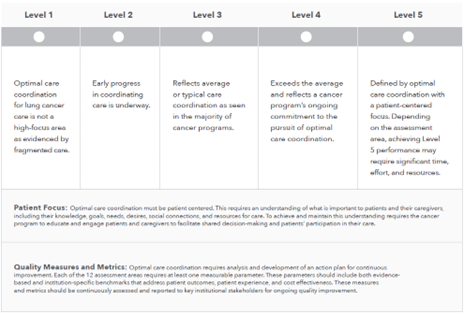
The Model is a framework that includes 12 assessment areas with 5 levels. Within each level are service-asset criteria, with Level 1 representing the most basic provision of care and Level 5 representing the optimal best practice for care coordination. The Model is intended to help cancer programs and practices improve to any achievable target level within a selected assessment area.

Who Should Use It?

The Model is intended to be used by a multidisciplinary team that cares for patients with cancer, including oncologists, hematologists, physician assistants, nurse practitioners, pharmacists, social workers, financial advocates, and administrators. The Model supports an objective assessment on how cancer care is provided at an institutional level. Further, while the Model was originally created to improve care coordination for lung cancer patients covered by Medicaid, it serves as a scaffolding to build quality improvement initiatives focused on care coordination for all patients. The Model can be utilized across all cancer types and oncology centers.

How Do You Use It?

When a cancer program or practice employs the Model to assess its current state of care coordination, it is likely to find its performance includes some components of 1 level and some of another. As a framework, the Model’s purpose is to help cancer programs and practices objectively identify where opportunities exist to improve care coordination for patients, rather than be concerned with reaching a certain level in a specific assessment area.

The 12 assessment areas should be evaluated on their own merits. However, as a cancer program or practice begins to work with the Model, it is likely to find that improvement in optimal care coordination in 1 assessment area often depends on improvements in other areas. And, conversely, improvements in 1 assessment area will often lead to synergistic improvements in other areas. Additionally, although the Model is intended as an internal evaluation tool, cancer programs and practices may benefit from having an unbiased external evaluator complete the self-assessment.

Why Is It Important to Do?

Continuous quality improvement (CQI) in health care is vital to providing quality patient care and maintaining satisfaction among providers and patients. The goal of CQI is to make gradual improvements in operating processes, safety (ie, improved work environment), and patient care. The ICC Model is a tool that can support cancer programs and practices in evaluating strengths and areas that need improvement in the pursuit of optimal patient care. Each of the assessment areas has 5 levels, with level 1 representing the most basic provision of care and level 5 representing the achievement of optimal best practice.

The ICC model aims to help cancer programs and practices improve to any achievable target level within a selected assessment area. Although the Model was originally developed for the lung cancer population, many components of the Model can be used across the cancer care delivery system, independent of patient tumor type.

Has your program used the Model? Let us know! Send your thoughts to Lilly Meier.

Recent work to update the ICC Model is made possible by support from Regeneron.

Related Content

Small Cell SMASHERS: How Community, Advocacy, and Emerging Science Are Changing the Narrative in Small Cell Lung CancerACCCBuzz Blog

Small Cell SMASHERS: How Community, Advocacy, and Emerging Science Are Changing the Narrative in Small Cell Lung Cancer

April 24, 2026

Partnering to Deliver Targeted Treatment: Fox Chase Cancer Center and OmniscopeACCCBuzz Blog

Partnering to Deliver Targeted Treatment: Fox Chase Cancer Center and Omniscope

Rachel Radwan

April 22, 2026

Innovation, Policy, and Partnership: Key Takeaways From the Inaugural ACCC Leadership SummitACCCBuzz Blog

Innovation, Policy, and Partnership: Key Takeaways From the Inaugural ACCC Leadership Summit

Gabrielle Stearns

April 20, 2026

Bispecific Antibodies Are Moving Forward; So Are the Implementation QuestionsACCCBuzz Blog

Bispecific Antibodies Are Moving Forward; So Are the Implementation Questions

Rifeta Kajdić Hodžić

April 17, 2026

Highlights From Volume 41, Number 2 Oncology IssuesACCCBuzz Blog

Highlights From Volume 41, Number 2 Oncology Issues

Gabrielle Stearns

April 15, 2026

Developing Clinical Insight, Professional Competencies, and Strategic Awareness: NCCN 2026 Annual ConferenceACCCBuzz Blog

Developing Clinical Insight, Professional Competencies, and Strategic Awareness: NCCN 2026 Annual Conference

Rachel Radwan; Gabrielle Stearns

April 8, 2026

Representing Veterans in Clinical Trials Through Public-Private Partnerships: A Q&A With NAVREFACCCBuzz Blog

Representing Veterans in Clinical Trials Through Public-Private Partnerships: A Q&A With NAVREF

Gabrielle Stearns

March 26, 2026

Confronting a Lethal Cancer: Duke Launches Multidisciplinary Pancreatic Cancer Center for Earlier Detection and Better OutcomesACCCBuzz Blog

Confronting a Lethal Cancer: Duke Launches Multidisciplinary Pancreatic Cancer Center for Earlier Detection and Better Outcomes

Rachel Radwan

March 25, 2026

Upcoming Events

ACCC Oncology Reimbursement Meeting | Charleston
Oncology

ACCC Oncology Reimbursement Meeting | Charleston

In Person Meeting & NetworkingMay 6, 2026 at 8:00 AM EDT560 King Street, Charleston, SC, USAHyatt Place + Hyatt House Charleston - Historic District, Charleston
Register Now!
ACCC Oncology Reimbursement Meeting | St. Louis
Oncology

ACCC Oncology Reimbursement Meeting | St. Louis

In Person Meeting & NetworkingMay 13, 2026 at 8:00 AM CDT1335 South Lindbergh Boulevard, St. Louis, MO, USAHilton St. Louis Frontenac, St. Louis
Register Now!
ACCC 43rd National Oncology Conference
Oncology

ACCC 43rd National Oncology Conference

In Person Conference & ConventionOctober 21, 2026 at 8:00 AM MDT450 Summer St, Boston, MA 02210Omni Boston Hotel at the Seaport, Boston
Register Now!
RIOS 2026 Spring Symposium
Oncology

RIOS 2026 Spring Symposium

In Person Conference & ConventionMay 9, 2026 at 11:00 AM EDT4 Richmond Square, Providence, RI 02906, USAWaterman Grille, Providence
Register Now!
 HSCO 2026 May Dinner Symposium
Oncology

HSCO 2026 May Dinner Symposium

In Person Conference & ConventionMay 13, 2026 at 5:30 PM HST6600 Kalanianaʻole Highway suite 110, Honolulu, HI, USARoy's Restaurants – Hawaii Kai, Honolulu
Register Now!
WSOS 2026 Laramie Meeting
Oncology

WSOS 2026 Laramie Meeting

In Person Conference & ConventionMay 20, 2026 at 5:30 PM MDT222 South 22nd Street, Laramie, WY, USAUniversity of Wyoming – Rochelle Gateway Center, Laramie
Register Now!
IOS 2026 Welcome Reception
Oncology

IOS 2026 Welcome Reception

In Person Conference & ConventionMay 30, 2026 at 6:00 PM CDT1060 West Addison Street, Chicago, IL, USAWrigley Field, Chicago
Register Now!
WAHO 2026 Welcome Reception
Oncology

WAHO 2026 Welcome Reception

In Person Conference & ConventionMay 30, 2026 at 6:00 PM CDT1060 W Addison St, Chicago, IL, USAWrigley Field , Chicago
Register Now!
WSOS 2026 Rock Springs Meeting
Oncology

WSOS 2026 Rock Springs Meeting

In Person Conference & ConventionJune 9, 2026 at 5:30 PM MDT1675 Sunset Dr, Rock Springs, WY, USAHoliday Inn Rock Springs, Rock Springs
Register Now!
HSCO 2026 June Dinner Symposium
Oncology

HSCO 2026 June Dinner Symposium

In Person Conference & ConventionJune 10, 2026 at 5:30 PM HST3660 Waialae Ave, Honolulu, HI, USA3660 On The Rise, Honolulu
Register Now!
Advertisement
Advertisement

Trending Now on
ACCCBuzz Blog

Small Cell SMASHERS: How Community, Advocacy, and Emerging Science Are Changing the Narrative in Small Cell Lung Cancer

Small Cell SMASHERS: How Community, Advocacy, and Emerging Science Are Changing the Narrative in Small Cell Lung Cancer

Small Cell SMASHERS was founded in 2023 as a patient-centered advocacy and education community designed to challenge long-standing narratives about small cell lung cancer and restore a sense of voice, connection, and hope for patients and their loved ones.

Partnering to Deliver Targeted Treatment: Fox Chase Cancer Center and Omniscope

Partnering to Deliver Targeted Treatment: Fox Chase Cancer Center and Omniscope

ACCCBuzz spoke with Fox Chase Cancer Center to learn more about its partnership with Omniscope, a leader in advanced molecular profiling technology, in hopes of developing an assay that accurately predicts which patients will respond well to immunotherapy based on the presence of certain T-cell clones.

Innovation, Policy, and Partnership: Key Takeaways From the Inaugural ACCC Leadership Summit

Innovation, Policy, and Partnership: Key Takeaways From the Inaugural ACCC Leadership Summit

On Friday, April 17, ACCC welcomed oncology leaders from around the country to Washington, DC for the inaugural ACCC Leadership Summit, a forum designed for executive-level decision-makers to engage in strategic dialogue, peer-to-peer exchange, and actionable insights at the highest level of oncology leadership.

Bispecific Antibodies Are Moving Forward; So Are the Implementation Questions

Bispecific Antibodies Are Moving Forward; So Are the Implementation Questions

During the HOPA 2026 annual conference, ACCC brought together a small group of oncology pharmacists for a practical, candid conversation about challenges with the implementation of bispecific antibodies that was deeply grounded in real-world experience and what it takes to operationalize care.

View All ACCCBuzz Blogs

Recently Heard on
CANCER BUZZ Podcast

Innovation in Action: Breaking Down the 2025 ACCC Impact Report – [Mini Podcast] Ep. 228

Transforming Palliative Care in Oncology – [Video Podcast] Ep. 227

Streamlining Access to TIL Cell Therapy for Melanoma – [Podcast] Ep. 226

Policy in Practice: Change Hits the Clinic – [Podcast] Ep. 225

View All Podcasts

Latest from Oncology Issues

April 2026
April 2026
February 2026
December 2025
October 2025
August 2025
View All Oncology Issues

Join the Conversation

ACCC eXchange Digital Banner
Login