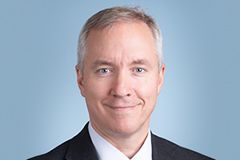
ACCCBuzz is kicking off a series of interviews with ACCC leadership. In this inaugural post, ACCCBuzz talked with ACCC Board and Executive Committee member Dr. David R. Penberthy.
ACCC Treasurer 2019-2020, David R. Penberthy, MD, MBA, is medical director of radiation oncology at Southside Regional Medical Center in Petersburg, Virginia, and the immediate past president of Virginia Radiation Oncology Associates, a private medical practice based in Richmond, Virginia.
After earning a BA in electrical engineering from Virginia Tech and an MD from Virginia Commonwealth University, Dr. Penberthy completed a surgical internship at Bethesda Naval Hospital. He then served as a U.S. Navy flight surgeon with Fighter Squadron 101 in Oceana, Virginia. His strong interest in and knowledge of technology eventually led him to the field of radiation oncology, where he applies sophisticated medical technologies to alleviate the suffering caused by cancer.
ACCCBuzz: How did you decide to go into medicine?
Dr. Penberthy: I’ve been interested in medicine since I was a child, although I ultimately decided to study electrical engineering in college. When I graduated, I applied for jobs in Silicon Valley, but I also applied to medical schools. After I was offered both engineering jobs and admission to medical school, I had to make a choice. I did a lot of soul-searching, and I knew that my heart was in medicine.
Medical school was expensive, though, and I had to find way to pay for it. I decided to join the Navy, and they paid my way. Upon graduating from Virginia Commonwealth University with my medical degree, I intended to study neurosurgery. I completed a surgical internship at Bethesda Naval Hospital, and I had the opportunity to learn how to fly and be a flight surgeon. I flew in Fighter Squadron 101 in Oceana, Virginia, taking off and landing on aircraft carriers. I lived the Top Gun lifestyle for a few years, and I loved it.
ACCCBuzz: How did you come to specialize in radiation oncology?
Dr. Penberthy: When I was in the Navy, my mother was diagnosed with breast cancer. While she was in treatment, I flew home to meet her team of doctors, which included a radiation oncologist. I saw how technology could be applied to the field of oncology, and I decided to learn more about it. I discovered that my first interest—engineering—could be used in medicine. Since a lot of a radiation oncologist's work is related to the treatment of brain diseases, I get to work side-by-side with neurosurgeons to treat patients, and I love that.
ACCCBuzz: How did you first get involved with ACCC?
Dr. Penberthy: Southside Regional Medical Center has a long-time, fruitful affiliation with ACCC. We’ve leveraged ACCC’s resources for years, particularly in informing best practices and developing financial advocacy strategies. When I heard that ACCC was interested in helping serve the radiation oncology space, I decided to get involved. I joined the ACCC Board of Trustees in 2015, and I am now ACCC’s treasurer.
ACCCBuzz: What are some of the biggest advantages of being part of ACCC?
Dr. Penberthy: Oncology is changing constantly. It is a discipline in which practitioners have to be able to continually stay up to date with the latest and greatest treatments and clinical techniques. ACCC and its industry partnerships help me stay aware of the newest developments in oncology and teach me what I need to anticipate.
ACCC also helps me network with my peers and learn what other people in the field are doing. My affiliation with ACCC gives me the opportunity to work with a wide array of people throughout the country who may see things and approach problems differently, and we learn from one another.
ACCCBuzz: Which of ACCC’s education programs have brought you the most value?
Dr. Penberthy: For me, a very important part of ACCC is its Immuno-Oncology Institute. Many of my colleagues at major academic institutions agree that it’s a discipline that requires staying knowledgeable of the latest developments. There are so many new approvals and payment models coming up fast and furious, and we need organizations like ACCC to help us keep on top of things.
ACCCBuzz: What do you consider the most pressing problem in the delivery of cancer care today?
Dr. Penberthy: We know what to do, but getting it paid for by the powers that be is a challenge. Obtaining the best healthcare for the underserved and uninsured is also a big challenge.
ACCCBuzz: What do you perceive as the most promising development in cancer care?
Dr. Penberthy: We are seeing more successes now than ever before. There are far fewer toxicities from treatments. Stereotactic body radiation therapy and immuno-oncology are huge developments in the treatment of cancer. Oral oncolytics have also brought tremendous advances. Some patients only have to take oral medications to successfully control their disease. We are entering an era in which oncology is gradually evolving into the management of chronic disease with less toxic treatments, rather than a series of frightening, life-threatening diseases with toxic treatments.
ACCCBuzz: What specific assets do community cancer programs bring to cancer care delivery?
Dr. Penberthy: Patients being treated in community cancer centers are receiving state-of-the-art care in their own backyards. Some of my patients have gone to large academic medical centers for consultations only to return to me after realizing that I can offer them the same quality treatments. Patients should have confidence that they are getting the best available care in their communities, and ACCC helps make that possible.




In recognition of Leukemia and Lymphoma Awareness Month, ACCC compiled a group of resources to help care teams navigate two of the most commonly diagnosed adult leukemias: acute myeloid leukemia and chronic lymphocytic leukemia.