Author(s):
In the third in a series of multidisciplinary consensus-building roundtables, ACCC and its partners explored ways to bridge the gap between community oncology programs and authorized treatment centers offering CAR T for patients with multiple myeloma.

In 2023, the Association of Cancer Care Centers (ACCC), in partnership with the Association of American Cancer Institutes (AACI) and the American Society for Transplantation and Cellular Therapy (ASTCT), convened a roundtable of multidisciplinary oncology providers to bridge the gap between community oncology programs and authorized treatment centers (ATCs) for chimeric antigen receptor–modified T-cell therapy (CAR T). The result was “If They RECUR, You Should Refer,” a standardized framework to help community oncology care teams more easily assess and refer patients with large B-cell lymphoma (LBCL) for CAR T evaluation.
Since the RECUR article was published, CAR T has continued to evolve, with emerging real-world data and new indications broadening its role in extending disease-free survival for patients with hematologic malignancies. ACCC’s membership has expressed a need for resources that keep pace with these changes and provide guidance on hematologic malignancies beyond LBCL.
During the first phase of work, ACCC and its partners convened 3 multidisciplinary consensus-building roundtables to explore how the RECUR framework could be extended to multiple myeloma. Participants represented community cancer programs, ATCs, and patient advocacy organizations—all committed to addressing the opportunities and challenges of developing resources in the rapidly expanding field of CAR T.

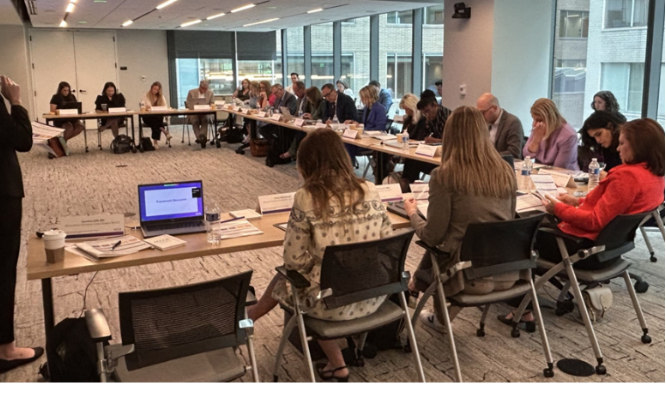
The final roundtable occurred in person at the ASTCT office in Washington, DC.
“It’s critically important that patients cared for in a community setting that does not have familiarity or immediate access to CAR T-cell therapy are referred early to a program that does,” said David L. Porter, MD, director of Cell Therapy and Transplant at Penn Medicine and a participant in the roundtables.
Roundtable participants described a shared concern that ATCs may be drawing patients away from community oncology programs. However, the consensus was that these providers should be treated as collaborators, not competitors, with a common goal of ensuring patients return to their “home” oncologist for ongoing care following CAR T. The intent is to ensure a smooth, safe transition back to the community oncologist, and this expectation should be clearly communicated to all stakeholders, including the patient and their care partner.
To achieve this supportive relationship, roundtable participants emphasized the need to build intentional partnerships between community programs and ATCs, where the skills and strengths of both parties are respected. For example, community providers can encourage early communication and referral before CAR T is indicated so patients and care partners can plan ahead, proactively learn about the therapy, and establish care with providers at the ATC. On the other side of the relationship, a roundtable participant described their institution’s practice of acknowledging the referring physician’s effort and contributions when speaking to the patient. This ensures the patient understands that providers in both settings are vital to the treatment process.
The updated framework aims to promote partnerships between community programs and ATCs by using language that empowers providers in both settings and employing tangible strategies to increase collaboration. When these relationships are established proactively, they allow for early, seamless referrals that improve patient outcomes.
“Rural patients deserve the comfort and independence of receiving care close to home while knowing expertise at one of the nation’s leading academic centers is within reach,” said roundtable participant Amy Smith, FNP-BC, director of the Meredith and Jeannie Ray Cancer Center. “When we put patients first, refer early, and work hand in hand across institutions, we give families not only access to advanced treatment and innovation, but also the reassurance that they are never facing cancer alone.”
By bringing together a diversity of perspectives across settings, regions, and roles, ACCC and its partners aim to create an adaptable resource that meets the needs of a growing field. The final, in-person roundtable served as a strategizing session to shape the content, formatting, and dissemination of the new framework. One of the key goals was to balance present-day utility with long-term relevance. Clinical research and indications for CAR T continue to expand rapidly, requiring flexibility and adaptability. However, each hematologic malignancy presents unique considerations, underscoring the need for tailored resources. While the new framework is designed for multiple myeloma, roundtable participants were already thinking ahead to how it will be used years down the line and how it can be further adapted in future iterations.
By the end of the final meeting, participants were energized. Beth Faiman, PhD, MSN, APN-BC, AOCN, TCTCN, FAAN, FAPO, nurse practitioner in the multiple myeloma program at the Cleveland Clinic, shared that, “It was an honor to be a part of this process...which accurately captures the state of myeloma today and how it will look in 5 years.”
Read more about RECUR in Oncology Issues and stay tuned for more information about the new framework in the coming months.
This program is made possible with support from Arcellx, Kite, a Gilead Company, Johnson & Johnson, and Legend Biotech.


In recognition of Leukemia and Lymphoma Awareness Month, ACCC compiled a group of resources to help care teams navigate two of the most commonly diagnosed adult leukemias: acute myeloid leukemia and chronic lymphocytic leukemia.