ACCC association of cancer care centers
Join/Renew
Login
Join/Renew
Login
Education & Resources
ACCC eXchange LogInCorporate Member Sponsored ResourcesPresentations & AbstractsPresident's ThemeACCC Connect eLearning LogIn
Publications
Oncology IssuesPatient Assistance & Reimbursement GuideTrending Now in Cancer Care
Events
2026 ACCC Leadership SummitAnnual Meeting & Cancer Center Business SummitCapitol Hill DayNational Oncology ConferenceOncology Reimbursement MeetingsOncology State Society Meetings
Policy & Advocacy
2024 Policy Wrap-Up and ACCC 2025 Policy PrioritiesLetters & StatementsAccess, Payment & Reimbursement ReformWhite Bagging & Brown BaggingAdvocacy ResourcesCancer Moonshot
Membership
Join | RenewWho We AreMembership Types & BenefitsCorporate MembersACCC Member Portal FAQMember Directory
Partners
Oncology State SocietiesPartner OrganizationsCME
News
News ReleasesAdvocacy News ReleasesOncology News
About ACCC
Timeline / 50th Anniversary2025 Impact ReportACCC Innovator AwardsACCC FellowsACCC Senior Staff
Breast CancerMetastatic Breast Cancer
Gastrointestinal CancerBiliary Tract CancerColorectal CancerGastric CancerLiver Cancer
Genitourinary CancerBladder CancerProstate CancerRenal Cell Carcinoma
Gynecologic CancerOvarian Cancer
Head & Neck Cancer
Hematologic MalignanciesAcute Lymphocytic Leukemia (ALL)Acute Myeloid Leukemia (AML)Chronic Lymphocytic Leukemia (CLL)Mantle Cell Lymphoma (MCL)Multiple Myeloma (MM)Myelodysplastic Syndromes (MDS)
Lung CancerNon-Small Cell Lung Cancer (NSCLC)Small Cell Lung Cancer (SCLC)
Sarcoma
Skin CancerMelanomaNon-Melanoma Skin Cancers (NMSC)
Clinical Practice & TreatmentCancer DiagnosticsCare CoordinationEHR Integration for Biomarker TestingQuality Improvement Collaboration: Integration of Precision Medicine in Community OncologyTreatment
Financial NavigationFAN Boot CampFinancial Advocacy Network (FAN) Resource LibraryPatient Assistance & Reimbursement GuidePrior Authorization
Health Equity & Access3, 2, 1, Go! Practical Solutions for Addressing Cancer Care DisparitiesAppalachian Community Cancer AllianceOncology Advanced PractitionersPersonalizing Care for Patients of All BackgroundsSocial Drivers of Health
Patient-Centered CareAddressing Care Disparities for VeteransAdolescent and Young Adult (AYA)Care Action Plans for People with CancerDermatologic ToxicitiesEmpowering CaregiversGeriatric OncologyHealth LiteracyNutritionOncology PharmacyPatient NavigationPsychosocial Care in OncologyShared Decision-MakingSupportive CareSurvivorship Care
Practice Management & OperationsCancer Program FundamentalsLeadership Sustainment and Engagement VideosOncology Practice Transformation and Integration CenterOncology Team Resiliency
ResearchACCC Community Oncology Research Institute (ACORI)
Technology & InnovationTelehealth & Digital Medicine
ACCCBuzz Blog
CANCER BUZZ Podcast
Oncology Issues
Join/Renew
Login
Breast CancerMetastatic Breast Cancer
Gastrointestinal CancerBiliary Tract CancerColorectal CancerGastric CancerLiver Cancer
Genitourinary CancerBladder CancerProstate CancerRenal Cell Carcinoma
Gynecologic CancerOvarian Cancer
Head & Neck Cancer
Hematologic MalignanciesAcute Lymphocytic Leukemia (ALL)Acute Myeloid Leukemia (AML)Chronic Lymphocytic Leukemia (CLL)Mantle Cell Lymphoma (MCL)Multiple Myeloma (MM)Myelodysplastic Syndromes (MDS)
Lung CancerNon-Small Cell Lung Cancer (NSCLC)Small Cell Lung Cancer (SCLC)
Sarcoma
Skin CancerMelanomaNon-Melanoma Skin Cancers (NMSC)
Clinical Practice & TreatmentCancer DiagnosticsCare CoordinationEHR Integration for Biomarker TestingQuality Improvement Collaboration: Integration of Precision Medicine in Community OncologyTreatment
Financial NavigationFAN Boot CampFinancial Advocacy Network (FAN) Resource LibraryPatient Assistance & Reimbursement GuidePrior Authorization
Health Equity & Access3, 2, 1, Go! Practical Solutions for Addressing Cancer Care DisparitiesAppalachian Community Cancer AllianceOncology Advanced PractitionersPersonalizing Care for Patients of All BackgroundsSocial Drivers of Health
Patient-Centered CareAddressing Care Disparities for VeteransAdolescent and Young Adult (AYA)Care Action Plans for People with CancerDermatologic ToxicitiesEmpowering CaregiversGeriatric OncologyHealth LiteracyNutritionOncology PharmacyPatient NavigationPsychosocial Care in OncologyShared Decision-MakingSupportive CareSurvivorship Care
Practice Management & OperationsCancer Program FundamentalsLeadership Sustainment and Engagement VideosOncology Practice Transformation and Integration CenterOncology Team Resiliency
ResearchACCC Community Oncology Research Institute (ACORI)
Technology & InnovationTelehealth & Digital Medicine
ACCCBuzz Blog
CANCER BUZZ Podcast
Oncology Issues
    • Education & Resources
    • Publications
    • Events
    • Policy & Advocacy
    • Membership
    • Partners
    • News
    • About ACCC
ACCC association of cancer care centers
1801 Research Boulevard, Suite 400, Rockville, MD 20850
Tel: 301.984.9496 Fax: 301.770.1949 Email Us
Contact UsVolunteers
Advertise
Career Center
Terms and Conditions
Privacy Policy
ACCC Rebranding
Copyright © 2026 Association of Cancer Care Centers. All Rights Reserved.
Advertisement

News

Article

August 13, 2020

Association of Community Cancer Centers Releases Lung Cancer Care Quality Improvement Model

Online Tool Available for Cancer Programs

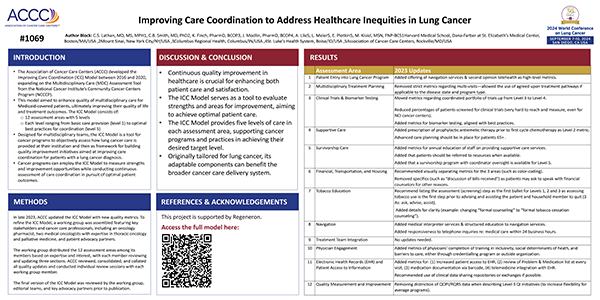
Rockville, MD – The Association of Cancer Care Centers (ACCC) has just released a model framework for cancer care providers to use in improving care coordination for lung cancer patients covered by Medicaid. “Improving Care Coordination: A Model for Lung Cancer” is a first-of-its-kind quality improvement tool, now available to cancer programs and practices nationwide.

The Model is based upon an extensive research process and addresses lung cancer care for the patient populations enrolled in Medicaid, as these patients experience more negative lung cancer outcomes.

Led by co-principal investigators Christopher Lathan, MD, MS, MPH, Medical Director, Dana-Farber at St. Elizabeth’s Medical Center and Randall Oyer, MD, Medical Director, Ann B. Barshinger Cancer institute, Penn Medicine Lancaster General Health, the model was developed through peer-to-peer collaboration between industry researchers, lung cancer experts, oncology providers, administrators, epidemiologists, and patient advocates among the project’s Advisory Committee and Technical Expert Panel.

“The number-one deadliest cancer hits this patient population particularly hard for a number of reasons. We were looking to create a central hub where cancer centers could assess their care in specific areas and then access resources to improve those areas of their program,” said Dr. Lathan.

Oncology programs of all sizes can utilize the twelve assessment areas within the Model to analyze strengths and weaknesses, pinpoint barriers to coordinated care, and bolster the quality of the patient journey from diagnosis to survivorship care. Each assessment area is linked to more than 100 quality measures aligned with CMS MIPS, ASCO QOPI, NCQA PCSP, AHRQ CAHPS, and CoC 2020 Cancer Program Standards. The model was designed so any member of a multidisciplinary team can lead the QI effort.

“This is a unique QI model that will help programs regardless of prior experience with self-assessment and self-directed improvement,” said Randall Oyer. “It’s not one size fits all. Regardless of resources, cancer programs of any size can identify areas of interest for improvement that they can address, making the model scalable and effective for quality improvement.”

Participation from lung cancer experts and the cancer community was critical and an important component of the entire model development process. ACCC Cancer Program Members were invited to apply to serve as Testing Sites for the Model, and seven testing sites undertook unique quality improvement projects for a twelve-month period from October 2017 to September 2018. Those centers included the Advocate Lutheran General Hospital Cancer Care Program; Ascension Wheaton Memorial Medical Center; Cowell Family Cancer Center, Munson Healthcare; Florida Hospital Memorial Medical Center; Genesis HealthCare System, Genesis Cancer Care Center; Northwest Medical Specialties, PLLC; and Southern Ohio Medical Center, Southern Ohio Medical Center Cancer Care.

The model is the result of a comprehensive project ACCC launched in 2016 upon receipt of a grant from the Bristol-Myers Squibb Foundation. Cancer programs can access the model on ACCC’s website.