Bispecific antibodies (BsAbs) have emerged as a significant step forward in the treatment of numerous hematological malignancies in recent years. As this novel class of biologics moves into earlier lines of therapy and new indications, such as solid tumors, care programs are increasingly focused on how to integrate these treatments into clinical practice. Despite the therapeutic success of BsAbs, many clinics still face challenges in operationalizing their delivery to the patients who need them most.
The Association of Cancer Care Centers (ACCC) has been focused on the challenges programs face when implementing BsAbs in the community and has learned from programs across the country that have successfully overcome these barriers. Six in-person workshops and six virtual office hours were held across a diverse mix of both academic and community programs and providers. Despite differences in geography, size, and resources, the same operational questions arose during these conversations. Programs that offer BsAbs want to understand how to best educate staff and patients, manage risk, and deliver these therapeutics in ways that best fit their program. Drawing on insights gathered through the ACCC BsAb initiative and partnerships with experienced institutions, several key lessons emerged to help guide programs preparing to implement BsAb therapy in their communities.
The rapid growth of BsAbs in recent years has led to numerous agents, all with specific indications and treatment plans, which can feel overwhelming to cancer center staff. Centers may also hesitate to establish these programs because they may expect to treat only a small number of patients each year. However, early adopters who have established successful programs report that establishing workflows while volumes are low allows teams to gain footing and confidence to scale their programs as indications expand into new therapies.
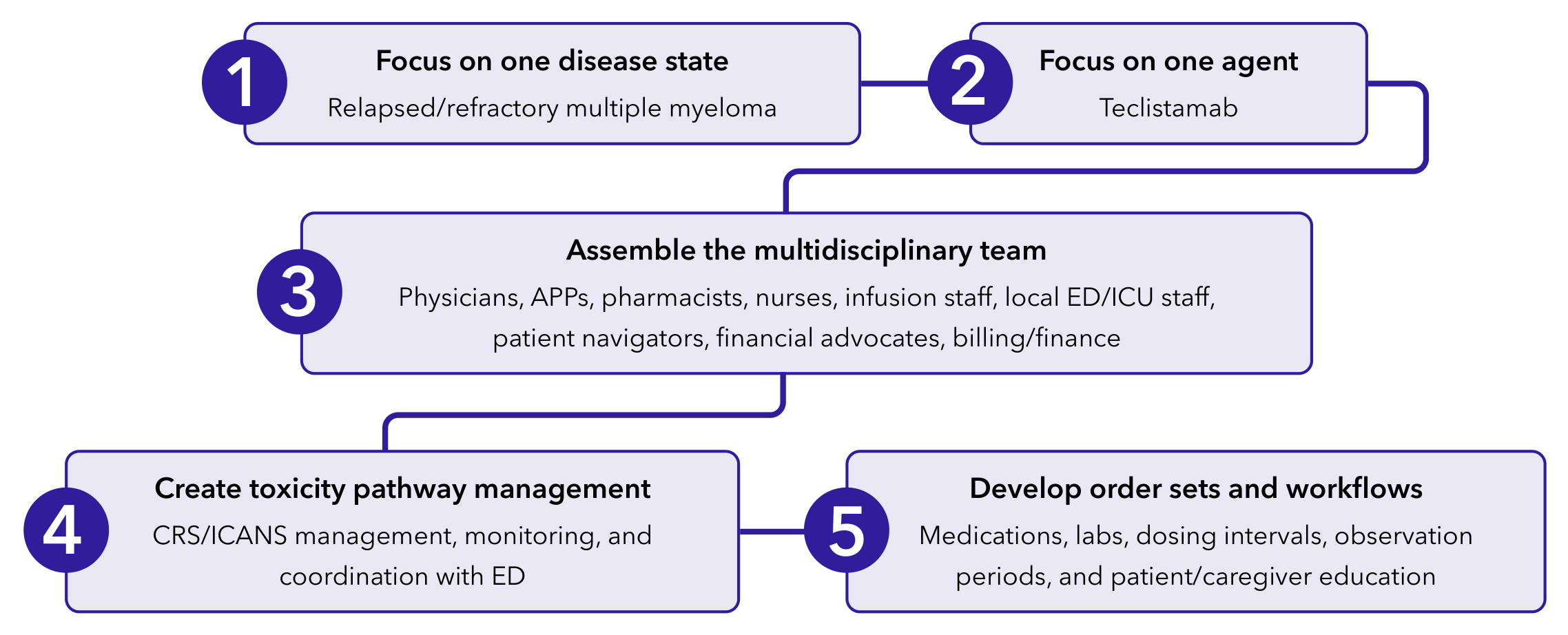
One of the hallmarks of successful programs has been establishing a strong framework for delivering BsAbs centered around starting with one disease and one agent (Figure 1). While it may seem counterintuitive to focus on such a small population of patients, programs have reported that treating even as few as five patients per year was worthwhile. This allows for building staff familiarity with BsAbs and prevents overloading the program with similar but distinct protocols, which are essential to patient safety and care. It also gives programs time to address operational and financial questions related to program sustainability, such as BsAb procurement and reimbursement, and site capacity to support care.

During this initial phase, centers must ask themselves key questions, such as:
Implementing a successful BsAb program requires two complementary forms of readiness: operational and clinical. These capabilities develop together over time, strengthening each other as the program evolves.
Patients must be able to access care, and while the oncology staff can deliver it, this requires looping in departments outside oncology. Sites need to have the correct billing, authorization, and financial counseling workflows in place. Prior authorizations for BsAbs can be complex and may require multi-step approvals. By planning in advance, programs can avoid delays in coverage.
Understanding payer coverage for supportive care medications and whether there are site-of-care restrictions is another factor to consider in these workflows. When transitioning patients between sites of care, having processes that proactively update or transfer prior authorizations is essential. Observational billing, drug procurement, and accurate waste billing are additional factors to consider from a billing standpoint to ensure there are no gaps in patient care or undue hardships due to claims denials.
Once therapy can be delivered, systems must be in place so patients can receive it safely. Institutional preparedness is essential for this, whether it means having the necessary certifications to administer the drugs or having clear escalation protocols, teams need to be prepared for all situations. Since BsAbs can cause delayed-onset adverse events, even with proper monitoring, it is essential to educate patients, caregivers, local EDs, and intensive care units (ICUs) about these risks.
The most typical life-threatening adverse events are cytokine release syndrome (CRS) and immune effector-cell associated neurotoxicity syndrome (ICANS), where symptoms can initially present as mild but can rapidly deteriorate. Education on these adverse events starts with patients and caregivers, teaching them how to properly recognize and monitor symptoms. This includes providing the patient with wallet cards or updates in their electronic health record to properly inform local ED and ICU staff that the patient is receiving a BsAb. Clear communication with these departments is also essential so staff can recognize the signs and symptoms of CRS and ICANS. It is important to understand the escalation protocols as well. For example, if a patient presents with concerning symptoms, the ED should be familiar with the established escalation pathway and know whom to contact for guidance.
“I think my tip to our teams, particularly as we’ve rolled out to solid tumor teams that are unfamiliar with CRS, is, you don’t need to fear [therapies], but you just need to have a healthy respect. They’re really potent medications, but they are very manageable if you follow the protocols and ask questions and have a low threshold to phone a friend if…you’re running into a question where you don’t know what to do.”
- Nicholas Zorko, MD, PhD, Assistant Professor of Medicine; Division of Hematology, Oncology, and Transplantation, University of Minnesota
Clinical and operational readiness evolve together in successful programs. Developing an escalation pathway without a corresponding reimbursement process limits a program’s ability to expand beyond its initial patients. Building a safe program also means building a sustainable program, which requires engaging the multidisciplinary team from the initial stages to reach full operational maturity.
Some of the biggest barriers to BsAb delivery are not clinical, they are circumnavigating the social challenges that obstruct care coordination. BsAbs are not a simple treatment; they require long observational periods and may require inpatient monitoring due to the risk of serious adverse events. These compound the anxiety around administering these treatments. However, programs have had success when they focus on patient and caregiver education and support.
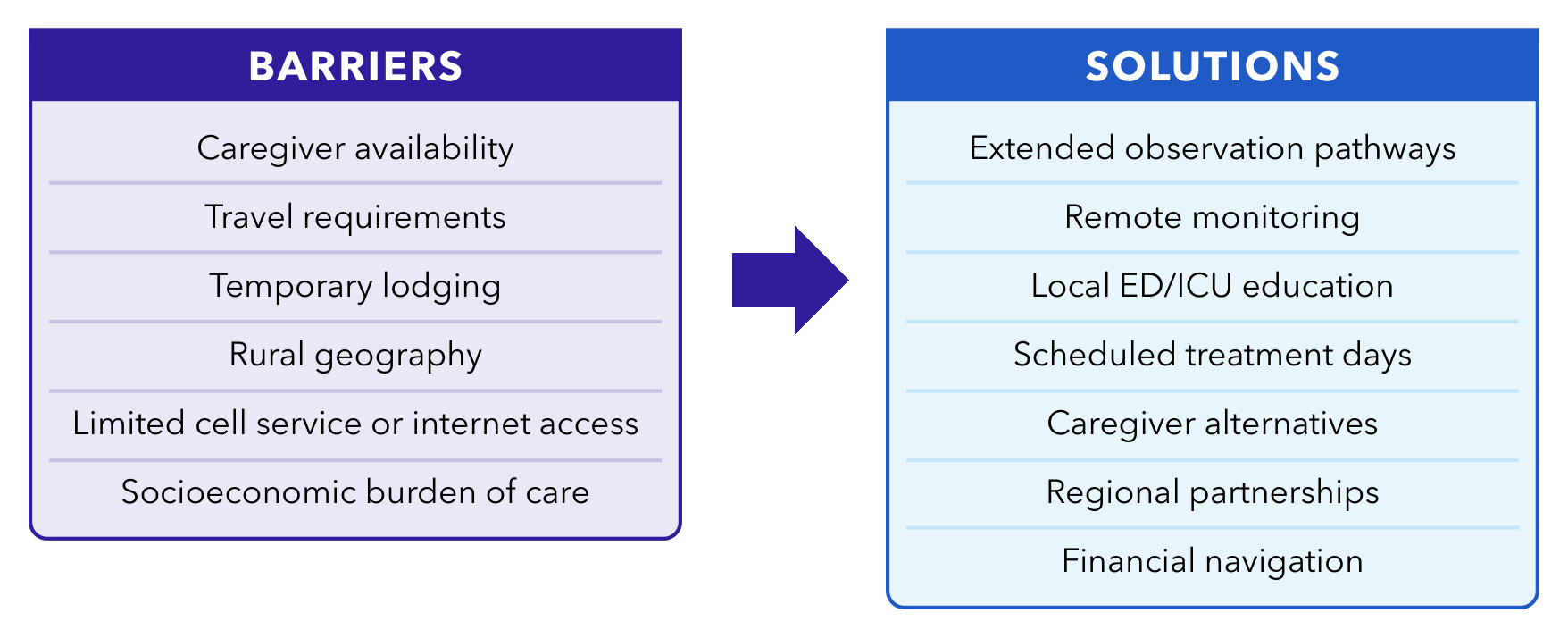
Through ACCC office hours and workshops on BsAb delivery and care, programs identified several key barriers to care. Every barrier poses unique challenges to overcome and will be specific to each program’s location, size, and the socioeconomic background of the community it serves, among other factors. However, programs have successfully overcome these barriers (Figure 2). For example, not every patient has access to a caregiver. While caregiver support is ideal, programs have found success in alternative approaches, including inpatient admissions, extended observation periods, or temporary lodging with remote clinical monitoring. In fact, while rural geography was a commonly perceived, barriers to care are becoming doors of opportunity to both grow and learn as a center. Remote monitoring, physician check-ins, and coordination with local EDs have made delivering BsAbs in the rural community a reality. By using these alternative approaches, as best fits the needs of the population and program, barriers to care are becoming doors of opportunity, to both grow and learn, and a center.
Understanding the needs of the community and the socioeconomic challenges that they may be facing is an essential step in initiating a successful BsAb program. Programs can address these challenges early, such as partnering with a center to provide temporary lodging or providing extended observations on a designated administration day each week. This helps ensure that the most underserved populations can access the care they need.

“We’ve really tried to streamline our workflows...trying not to reinvent the wheel...We send our patients home with blood pressure cuffs, pulse oximeters, and thermometers so they have the tools they need, and they’re provided ample education, as are their caregivers, on what to monitor for and who to call.”
- Zahra Mahmoudjafari, PharmD, MBA, BCOP, FHOPA, Clinical Pharmacy Manager, Division of Hematologic Malignancies and Cellular Therapeutics, The University of Kansas Cancer Center
A key takeaway from discussions with institutions that have implemented successful BsAb programs is that flexibility is paramount to establishing a successful point of care. Centers have taken different approaches to BsAb delivery. Some continue inpatient initial and step-up dosing, while others have transitioned to outpatient settings or have even adopted a hybrid model of care.
Three delivery models—Refer, Partner, and Deliver—were identified to help programs understand the responsibilities and commitments associated with each approach (Figure 3). When developing a program, cancer centers must determine which model best aligns with their institutional readiness, available resources, patient population, and geographic context. The models are not hierarchical. As institutions build experience and capacity, they may transition among approaches to reflect their evolving readiness to provide treatment.

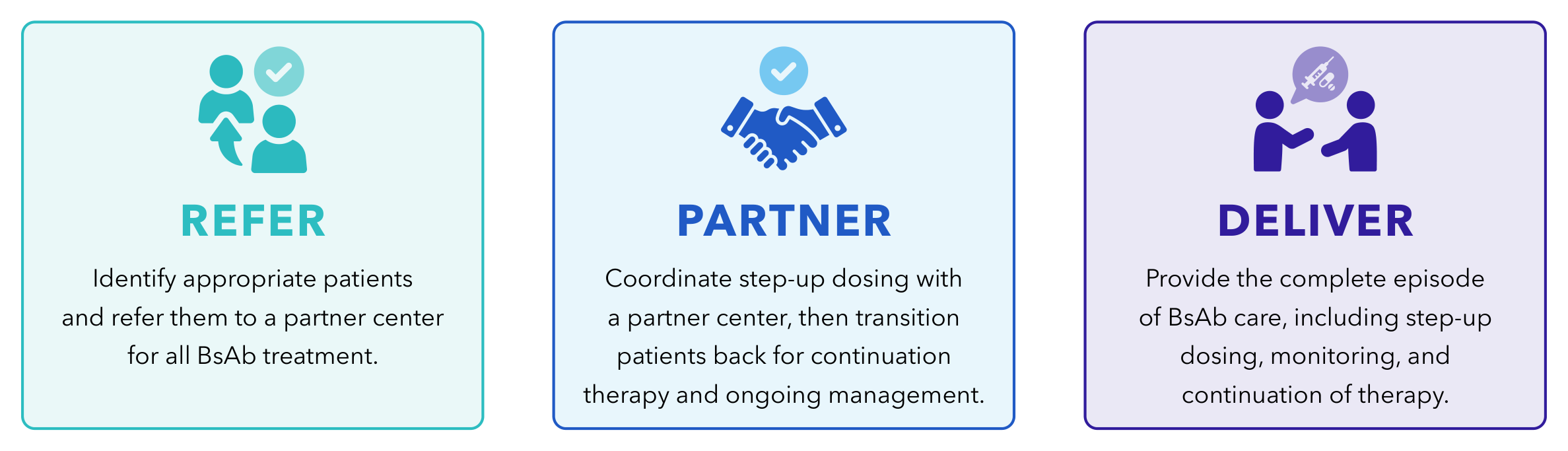
Long description: Refer: identify appropriate patients and refer them to a partner center for all BsAb treatment. Partner: coordinate step-up dosing with a partner center, then transition patients back for continuation therapy and ongoing management. Deliver: provide the complete episode of BsAb care, including step-up dosing, monitoring, and continuation of therapy.]
FirstHealth, a rural cancer center in North Carolina, demonstrated how programs can adapt to new models as their experience and capabilities expand. After initially using a partner-based model, they saw the need to treat an increasing patient base closer to home and developed the infrastructure to deliver step-up dosing in-house. To support this transition, they coordinated with the local ED and ICU, developed admission and treatment workflows, and established remote monitoring pathways for patients at home or in a hospitality house. This allowed patients to remain near emergency care during the period when adverse events were most likely to occur.
A general theme that gave many centers pause involved risk management strategies and how and by whom these tasks would be performed. Many programs agreed that through the education of both staff and patients, familiarity and confidence with the treatment regimens build over time. By implementing these strategies, many felt comfortable navigating more hands-on models in which the center is directly involved in patient care, allowing treatment to take place closer to home.
By preparing today, programs are laying the groundwork for the infrastructure needed for the future of BsAbs. Current approvals for most BsAbs are generally restricted to late-line therapies in relapsed and/or refractory hematological malignancies. However, clinical trials are rapidly evaluating these therapies in earlier lines of treatment. As these indications expand, more patients will become eligible for treatment, making it imperative that treatment centers begin to establish the infrastructure, workflows, and multidisciplinary coordination needed to deliver BsAbs safely and efficiently.
The future of the BsAb space extends beyond earlier-line use. An increasing number of FDA approvals and clinical trials are expanding the use of BsAbs into new indications and treatment paradigms. Only a few years ago, they were exclusively approved for use in hematological malignancies. Today, they have begun to enter the solid tumor space with approved indications for non-small cell lung cancer and small cell lung cancer, among others. Many BsAbs are also being investigated for use in combination with standard of care, creating additional treatment options while introducing new considerations for providers related to toxicity management and patient safety. They are also being introduced in non-oncology care specialties, incentivizing hospital systems working with cancer care providers to have protocols in place now before patient volume increases.
“My last takeaway is…I know we spent a lot of time talking about toxicity, and I know the toxicities for these drugs can give a lot of people pause who aren’t familiar with them, but also remember, too: At the end of the day, these are also very effective drugs. They are approved for a reason, they are moving up into earlier lines of therapy for a reason, and so…we’re only going to get more of them.”
- Donald Moore, PharmD, BCPS, BCOP, DPLA, FCCP, FASHP, FAPO, Clinical Oncology Pharmacy Manager, Atrium Health Levine Cancer Institute
This rapidly evolving field raises important strategic questions for both developed and new programs alike:
Increasingly, the answer is yes, and programs that begin planning now will be better positioned to integrate these therapies into their treatment paradigms, rather than reacting after approvals occur.
Preparing for tomorrow’s therapies also goes beyond initial drug administration. As the use of BsAbs expands, programs should look toward long-term survivorship and supportive care plans. Protocols need to be established to help safely integrate patients back into the community. BsAbs can have lasting adverse effects, leaving patients susceptible to infection. Establishing infection management protocols can help standardize approaches for infection prevention, monitoring, and patient education (Figure 4).

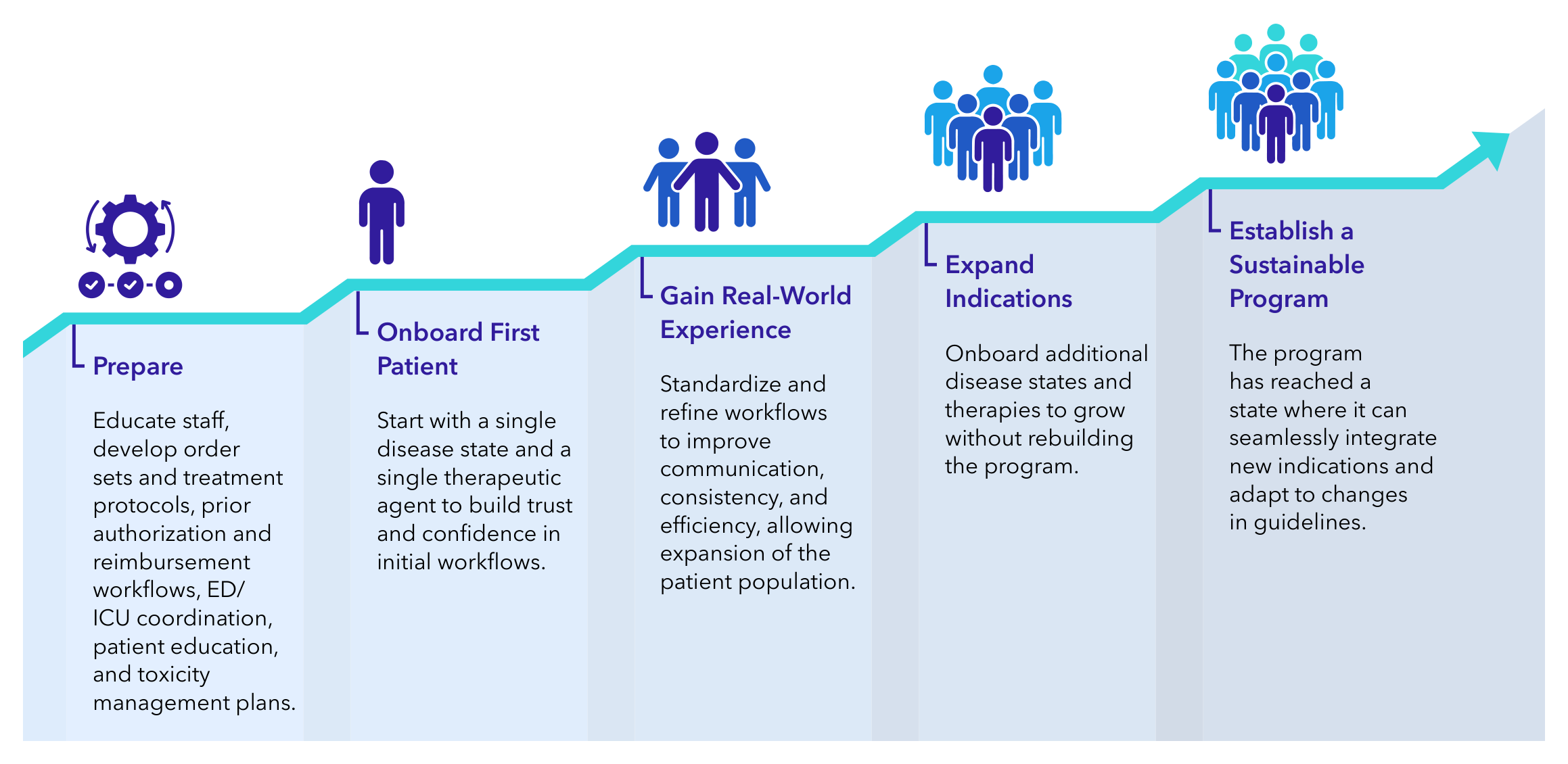
Long description: Prepare: educate staff, develop order sets and treatment protocols, prior authorization and reimbursement workflows, ED/ICU coordination, patient education, and toxicity management plans. Onboard First Patient: start with a single disease state and a single therapeutic agent to build trust and confidence in initial workflows. Gain Real-World Experience: standardize and refine workflows to improve communication, consistency, and efficiency, allowing expansion of the patient population. Expand Indications: onboard additional disease states and therapies to grow without rebuilding the program. Establish a Sustainable Program: the program has reached a state where it can seamlessly integrate new indications and adapt to changes in guidelines.]
By addressing these operational and clinical considerations today, programs are setting themselves up for success just as the BsAb landscape takes off. Establishing these foundations now will enable programs to accommodate larger and more diverse patient populations and support the transition from referral-based models to outpatient and hybrid care delivery as needed.
Building a BsAb program is an ongoing process that will evolve alongside the field. It represents more than the adoption of a new therapy; it requires a care-delivery philosophy centered on expanding access through thoughtful planning, collaboration, and continuous learning.
There is no single ”right” way to launch a program. Successful programs demonstrate that innovation is possible across settings, from National Cancer Institute-designated centers to small rural community practices. By assessing local needs and resources, learning through peer exchange, and investing in ongoing education, oncology teams can build sustainable approaches that reflect their communities and strengthen the broader care network.
Community cancer centers can take action now to develop innovative, sustainable strategies that integrate BsAbs into their standards of care and expand access to these transformative therapies.
Explore additional resources on bispecific antibodies at accc-cancer.org/bispecific-antibodies.
Discussion points, such as those in this article, along with a comprehensive suite of considerations, tips, and tools to build a successful BsAb program, were compiled into the ACCC BsAb initiative through peer discussions among multiple community and academic centers. These resources can help establish a strong, adaptable program that is ready now and for the future of BsAbs as they expand further into the oncology space.
ACCC would like to thank the expert advisory committee for their contributions.
Pedro Barata, MD, MSc, FACP
Associate Professor of Medicine
Case Western Reserve University School of Medicine
Medical Oncologist
Director, Clinical Genitourinary Medical Oncology Research Program
University Hospitals Seidman Cancer Center
Joshua D. Brody, MD
Director, Lymphoma Immunotherapy Program
Tisch Cancer Institute at Mount Sinai Hess Center for Science and Medicine
Elizabeth Budde, MD, PhD
Associate Professor, Hematology and Medical Oncology
City of Hope
Jeffrey M. Clarke, MD
Associate Professor of Medicine
Medical Oncologist
Duke Cancer Institute
Kirollos S. Hanna, PharmD, BCPS, BCOP, FAPO, FACCC, FHOPA
Assistant Professor of Pharmacy
Mayo Clinic School of Medicine Director of Pharmacy
Minnesota Oncology
Jean Louise Koff, MD, MS
Associate Professor, Hematology and Medical Oncology
Winship Cancer Institute of Emory University
Zahra Mahmoudjafari, PharmD, BCOP, FHOPA, MBA
Clinical Pharmacy Manager, Division of Hematologic Malignancies and Cellular Therapies
University of Kansas Health System
Robert Mancini, PharmD, BCOP, FHOPA
Adjunct Clinical Instructor – Oncology
Idaho State University College of Pharmacy
BMT Pharmacy Program Coordinator & PGY2 Residency Program Director
St. Luke’s Cancer Institute
Megan May, PharmD, BCOP, FHOPA, FAPO
Ambulatory Oncology Clinical Pharmacy Specialist
Baptist Health System
Donald Moore, PharmD, BCPS, BCOP, DPLA, FCCP, FASHP, FAPO
Clinical Oncology Pharmacy Manager
Atrium Health Levine Cancer Institute
Angie Santiago, BBA, CRCS, FACCC
Senior Business Manager, Medical Oncology
Sidney Kimmel Cancer Center at the Thomas Jefferson University Health System
David M. Waterhouse, MD, MPH
Chief Innovation Officer
Medical Oncologist and Hematologist
Oncology Hematology Care
Bradley Wuthrich, PharmD
Clinical Pharmacist, Oncology
Munson Healthcare, Cowell Family Cancer Center
Kayvan (Kevin) Zarrabi, MD, MS, FACP
Medical Oncologist
Assistant Professor, Department of Medical Oncology
Sidney Kimmel Cancer Center at the Thomas Jefferson University Health System
Rifeta Kajdic Hodzic, CHPM
Assistant Director, Education
Meagan O’Neill, MS
Chief Executive Officer
Elana Plotkin, CMP-HC
Vice President, Provider Education
Stephen D. Willis, PhD
Clinical Content Manager
In partnership with: Advanced Practitioner Society for Hematology and Oncology (APSHO), Hematology/Oncology Pharmacy Association (HOPA), and Lymphoma Research Foundation.
Made possible with support from: Genentech, A Member of the Roche Group, and Johnson & Johnson.
The Association of Cancer Care Centers (ACCC) provides education and advocacy for the cancer care community. For more information, visit accc-cancer.org.
© 2026. Association of Cancer Care Centers. All rights reserved. No part of this publication may be reproduced or transmitted in any form or by any means without written permission.