Author(s):
In oncology, we sometimes confuse providing information with creating understanding. They are not the same. We may carefully explain a diagnosis, review a pathology report, discuss treatment options, describe potential adverse effects, and answer every question a patient asks. Yet, when the patient returns, we often discover that much of the conversation was not fully understood or remembered. This is not because patients are not listening. It is not because they are not intelligent or do not care. It is because cancer education often takes place at the most emotionally overwhelming moment in a person’s life. After hearing the words, “You have cancer,” patients are often immediately asked to understand staging, biomarkers, chemotherapy, immunotherapy, molecular testing, clinical trials, supportive medications, prognosis, and survivorship. In a single visit, patients are expected to learn an entirely new language while also processing fear, uncertainty, and the possibility that their life has suddenly changed.
Even highly educated patients can become overwhelmed. Family members may be equally frightened and may remember different parts of the conversation. By the time everyone returns home, they may be left with more questions than answers.
After more than 2 decades of practicing community oncology, I began to recognize a recurring pattern. We were providing excellent treatment and spending significant time educating our patients; however, the traditional model still depended heavily on a single conversation, a chemotherapy education visit, and written materials that might never be opened again.
We needed another layer of support.
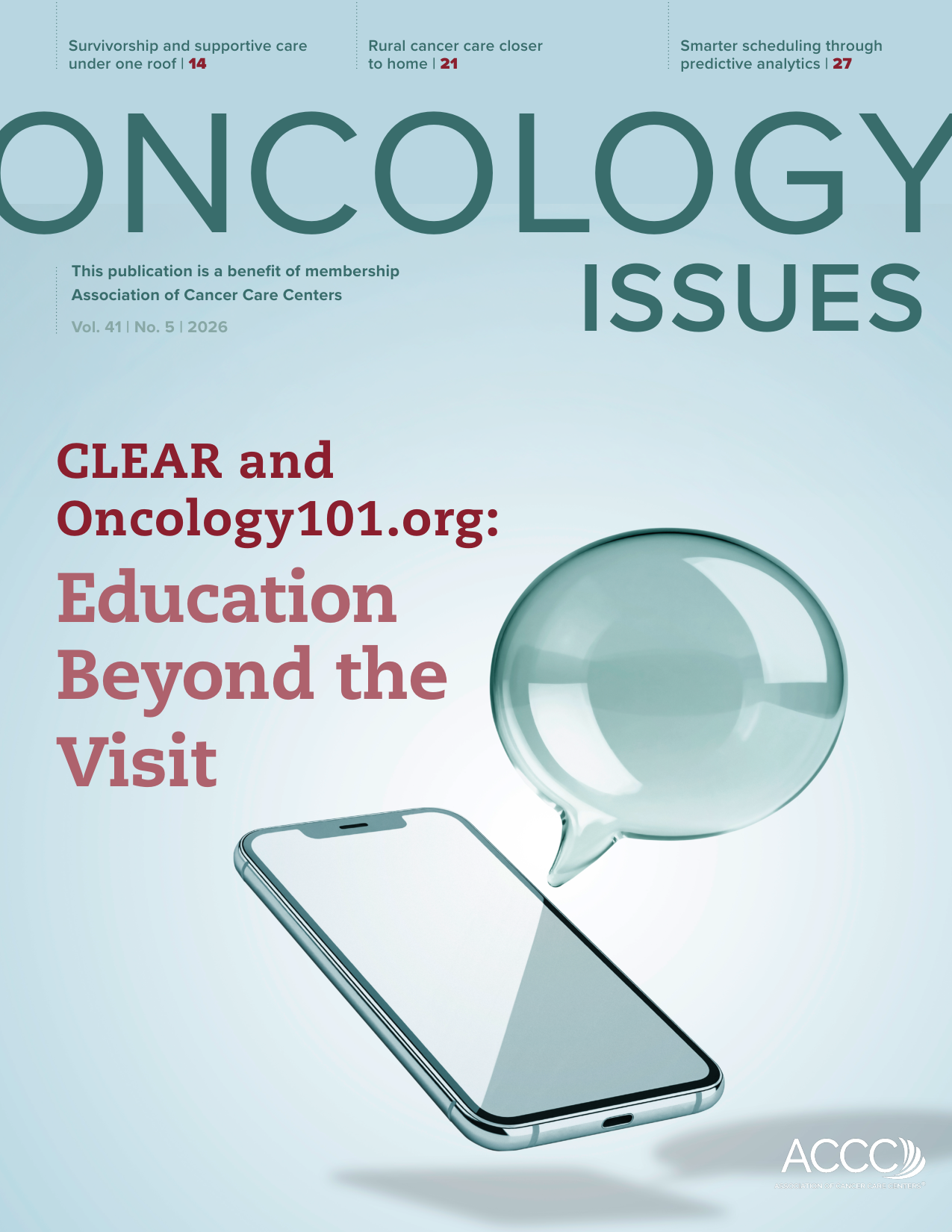
That observation ultimately led to the development of the Cancer Literacy, Education, and Resources program—CLEAR—and Oncology101.org. As the initiative grew, I was fortunate to collaborate with my colleague, Ruiling Yuan, MD, who became a codeveloper of the CLEAR model and an adviser to Oncology101.org. Together with our nurses, pharmacists, navigators, educators, and other members of the cancer care team, we worked to create physician-led, plain-language education that patients and caregivers could access before and after clinical visits.
CLEAR addresses a simple, yet often overlooked, challenge: Even the best treatment plan can be compromised if a patient does not fully understand it.
A patient may not know why a medication must be taken on a particular schedule. Someone receiving oral cancer therapy may not realize that missed doses can affect treatment. A patient experiencing fever, diarrhea, shortness of breath, confusion, or other serious symptoms may wait too long to call because no one clearly explained to them when the situation is considered urgent.
Another patient may stop treatment after developing an expected adverse effect without first contacting the oncology team. Others may take over-the-counter medications or supplements without understanding the potential for interaction with their cancer treatments. These are not simply educational problems. They are patient-safety problems.
Health literacy influences whether patients can understand the purpose of treatment, recognize adverse effects, follow medication instructions, participate in shared decision-making, and know when to seek help. It also influences whether they feel confident asking questions or expressing concerns.
Health literacy should never be confused with intelligence. Cancer care has developed its own highly specialized vocabulary. Words such as mutation, progression, biomarker, randomization, investigational therapy, and progression-free survival are familiar to oncology professionals but may be entirely new to the person sitting across from us in the clinic.
Our responsibility is not only to possess medical knowledge, it is to make that knowledge understandable.
CLEAR was designed to reinforce the education provided by physicians, nurses, pharmacists, navigators, and other members of the cancer care team. It does not replace those professionals, and it does not replace the personal conversation between a patient and clinician. Instead, it helps patients prepare for that conversation and gives them a way to review the information afterward. Through short, physician-led videos, patients can learn the basic concepts related to their diagnosis, treatment, medications, adverse effects, clinical trials, supportive care, and survivorship. They can watch at home, pause when needed, return to a difficult section, and share the video with a spouse, child, caregiver, or other family member.
The CLEAR model follows 4 steps: prepare, educate, reinforce, and support. A patient receives a short educational video before the formal teaching visit. The video introduces the essential concepts in plain language. The oncology team then provides individualized education, answers questions, and reviews the patient’s specific treatment plan. After the visit, the same material remains available for the patient and family to revisit as needed. This model changes the starting point of the clinical conversation.
Instead of hearing every term for the first time while sitting in the clinic, patients arrive with some foundational knowledge. They have already had time to think. They may have written down questions. Family members who could not attend the appointment can still hear the same explanation.
Patients who arrive prepared ask better questions. Better questions lead to better care. This philosophy became our guide.
Furthermore, preparation does not shorten or diminish the clinical conversation. It makes that conversation more meaningful. Nurses and physicians can spend less time repeatedly defining basic terminology and more time discussing the patient’s individual concerns, values, risks, and goals.
Cancer education has traditionally been treated as an appointment: A patient attends a chemotherapy teaching session, receives a folder of materials, and then begins treatment.
Modern cancer care no longer fits that model.
Many patients receive treatment over the course of months or years. Some take oral therapies at home. Others require long-term immunotherapy, symptom monitoring, rehabilitation, surveillance, nutritional support, or management of late treatment effects. Cancer increasingly behaves like a chronic disease, requiring patients and caregivers to make important decisions outside the clinic every day. Education must therefore become continuous rather than episodic.
A patient may not be ready to learn about survivorship at the time of diagnosis. Someone beginning treatment may not remember every potential adverse effect until that symptom actually occurs. A caregiver may need information late at night, after the clinic has closed. Patients may also need to revisit the same explanation several times before it feels familiar.
Oncology101.org allows the educational conversation to continue beyond the clinic walls. The information remains available when the patient is emotionally ready to absorb it and when the knowledge becomes relevant to what they are experiencing.
Most importantly, the resources are free for patients. Reliable cancer education should not depend on where a patient lives, the size of the institution providing care, or the resources available within a particular practice.
Cancer rarely affects only one person. Caregivers often become informal nurses, medication coordinators, transportation planners, advocates, and interpreters of medical information. They help patients remember appointments, manage medications, monitor symptoms, communicate with the clinical team, and make difficult decisions. Yet caregivers cannot always attend every appointment. They may be working, caring for children, living in another city, or supporting the patient from a distance.
Shareable, on-demand education allows caregivers to hear the same core information as the patient. This creates a more consistent understanding within the family and helps everyone recognize the same warning signs, treatment expectations, and questions that need to be addressed.
It also reduces the burden on patients, who should not be expected to return home and accurately reproduce an emotionally difficult medical conversation for everyone who could not be present.
The need for accessible education is especially urgent in rural oncology.
Patients in rural communities may travel long distances for appointments, face transportation and financial barriers, have limited broadband access, or receive care in systems with fewer specialized educators and navigators. Some patients cannot easily return to the clinic simply because they have another question.
CLEAR was developed within community oncology rather than adapted from an academic medical center model. It was designed around the realities of caring for patients who may have limited time, limited transportation, varying levels of health literacy, and family members who cannot always be physically present.
The videos are short, mobile device–friendly, and available outside traditional clinic hours. They can be incorporated into chemotherapy education, oral therapy teaching, clinical trial discussions, survivorship visits, community outreach, and supportive care.
This is not sophisticated technology for the sake of technology. It is a practical way to bring specialist-level education closer to where patients live.
Our early quality-improvement experience has been encouraging. Patients who viewed CLEAR educational videos reported preparedness scores 16.7% higher than patients who received no educational materials and 10.5% higher than those who received a pamphlet. Oncology team members also reported improved patient engagement.
Patients appeared more comfortable asking questions. Caregivers could participate more easily. Staff found that education visits became more interactive and focused on individual concerns rather than introducing every concept for the first time. The digital format also helped create more consistent messaging across the cancer program.
These findings led to the abstract, “Improving Cancer Education and Safety in Rural Communities Through a Digital Literacy Platform,” which was accepted and presented at the 2026 ASCO Annual Meeting.
The recognition was meaningful, but the most important validation came from patients and staff. It came from seeing a patient arrive less frightened because the treatment was no longer completely unfamiliar. It came from hearing better questions. It came from caregivers who appreciated being able to review the information themselves.
The broader mission of this work was also recognized through the 2026 OncoDaily Yvonne Award for Community Oncology. I was deeply honored by that recognition, but I see it primarily as recognition of an idea: Patient education is not an optional addition to cancer care. It is an essential part of high-quality cancer care.
Patients today have access to more medical information than ever before, but access to information is not the same as access to reliable education.
A general internet search may return valuable resources alongside outdated recommendations, commercial advertising, frightening personal stories, misinformation, and advice that does not apply to the patient’s diagnosis or treatment.
Artificial intelligence can help explain terminology and improve access to information, but it can also provide inaccurate, incomplete, or overly generalized answers. Technology should therefore extend the clinical team’s reach—not replace its judgment or responsibility.
The content on Oncology101.org is developed and reviewed by oncology professionals so that patients receive information that is accurate, consistent, evidence-based, and clinically relevant. The goal is not to compete with the physician-patient relationship. It is to strengthen it.
When patients arrive with a basic understanding of the subject, physicians can focus on what generic websites or technology cannot provide: personalized interpretation of the individual patient’s disease, treatment options, medical history, values, and goals.
From the beginning, one of our goals was to create a program that other community cancer centers could use without having to develop every educational resource from scratch.
Many smaller oncology programs recognize the need for better patient education but lack the personnel, time, or financial resources to create a comprehensive video library. A freely available, physician-led platform can help reduce that duplication of effort while still allowing each cancer center to integrate the materials into its own workflows.
The model is intentionally practical. A video may be sent before an appointment, shared through a QR code, incorporated into a patient portal, shown in an infusion area, or recommended during a survivorship visit. The same resource can support the patient, family, nurse, navigator, pharmacist, and physician.
Community cancer centers should not be viewed simply as places where innovations developed elsewhere are implemented. They can also be places where meaningful innovation begins.
CLEAR grew from the examination room, from listening to patients and recognizing a recurring problem. It did not begin with a large technology company or an elaborate infrastructure. It began with a simple question: How can we help patients understand what we are trying so hard to explain?
In cancer care, we routinely measure response rates, survival, toxicity, hospitalizations, treatment delays, and quality of life.
We should also measure understanding. Did the patient understand the diagnosis? Did the patient understand the purpose of the treatment? Does the patient know which symptoms require an urgent call? Can the patient explain how to take the medication safely? Does the patient understand the available choices well enough to participate meaningfully in the decision?
These questions are not secondary to the treatment plan. They help determine whether the treatment plan can succeed.
We talk frequently about precision oncology. We invest in molecular testing, targeted therapies, immunotherapy, artificial intelligence, and increasingly complex treatments. These advances are extraordinary, but precision treatment without understandable communication remains incomplete.
The most sophisticated treatment plan in the world cannot fully help a patient who does not understand why the treatment is being given, how to take it, what adverse effects to watch for, or when to seek help.
Cancer literacy is patient safety. It is shared decision-making. It is caregiver support. It is health equity. At a time when a cancer diagnosis can make patients feel that they have lost control of their lives, understanding gives something important back to them: the ability to participate actively and confidently in their own care.
Joanna Metzner-Sadurski, MD, is a board-certified hematologist and medical oncologist who has cared for patients in Greenwood, South Carolina, for more than two decades. She serves as Director of Medical Oncology at Self Regional Healthcare and is the Founder and President of Oncology101.org, a nonprofit physician-led initiative dedicated to improving cancer health literacy and making reliable, understandable cancer education freely accessible to patients and caregivers. She is actively involved in clinical research, medical education, rural oncology, health policy, and advocacy and serves on the American Society of Clinical Oncology (ASCO) Health Policy Committee. Her work focuses on improving health literacy, expanding access to clinical trials, and advancing equitable, high-quality cancer care for patients in rural and underserved communities.
The author would like to recognize her colleague Ruiling Yuan, MD, MS, codeveloper of the CLEAR model and adviser to Oncology101.org. Her collaboration, clinical insight, and shared commitment to improving patient understanding have been invaluable in expanding the program and bringing its principles into everyday community oncology practice.