What is the greatest opportunity for innovation to ensure that cancer care will be accessible, affordable, and convenient?
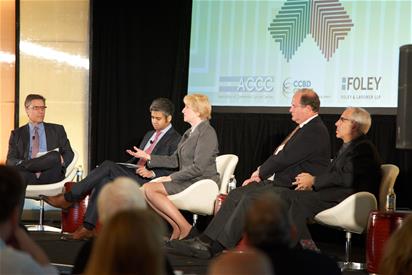
Opening last week’s ACCC 44th Annual Meeting & Cancer Center Business Summit (AMCCBS) in Washington, D.C., Harlan Levine, MD, President Strategy and Business Ventures, City of Hope, moderated a distinguished panel challenged with answering this question: Barbara McAneny, MD, FASCO, MACP, President-Elect of the American Medical Association (AMA); Anand Shah, MD, MPH, Chief Medical Officer, the Center for Medicare and Medicaid Innovation (CMMI); Roy Beveridge, MD, Senior Vice President and Chief Medical Officer, Humana, Inc.; and Greg Simon, President, Biden Cancer Initiative.
Parsing the discussion, the answer behind the answers can be summed up in two words: Stakeholder alignment.
But in our current healthcare environment, diverse and competing economic interests still shore up siloes and barriers—top among the latter is interoperability, panelists agreed.
Moving from Obstacles to Opportunities
Other sectors of the economy not only have interoperability, they’ve put it to work for them. If we can travel to Europe, go to an ATM, and use our bankcard to withdraw funds in the local currency, why can’t we go from one healthcare institution to another in this country and have accessible electronic health records?
It’s a pain point that resonates with cancer programs and practices across the country. According to ACCC’s 2017 Trending Now in Cancer Care survey, 37 percent of respondents cite EHR interoperability as their number one IT challenge. One in four report using four or more EHR platforms, and 80 percent say EHRs have increased physician and staff workloads.
The AMA’s Health2047 initiative aims to bring software designers and physicians together “to actually help us do what we do,” said Dr. McAneny. Physician workflow in caring for patients will be at the center of this collaborative process, finding ways to structure systems so that we “don’t drown in data” but are able to access the data that physicians can use.
Payers, too, recognize that interoperability is essential, and they are willing to work collaboratively to figure out how to fix the problem of everyone holding on to their own data, said Roy Beveridge, MD. “The value of data as a larger entity is even greater,” he said. “If we don’t have that kind of [data exchange], we can’t be successful.”
Another opportunity for data-driven innovation lies in the area of social determinants of health, Dr. McAneny said. Through Health2047, the AMA will work to connect and leverage these data into improving health and delivery of care. Dr. Beveridge agreed, but views the area of social determinants of health as another argument for payment reform “as the fee-for-service model doesn’t allow for long-term investment in these things.”
Biden Cancer Initiative President Greg Simon, a cancer survivor, brought the discussion back to the patient and innovation through research. “Interoperability is incredibly important,” he said, “as are data sharing, data standards, and virtual clinical trials”—conducting the trials where the patients are. “The most important part of clinical trials are the patients, and we put the most burden on them.”
Dr. Shah’s comments circled back to the need for innovation to be inclusive of multiple stakeholders. “Innovation in the delivery of cancer care must result in care being accessible, affordable, and developed through a multi-stakeholder-driven process.”
What’s the One Change?
Distilling the discussion further, Dr. Levine asked panelists to name one change that must happen for innovation in cancer care delivery.
“Transparency on where the money [in the healthcare system] goes,” said Dr. McAneny. The U.S. spends more per capita on healthcare than any other country but our outcomes do not measure up to our expenditures. Further, she urged unwinding the mergers and acquisitions in the U.S. healthcare system that have occurred over recent years. “Large systems decrease choice, stifle innovation, and increase cost.” Some of these resources would be better focused on the social determinants of health, she said.
Greg Simon’s “one change” reflected the Biden Initiative’s mission of accelerating progress in cancer prevention, detection, diagnosis, and care while also reducing disparities in outcomes. He pointed to lack of alignment between the risk-averse goals common to the academic setting—where much of National Institutes of Health and National Cancer Institute funding for basic and translational research goes—and the risk-tolerant mindset needed to innovate.
“Innovation has two parts: idea and execution,” he said. “Innovation is an idea in action. To get the idea into action you need to be willing to do something risky. The current system is creating a lot of activity without productivity.”
Dr. Shah’s “one change” turned the conversation to value. “We’re not going to achieve our goals on value until we put the patient first,” he said. “We have a long way to go to enable patients to have transparency around pricing and quality.” Dr. Shah said that we must put new tools in the hands of patients so that they can be “fully engaged and active in the decision-making process.”
Can We Afford It?
If innovation leads to more expensive tools, can we afford it?
“The problem is not when the innovation cures more people . . . the struggle is with the inefficiencies of the system,” responded Dr. Beveridge. “There is a lot of waste in the system.” Evidence-based treatment is needed to assess if the cost is worth the benefit.
Greg Simon countered that “the problem isn’t how much we spend on health, it’s what we’re getting for it.” Drawing a comparison between innovation and the economic risk farmers face with uncertainty around next year’s crop yield, Simon pointed to how farmers hedge their risk by selling their crops a year in advance, and the futures market guarantees that someone will share in the risk. “Our health system is not set up to deal with unexpected costs and unexpected benefits. In healthcare, we never thought of health as an asset. We know that it is. Why do we treat health as a cost?”
Bringing the value question back to the patient, Dr. McAneny noted that the value of a new therapy may be enormous for patients. “While the focus [of care] has to be on what we can do for individual patients, the reality is, our resources are limited. If we continue on our current track, we will spend all of our country’s money on healthcare, which does not translate to health.”
True Quality
As an industry, we can standardize quality metrics—how we report information to be more efficient, said Dr. Beveridge. Moving from volume to value requires thinking about how data will flow so that physician groups are empowered to be successful. If we had [the capacity for data sharing], the payer could be a support of information, he said. In oncology, we are not close to that.
Dr. Shah linked data sharing with value and quality for the empowered patient. “If we create a level playing field for our patients, including patient-reported outcomes and price transparency, and unleash their data, I believe we will have a competitive advantage for oncologists who deliver coordinated, high-volume care.”
Commenting on the CMS RFI on potential new directions for CMMI (which closed in November), Shah said the agency received more than 6,000 comments from a range of providers with more than 900 unique comments. “Quality will be defined by our external stakeholders,” he said, adding this is a partnership between the government and external stakeholders, with the patient coming first.
Dr. Shah reminded attendees that the Oncology Care Model is just one of many CMMI models over a range of services; how quality is defined depends on the model. “I encourage everyone here to bring your thoughts to CMMI on how we should be thinking about quality,” he said. While CMMI uses some endorsed “playbooks” to glean measures, “the unique aspect of the Innovation Center is that we have an opportunity to work together. We all define quality together, and I really hope everyone sees that as a partnership.”
Commenting on measuring quality, Dr. McAneny added that quality can be assessed in two general areas: delivery of the right drug at the right time to the right patient, which is best measured by pathway adherence; and customer service, which is best measured with metrics such as wait time from entry to the examination room, not traditional patient satisfaction surveys.
From Dr. Beveridge’s perspective, the ability to compare quality across all providers is critical. His closing comments circled back to the discussion’s starting point: interoperability. “We’ve got claims-based data to look at quality measures,” he said, these provide a broad, but not deep, picture. “To get to quality data, we have to mine through EHRs.” Without interoperability, everything else is limited.


In recognition of Leukemia and Lymphoma Awareness Month, ACCC compiled a group of resources to help care teams navigate two of the most commonly diagnosed adult leukemias: acute myeloid leukemia and chronic lymphocytic leukemia.