
Authors
Amy Marbaugh1 , Thomas Asfeldt 2 , Randall Oyer MD3 , Christopher Lathan MD4 , Matthew Smeltzer PhD5 , Vikki Nolan PhD5 , Meredith Ray PhD5 , Nicholas Faris 6 , Mary Nalan 5 , Walter Stevens 5 , Amanda Kramar 1 , Lorna Lucas 1 , Raymond Osarogiagbon MD6
1Association of Cancer Care Centers, Rockville, MD, USA;
2Sanford Health, Sioux Falls, SD, USA;
3Lancaster General Health, Lancaster, PA, USA;
4Dana-Farber Cancer Institute, Boston, MA, USA;
5University of Memphis School of Public Health, Memphis, TN, USA;
6Baptist Cancer Center, Memphis, TN, USA
Background
The Association of Cancer Care Centers (ACCC) created an Optimal Care Coordination Model (OCCM), which provides a comprehensive self-assessment tool designed to orient cancer programs to achieving patient-centered, multidisciplinary care. The OCCM is designed to help cancer programs, regardless of resources, location, or population, improve care for lung cancer patients, especially those on Medicaid.
Method
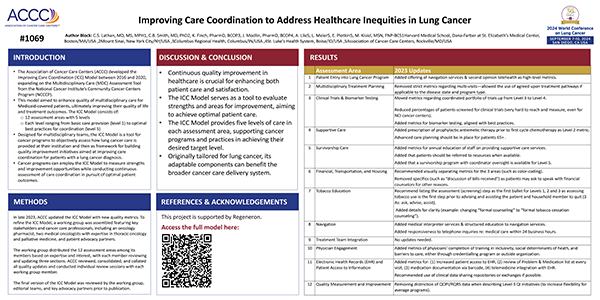
Using findings from an environmental scan (April 2016) and visits to 5 US cancer programs to explore current care models (July-October 2016), a Technical Expert Panel developed the OCCM, which has 13 defined Assessment Areas and utilizes an evaluation matrix.
To validate the OCCM, a competitive application process among ACCC’s membership used a comprehensive institutional quantitative and qualitative questionnaire. Applicants completed a self-assessment using the OCCM and then developed quality improvement projects designed to move their OCCM-scored care delivery performance from baseline to a higher level over a 12-month implementation period. Seven US community cancer centers were selected as Testing Sites. Quantifiable outcome measures were identified for each site, standardized across sites, and collected by a centralized data coordinating center.



 ACCCBuzz Blog
July 6, 2020
![[Abstract #12318] Creating an Optimal Care Coordination Model to Improve Multidisciplinary Care for Lung Cancer Patients on Medicaid](https://cdn.sanity.io/images/gvduir9b/production/9502df85b4fb9a6565a30137a5d28e7289240baf-768x490.png?fit=crop&auto=format)

![[Abstract #105] An Optimal Care Coordination Model (OCCM) for Medicaid Patients With Lung Cancer: Results From the Beta Model Testing Phase of a Multisite Initiative in the US](https://cdn.sanity.io/images/gvduir9b/production/c89f5a36d0c36f09d59fce2f3e8d26152ddc7c53-694x474.png)

![[Abstract #104] An Optimal Care Coordination Model (OCCM) for Medicaid Patients With Lung Cancer: Finalization of the Model and Implications for Clinical Practice in the US](https://cdn.sanity.io/images/gvduir9b/production/c0816d67a25d1397bd0e8c3ec1c5c226cc13dc44-518x386.png)

![[Abstract e14010] An Optimal Care Coordination Model for Medicaid Patients with Lung Cancer: Lessons Learned from the Beta Testing Phase of a Multisite Initiative](https://cdn.sanity.io/images/gvduir9b/production/d7450ab43167f577ba770be17b6b4078279e6836-190x236.png)