ACCC association of cancer care centers
Join/Renew
Login
Join/Renew
Login
Education & Resources
ACCC eXchange LogInCorporate Member Sponsored ResourcesPresentations & AbstractsACCC Connect eLearning LogIn
Publications
Oncology IssuesPatient Assistance & Reimbursement GuideTrending Now in Cancer CareBusiness Case Studies for Hiring New Staff
Events
2026 ACCC Leadership SummitAnnual Meeting & Cancer Center Business SummitCapitol Hill DayNational Oncology ConferenceOncology Reimbursement MeetingsOncology State Society Meetings
Policy & Advocacy
2024 Policy Wrap-Up and ACCC 2025 Policy PrioritiesLetters & StatementsAccess, Payment & Reimbursement ReformWhite Bagging & Brown BaggingAdvocacy ResourcesCancer Moonshot
Membership
Join | RenewWho We AreMembership Types & BenefitsCorporate MembersACCC Member Portal FAQMember Directory
Partners
Oncology State SocietiesPartner OrganizationsCME
News
News ReleasesAdvocacy News ReleasesOncology News
About ACCC
Timeline / 50th Anniversary2025 Impact ReportPresident's ThemeACCC Innovator AwardsACCC FellowsBoard of TrusteesACCC Senior Staff
Breast CancerMetastatic Breast Cancer
Gastrointestinal CancerBiliary Tract CancerColorectal CancerGastric CancerLiver Cancer
Genitourinary CancerBladder CancerProstate CancerRenal Cell Carcinoma
Gynecologic CancerOvarian Cancer
Head & Neck Cancer
Hematologic MalignanciesAcute Lymphocytic Leukemia (ALL)Acute Myeloid Leukemia (AML)Chronic Lymphocytic Leukemia (CLL)Mantle Cell Lymphoma (MCL)Multiple Myeloma (MM)Myelodysplastic Syndromes (MDS)
Lung CancerNon-Small Cell Lung Cancer (NSCLC)Small Cell Lung Cancer (SCLC)
Sarcoma
Skin CancerMelanomaNon-Melanoma Skin Cancers (NMSC)
Clinical Practice & TreatmentCancer DiagnosticsCare CoordinationEHR Integration for Biomarker TestingQuality Improvement Collaboration: Integration of Precision Medicine in Community OncologyTreatment
Financial NavigationFAN Boot CampFinancial Advocacy Network (FAN) Resource LibraryPatient Assistance & Reimbursement GuidePrior Authorization
Health Equity & Access3, 2, 1, Go! Practical Solutions for Addressing Cancer Care DisparitiesAppalachian Community Cancer AllianceOncology Advanced PractitionersPersonalizing Care for Patients of All BackgroundsSocial Drivers of Health
Patient-Centered CareAddressing Care Disparities for VeteransAdolescent and Young Adult (AYA)Care Action Plans for People with CancerDermatologic ToxicitiesEmpowering CaregiversGeriatric OncologyHealth LiteracyNutritionOncology PharmacyPatient NavigationPsychosocial Care in OncologyShared Decision-MakingSupportive CareSurvivorship Care
Practice Management & OperationsCancer Program FundamentalsLeadership Sustainment and Engagement VideosOncology Practice Transformation and Integration CenterOncology Team Resiliency
ResearchACCC Community Oncology Research Institute (ACORI)
Technology & InnovationTelehealth & Digital Medicine
ACCCBuzz Blog
CANCER BUZZ Podcast
Oncology Issues
Join/Renew
Login
Breast CancerMetastatic Breast Cancer
Gastrointestinal CancerBiliary Tract CancerColorectal CancerGastric CancerLiver Cancer
Genitourinary CancerBladder CancerProstate CancerRenal Cell Carcinoma
Gynecologic CancerOvarian Cancer
Head & Neck Cancer
Hematologic MalignanciesAcute Lymphocytic Leukemia (ALL)Acute Myeloid Leukemia (AML)Chronic Lymphocytic Leukemia (CLL)Mantle Cell Lymphoma (MCL)Multiple Myeloma (MM)Myelodysplastic Syndromes (MDS)
Lung CancerNon-Small Cell Lung Cancer (NSCLC)Small Cell Lung Cancer (SCLC)
Sarcoma
Skin CancerMelanomaNon-Melanoma Skin Cancers (NMSC)
Clinical Practice & TreatmentCancer DiagnosticsCare CoordinationEHR Integration for Biomarker TestingQuality Improvement Collaboration: Integration of Precision Medicine in Community OncologyTreatment
Financial NavigationFAN Boot CampFinancial Advocacy Network (FAN) Resource LibraryPatient Assistance & Reimbursement GuidePrior Authorization
Health Equity & Access3, 2, 1, Go! Practical Solutions for Addressing Cancer Care DisparitiesAppalachian Community Cancer AllianceOncology Advanced PractitionersPersonalizing Care for Patients of All BackgroundsSocial Drivers of Health
Patient-Centered CareAddressing Care Disparities for VeteransAdolescent and Young Adult (AYA)Care Action Plans for People with CancerDermatologic ToxicitiesEmpowering CaregiversGeriatric OncologyHealth LiteracyNutritionOncology PharmacyPatient NavigationPsychosocial Care in OncologyShared Decision-MakingSupportive CareSurvivorship Care
Practice Management & OperationsCancer Program FundamentalsLeadership Sustainment and Engagement VideosOncology Practice Transformation and Integration CenterOncology Team Resiliency
ResearchACCC Community Oncology Research Institute (ACORI)
Technology & InnovationTelehealth & Digital Medicine
ACCCBuzz Blog
CANCER BUZZ Podcast
Oncology Issues
    • Education & Resources
    • Publications
    • Events
    • Policy & Advocacy
    • Membership
    • Partners
    • News
    • About ACCC
ACCC association of cancer care centers
1801 Research Boulevard, Suite 400, Rockville, MD 20850
Tel: 301.984.9496 Fax: 301.770.1949 Email Us
Contact UsVolunteers
Advertise
Career Center
Terms and Conditions
Privacy Policy
ACCC Rebranding
Copyright © 2026 Association of Cancer Care Centers. All Rights Reserved.
HomeEducation & Resources

Managing Dermatologic Adverse Events From Immunotherapy

April 23, 2021
Joshua Arbesman, MD

Oncodermatology is a rapidly developing field that is attracting significant interest and generating new literature in the context of cancer treatment strategies.
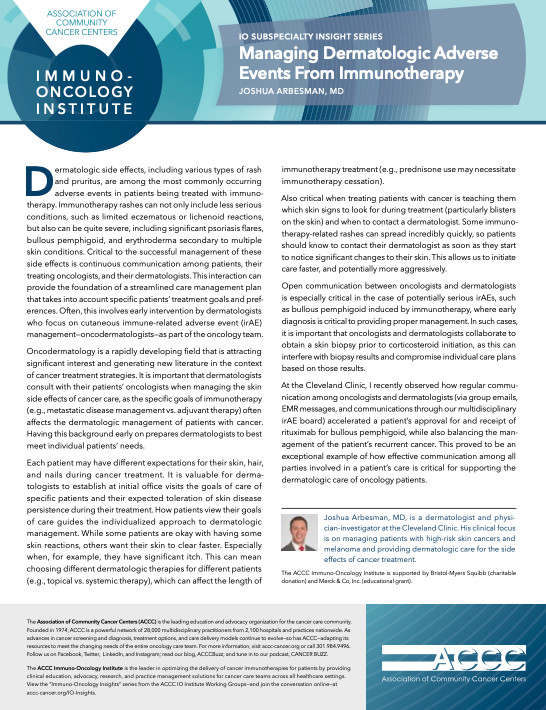
Managing Dermatologic Adverse  Events From Immunotherapy

Dermatologic side effects, including various types of rash and pruritus, are among the most commonly occurring adverse events in patients being treated with immunotherapy. Immunotherapy rashes can not only include less serious conditions, such as limited eczematous or lichenoid reactions, but also can be quite severe, including significant psoriasis flares, bullous pemphigoid, and erythroderma secondary to multiple skin conditions. Critical to the successful management of these side effects is continuous communication among patients, their treating oncologists, and their dermatologists. This interaction can provide the foundation of a streamlined care management plan that takes into account specific patients’ treatment goals and pref- erences. Often, this involves early intervention by dermatologists who focus on cutaneous immune-related adverse event (irAE) management—oncodermatologists—as part of the oncology team.

Oncodermatology is a rapidly developing field that is attracting significant interest and generating new literature in the context of cancer treatment strategies. It is important that dermatologists consult with their patients’ oncologists when managing the skin side effects of cancer care, as the specific goals of immunotherapy (e.g., metastatic disease management vs. adjuvant therapy) often affects the dermatologic management of patients with cancer. Having this background early on prepares dermatologists to best meet individual patients’ needs.

Each patient may have different expectations for their skin, hair, and nails during cancer treatment. It is valuable for dermatologists to establish at initial office visits the goals of care of specific patients and their expected toleration of skin disease persistence during their treatment. How patients view their goals of care guides the individualized approach to dermatologic management. While some patients are okay with having some skin reactions, others want their skin to clear faster. Especially when, for example, they have significant itch. This can mean choosing different dermatologic therapies for different patients (e.g., topical vs. systemic therapy), which can affect the length of immunotherapy treatment (e.g., prednisone use may necessitate immunotherapy cessation).

Also critical when treating patients with cancer is teaching them which skin signs to look for during treatment (particularly blisters on the skin) and when to contact a dermatologist. Some immunotherapy-related rashes can spread incredibly quickly, so patients should know to contact their dermatologist as soon as they start to notice significant changes to their skin. This allows us to initiate care faster, and potentially more aggressively.

Open communication between oncologists and dermatologists is especially critical in the case of potentially serious irAEs, such as bullous pemphigoid induced by immunotherapy, where early diagnosis is critical to providing proper management. In such cases, it is important that oncologists and dermatologists collaborate to obtain a skin biopsy prior to corticosteroid initiation, as this can interfere with biopsy results and compromise individual care plans based on those results.

At the Cleveland Clinic, I recently observed how regular communication among oncologists and dermatologists (via group emails, EMR messages, and communications through our multidisciplinary irAE board) accelerated a patient’s approval for and receipt of rituximab for bullous pemphigoid, while also balancing the management of the patient’s recurrent cancer. This proved to be an exceptional example of how effective communication among all parties involved in a patient’s care is critical for supporting the dermatologic care of oncology patients.

Upcoming Events

ACCC Leadership Summit
Oncology

ACCC Leadership Summit

In Person Meeting & NetworkingApril 16, 2026 at 8:00 AM EDT
Express Interest Now!
ACCC Oncology Reimbursement Meeting | Charleston
Oncology

ACCC Oncology Reimbursement Meeting | Charleston

In Person Meeting & NetworkingMay 6, 2026 at 8:00 AM EDT560 King Street, Charleston, SC, USAHyatt Place + Hyatt House Charleston - Historic District, Charleston
Register Now!
ACCC Oncology Reimbursement Meeting | St. Louis
Oncology

ACCC Oncology Reimbursement Meeting | St. Louis

In Person Meeting & NetworkingMay 13, 2026 at 8:00 AM CDT1335 South Lindbergh Boulevard, St. Louis, MO, USAHilton St. Louis Frontenac, St. Louis
Register Now!
ACCC 43rd National Oncology Conference
Oncology

ACCC 43rd National Oncology Conference

In Person Conference & ConventionOctober 21, 2026 at 8:00 AM MDT450 Summer St, Boston, MA 02210Omni Boston Hotel at the Seaport, Boston
Register Now!
HSCO 2026 March Dinner Symposium
Oncology

HSCO 2026 March Dinner Symposium

In Person Conference & ConventionMarch 25, 2026 at 5:30 PM HST3660 Waialae Ave, Honolulu, HI 96816, USA3660 On The Rise, Honolulu
Register Now!
 LOS 2026 Advocacy Summit
Oncology

LOS 2026 Advocacy Summit

In Person Conference & ConventionApril 1, 2026 at 5:00 PM CDT355 North Boulevard, Baton Rouge, Louisiana, USACity Club of Baton Rouge, Baton Rouge
Register Now!
COS 2026 Dinner Symposium - Grand Junction
Oncology

COS 2026 Dinner Symposium - Grand Junction

In Person Conference & ConventionApril 9, 2026 at 6:00 PM MDT840 Kennedy Avenue, Grand Junction, CO, USADevil's Kitchen, Grand Junction
Register Now!
TOPS 2026 Annual Conference
Oncology

TOPS 2026 Annual Conference

In Person Conference & ConventionApril 11, 2026 at 7:00 AM CDT201 8th Avenue South, Nashville, TN 37203, USAJW Marriott Nashville, Nashville
Register Now!
MSCO 2026 Spring Conference
Oncology

MSCO 2026 Spring Conference

In Person Conference & ConventionApril 15, 2026 at 5:00 PM CDTPark Pl Blvd, St. Louis Park, MN, USADoubleTree by Hilton Hotel Minneapolis - Park Place, St. Louis Park
Register Now!
KaSCO 2026 Spring Dinner Symposium
Oncology

KaSCO 2026 Spring Dinner Symposium

In Person Conference & ConventionApril 15, 2026 at 6:00 PM CDT101 W 22nd St, Kansas City, MO, USALidia's Kansas City, Kansas City
Register Now!
WVOS 2026 Spring Conference
Oncology

WVOS 2026 Spring Conference

In Person Conference & ConventionApril 16, 2026 at 8:00 AM EDT200 Lee Street East, Charleston, WV, USACharleston Marriott Town Center, Charleston
Register Now!
Advertisement
Advertisement

Trending Now on
ACCCBuzz Blog

Confronting a Lethal Cancer: Duke Launches Multidisciplinary Pancreatic Cancer Center for Earlier Detection and Better Outcomes

Confronting a Lethal Cancer: Duke Launches Multidisciplinary Pancreatic Cancer Center for Earlier Detection and Better Outcomes

In an effort to improve outcomes and deliver the highest quality of care to patients with pancreatic cancer, Duke Cancer Institute launched a multidisciplinary Pancreatic Cancer Center that prioritizes thorough surveillance of high-risk patients, stays at the forefront of clinical trials, and considers the role of comorbidities.

From Hospital to Home: A Solution for Proactive Symptom Monitoring and Precise Care

From Hospital to Home: A Solution for Proactive Symptom Monitoring and Precise Care

Electronic patient-reported outcomes (ePROs) can address limited visibility into patients' health and well-being between visits. Yet, many solutions remain generic in their workflows and mainly help capture adverse events, without helping care teams proactively manage or prevent them from worsening. Cureety offers a new kind of ePRO solution, specialized in oncology and designed to make care better quality, more efficient, and more proactive for all patients.

A Candid Conversation About the Power of Early Palliative Care

A Candid Conversation About the Power of Early Palliative Care

In the latest episode of Oncology Unscripted, hosts Deirdre Saulet and Mark Liu sit down with Andrew Ambort, DO, a palliative care consulting physician whose work in reshaping the role of palliative care across oncology helped WellSpan Health win a 2025 ACCC Innovator Award.

Rare but Real: Lessons From Providers Treating BPDCN and MCL

Rare but Real: Lessons From Providers Treating BPDCN and MCL

Patients with rare diseases and their families often feel isolated and overlooked, with many medical questions left unanswered and few people who can empathize with their condition. Rare Disease Day is observed globally each year to bring awareness for diseases and the people behind them by promoting the challenges these rare medical journeys pose for patients and caregivers.

View All ACCCBuzz Blogs

Recently Heard on
CANCER BUZZ Podcast

Transforming Palliative Care in Oncology – [Video Podcast] Ep. 227

Streamlining Access to TIL Cell Therapy for Melanoma

Policy in Practice: Change Hits the Clinic – [Podcast] Ep. 225

Addressing Psychosocial Distress With Psychedelic-Inspired Therapies – [Podcast] Ep. 224

View All Podcasts

Latest from Oncology Issues

February 2026
February 2026
December 2025
October 2025
August 2025
June 2025
View All Oncology Issues

Join the Conversation

ACCC eXchange Digital Banner
Login