ACCC association of cancer care centers
Join/Renew
Login
Join/Renew
Login
Education & Resources
ACCC eXchange LogInCorporate Member Sponsored ResourcesPresentations & AbstractsACCC Connect eLearning LogIn
Publications
Oncology IssuesPatient Assistance & Reimbursement GuideTrending Now in Cancer CareBusiness Case Studies for Hiring New Staff
Events
2026 ACCC Leadership SummitAnnual Meeting & Cancer Center Business SummitCapitol Hill DayNational Oncology ConferenceOncology Reimbursement MeetingsOncology State Society Meetings
Policy & Advocacy
2024 Policy Wrap-Up and ACCC 2025 Policy PrioritiesLetters & StatementsAccess, Payment & Reimbursement ReformWhite Bagging & Brown BaggingAdvocacy ResourcesCancer Moonshot
Membership
Join | RenewWho We AreMembership Types & BenefitsCorporate MembersACCC Member Portal FAQMember Directory
Partners
Oncology State SocietiesPartner OrganizationsCME
News
News ReleasesAdvocacy News ReleasesOncology News
About ACCC
Timeline / 50th Anniversary2025 Impact ReportPresident's ThemeACCC Innovator AwardsACCC FellowsACCC Senior Staff
Breast CancerMetastatic Breast Cancer
Gastrointestinal CancerBiliary Tract CancerColorectal CancerGastric CancerLiver Cancer
Genitourinary CancerBladder CancerProstate CancerRenal Cell Carcinoma
Gynecologic CancerOvarian Cancer
Head & Neck Cancer
Hematologic MalignanciesAcute Lymphocytic Leukemia (ALL)Acute Myeloid Leukemia (AML)Chronic Lymphocytic Leukemia (CLL)Mantle Cell Lymphoma (MCL)Multiple Myeloma (MM)Myelodysplastic Syndromes (MDS)
Lung CancerNon-Small Cell Lung Cancer (NSCLC)Small Cell Lung Cancer (SCLC)
Sarcoma
Skin CancerMelanomaNon-Melanoma Skin Cancers (NMSC)
Clinical Practice & TreatmentCancer DiagnosticsCare CoordinationEHR Integration for Biomarker TestingQuality Improvement Collaboration: Integration of Precision Medicine in Community OncologyTreatment
Financial NavigationFAN Boot CampFinancial Advocacy Network (FAN) Resource LibraryPatient Assistance & Reimbursement GuidePrior Authorization
Health Equity & Access3, 2, 1, Go! Practical Solutions for Addressing Cancer Care DisparitiesAppalachian Community Cancer AllianceOncology Advanced PractitionersPersonalizing Care for Patients of All BackgroundsSocial Drivers of Health
Patient-Centered CareAddressing Care Disparities for VeteransAdolescent and Young Adult (AYA)Care Action Plans for People with CancerDermatologic ToxicitiesEmpowering CaregiversGeriatric OncologyHealth LiteracyNutritionOncology PharmacyPatient NavigationPsychosocial Care in OncologyShared Decision-MakingSupportive CareSurvivorship Care
Practice Management & OperationsCancer Program FundamentalsLeadership Sustainment and Engagement VideosOncology Practice Transformation and Integration CenterOncology Team Resiliency
ResearchACCC Community Oncology Research Institute (ACORI)
Technology & InnovationTelehealth & Digital Medicine
ACCCBuzz Blog
CANCER BUZZ Podcast
Oncology Issues
Join/Renew
Login
Breast CancerMetastatic Breast Cancer
Gastrointestinal CancerBiliary Tract CancerColorectal CancerGastric CancerLiver Cancer
Genitourinary CancerBladder CancerProstate CancerRenal Cell Carcinoma
Gynecologic CancerOvarian Cancer
Head & Neck Cancer
Hematologic MalignanciesAcute Lymphocytic Leukemia (ALL)Acute Myeloid Leukemia (AML)Chronic Lymphocytic Leukemia (CLL)Mantle Cell Lymphoma (MCL)Multiple Myeloma (MM)Myelodysplastic Syndromes (MDS)
Lung CancerNon-Small Cell Lung Cancer (NSCLC)Small Cell Lung Cancer (SCLC)
Sarcoma
Skin CancerMelanomaNon-Melanoma Skin Cancers (NMSC)
Clinical Practice & TreatmentCancer DiagnosticsCare CoordinationEHR Integration for Biomarker TestingQuality Improvement Collaboration: Integration of Precision Medicine in Community OncologyTreatment
Financial NavigationFAN Boot CampFinancial Advocacy Network (FAN) Resource LibraryPatient Assistance & Reimbursement GuidePrior Authorization
Health Equity & Access3, 2, 1, Go! Practical Solutions for Addressing Cancer Care DisparitiesAppalachian Community Cancer AllianceOncology Advanced PractitionersPersonalizing Care for Patients of All BackgroundsSocial Drivers of Health
Patient-Centered CareAddressing Care Disparities for VeteransAdolescent and Young Adult (AYA)Care Action Plans for People with CancerDermatologic ToxicitiesEmpowering CaregiversGeriatric OncologyHealth LiteracyNutritionOncology PharmacyPatient NavigationPsychosocial Care in OncologyShared Decision-MakingSupportive CareSurvivorship Care
Practice Management & OperationsCancer Program FundamentalsLeadership Sustainment and Engagement VideosOncology Practice Transformation and Integration CenterOncology Team Resiliency
ResearchACCC Community Oncology Research Institute (ACORI)
Technology & InnovationTelehealth & Digital Medicine
ACCCBuzz Blog
CANCER BUZZ Podcast
Oncology Issues
    • Education & Resources
    • Publications
    • Events
    • Policy & Advocacy
    • Membership
    • Partners
    • News
    • About ACCC
ACCC association of cancer care centers
1801 Research Boulevard, Suite 400, Rockville, MD 20850
Tel: 301.984.9496 Fax: 301.770.1949 Email Us
Contact UsVolunteers
Advertise
Career Center
Terms and Conditions
Privacy Policy
ACCC Rebranding
Copyright © 2026 Association of Cancer Care Centers. All Rights Reserved.
Advertisement

Blog

Article

April 15, 2021

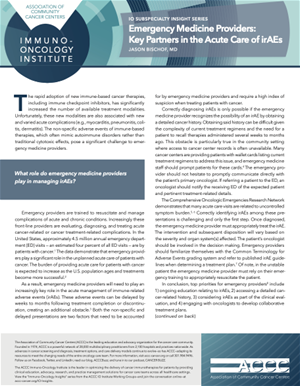
Emergency Medicine Providers: Key Partners in the Acute Care of irAEs

Jason Bischof, MD

The non-specific adverse events of immune-based therapies, which often mimic autoimmune disorders rather than traditional cytotoxic effects, pose a significant challenge to emergency medicine providers.
Emergency Medicine Providers:  Key Partners in the Acute Care of irAEs

The rapid adoption of new immune-based cancer therapies, including immune checkpoint inhibitors, has significantly increased the number of available treatment modalities. Unfortunately, these new modalities are also associated with new and varied acute complications (e.g., myocarditis, pneumonitis, colitis, dermatitis). The non-specific adverse events of immune-based therapies, which often mimic autoimmune disorders rather than traditional cytotoxic effects, pose a significant challenge to emergency medicine providers.

Emergency providers are trained to resuscitate and manage complications of acute and chronic conditions. Increasingly these front-line providers are evaluating, diagnosing, and treating acute cancer-related or cancer treatment-related complications. In the United States, approximately 4.5 million annual emergency department (ED) visits — an estimated four percent of all ED visits — are by patients with cancer.1 The data demonstrate that emergency providers play a significant role in the unplanned acute care of patients with cancer. The burden of providing acute care for patients with cancer is expected to increase as the U.S. population ages and treatments become more successful.2

As a result, emergency medicine providers will need to play an increasingly key role in the acute management of immune-related adverse events (irAEs). These adverse events can be delayed by weeks to months following treatment completion or discontinuation, creating an additional obstacle.3 Both the non-specific and delayed presentations are two factors that need to be accounted for by emergency medicine providers and require a high index of suspicion when treating patients with cancer.

Correctly diagnosing irAEs is only possible if the emergency medicine provider recognizes the possibility of an irAE by obtaining a detailed cancer history. Obtaining said history can be difficult given the complexity of current treatment regimens and the need for a patient to recall therapies administered several weeks to months ago. This obstacle is particularly true in the community setting where access to cancer center records is often unavailable. Many cancer centers are providing patients with wallet cards listing current treatment regimens to address this issue, and emergency medicine staff should prompt patients for these cards.4 The emergency provider should not hesitate to promptly communicate directly with the patient’s primary oncologist. If referring a patient to the ED, an oncologist should notify the receiving ED of the expected patient and pertinent treatment-related details.

The Comprehensive Oncologic Emergencies Research Network demonstrates that many acute care visits are related to uncontrolled symptom burden.5, 6 Correctly identifying irAEs among these pre- sentations is challenging and only the first step. Once diagnosed, the emergency medicine provider must appropriately treat the irAE. The intervention and subsequent disposition will vary based on the severity and organ system(s) affected. The patient’s oncologist should be involved in the decision making. Emergency providers should familiarize themselves with the Common Terminology for Adverse Events grading system and refer to published irAE guide- lines when determining a treatment plan.7 Of note, in the unstable patient the emergency medicine provider must rely on their emergency training to appropriately resuscitate the patient.

In conclusion, top priorities for emergency providers8 include 1) ongoing education relating to irAEs, 2) accessing a detailed cancer-related history, 3) considering irAEs as part of the clinical evaluation, and 4) engaging with oncologists to develop collaborative treatment plans.

References

  1. Rivera DR, Gallicchio L, Brown J, Liu B, Kyriacou DN, Shelburne N. Trends in Adult Cancer-Related Emergency Department Utilization: An Analysis of Data From the Nationwide Emergency Department Sample. JAMA Oncol. Oct 12 2017;3(10):e172450. doi:10.1001/jamaoncol.2017.2450
  2. Bluethmann SM, Mariotto AB, Rowland JH. Anticipating the “Silver Tsunami”: Prevalence Trajectories and Comorbidity Burden among Older Cancer Survivors in the United States. Cancer Epidemiol Biomarkers Prev. ©2016 American Association for Cancer Research.; 2016:1029-36. vol. 7.
  3. Pallin DJ, Baugh CW, Postow MA, Caterino JM, Erickson TB, Lyman GH. Immune-related Adverse Events in Cancer Patients. Acad Emerg Med. Jul 2018;25(7):819-827. doi:10.1111/acem.13443
  4. Rubin KM. Understanding Immune Checkpoint Inhibitors for Effective Patient Care. Clin J Oncol Nurs. Dec 2015;19(6):709-17. doi:10.1188/15.cjon.709-717
  5. Caterino JM, Adler D, Durham DD, et al. Analysis of Diagnoses, Symptoms, Medications, and Admissions Among Patients With Cancer Presenting to Emergency Departments. JAMA Netw Open. Mar 1 2019;2(3):e190979. doi:10.1001/jamanetworkopen.2019.0979
  6. Adler D, Abar B, Durham DD, et al. Validation of the Emergency Severity Index (Version 4) for the Triage of Adult Emergency Department Patients With Active Cancer. J Emerg Med. Jul 26 2019;doi:10.1016/j.jemermed.2019.05.023
  7. Brahmer JR, Lacchetti C, Schneider BJ, et al. Management of Immune-Related Adverse Events in Patients Treated With Immune Checkpoint Inhibitor Therapy: American Society of Clinical Oncology Clinical Practice Guideline. J Clin Oncol. Jun 10 2018;36(17):1714-1768. doi:10.1200/jco.2017.77.6385
  8. Bischof JJ, Presley CJ, Caterino JM. Addressing New Diagnostic and Treatment Challenges Associated With a New Age of Cancer Treatment. Ann Emerg Med. Jan 2019;73(1):88-90. doi:10.1016/j.annemergmed.2018.08.421