
ACCC association of cancer care centers
Join/Renew
Login
Join/Renew
Login
Education & Resources
ACCC eXchange LogInCorporate Member Sponsored ResourcesPresentations & AbstractsACCC Connect eLearning LogIn
Publications
Oncology IssuesPatient Assistance & Reimbursement GuideTrending Now in Cancer CareBusiness Case Studies for Hiring New Staff
Events
2026 ACCC Leadership SummitAnnual Meeting & Cancer Center Business SummitCapitol Hill DayNational Oncology ConferenceOncology Reimbursement MeetingsOncology State Society Meetings
Policy & Advocacy
2024 Policy Wrap-Up and ACCC 2025 Policy PrioritiesLetters & StatementsAccess, Payment & Reimbursement ReformWhite Bagging & Brown BaggingAdvocacy ResourcesCancer Moonshot
Membership
Join | RenewWho We AreMembership Types & BenefitsCorporate MembersACCC Member Portal FAQMember Directory
Partners
Oncology State SocietiesPartner OrganizationsCME
News
News ReleasesAdvocacy News ReleasesOncology News
About ACCC
Timeline / 50th Anniversary2025 Impact ReportPresident's ThemeACCC Innovator AwardsACCC FellowsACCC Senior Staff
Breast CancerMetastatic Breast Cancer
Gastrointestinal CancerBiliary Tract CancerColorectal CancerGastric CancerLiver Cancer
Genitourinary CancerBladder CancerProstate CancerRenal Cell Carcinoma
Gynecologic CancerOvarian Cancer
Head & Neck Cancer
Hematologic MalignanciesAcute Lymphocytic Leukemia (ALL)Acute Myeloid Leukemia (AML)Chronic Lymphocytic Leukemia (CLL)Mantle Cell Lymphoma (MCL)Multiple Myeloma (MM)Myelodysplastic Syndromes (MDS)
Lung CancerNon-Small Cell Lung Cancer (NSCLC)Small Cell Lung Cancer (SCLC)
Sarcoma
Skin CancerMelanomaNon-Melanoma Skin Cancers (NMSC)
Clinical Practice & TreatmentCancer DiagnosticsCare CoordinationEHR Integration for Biomarker TestingQuality Improvement Collaboration: Integration of Precision Medicine in Community OncologyTreatment
Financial NavigationFAN Boot CampFinancial Advocacy Network (FAN) Resource LibraryPatient Assistance & Reimbursement GuidePrior Authorization
Health Equity & Access3, 2, 1, Go! Practical Solutions for Addressing Cancer Care DisparitiesAppalachian Community Cancer AllianceOncology Advanced PractitionersPersonalizing Care for Patients of All BackgroundsSocial Drivers of Health
Patient-Centered CareAddressing Care Disparities for VeteransAdolescent and Young Adult (AYA)Care Action Plans for People with CancerDermatologic ToxicitiesEmpowering CaregiversGeriatric OncologyHealth LiteracyNutritionOncology PharmacyPatient NavigationPsychosocial Care in OncologyShared Decision-MakingSupportive CareSurvivorship Care
Practice Management & OperationsCancer Program FundamentalsLeadership Sustainment and Engagement VideosOncology Practice Transformation and Integration CenterOncology Team Resiliency
ResearchACCC Community Oncology Research Institute (ACORI)
Technology & InnovationTelehealth & Digital Medicine
ACCCBuzz Blog
CANCER BUZZ Podcast
Oncology Issues
Join/Renew
Login
Breast CancerMetastatic Breast Cancer
Gastrointestinal CancerBiliary Tract CancerColorectal CancerGastric CancerLiver Cancer
Genitourinary CancerBladder CancerProstate CancerRenal Cell Carcinoma
Gynecologic CancerOvarian Cancer
Head & Neck Cancer
Hematologic MalignanciesAcute Lymphocytic Leukemia (ALL)Acute Myeloid Leukemia (AML)Chronic Lymphocytic Leukemia (CLL)Mantle Cell Lymphoma (MCL)Multiple Myeloma (MM)Myelodysplastic Syndromes (MDS)
Lung CancerNon-Small Cell Lung Cancer (NSCLC)Small Cell Lung Cancer (SCLC)
Sarcoma
Skin CancerMelanomaNon-Melanoma Skin Cancers (NMSC)
Clinical Practice & TreatmentCancer DiagnosticsCare CoordinationEHR Integration for Biomarker TestingQuality Improvement Collaboration: Integration of Precision Medicine in Community OncologyTreatment
Financial NavigationFAN Boot CampFinancial Advocacy Network (FAN) Resource LibraryPatient Assistance & Reimbursement GuidePrior Authorization
Health Equity & Access3, 2, 1, Go! Practical Solutions for Addressing Cancer Care DisparitiesAppalachian Community Cancer AllianceOncology Advanced PractitionersPersonalizing Care for Patients of All BackgroundsSocial Drivers of Health
Patient-Centered CareAddressing Care Disparities for VeteransAdolescent and Young Adult (AYA)Care Action Plans for People with CancerDermatologic ToxicitiesEmpowering CaregiversGeriatric OncologyHealth LiteracyNutritionOncology PharmacyPatient NavigationPsychosocial Care in OncologyShared Decision-MakingSupportive CareSurvivorship Care
Practice Management & OperationsCancer Program FundamentalsLeadership Sustainment and Engagement VideosOncology Practice Transformation and Integration CenterOncology Team Resiliency
ResearchACCC Community Oncology Research Institute (ACORI)
Technology & InnovationTelehealth & Digital Medicine
ACCCBuzz Blog
CANCER BUZZ Podcast
Oncology Issues
    • Education & Resources
    • Publications
    • Events
    • Policy & Advocacy
    • Membership
    • Partners
    • News
    • About ACCC
ACCC association of cancer care centers
1801 Research Boulevard, Suite 400, Rockville, MD 20850
Tel: 301.984.9496 Fax: 301.770.1949 Email Us
Contact UsVolunteers
Advertise
Career Center
Terms and Conditions
Privacy Policy
ACCC Rebranding
Copyright © 2026 Association of Cancer Care Centers. All Rights Reserved.
Advertisement
Home / Education And Resources / Clinical Practice Treatment / Treatment / Tumor Infiltrating Lymphocyte Therapy

TUMOR-INFILTRATING LYMPHOCYTE (TIL) THERAPY

Tumor infiltrating lymphocytes (TILs) are immune cells that have migrated into the tumor microenvironment, where they recognize and target cancer cells. As a form of adoptive cell therapy, TILs can be harvested from a patient’s tumor, expanded ex vivo, and reinfused to promote immune-mediated tumor destruction. This approach leverages the body’s natural defense mechanisms and has shown promise in treating solid tumors, particularly in patients with limited responses to conventional therapies. Ongoing research continues to refine TIL-based strategies, optimizing their efficacy and integration into multidisciplinary cancer care.


The Association of Cancer Care Centers (ACCC) offers resources for TIL provider education and highlights best practices for improving care coordination between authorized treatment centers and community practices to enable timely referrals and access to treatment.

Featured Publications

1/2

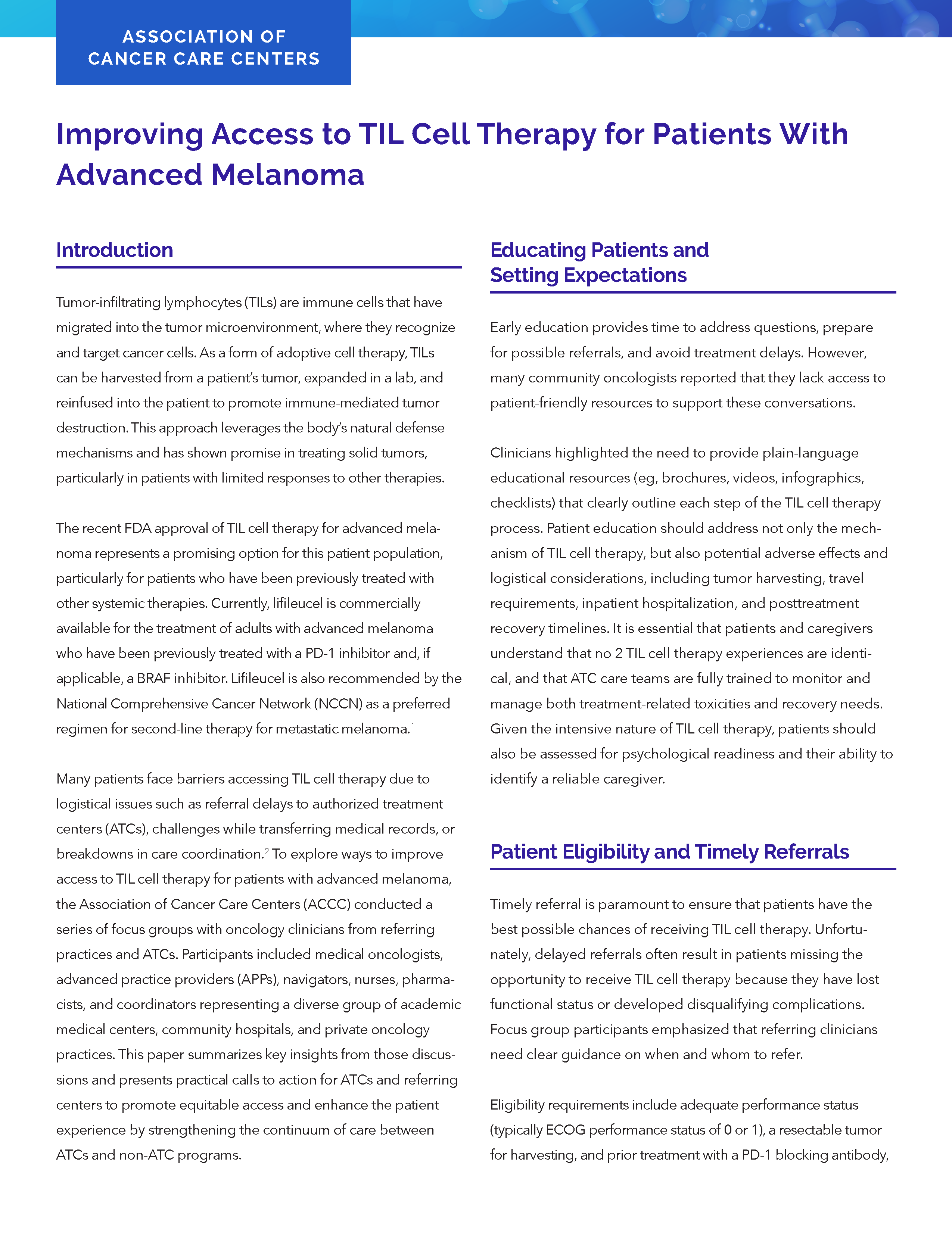
Improving Access to TIL Cell Therapy for Patients With Advanced Melanoma

Examine key findings from oncology clinician focus groups on improving access to TIL cell therapy for advanced melanoma. Discover how referring practices and authorized treatment centers can optimize coordination, enhance patient and caregiver education, and ensure equitable access.
Download Now
Improving Access to TIL Cell Therapy for Patients With Advanced Melanoma

Featured Resources

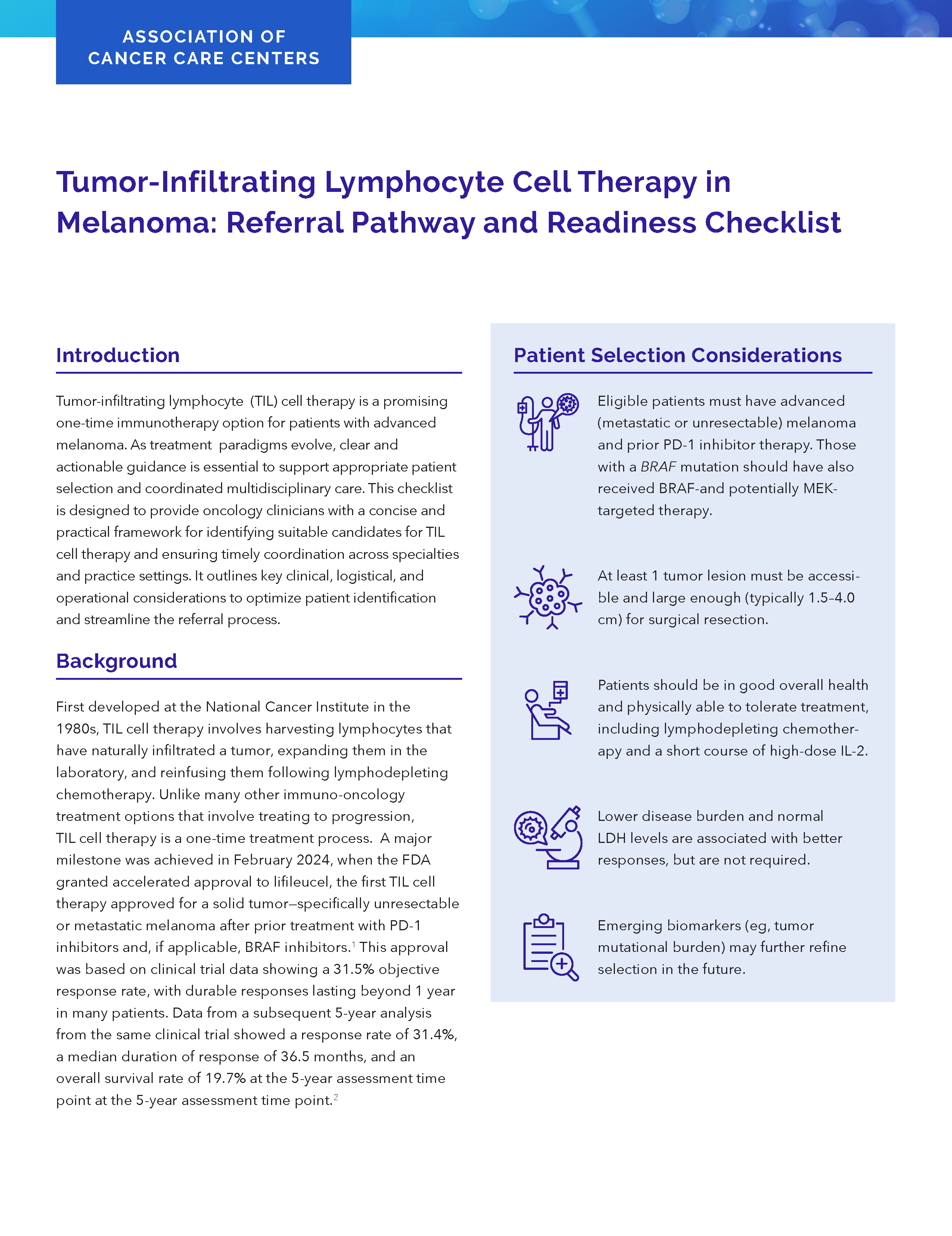
Referral Pathway and Readiness Checklist

Explore a concise, practical framework to identify patients with advanced melanoma who may benefit from TIL cell therapy. Gain key insights for ensuring timely, coordinated care through enhanced multidisciplinary collaboration and streamlined referral processes.

Download Now
Referral Pathway and Readiness Checklist

From the ACCCBuzz Blog

Streamlining TIL Cell Therapy: ACCC Resources to Improve Referral Pathways and Academic–Community Coordination

Streamlining TIL Cell Therapy: ACCC Resources to Improve Referral Pathways and Academic–Community Coordination

Nov 17th 2025

ACCC is excited to share its new provider resources for TIL cell therapy, including a referral readiness checklist, patient pathway guide, and white paper with tangible steps for improving access.

CANCER BUZZ Podcasts

Streamlining Access to TIL Cell Therapy for Melanoma

Mar 5th 2026

Tumor-infiltrating lymphocyte (TIL) cell therapy is a promising option for patients with advanced melanoma, but logistical and referral challenges can be a barrier to care. In this episode, CANCER BUZZ speaks with Lilit Karapetyan, MD, MS, FACP, medical oncologist at Moffit Cancer Center and Research Institute, an authorized treatment center (ATC) for TIL cell therapy, and Raju Vaddepally, MD, hematologist-oncologist at Florida Cancer Specialists, a non-ATC, about the referral process. Both guests discuss the relationship between their cancer programs, offering actionable tips on how to streamline the identification and referral of melanoma patients for TIL therapy across institutions.

Our Supporter

This program was made possible with support from Iovance.

Iovance Biotherapeutics