ACCC association of cancer care centers
Join/Renew
Login
Join/Renew
Login
Education & Resources
ACCC eXchange LogInCorporate Member Sponsored ResourcesPresentations & AbstractsACCC Connect eLearning LogIn
Publications
Oncology IssuesPatient Assistance & Reimbursement GuideTrending Now in Cancer CareBusiness Case Studies for Hiring New Staff
Events
2026 ACCC Leadership SummitAnnual Meeting & Cancer Center Business SummitCapitol Hill DayNational Oncology ConferenceOncology Reimbursement MeetingsOncology State Society Meetings
Policy & Advocacy
2024 Policy Wrap-Up and ACCC 2025 Policy PrioritiesLetters & StatementsAccess, Payment & Reimbursement ReformWhite Bagging & Brown BaggingAdvocacy ResourcesCancer Moonshot
Membership
Join | RenewWho We AreMembership Types & BenefitsCorporate MembersACCC Member Portal FAQMember Directory
Partners
Oncology State SocietiesPartner OrganizationsCME
News
News ReleasesAdvocacy News ReleasesOncology News
About ACCC
Timeline / 50th Anniversary2025 Impact ReportPresident's ThemeACCC Innovator AwardsACCC FellowsACCC Senior Staff
Breast CancerMetastatic Breast Cancer
Gastrointestinal CancerBiliary Tract CancerColorectal CancerGastric CancerLiver Cancer
Genitourinary CancerBladder CancerProstate CancerRenal Cell Carcinoma
Gynecologic CancerOvarian Cancer
Head & Neck Cancer
Hematologic MalignanciesAcute Lymphocytic Leukemia (ALL)Acute Myeloid Leukemia (AML)Chronic Lymphocytic Leukemia (CLL)Mantle Cell Lymphoma (MCL)Multiple Myeloma (MM)Myelodysplastic Syndromes (MDS)
Lung CancerNon-Small Cell Lung Cancer (NSCLC)Small Cell Lung Cancer (SCLC)
Sarcoma
Skin CancerMelanomaNon-Melanoma Skin Cancers (NMSC)
Clinical Practice & TreatmentCancer DiagnosticsCare CoordinationEHR Integration for Biomarker TestingQuality Improvement Collaboration: Integration of Precision Medicine in Community OncologyTreatment
Financial NavigationFAN Boot CampFinancial Advocacy Network (FAN) Resource LibraryPatient Assistance & Reimbursement GuidePrior Authorization
Health Equity & Access3, 2, 1, Go! Practical Solutions for Addressing Cancer Care DisparitiesAppalachian Community Cancer AllianceOncology Advanced PractitionersPersonalizing Care for Patients of All BackgroundsSocial Drivers of Health
Patient-Centered CareAddressing Care Disparities for VeteransAdolescent and Young Adult (AYA)Care Action Plans for People with CancerDermatologic ToxicitiesEmpowering CaregiversGeriatric OncologyHealth LiteracyNutritionOncology PharmacyPatient NavigationPsychosocial Care in OncologyShared Decision-MakingSupportive CareSurvivorship Care
Practice Management & OperationsCancer Program FundamentalsLeadership Sustainment and Engagement VideosOncology Practice Transformation and Integration CenterOncology Team Resiliency
ResearchACCC Community Oncology Research Institute (ACORI)
Technology & InnovationTelehealth & Digital Medicine
ACCCBuzz Blog
CANCER BUZZ Podcast
Oncology Issues
Join/Renew
Login
Breast CancerMetastatic Breast Cancer
Gastrointestinal CancerBiliary Tract CancerColorectal CancerGastric CancerLiver Cancer
Genitourinary CancerBladder CancerProstate CancerRenal Cell Carcinoma
Gynecologic CancerOvarian Cancer
Head & Neck Cancer
Hematologic MalignanciesAcute Lymphocytic Leukemia (ALL)Acute Myeloid Leukemia (AML)Chronic Lymphocytic Leukemia (CLL)Mantle Cell Lymphoma (MCL)Multiple Myeloma (MM)Myelodysplastic Syndromes (MDS)
Lung CancerNon-Small Cell Lung Cancer (NSCLC)Small Cell Lung Cancer (SCLC)
Sarcoma
Skin CancerMelanomaNon-Melanoma Skin Cancers (NMSC)
Clinical Practice & TreatmentCancer DiagnosticsCare CoordinationEHR Integration for Biomarker TestingQuality Improvement Collaboration: Integration of Precision Medicine in Community OncologyTreatment
Financial NavigationFAN Boot CampFinancial Advocacy Network (FAN) Resource LibraryPatient Assistance & Reimbursement GuidePrior Authorization
Health Equity & Access3, 2, 1, Go! Practical Solutions for Addressing Cancer Care DisparitiesAppalachian Community Cancer AllianceOncology Advanced PractitionersPersonalizing Care for Patients of All BackgroundsSocial Drivers of Health
Patient-Centered CareAddressing Care Disparities for VeteransAdolescent and Young Adult (AYA)Care Action Plans for People with CancerDermatologic ToxicitiesEmpowering CaregiversGeriatric OncologyHealth LiteracyNutritionOncology PharmacyPatient NavigationPsychosocial Care in OncologyShared Decision-MakingSupportive CareSurvivorship Care
Practice Management & OperationsCancer Program FundamentalsLeadership Sustainment and Engagement VideosOncology Practice Transformation and Integration CenterOncology Team Resiliency
ResearchACCC Community Oncology Research Institute (ACORI)
Technology & InnovationTelehealth & Digital Medicine
ACCCBuzz Blog
CANCER BUZZ Podcast
Oncology Issues
    • Education & Resources
    • Publications
    • Events
    • Policy & Advocacy
    • Membership
    • Partners
    • News
    • About ACCC
ACCC association of cancer care centers
1801 Research Boulevard, Suite 400, Rockville, MD 20850
Tel: 301.984.9496 Fax: 301.770.1949 Email Us
Contact UsVolunteers
Advertise
Career Center
Terms and Conditions
Privacy Policy
ACCC Rebranding
Copyright © 2026 Association of Cancer Care Centers. All Rights Reserved.
Advertisement

Blog

Article

March 11, 2021

Working with Rheumatologists to Manage irAEs

Laura C. Capelli, MD, MHS

Accurately diagnosing and treating rheumatic irAEs requires that providers obtain a tailored patient history and physical examination, since there are no definitive diagnostic laboratory tests for these complications.
Working with Rheumatologists to Manage irAEs

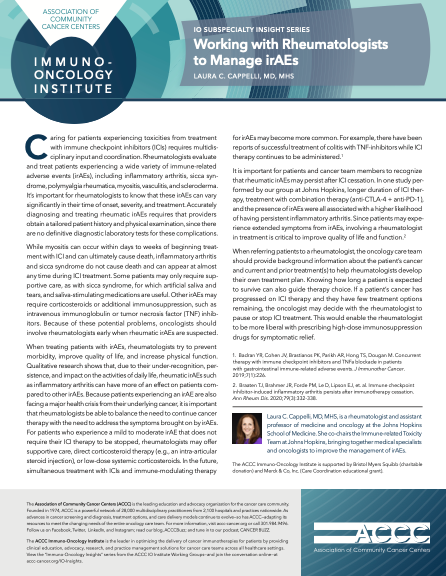
Caring for patients experiencing toxicities from treatment with immune checkpoint inhibitors (ICIs) requires multidisciplinary input and coordination. Rheumatologists evaluate and treat patients experiencing a wide variety of immune-related adverse events (irAEs), including inflammatory arthritis, sicca syndrome, polymyalgia rheumatica, myositis, vasculitis, and scleroderma. It’s important for rheumatologists to know that these irAEs can vary significantly in their time of onset, severity, and treatment. Accurately diagnosing and treating rheumatic irAEs requires that providers obtain a tailored patient history and physical examination, since there are no definitive diagnostic laboratory tests for these complications.

While myositis can occur within days to weeks of beginning treatment with ICI and can ultimately cause death, inflammatory arthritis and sicca syndrome do not cause death and can appear at almost any time during ICI treatment. Some patients may only require supportive care, as with sicca syndrome, for which artificial saliva and tears, and saliva-stimulating medications are useful. Other irAEs may require corticosteroids or additional immunosuppression, such as intravenous immunoglobulin or tumor necrosis factor (TNF) inhibitors. Because of these potential problems, oncologists should involve rheumatologists early when rheumatic irAEs are suspected.

When treating patients with irAEs, rheumatologists try to prevent morbidity, improve quality of life, and increase physical function. Qualitative research shows that, due to their under-recognition, persistence, and impact on the activities of daily life, rheumatic irAEs such as inflammatory arthritis can have more of an effect on patients compared to other irAEs. Because patients experiencing an irAE are also facing a major health crisis from their underlying cancer, it is important that rheumatologists be able to balance the need to continue cancer therapy with the need to address the symptoms brought on by irAEs. For patients who experience a mild to moderate irAE that does not require their ICI therapy to be stopped, rheumatologists may offer supportive care, direct corticosteroid therapy (e.g., an intra-articular steroid injection), or low-dose systemic corticosteroids. In the future, simultaneous treatment with ICIs and immune-modulating therapy for irAEs may become more common. For example, there have been reports of successful treatment of colitis with TNF-inhibitors while ICI therapy continues to be administered.1

It is important for patients and cancer team members to recognize that rheumatic irAEs may persist after ICI cessation. In one study performed by our group at Johns Hopkins, longer duration of ICI therapy, treatment with combination therapy (anti-CTLA-4 + anti-PD-1), and the presence of irAEs were all associated with a higher likelihood of having persistent inflammatory arthritis. Since patients may experience extended symptoms from irAEs, involving a rheumatologist in treatment is critical to improve quality of life and function.2

When referring patients to a rheumatologist, the oncology care team should provide background information about the patient’s cancer and current and prior treatment(s) to help rheumatologists develop their own treatment plan. Knowing how long a patient is expected to survive can also guide therapy choice. If a patient’s cancer has progressed on ICI therapy and they have few treatment options remaining, the oncologist may decide with the rheumatologist to pause or stop ICI treatment. This would enable the rheumatologist to be more liberal with prescribing high-dose immunosuppression drugs for symptomatic relief.

References

  1. Badran YR, Cohen JV, Brastianos PK, Parikh AR, Hong TS, Dougan M. Concurrent therapy with immune checkpoint inhibitors and TNFa blockade in patients with gastrointestinal immune-related adverse events. J Immunother Cancer. 2019;7(1):226.
  2. Braaten TJ, Brahmer JR, Forde PM, Le D, Lipson EJ, et. al. Immune checkpoint inhibitor-induced inflammatory arthritis persists after immunotherapy cessation. Ann Rheum Dis. 2020;79(3):332-338.