
ACCC association of cancer care centers
Join/Renew
Login
Join/Renew
Login
Education & Resources
ACCC eXchange LogInCorporate Member Sponsored ResourcesPresentations & AbstractsPresident's ThemeACCC Connect eLearning LogIn
Publications
Oncology IssuesPatient Assistance & Reimbursement GuideTrending Now in Cancer Care
Events
2026 ACCC Leadership SummitAnnual Meeting & Cancer Center Business SummitCapitol Hill DayNational Oncology ConferenceOncology Reimbursement MeetingsOncology State Society Meetings
Policy & Advocacy
2024 Policy Wrap-Up and ACCC 2025 Policy PrioritiesLetters & StatementsAccess, Payment & Reimbursement ReformWhite Bagging & Brown BaggingAdvocacy ResourcesCancer Moonshot
Membership
Join | RenewWho We AreMembership Types & BenefitsCorporate MembersACCC Member Portal FAQMember Directory
Partners
Oncology State SocietiesPartner OrganizationsCME
News
News ReleasesAdvocacy News ReleasesOncology News
About ACCC
Timeline / 50th Anniversary2025 Impact ReportACCC Innovator AwardsACCC FellowsACCC Senior Staff
Breast CancerMetastatic Breast Cancer
Gastrointestinal CancerBiliary Tract CancerColorectal CancerGastric CancerLiver Cancer
Genitourinary CancerBladder CancerProstate CancerRenal Cell Carcinoma
Gynecologic CancerOvarian Cancer
Head & Neck Cancer
Hematologic MalignanciesAcute Lymphocytic Leukemia (ALL)Acute Myeloid Leukemia (AML)Chronic Lymphocytic Leukemia (CLL)Mantle Cell Lymphoma (MCL)Multiple Myeloma (MM)Myelodysplastic Syndromes (MDS)
Lung CancerNon-Small Cell Lung Cancer (NSCLC)Small Cell Lung Cancer (SCLC)
Sarcoma
Skin CancerMelanomaNon-Melanoma Skin Cancers (NMSC)
Clinical Practice & TreatmentCancer DiagnosticsCare CoordinationEHR Integration for Biomarker TestingQuality Improvement Collaboration: Integration of Precision Medicine in Community OncologyTreatment
Financial NavigationFAN Boot CampFinancial Advocacy Network (FAN) Resource LibraryPatient Assistance & Reimbursement GuidePrior Authorization
Health Equity & Access3, 2, 1, Go! Practical Solutions for Addressing Cancer Care DisparitiesAppalachian Community Cancer AllianceOncology Advanced PractitionersPersonalizing Care for Patients of All BackgroundsSocial Drivers of Health
Patient-Centered CareAddressing Care Disparities for VeteransAdolescent and Young Adult (AYA)Care Action Plans for People with CancerDermatologic ToxicitiesEmpowering CaregiversGeriatric OncologyHealth LiteracyNutritionOncology PharmacyPatient NavigationPsychosocial Care in OncologyShared Decision-MakingSupportive CareSurvivorship Care
Practice Management & OperationsCancer Program FundamentalsLeadership Sustainment and Engagement VideosOncology Practice Transformation and Integration CenterOncology Team Resiliency
ResearchACCC Community Oncology Research Institute (ACORI)
Technology & InnovationTelehealth & Digital Medicine
ACCCBuzz Blog
CANCER BUZZ Podcast
Oncology Issues
Join/Renew
Login
Breast CancerMetastatic Breast Cancer
Gastrointestinal CancerBiliary Tract CancerColorectal CancerGastric CancerLiver Cancer
Genitourinary CancerBladder CancerProstate CancerRenal Cell Carcinoma
Gynecologic CancerOvarian Cancer
Head & Neck Cancer
Hematologic MalignanciesAcute Lymphocytic Leukemia (ALL)Acute Myeloid Leukemia (AML)Chronic Lymphocytic Leukemia (CLL)Mantle Cell Lymphoma (MCL)Multiple Myeloma (MM)Myelodysplastic Syndromes (MDS)
Lung CancerNon-Small Cell Lung Cancer (NSCLC)Small Cell Lung Cancer (SCLC)
Sarcoma
Skin CancerMelanomaNon-Melanoma Skin Cancers (NMSC)
Clinical Practice & TreatmentCancer DiagnosticsCare CoordinationEHR Integration for Biomarker TestingQuality Improvement Collaboration: Integration of Precision Medicine in Community OncologyTreatment
Financial NavigationFAN Boot CampFinancial Advocacy Network (FAN) Resource LibraryPatient Assistance & Reimbursement GuidePrior Authorization
Health Equity & Access3, 2, 1, Go! Practical Solutions for Addressing Cancer Care DisparitiesAppalachian Community Cancer AllianceOncology Advanced PractitionersPersonalizing Care for Patients of All BackgroundsSocial Drivers of Health
Patient-Centered CareAddressing Care Disparities for VeteransAdolescent and Young Adult (AYA)Care Action Plans for People with CancerDermatologic ToxicitiesEmpowering CaregiversGeriatric OncologyHealth LiteracyNutritionOncology PharmacyPatient NavigationPsychosocial Care in OncologyShared Decision-MakingSupportive CareSurvivorship Care
Practice Management & OperationsCancer Program FundamentalsLeadership Sustainment and Engagement VideosOncology Practice Transformation and Integration CenterOncology Team Resiliency
ResearchACCC Community Oncology Research Institute (ACORI)
Technology & InnovationTelehealth & Digital Medicine
ACCCBuzz Blog
CANCER BUZZ Podcast
Oncology Issues
    • Education & Resources
    • Publications
    • Events
    • Policy & Advocacy
    • Membership
    • Partners
    • News
    • About ACCC
ACCC association of cancer care centers
1801 Research Boulevard, Suite 400, Rockville, MD 20850
Tel: 301.984.9496 Fax: 301.770.1949 Email Us
Contact UsVolunteers
Advertise
Career Center
Terms and Conditions
Privacy Policy
ACCC Rebranding
Copyright © 2026 Association of Cancer Care Centers. All Rights Reserved.
Advertisement
Home / Education And Resources / Clinical Practice Treatment / Treatment / Immunotherapy / CAR T Cell Therapy / Tips For Early Patient Identification For CAR T Cell Therapy And Care Continuity With Community Providers

TIPS FOR EARLY PATIENT IDENTIFICATION FOR CAR T-CELL THERAPY AND CARE CONTINUITY WITH COMMUNITY PROVIDERS

In the community setting, accurate patient identification for CAR T-cell therapy is critical for appropriate and timely treatment. Often, patients with advanced hematologic cancers are considered for, or become aware of, CAR T-cell therapy after the optimal treatment window has closed.1 Additionally, there are significant financial, logistical, and educational barriers that patients and their caregivers may face in accessing this potentially life-saving immunotherapy.2 However, less is known about how patients are educated on CAR T-cell therapy and how well they are able to maintain relationships with their referring providers. Additionally, there remains an opportunity to improve community oncology education surrounding timely patient identification and ways to harmonize collaboration between referring community programs and accredited treatment centers.

ACCC—with its program partners Cancer Support Community, the Association of American Cancer Institutes and the Advanced Practitioner Society for Hematology and Oncology, and with support by Kite Pharma—aims to better understand patient and caregiver education and experience with CAR T-cell therapy and identify ways in which cancer programs can improve timely identification and referral as well as improve communication and care coordination between referring and treating providers. ACCC will also share tips and highlight resources that can be utilized to educate patients and their caregivers on the option of CAR T-cell therapy early in the treatment journey, to enable more patients to potentially qualify for therapy.

For more information on this program, please contact the ACCC Provider Education department.

Featured Publications

Featured Publications

1/3

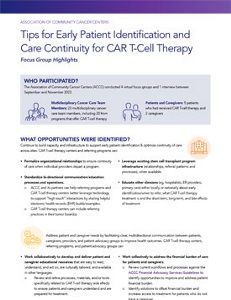
Tips for Early Patient Identification and Care Continuity for CAR T-Cell Therapy

In 2023, ACCC conducted virtual focus groups to better understand patient and caregiver education and experience with CAR T-cell therapy and identify ways in which cancer programs can improve timely identification and referral as well as understand current practices for communication and care coordination between referring and treating providers.
Download
Tips for Early Patient Identification and Care Continuity for CAR T-Cell Therapy

From Oncology Issues

Emerging Opportunities in CAR T-Cell Therapy to Improve Early Patient Identification and Care Continuity

Emerging Opportunities in CAR T-Cell Therapy to Improve Early Patient Identification and Care Continuity

Explore how peer-to-peer education and regional networking opportunities between academic medical centers, community programs, and providers can promote effective care continuity and gain insights on how to engage patients and caregivers in a candid and thorough discussion about the distinct adverse events (AEs) associated with CAR T-cell therapy.

If They Recur, You Should Refer

If They Recur, You Should Refer

This Community Oncologist Patient ID Roundtable brought together 3 professional societies: the Association of American Cancer Institutes, the Association of Community Cancer Centers, and the American Society for Transplantation and Cellular Therapy with the aim of developing a standardized framework to enable community oncologists to easily assess patients for CAR T-cell therapy, with a focus on large B cell lymphoma.