Dr. Una Hopkins’s 2025-2026 ACCC President’s Theme, Designing Oncology Care to Meet the Needs of a Growing Patient Population, places workforce empowerment at the heart of a transformative vision for cancer care. As the demand for oncology services rises, Dr. Hopkins emphasizes the critical need to harness the full potential of interdisciplinary teams across the entire cancer care continuum—from screening and prevention to survivorship and end-of-life care. Workforce empowerment and enablement are foundational to this approach, ensuring that clinicians and cancer program staff are equipped, supported, and valued. These efforts include not only investing in education, certification, onboarding, and role expansion (working to top of license), but also prioritizing resiliency training and emotional support to help staff navigate the intense pressures of oncology care. By fostering a culture of well-being and psychological safety, cancer programs can reduce burnout, improve retention and recruitment, and ensure that care teams remain compassionate, focused, and resilient—ultimately improving patient care and the patient experience.
Then—Jeffrey Kendall
In 2002, in my role as director of Oncology Psychology at ChristianaCare Health System’s Helen F. Graham Cancer Center, I was struck by the emotional toll oncology work was taking on our staff. The intensity of caring for patients with cancer—often over long periods and through heartbreaking outcomes—was leading to widespread burnout and compassion fatigue. Nurses, physicians, and support staff were emotionally exhausted, and many internalized poor patient outcomes as personal failures.
Twenty years ago, the data were sobering: our oncology workforce was reporting emotional exhaustion, depersonalization, and diminished personal accomplishment.¹,² Over half of our oncology nurses reported moderate to severe burnout, while 60% experienced moderate to severe compassion fatigue on the Professional Quality of Life (ProQOL R-IV) scale.³ Similarly, over 50% of our oncology physicians reported burnout, contributing to increased turnover and lower job satisfaction.²
It was clear that action was needed. That is why I helped launch the Esprit d’Corps program—a structured initiative designed to build resilience, foster connection, and bring a sense of joy and balance back into our workplace. I began by conducting informal interviews with staff to understand what services would truly support them. Staff asked for fun activities during work hours, opportunities to connect with peers, food-centered events, participation incentives, and educational sessions that could help them grow both personally and professionally.
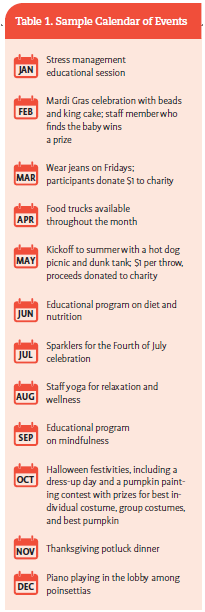
My team then built the program around these needs, integrating 1 structured event per month into our calendar (Table 1 is a sample calendar of our events). From Mardi Gras celebrations and food trucks to yoga sessions and mindfulness seminars, each activity was designed to relieve stress and strengthen our community. We also leveraged the incredible expertise within our own team—dietitians, nurses, social workers, and psychologists—to lead educational sessions on nutrition, stress management, and wellness activities.
Esprit d’Corps became more than just a program—it was a cultural shift. It reminded us that caring for our caregivers is just as important as caring for our patients. By investing in resilience and emotional support, we created a more connected, compassionate, and sustainable oncology workforce.
By 2013, Esprit d’Corps was a core component of the programming that helped our cancer center win an American Psychological Association Psychologically Healthy Workplace Award.4 That year, ChristianaCare was 1 of only 4 employers in North America to receive the award; the health care system won in the not-for-profit category. At that time, ChristianaCare was only the fourth hospital system ever to win the national award.4
Now—Hillary Lynn Howrey
More than 20 years later, I am proud to say the Esprit d’Corps program is still going strong—and in many ways, it is more essential now than ever in this post–COVID-19 era.
Recent research shows that burnout and compassion fatigue among oncology professionals have only intensified between 2020 and 2025. A 2023 ASCO survey revealed that 59% of oncologists reported burnout, a significant jump from 45% in 2013.5 Today, burnout affects all oncology roles, with younger oncologists (those under age 50) experiencing even higher rates (64%) compared with their older peers (51%).5 Compassion fatigue continues to be a major concern, especially among nurses; it is driven by long hours, increased demands, frequent patient loss, and emotional strain.6
We are also seeing new contributors to burnout—staffing shortages and administrative burdens like electronic health record management.5,6 These challenges only reinforce the importance of structured interventions like Esprit d’Corps. The program continues to offer resilience-building strategies tailored to the unique pressures faced by today’s oncology professionals.
One lesson I have learned over the years is that programs like Esprit d’Corps thrive when they have a consistent structure and a formal champion. As leadership evolved at the Helen F. Graham Cancer Center, the program transitioned from the Psychosocial Oncology department to the executive suite. In many ways, this shift reflects its success: the culture around well-being had matured enough that our C-suite embraced and sustained the program. While the program has now scaled back to a few key events each year—like food trucks, Mardi Gras, Halloween, and piano playing for the winter holidays—it still plays a vital role in our workplace.
To ensure long-term sustainability, especially amid ongoing changes in leadership and health care demands, I believe that resiliency and well-being programs should be supported by cross-functional committees. These groups can represent diverse areas of the cancer program and advocate for their teams’ needs. In addition to Esprit d’Corps, our broader caregiver well-being initiatives have grown to include events like therapy dog visits and annual well-being days, and offerings such as snacks, massages, educational resources, and fun activities. These efforts remind us that caring for our caregivers is not a luxury—it is a necessity.

The Importance of Ongoing Support
Over the years, we have seen firsthand how the Esprit d’Corps program has helped buffer the emotional toll of oncology work. From its early days addressing burnout and compassion fatigue to its continued relevance in today’s post–COVID-19 landscape, we have watched it evolve into a cornerstone of staff support. As Dr. Hopkins reminds us, designing oncology care to meet the needs of a growing patient population requires empowered, resilient teams. We believe that resilience-building programs like Esprit d’Corps must be embedded into the culture of cancer care—offering consistent, meaningful opportunities for connection, education, and emotional renewal. We should focus our future efforts on expanding evidence-based self-care models, incorporating holistic approaches, and improving access—and acceptance—of mental health resources. To truly support our colleagues, we must eliminate the stigma around mental health because seeking help should be seen as a strength, not a weakness. Let us commit to expanding access to mental health resources for our oncology teams, normalizing emotional support, and building a future where every member of the team feels seen, supported, and sustained.
Jeffrey Kendall, PsyD, LP, FACCC, is director of Therapy Services at Sonder Behavioral Health & Wellness in Minnetonka, Minnesota and director of Psychosocial Oncology at Kendall Psychological Services, PLLC in Minnesota. Hillary Lynn Howrey, PhD, is a licensed clinical psychologist with the Psychosocial Oncology team at the Helen F. Graham Cancer Center & Research Institute in Wilmington, Delaware.
References
1. Barrett L, Yates P. Oncology/haematology nurses: a study of job satisfaction, burnout, and intention to leave the specialty. Aust Health Rev. 2002;25(3):109-121. doi:10.1071/ah020109
2. Potter P, Deshields T, Divanbeigi J, et al. Compassion fatigue and burnout: prevalence among oncology nurses. Clin J Oncol Nurs. 2010 Oct;14(5):E56-62. doi:10.1188/10.CJON.E56-E62
3. Barnard D, Street A, Love AW. Relationships between stressors, work supports, and burnout among cancer nurses. Cancer Nurs. 2006;29(4):338-345. doi:10.1097/00002820-200607000-00013
4. Helen F. Graham Cancer Center earns American Psychological Association’s Psychologically Healthy Workplace Award. ChristinaCare News. Published March 8, 2013. Accessed August 27, 2025. https://news.christianacare.org/2013/03/helen-f-graham-cancer-center-earns-american-psychological-associations-psychologically-healthy-workplace-award/
5. Schenkel C, Levit LA, Kirkwood K, Shanafelt T, Subbiah IM. Ten-year trends in clinician well-being and burnout among oncology fellows in training: an ASCO State of Cancer Care in America study. JCO Oncol Pract. 2025;21(7):1039-1044. doi:10.1200/OP.24.00200
6. American Nurses Association (ANA). (2025). Compassion fatigue and burnout among oncology nurses: Trends and interventions. ANA Position Statement. https://www.nursingworld.org/content-hub/resources/workplace/what-is-nurse-burnout-how-to-prevent-it/





Recognizing the critical role advanced practice providers and allied health professionals play in the care continuum, the American Oncology Network provides infrastructure, leadership, and professional growth opportunities to empower these members of the cancer care team to practice at the top of their license.