ACCC association of cancer care centers
Join/Renew
Login
Join/Renew
Login
Education & Resources
ACCC eXchange LogInCorporate Member Sponsored ResourcesPresentations & AbstractsPresident's ThemeACCC Connect eLearning LogIn
Publications
Oncology IssuesPatient Assistance & Reimbursement GuideTrending Now in Cancer Care
Events
2026 ACCC Leadership SummitAnnual Meeting & Cancer Center Business SummitCapitol Hill DayNational Oncology ConferenceOncology Reimbursement MeetingsOncology State Society Meetings
Policy & Advocacy
2024 Policy Wrap-Up and ACCC 2025 Policy PrioritiesLetters & StatementsAccess, Payment & Reimbursement ReformWhite Bagging & Brown BaggingAdvocacy ResourcesCancer Moonshot
Membership
Join | RenewWho We AreMembership Types & BenefitsCorporate MembersACCC Member Portal FAQMember Directory
Partners
Oncology State SocietiesPartner OrganizationsCME
News
News ReleasesAdvocacy News ReleasesOncology News
About ACCC
Timeline / 50th Anniversary2025 Impact ReportACCC Innovator AwardsACCC FellowsACCC Senior Staff
Breast CancerMetastatic Breast Cancer
Gastrointestinal CancerBiliary Tract CancerColorectal CancerGastric CancerLiver Cancer
Genitourinary CancerBladder CancerProstate CancerRenal Cell Carcinoma
Gynecologic CancerOvarian Cancer
Head & Neck Cancer
Hematologic MalignanciesAcute Lymphocytic Leukemia (ALL)Acute Myeloid Leukemia (AML)Chronic Lymphocytic Leukemia (CLL)Mantle Cell Lymphoma (MCL)Multiple Myeloma (MM)Myelodysplastic Syndromes (MDS)
Lung CancerNon-Small Cell Lung Cancer (NSCLC)Small Cell Lung Cancer (SCLC)
Sarcoma
Skin CancerMelanomaNon-Melanoma Skin Cancers (NMSC)
Clinical Practice & TreatmentCancer DiagnosticsCare CoordinationEHR Integration for Biomarker TestingQuality Improvement Collaboration: Integration of Precision Medicine in Community OncologyTreatment
Financial NavigationFAN Boot CampFinancial Advocacy Network (FAN) Resource LibraryPatient Assistance & Reimbursement GuidePrior Authorization
Health Equity & Access3, 2, 1, Go! Practical Solutions for Addressing Cancer Care DisparitiesAppalachian Community Cancer AllianceOncology Advanced PractitionersPersonalizing Care for Patients of All BackgroundsSocial Drivers of Health
Patient-Centered CareAddressing Care Disparities for VeteransAdolescent and Young Adult (AYA)Care Action Plans for People with CancerDermatologic ToxicitiesEmpowering CaregiversGeriatric OncologyHealth LiteracyNutritionOncology PharmacyPatient NavigationPsychosocial Care in OncologyShared Decision-MakingSupportive CareSurvivorship Care
Practice Management & OperationsCancer Program FundamentalsLeadership Sustainment and Engagement VideosOncology Practice Transformation and Integration CenterOncology Team Resiliency
ResearchACCC Community Oncology Research Institute (ACORI)
Technology & InnovationTelehealth & Digital Medicine
ACCCBuzz Blog
CANCER BUZZ Podcast
Oncology Issues
Join/Renew
Login
Breast CancerMetastatic Breast Cancer
Gastrointestinal CancerBiliary Tract CancerColorectal CancerGastric CancerLiver Cancer
Genitourinary CancerBladder CancerProstate CancerRenal Cell Carcinoma
Gynecologic CancerOvarian Cancer
Head & Neck Cancer
Hematologic MalignanciesAcute Lymphocytic Leukemia (ALL)Acute Myeloid Leukemia (AML)Chronic Lymphocytic Leukemia (CLL)Mantle Cell Lymphoma (MCL)Multiple Myeloma (MM)Myelodysplastic Syndromes (MDS)
Lung CancerNon-Small Cell Lung Cancer (NSCLC)Small Cell Lung Cancer (SCLC)
Sarcoma
Skin CancerMelanomaNon-Melanoma Skin Cancers (NMSC)
Clinical Practice & TreatmentCancer DiagnosticsCare CoordinationEHR Integration for Biomarker TestingQuality Improvement Collaboration: Integration of Precision Medicine in Community OncologyTreatment
Financial NavigationFAN Boot CampFinancial Advocacy Network (FAN) Resource LibraryPatient Assistance & Reimbursement GuidePrior Authorization
Health Equity & Access3, 2, 1, Go! Practical Solutions for Addressing Cancer Care DisparitiesAppalachian Community Cancer AllianceOncology Advanced PractitionersPersonalizing Care for Patients of All BackgroundsSocial Drivers of Health
Patient-Centered CareAddressing Care Disparities for VeteransAdolescent and Young Adult (AYA)Care Action Plans for People with CancerDermatologic ToxicitiesEmpowering CaregiversGeriatric OncologyHealth LiteracyNutritionOncology PharmacyPatient NavigationPsychosocial Care in OncologyShared Decision-MakingSupportive CareSurvivorship Care
Practice Management & OperationsCancer Program FundamentalsLeadership Sustainment and Engagement VideosOncology Practice Transformation and Integration CenterOncology Team Resiliency
ResearchACCC Community Oncology Research Institute (ACORI)
Technology & InnovationTelehealth & Digital Medicine
ACCCBuzz Blog
CANCER BUZZ Podcast
Oncology Issues
    • Education & Resources
    • Publications
    • Events
    • Policy & Advocacy
    • Membership
    • Partners
    • News
    • About ACCC
ACCC association of cancer care centers
1801 Research Boulevard, Suite 400, Rockville, MD 20850
Tel: 301.984.9496 Fax: 301.770.1949 Email Us
Contact UsVolunteers
Advertise
Career Center
Terms and Conditions
Privacy Policy
ACCC Rebranding
Copyright © 2026 Association of Cancer Care Centers. All Rights Reserved.
Advertisement

Publication

Article

From the Editor

February 16, 2026
Oncology Issues
February 2026
Volume 41
Issue 1

Innovation With Intention: Building Oncology Care Around What Matters Most

Author(s):

Krista Nelson, MSW, LCSW, OSW-C, FAOSW

Innovation With Intention: Building Oncology Care Around What Matters Most
Download Issue PDFDownload PDF

As we open our first issue of 2026, we do so at a moment of profound transition in health care, one marked by innovation, uncertainty, and an urgent call to care for patients more holistically, more equitably, and more sustainably. Across oncology, clinicians are being asked to do more with less, to navigate shifting reimbursement landscapes, workforce strain, and rising patient complexity, all while preserving the humanity at the center of our work. This issue is grounded in that reality, which is cause for optimism.

The articles featured here share a common thread: They are written by clinicians and leaders who have spent years building, testing, and refining models of care that meet patients where they are—earlier, more thoughtfully, and with intention. Together, they illustrate how data, technology, and interdisciplinary design can be leveraged not to replace clinical judgment, but to extend its reach. The articles discuss issues from early detection to symptom management, psychosocial support, and goal-concordant care.

Staff at WellSpan Cancer Institute demonstrate how predictive analytics and AI can be harnessed to support early palliative care identification in both outpatient and home-based settings. As a clinician and editor, I found this work particularly compelling because it reinforces a truth many of us know intuitively: Early palliative care is not about prognosis, it is about presence. By integrating technology into real-world workflows, this model shows how we can reduce suffering, address mental health and symptom burden sooner, and ensure patients and families receive the right support at the right time, regardless of care setting.

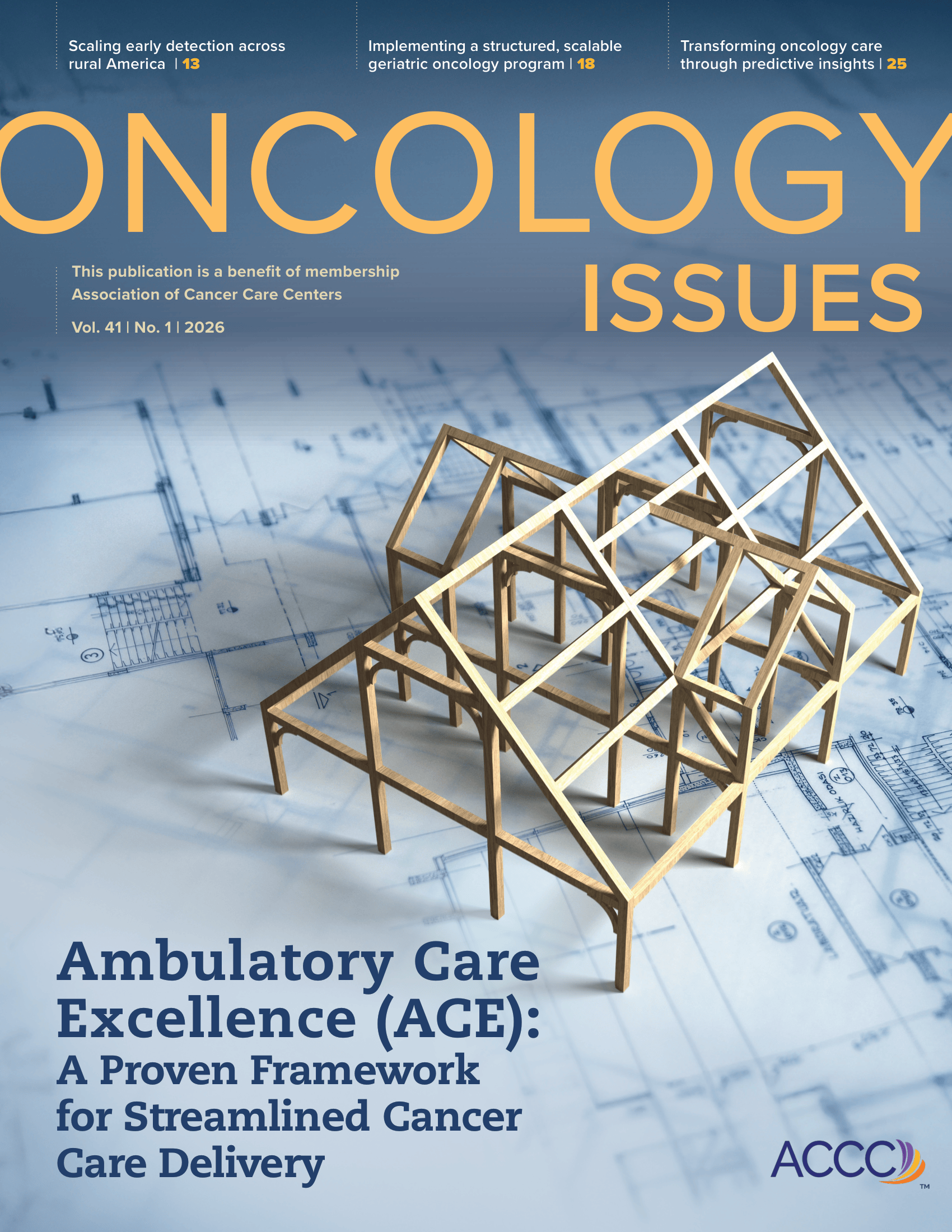
Similarly, the Ambulatory Care Excellence model at Fox Chase Cancer Center offers a powerful example of how operational excellence can translate directly into better patient and clinician experiences. Through standardized roles, protected care coordination time, and data-driven staffing that is aligned with demand, this work reminds us that efficiency and compassion are not competing values. In fact, when systems are designed well, they create space for what matters most: timely access, clearer communication, and sustainable practice for the oncology workforce.

The geriatric oncology program at Penn Medicine Princeton Health further expands this vision, redefining what it means to deliver age-inclusive cancer care in a community setting. By embedding geriatric assessments, behavior modification nudges, population health dashboards, and palliative and social work services into routine oncology care, this program moves beyond guideline adherence to truly personalized, goal-concordant care. Its success underscores that innovation in oncology is not limited to academic centers, and that honoring function, independence, mental health, and dignity is as critical as treating disease.

Across these articles, we see a shared commitment to scalable, sustainable models that improve access and outcomes, even as reimbursement pressures and coverage uncertainty loom large. For patients with insurance and those without, for clinicians in academic centers and community programs alike, the imperative is the same: to design systems that work better, earlier, and more equitably.

As we begin 2026, this journal reflects both realism and resolve. The challenges before us are significant, but so, too, is the collective wisdom of the ACCC community. This community leads with creativity, compassion, and generosity as they share their knowledge. It is my hope that the models shared in these pages not only inform but inspire you, regardless of your role or where you provide oncology care. We can help by reminding each other that when innovation is guided by values, we can build systems of care that help people not only live longer, but live better.
Articles in this issue

Innovation With Intention: Building Oncology Care Around What Matters Most
Building Scalable  Systems for a Growing  Cancer Population
Building Scalable Systems for a Growing Cancer Population
Ambulatory Care Excellence (ACE): A Proven Framework for Streamlined Cancer Care Delivery
Scaling Early Detection Across Rural America: Lifepoint Health's Healthy Person Program
Implementing a Structured, Scalable Geriatric Oncology Program
Precision With Purpose: Transforming Oncology Care Through Predictive Insights
Staying Connected Between Visits: A Sustainable Model for Remote Monitoring
Bringing Cancer Care Home: The Shaw at Home Model for Community-Based Oncology Palliative Care
Embedding Precision Medicine Into Gynecologic Cancer Care: Lessons From a Nationwide Quality Improvement Effort
Fast Facts Vol. 41, No. 1
Year in Review: 2025 Policy Wrap-Up
CY 2026 HOPPS, MPFS, and Oncology Coding Update
The Esprit d’Corps Program—Then and Now
TidalHealth, Clinic Locations Throughout Delaware, Maryland, and Virginia
Action: Vol. 41, No. 1