ACCC association of cancer care centers
Join/Renew
Login
Join/Renew
Login
Education & Resources
ACCC eXchange LogInCorporate Member Sponsored ResourcesPresentations & AbstractsACCC Connect eLearning LogIn
Publications
Oncology IssuesPatient Assistance & Reimbursement GuideTrending Now in Cancer CareBusiness Case Studies for Hiring New Staff
Events
2026 ACCC Leadership SummitAnnual Meeting & Cancer Center Business SummitCapitol Hill DayNational Oncology ConferenceOncology Reimbursement MeetingsOncology State Society Meetings
Policy & Advocacy
ACCC 2026 Policy PrioritiesLetters & StatementsAccess, Payment & Reimbursement ReformWhite Bagging & Brown BaggingAdvocacy ResourcesCancer Moonshot
Membership
Join | RenewWho We AreMembership Types & BenefitsCorporate MembersACCC Member Portal FAQMember Directory
Partners
Oncology State SocietiesPartner OrganizationsCME
News
News ReleasesAdvocacy News ReleasesOncology News
About ACCC
Timeline / 50th Anniversary2025 Impact ReportPresident's ThemeACCC Innovator AwardsACCC FellowsBoard of TrusteesACCC Senior Staff
Breast CancerMetastatic Breast Cancer
Gastrointestinal CancerBiliary Tract CancerColorectal CancerGastric CancerLiver Cancer
Genitourinary CancerBladder CancerProstate CancerRenal Cell Carcinoma
Gynecologic CancerOvarian Cancer
Head & Neck Cancer
Hematologic MalignanciesAcute Lymphocytic Leukemia (ALL)Acute Myeloid Leukemia (AML)Chronic Lymphocytic Leukemia (CLL)Mantle Cell Lymphoma (MCL)Multiple Myeloma (MM)Myelodysplastic Syndromes (MDS)
Lung CancerNon-Small Cell Lung Cancer (NSCLC)Small Cell Lung Cancer (SCLC)
Sarcoma
Skin CancerMelanomaNon-Melanoma Skin Cancers (NMSC)
Clinical Practice & TreatmentCancer DiagnosticsCare CoordinationEHR Integration for Biomarker TestingQuality Improvement Collaboration: Integration of Precision Medicine in Community OncologyTreatment
Financial NavigationFAN Boot CampFinancial Advocacy Network (FAN) Resource LibraryPatient Assistance & Reimbursement GuidePrior Authorization
Health Equity & Access3, 2, 1, Go! Practical Solutions for Addressing Cancer Care DisparitiesAppalachian Community Cancer AllianceOncology Advanced PractitionersPersonalizing Care for Patients of All BackgroundsSocial Drivers of Health
Patient-Centered CareAddressing Care Disparities for VeteransAdolescent and Young Adult (AYA)Care Action Plans for People with CancerDermatologic ToxicitiesEmpowering CaregiversGeriatric OncologyHealth LiteracyNutritionOncology PharmacyPatient NavigationPsychosocial Care in OncologyShared Decision-MakingSupportive CareSurvivorship Care
Practice Management & OperationsCancer Program FundamentalsLeadership Sustainment and Engagement VideosOncology Practice Transformation and Integration CenterOncology Team Resiliency
ResearchACCC Community Oncology Research Institute (ACORI)
Technology & InnovationTelehealth & Digital Medicine
ACCCBuzz Blog
CANCER BUZZ Podcast
Oncology Issues
Join/Renew
Login
Breast CancerMetastatic Breast Cancer
Gastrointestinal CancerBiliary Tract CancerColorectal CancerGastric CancerLiver Cancer
Genitourinary CancerBladder CancerProstate CancerRenal Cell Carcinoma
Gynecologic CancerOvarian Cancer
Head & Neck Cancer
Hematologic MalignanciesAcute Lymphocytic Leukemia (ALL)Acute Myeloid Leukemia (AML)Chronic Lymphocytic Leukemia (CLL)Mantle Cell Lymphoma (MCL)Multiple Myeloma (MM)Myelodysplastic Syndromes (MDS)
Lung CancerNon-Small Cell Lung Cancer (NSCLC)Small Cell Lung Cancer (SCLC)
Sarcoma
Skin CancerMelanomaNon-Melanoma Skin Cancers (NMSC)
Clinical Practice & TreatmentCancer DiagnosticsCare CoordinationEHR Integration for Biomarker TestingQuality Improvement Collaboration: Integration of Precision Medicine in Community OncologyTreatment
Financial NavigationFAN Boot CampFinancial Advocacy Network (FAN) Resource LibraryPatient Assistance & Reimbursement GuidePrior Authorization
Health Equity & Access3, 2, 1, Go! Practical Solutions for Addressing Cancer Care DisparitiesAppalachian Community Cancer AllianceOncology Advanced PractitionersPersonalizing Care for Patients of All BackgroundsSocial Drivers of Health
Patient-Centered CareAddressing Care Disparities for VeteransAdolescent and Young Adult (AYA)Care Action Plans for People with CancerDermatologic ToxicitiesEmpowering CaregiversGeriatric OncologyHealth LiteracyNutritionOncology PharmacyPatient NavigationPsychosocial Care in OncologyShared Decision-MakingSupportive CareSurvivorship Care
Practice Management & OperationsCancer Program FundamentalsLeadership Sustainment and Engagement VideosOncology Practice Transformation and Integration CenterOncology Team Resiliency
ResearchACCC Community Oncology Research Institute (ACORI)
Technology & InnovationTelehealth & Digital Medicine
ACCCBuzz Blog
CANCER BUZZ Podcast
Oncology Issues
    • Education & Resources
    • Publications
    • Events
    • Policy & Advocacy
    • Membership
    • Partners
    • News
    • About ACCC
ACCC association of cancer care centers
1801 Research Boulevard, Suite 400, Rockville, MD 20850
Tel: 301.984.9496 Email Us
Contact UsVolunteers
Advertise
Career Center
Terms and Conditions
Privacy Policy
ACCC Rebranding
Copyright © 2026 Association of Cancer Care Centers. All Rights Reserved.
HomeEducation & Resources

Transitioning to Primary Care After IO Treatment

March 11, 2021
Regina Jacob, MD, MSCE, FACP

While immuno-oncology (IO) therapies have heralded significant advancements in cancer care, there are still many unknowns when it comes to the long-term side effects of these relatively new agents.
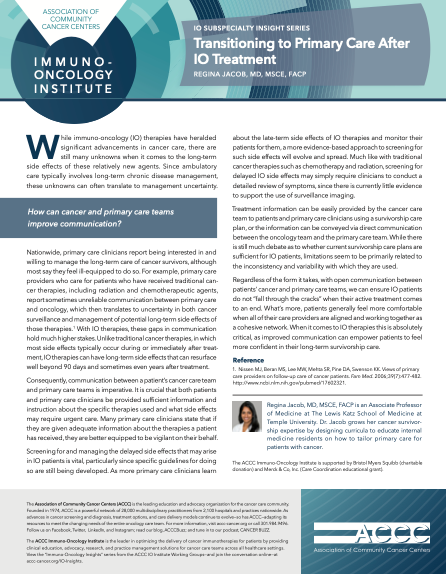
Transitioning to Primary Care After IO Treatment

While immuno-oncology (IO) therapies have heralded significant advancements in cancer care, there are still many unknowns when it comes to the long-term side effects of these relatively new agents. Since ambulatory care typically involves long-term chronic disease management, these unknowns can often translate to management uncertainty.

Nationwide, primary care clinicians report being interested in and willing to manage the long-term care of cancer survivors, although most say they feel ill-equipped to do so. For example, primary care providers who care for patients who have received traditional cancer therapies, including radiation and chemotherapeutic agents, report sometimes unreliable communication between primary care and oncology, which then translates to uncertainty in both cancer surveillance and management of potential long-term side effects of those therapies.1 With IO therapies, these gaps in communication hold much higher stakes. Unlike traditional cancer therapies, in which most side effects typically occur during or immediately after treatment, IO therapies can have long-term side effects that can resurface well beyond 90 days and sometimes even years after treatment.

Consequently, communication between a patient’s cancer care team and primary care teams is imperative. It is crucial that both patients and primary care clinicians be provided sufficient information and instruction about the specific therapies used and what side effects may require urgent care. Many primary care clinicians state that if they are given adequate information about the therapies a patient has received, they are better equipped to be vigilant on their behalf.

Screening for and managing the delayed side effects that may arise in IO patients is vital, particularly since specific guidelines for doing so are still being developed. As more primary care clinicians learn about the late-term side effects of IO therapies and monitor their patients for them, a more evidence-based approach to screening for such side effects will evolve and spread. Much like with traditional cancer therapies such as chemotherapy and radiation, screening for delayed IO side effects may simply require clinicians to conduct a detailed review of symptoms, since there is currently little evidence to support the use of surveillance imaging.

Treatment information can be easily provided by the cancer care team to patients and primary care clinicians using a survivorship care plan, or the information can be conveyed via direct communication between the oncology team and the primary care team. While there is still much debate as to whether current survivorship care plans are sufficient for IO patients, limitations seem to be primarily related to the inconsistency and variability with which they are used.

Regardless of the form it takes, with open communication between patients’ cancer and primary care teams, we can ensure IO patients do not “fall through the cracks” when their active treatment comes to an end. What’s more, patients generally feel more comfortable when all of their care providers are aligned and working together as a cohesive network. When it comes to IO therapies this is absolutely critical, as improved communication can empower patients to feel more confident in their long-term survivorship care.

References

  1. Nissen MJ, Beran MS, Lee MW, Mehta SR, Pine DA, Swenson KK. Views of primary care providers on follow-up care of cancer patients. Fam Med . 2006;39(7):477-482. http://www.ncbi.nlm.nih.gov/pubmed/17602321.

Upcoming Events

ACCC 43rd National Oncology Conference
Oncology

ACCC 43rd National Oncology Conference

In Person Conference & ConventionOctober 21, 2026 at 8:00 AM MDT450 Summer St, Boston, MA 02210Omni Boston Hotel at the Seaport, Boston
Register Now!
IOS 2026 Welcome Reception
Oncology

IOS 2026 Welcome Reception

In Person Conference & ConventionMay 30, 2026 at 6:00 PM CDT1060 West Addison Street, Chicago, IL, USAWrigley Field, Chicago
Register Now!
WAHO 2026 Welcome Reception
Oncology

WAHO 2026 Welcome Reception

In Person Conference & ConventionMay 30, 2026 at 6:00 PM CDT1060 W Addison St, Chicago, IL, USAWrigley Field , Chicago
Register Now!
WSOS 2026 Rock Springs Meeting
Oncology

WSOS 2026 Rock Springs Meeting

In Person Conference & ConventionJune 9, 2026 at 5:30 PM MDT1675 Sunset Dr, Rock Springs, WY, USAHoliday Inn Rock Springs, Rock Springs
Register Now!
HSCO 2026 June Dinner Symposium
Oncology

HSCO 2026 June Dinner Symposium

In Person Conference & ConventionJune 10, 2026 at 5:30 PM HST3660 Waialae Ave, Honolulu, HI, USA3660 On The Rise, Honolulu
Register Now!
COS 2026 Dinner at the Denver Best of ASCO
Oncology

COS 2026 Dinner at the Denver Best of ASCO

In Person Meeting & NetworkingJune 26, 2026 at 5:30 PM MDT7000 Church Ranch Blvd, Westminster, CO, USADenver Marriott Westminster, Westminster
Register Now!
KaSCO 2026 Fellows Dinner
Oncology

KaSCO 2026 Fellows Dinner

In Person Conference & ConventionJuly 16, 2026 at 6:00 PM CDT101 West 22nd Street, Kansas City, MO, USALidia's Kansas City, Kansas City
Register Now!
MSCO 2026 Professional Development Workshop
Oncology

MSCO 2026 Professional Development Workshop

In Person Conference & ConventionJuly 18, 2026 at 3:30 PM CDT5005 Glumack Drive, Minneapolis, MN, USAInterContinental Hotel Minneapolis – St. Paul Airport, Minneapolis
Register Now!
Advertisement
Advertisement

Trending Now on
ACCCBuzz Blog

Making AI Practical in Oncology: Lessons from Highlands Oncology

Making AI Practical in Oncology: Lessons from Highlands Oncology

A recent discussion between ACCC and Highlands Oncology centered on how artificial intelligence can be implemented thoughtfully in cancer care to support clinicians and operations without compromising clinical judgement or patient care.

Small Cell SMASHERS: How Community, Advocacy, and Emerging Science Are Changing the Narrative in Small Cell Lung Cancer

Small Cell SMASHERS: How Community, Advocacy, and Emerging Science Are Changing the Narrative in Small Cell Lung Cancer

Small Cell SMASHERS was founded in 2023 as a patient-centered advocacy and education community designed to challenge long-standing narratives about small cell lung cancer and restore a sense of voice, connection, and hope for patients and their loved ones.

Partnering to Deliver Targeted Treatment: Fox Chase Cancer Center and Omniscope

Partnering to Deliver Targeted Treatment: Fox Chase Cancer Center and Omniscope

ACCCBuzz spoke with Fox Chase Cancer Center to learn more about its partnership with Omniscope, a leader in advanced molecular profiling technology, in hopes of developing an assay that accurately predicts which patients will respond well to immunotherapy based on the presence of certain T-cell clones.

Innovation, Policy, and Partnership: Key Takeaways From the Inaugural ACCC Leadership Summit

Innovation, Policy, and Partnership: Key Takeaways From the Inaugural ACCC Leadership Summit

On Friday, April 17, ACCC welcomed oncology leaders from around the country to Washington, DC for the inaugural ACCC Leadership Summit, a forum designed for executive-level decision-makers to engage in strategic dialogue, peer-to-peer exchange, and actionable insights at the highest level of oncology leadership.

View All ACCCBuzz Blogs

Recently Heard on
CANCER BUZZ Podcast

Designing Care That Creates Value for Patients and the Health System - [Mini Podcast] Ep. 233

A Collaborative Approach to Health Policy Changes - [Mini Podcast] Ep. 232

Closing the Gap Between Innovation and Implementation: Strategic Partnerships in Oncology – [Mini Podcast] Ep. 231

Becoming a Smart Consumer of AI as an Oncology Leader – [Mini Podcast] Ep. 230

View All Podcasts

Latest from Oncology Issues

April 2026
April 2026
February 2026
December 2025
October 2025
August 2025
View All Oncology Issues

Join the Conversation

ACCC eXchange Digital Banner
Login