Envision a day that cancer clinicians can ask an app to advise on immuno-oncology (IO) treatment options for a patient. That day may not be far off.
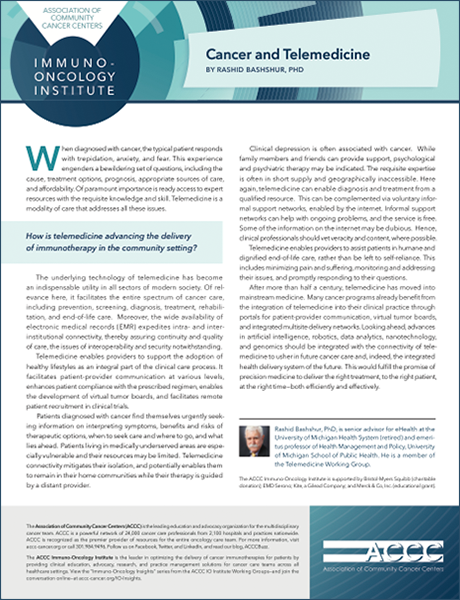
Despite a century-long history and a substantial body of recent empirical evidence that attests to its clinical and economic effectiveness and improved access, telemedicine has yet to become a routine part of clinical practice for the majority of clinicians. If used appropriately, it can serve as an effective substitute for in-person care which does not require physical examination in nearly all facets of the medical care process, including prevention, diagnosis, treatment, monitoring, and follow-up.
The COVID-19 pandemic altered the medical landscape dramatically, and while most clinicians transitioned promptly to telemedicine, many were ill-prepared for the rapid conversion. Indeed, telemedicine has become an essential component of care at least for the duration of the pandemic. Its current widespread use has been aided by the suspension of preceding restrictive regulations and rules (though not uniformly observed in all states) regarding conditions for reimbursement, interstate medical licensing, synchronous videoconferencing, confidentiality, compliance, and patient residential location. Recent speculation has focused on whether some, or all, of these regulations will be reinstated after successful mediation of COVID-19. Total reinstatement is not likely. In any case, states will retain control over medical practice licensing, and the Centers for Medicare & Medicaid Services (CMS) will likely find ways to limit its financial exposure to unrestrained use of service.
Read Full Article