ACCC association of cancer care centers
Join/Renew
Login
Join/Renew
Login
Education & Resources
ACCC eXchange LogInCorporate Member Sponsored ResourcesPresentations & AbstractsPresident's ThemeACCC Connect eLearning LogIn
Publications
Oncology IssuesPatient Assistance & Reimbursement GuideTrending Now in Cancer Care
Events
2026 ACCC Leadership SummitAnnual Meeting & Cancer Center Business SummitCapitol Hill DayNational Oncology ConferenceOncology Reimbursement MeetingsOncology State Society Meetings
Policy & Advocacy
2024 Policy Wrap-Up and ACCC 2025 Policy PrioritiesLetters & StatementsAccess, Payment & Reimbursement ReformWhite Bagging & Brown BaggingAdvocacy ResourcesCancer Moonshot
Membership
Join | RenewWho We AreMembership Types & BenefitsCorporate MembersACCC Member Portal FAQMember Directory
Partners
Oncology State SocietiesPartner OrganizationsCME
News
News ReleasesAdvocacy News ReleasesOncology News
About ACCC
Timeline / 50th Anniversary2025 Impact ReportACCC Innovator AwardsACCC FellowsACCC Senior Staff
Breast CancerMetastatic Breast Cancer
Gastrointestinal CancerBiliary Tract CancerColorectal CancerGastric CancerLiver Cancer
Genitourinary CancerBladder CancerProstate CancerRenal Cell Carcinoma
Gynecologic CancerOvarian Cancer
Head & Neck Cancer
Hematologic MalignanciesAcute Lymphocytic Leukemia (ALL)Acute Myeloid Leukemia (AML)Chronic Lymphocytic Leukemia (CLL)Mantle Cell Lymphoma (MCL)Multiple Myeloma (MM)Myelodysplastic Syndromes (MDS)
Lung CancerNon-Small Cell Lung Cancer (NSCLC)Small Cell Lung Cancer (SCLC)
Sarcoma
Skin CancerMelanomaNon-Melanoma Skin Cancers (NMSC)
Clinical Practice & TreatmentCancer DiagnosticsCare CoordinationEHR Integration for Biomarker TestingQuality Improvement Collaboration: Integration of Precision Medicine in Community OncologyTreatment
Financial NavigationFAN Boot CampFinancial Advocacy Network (FAN) Resource LibraryPatient Assistance & Reimbursement GuidePrior Authorization
Health Equity & Access3, 2, 1, Go! Practical Solutions for Addressing Cancer Care DisparitiesAppalachian Community Cancer AllianceOncology Advanced PractitionersPersonalizing Care for Patients of All BackgroundsSocial Drivers of Health
Patient-Centered CareAddressing Care Disparities for VeteransAdolescent and Young Adult (AYA)Care Action Plans for People with CancerDermatologic ToxicitiesEmpowering CaregiversGeriatric OncologyHealth LiteracyNutritionOncology PharmacyPatient NavigationPsychosocial Care in OncologyShared Decision-MakingSupportive CareSurvivorship Care
Practice Management & OperationsCancer Program FundamentalsLeadership Sustainment and Engagement VideosOncology Practice Transformation and Integration CenterOncology Team Resiliency
ResearchACCC Community Oncology Research Institute (ACORI)
Technology & InnovationTelehealth & Digital Medicine
ACCCBuzz Blog
CANCER BUZZ Podcast
Oncology Issues
Join/Renew
Login
Breast CancerMetastatic Breast Cancer
Gastrointestinal CancerBiliary Tract CancerColorectal CancerGastric CancerLiver Cancer
Genitourinary CancerBladder CancerProstate CancerRenal Cell Carcinoma
Gynecologic CancerOvarian Cancer
Head & Neck Cancer
Hematologic MalignanciesAcute Lymphocytic Leukemia (ALL)Acute Myeloid Leukemia (AML)Chronic Lymphocytic Leukemia (CLL)Mantle Cell Lymphoma (MCL)Multiple Myeloma (MM)Myelodysplastic Syndromes (MDS)
Lung CancerNon-Small Cell Lung Cancer (NSCLC)Small Cell Lung Cancer (SCLC)
Sarcoma
Skin CancerMelanomaNon-Melanoma Skin Cancers (NMSC)
Clinical Practice & TreatmentCancer DiagnosticsCare CoordinationEHR Integration for Biomarker TestingQuality Improvement Collaboration: Integration of Precision Medicine in Community OncologyTreatment
Financial NavigationFAN Boot CampFinancial Advocacy Network (FAN) Resource LibraryPatient Assistance & Reimbursement GuidePrior Authorization
Health Equity & Access3, 2, 1, Go! Practical Solutions for Addressing Cancer Care DisparitiesAppalachian Community Cancer AllianceOncology Advanced PractitionersPersonalizing Care for Patients of All BackgroundsSocial Drivers of Health
Patient-Centered CareAddressing Care Disparities for VeteransAdolescent and Young Adult (AYA)Care Action Plans for People with CancerDermatologic ToxicitiesEmpowering CaregiversGeriatric OncologyHealth LiteracyNutritionOncology PharmacyPatient NavigationPsychosocial Care in OncologyShared Decision-MakingSupportive CareSurvivorship Care
Practice Management & OperationsCancer Program FundamentalsLeadership Sustainment and Engagement VideosOncology Practice Transformation and Integration CenterOncology Team Resiliency
ResearchACCC Community Oncology Research Institute (ACORI)
Technology & InnovationTelehealth & Digital Medicine
ACCCBuzz Blog
CANCER BUZZ Podcast
Oncology Issues
    • Education & Resources
    • Publications
    • Events
    • Policy & Advocacy
    • Membership
    • Partners
    • News
    • About ACCC
ACCC association of cancer care centers
1801 Research Boulevard, Suite 400, Rockville, MD 20850
Tel: 301.984.9496 Fax: 301.770.1949 Email Us
Contact UsVolunteers
Advertise
Career Center
Terms and Conditions
Privacy Policy
ACCC Rebranding
Copyright © 2026 Association of Cancer Care Centers. All Rights Reserved.
Advertisement

Blog

Article

April 29, 2020

[Abstract #7765] Improving Care for Patients With Advanced Non-Small Cell Lung Cancer: Findings of Oncology Nurses and Navigators From a National Care Optimization Survey

Jennifer Aversano, MSN, RN, OCN, BMTCN1; Leigh Boehmer, PharmD, BCOP2; Alexander Spira, MD, PhD3

1Advocate Lutheran General Hospital, Park Ridge, Illinois, USA; 2Association of Cancer Care Centers, Rockville, Maryland, USA; 3Virginia Cancer Specialists, US Oncology Research, Johns Hopkins Medicine, Fairfax, Virginia, USA

Oncology navigation, being a vital component of cancer care planning, coordination, and delivery, is an important consideration in the optimization of cancer care. Oncology nurses and navigators were, therefore, key advisors, along with other multidisciplinary team (MDT) members, to a national survey of cancer centers, which aimed to identify barriers to optimal care delivery for patients in the U.S. with advanced (stage III/IV) non-small cell lung cancer (NSCLC).

Insights of oncology MDT members (i.e., oncologists, pathologists, pulmonologists, thoracic surgeons, pharmacists, cancer center administrators, and oncology nurses and navigators) from a diverse set of U.S. cancer centers were gathered via a comprehensive, double-blind, web-based survey between January and April 2019. Subanalyses were performed to examine relationships between care delivery practices relevant to oncology nursing and navigation and treatment-related outcomes such as shared decision-making (SDM).

NSCLC 1 - ONF_Mar 2020 Issue_ONS 2020 Late Breaking Congress Abstracts

Download


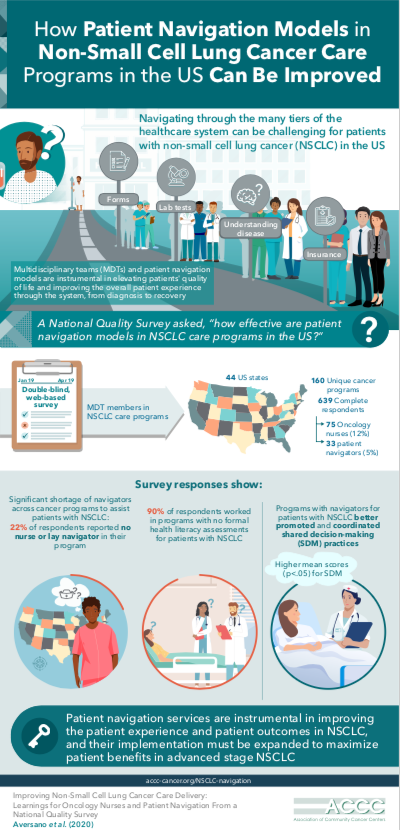
The survey included 639 complete responders from 160 unique oncology programs across 44 U.S. states, of whom 75 (11.7%) were oncology nurses, nurse navigators, or advanced practice nurses and 33 (5.2%) were financial advocates, navigators, or social workers who provide financial counseling and support patient access. Across programs, there was a deficiency of nurse or lay navigators (22.3% of respondents had neither, n=101) to assist patients with NSCLC.

Among cancer program types, Integrated Network Cancer Programs were significantly more likely to not have a navigator than to have one (7.9% vs. 3.1%; P<0.05). Most respondents (90.1%, n=100) reported no formal health literacy assessments in their programs. Presence of navigation services also has a significant impact on promoting and coordinating SDM, such as ensuring availability of pathology and biomarker reports when treatment options are being decided. Participants in programs with navigators had significantly higher (P<0.05) mean scores for (i) explaining SDM (3.82 vs. 3.29), (ii) asking patients if they wish to engage in SDM (3.55 vs. 3.11), (iii) explaining risks/benefits of treatment options (3.81 vs. 3.52), and (iv) use of educational resources (4.28 vs. 4.02) than those without navigators.

These insights highlight the need for further expansion of oncology navigation and should be used to inform resource development efforts to enhance high quality, patient-centered NSCLC care. Specific areas for process improvement may include increasing health literacy assessment use, improving patient education and engagement, and continued integration of navigators into MDTs.

Video Summary


Infographic

NSCLC Nurse Navigator infographic thumbnail


Download Infographic

ACCC Buzz Blog Post

lungs-385x247

ASCO Abstract: What Defines Quality Lung Cancer Care?
June 12, 2020